

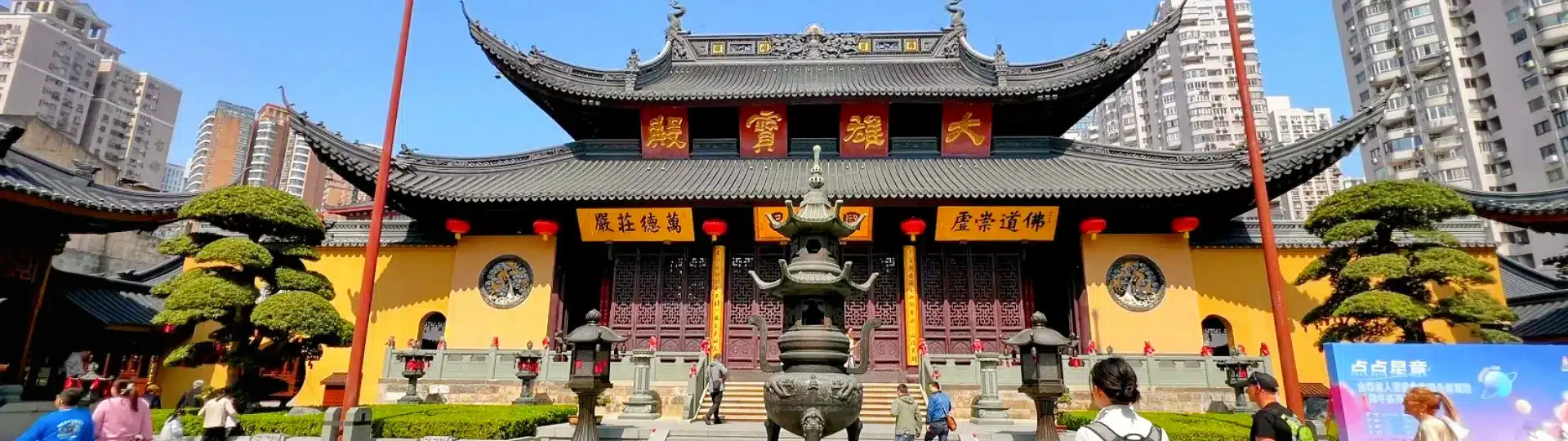
The Shanghai Jade Buddha Temple, founded in the Qing Dynasty, is one of the most famous Buddhist temples in China. The temple is best known for its two colossal jade statues of the Buddha Shakyamuni and the reclining Buddha that were brought back from Myanmar. They form the key appeal of the temple. Besides, you can admire many precious Buddhists stone scriptures and sculptures during a visit here. If you are keen on experiencing the religious culture in person, the temple also regularly holds various activities such as meditation sessions, vegetarian meals, etc. to make your trip more rewarding.
Now, let’s see how to plan a trip to the Jade Buddha Temple during your Shanghai tour. We have prepared all the detailed information for you, including what you must see in this temple, its history, transportation ideas, and and visiting tips.
Content Preview
- Overview of Shanghai Jade Buddha Temple
- History of Jade Buddha Temple
- Architecture of Jade Buddha Temple: The Layout & Sacred Halls
- Admire Jade Buddha Statues – Experience the Chinese Buddhism
- Taste Vegetarian Meal in Jade Buddha Temple
- Useful Tips for Visiting the Jade Buddha Temple
- Recommended Time for Visiting the Jade Buddha Temple
- How to Get to the Jade Buddha Temple?
- Jade Buddha Temple v.s. Jing’an Temple v.s. Longhua Temple
- Have An Essential Shanghai Jade Buddha Temple Experience with China Xian Tour
Overview of Shanghai Jade Buddha Temple
- In Chinese: 玉佛寺
- Address: No. 170 of An Yuan Road in the Putuo District
- Opening hours: 8:00~ 16:30
- Tickets: 20 yuan
- Best time to visit: 8:00 ~ 10:00; the 1stand 15th days of each lunar month; January 1st on lunar calender.
- Recommended Visiting Time: 1 ~ 2 hours
- Highlights: The jade Buddha statues;Song Dynasty palatial architectural style; healthy vegetarian food.
History of Jade Buddha Temple
Origin of the Jade Buddha Statues
You may wonder where are these jade Buddha statues from and why they are so precious. Actually, theie origin is related to the Chinese monk’s trip to the Southeast Aisa in the Qing dynasty. In 1882, Master Huigen from Zhejiang’s Putuo Mountain traveled alone to India to worship the Buddha. When he passed thorough Myanmar, he found that there are lots of good jade in the mountains. Therefore, with the support of the local Chinese residents, master Huigen found several artisans to carve five jade Buddhas, which were two seated Buddhas and three reclining Buddhas.
When master Huigen came back to China, he initially planned to send the jade Buddha to Mount Putuo for worship. However, considering the poor transportation conditions and the earnest requests from the Shanghai public, Master Huigen finally decided to leave two jade Buddhas in Shanghai for worship: one seated Buddha and the one reclining Buddha.
Development of the Jade Buddha Temple
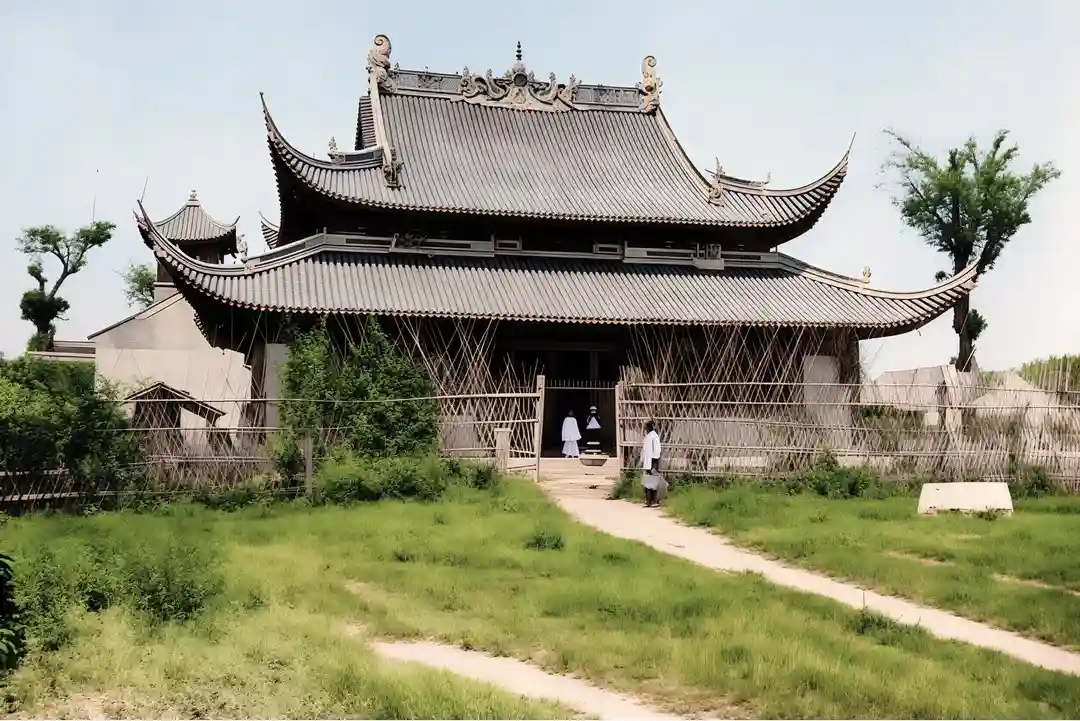
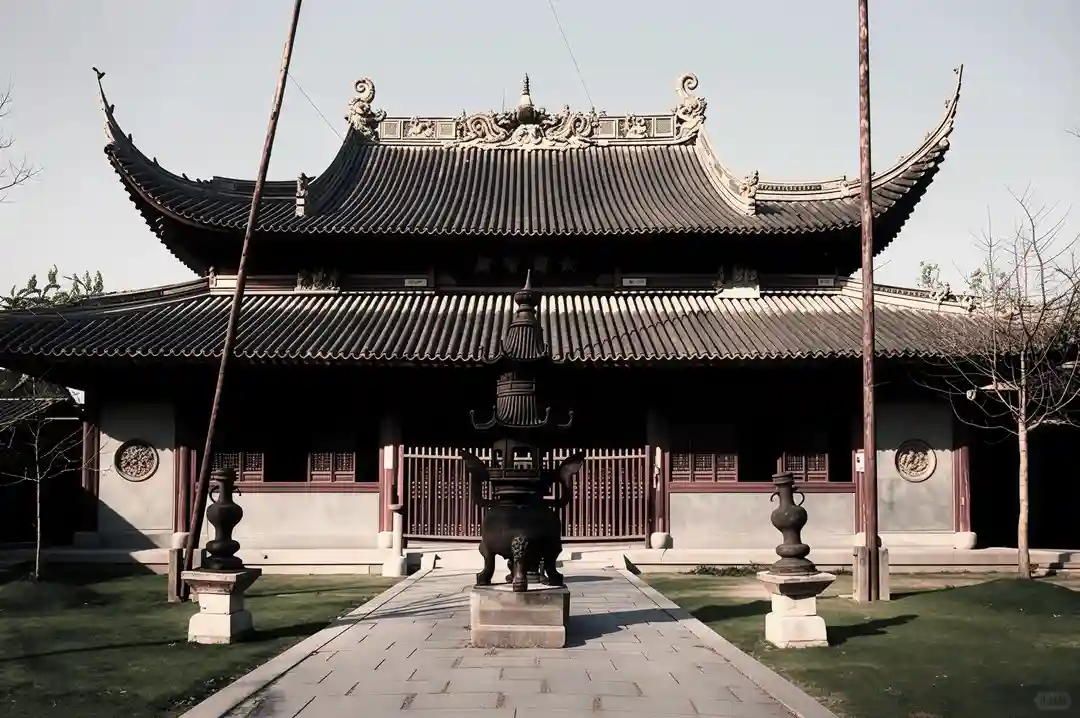
The two Jade Buddha was firstly worshiped in the thatched hut in Zhanghuabang, Shanghai. In 1900, a temple named Jade Buddha Temple was built in Jiangwan town to house the two Buddhas. Later, the temple was destroyed by war in 1911 and the jade Buddha was moved to a park for temporary storage. In 1918, Abbot Kaicheng raised funds on the An Yuan Road to rebuild a new temple, which took 10 years to complete the project and the current Jade Buddha Temple was finally established. During the Cultural Revolution, the Jade Buddha Temple was spared from destruction due to the instructions of Premier Zhou Enlai for protection, making it the only temple in Shanghai that was not severely affected.
Architecture of Jade Buddha Temple: The Layout & Sacred Halls
The Jade Buddha Temple adopts the architectural style of a Song Dynasty-style palace in the Han Chinese Buddhist tradition, which overall layout is rigorous and the form is regular. It faces north and south, following the symmetrical regulations along the central axis. On the central axis, there are the main gate wall, the Heavenly King Hall, the Great Buddha Hall, and the Jade Buddha Tower. On both the east and west sides, the bell tower, drum tower, Guanyin Hall, and Putian Temple are symmetrically distributed as auxiliary halls.
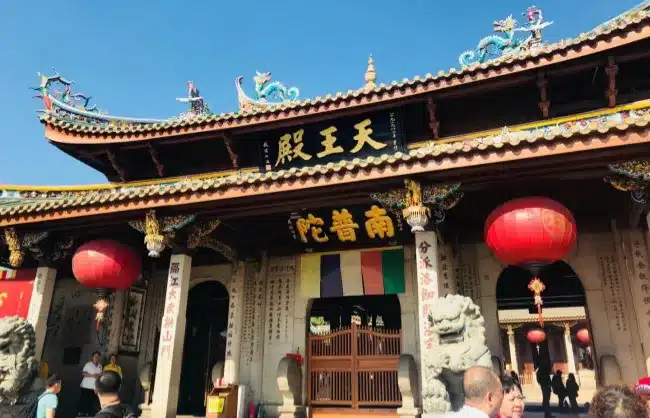
Hall of Heavenly Kings (天王殿)
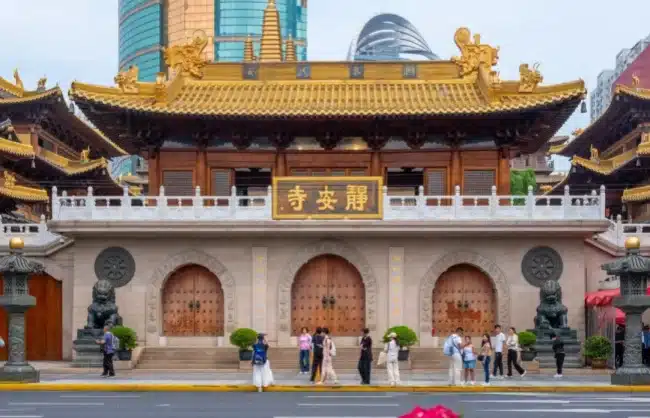
The Heavenly King Hall is the entrance hall of the Jade Buddha Temple, which architectural style follows the Song Dynasty’s imperial style. The main structure is a two-story hall facing north and south. It features a single-eave hip roof, a yellow glazed tile roof, and a raised beam wooden structure. The red beams and columns are complemented by exquisite eaves and brackets. There are plaques hanging below the eaves.
Ksitigarbha Hall (伽蓝殿)
Located at the east of the Guanyin Hall, the Ksitigarbha hall is a pure wooden structure pavilion in Jiangnan style in the Ming and Qing dynasties, which integrates the layout of seven pavilions of the Guanlan system of the Song Dynasty. It uses Burmese teak as the main building material, presenting a simple and brown wooden appearance with a delicate and sturdy structure. Inside the hall, Guanlan Bodhisattva is enshrined. The style not only maintains the solemn regulations of the auxiliary pavilions in Han Buddhism temples but also combines the elegant charm of ancient Jiangnan architecture.
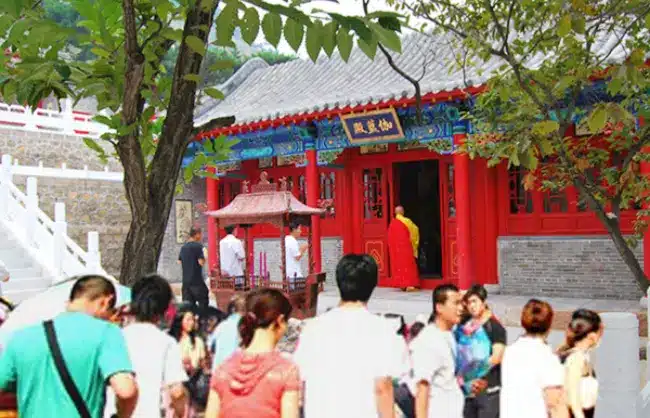
Hall of Medicine Buddha (药师殿)
The Medicine Buddha Hall follows the traditional style of Jiangnan temples from the Ming and Qing dynasties. As a pure wooden structure hall, it uses traditional mortise-and-tenon and bracket system techniques. A single-eave hip roof is paired with blue tiles on the eaves, and the yellow walls and red columns are in harmony with other halls. The eaves hang the famous calligrapher Zhou Zhigao’s inscription of Medicine Buddha Hall, the pillars have corresponding couplets engraved on them. The interior space is solemn and respectful, preserving the exquisite and elegant features of ancient Jiangnan architecture while conforming to the solemn regulations of Buddhist temples.
Samantabhadra Hall (普贤殿)
Although the Samantabhadra Hall is not as grand as the the Great Buddha’s Hall, nor as unique as the Jade Buddha Tower, the “practical spirit” it carries is crucial in Buddhist thought. It is constructed using mortise-and-tenon joints made of pure old teak. The single-eave roof is covered with dark gray tiles. The walls are built of traditional blue bricks and are externally coated with the unified yellow paint of the temple. The pillars of the hall are thick and sturdy, and the interior adopts a raised beam structure to expand the longitudinal space to accommodate the Buddhist worship facilities. The courtyard outside the hall is paved with gravel to simulate the Wish Sea scene, echoing Samantabhadra’s ten major vows.
Admire Jade Buddha Statues – Experience the Chinese Buddhism
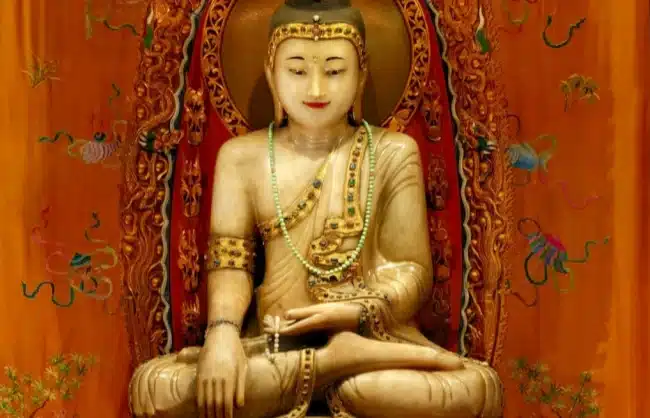
The Seated White Jade Buddha
The seated jade Buddha statue is enshrined in the Jade Buddha Tower at the north end of the central axis. Though it is as tall as 1.95 meters and as wide as 1.34 meters, it’s carved from a single piece of white jade. The Buddha statue sits cross-legged on a lotus pedestal, with his left palm facing upwards, while his right hand naturally hanging down to the ground. The Buddha’s face is plump with kind eyes and smile. The edges of the robe and the armlets are inlaid with 108 pieces of jade, agate and other gemstones. The natural luster of the jade beneath soft light fully display the solemnity and compassion of the Buddha.
The statue depicts the moment of Siddhartha Gautama’s enlightenment, featuring the meditation mudra and the earth-touching mudra, which encapsulates the core doctrine of “enlightenment beneath the Bodhi tree and subduing evil with the earth as evidence”. The compassionate expression on the Buddha’s face and the serene posture of the lotus position convey the Buddhist spirit of “compassion and diligent practice”, guiding believers to develop a compassionate heart.
The Reclining Jade Buddha
The reclining jade Buddha depicts the auspicious posture of the Buddha in a lying position as described in Buddhist scriptures. The right hand is bent and placed under the head and the left hand is placed on the left leg. The head faces north and is oriented towards the west, and the expression is serene and peaceful with a slight smile. It symbolizes the fulfillment of all wisdom, the extinction of all delusions, the liberation from the cycle of rebirth, and the attainment of the ultimate state of liberation.
Compared with this Jade Buddha, most of the Nanda Buddha statues in China are made of wood, stone or bronze. This buddha is in a small size and only focuses on the posture and expression of the Buddha’s nirvana. Other images of the Nirvana Buddha are larger in size, which present the anecdotes before and after the Nirvana through the depiction of various characters and scenes.
Other Statues in the Jade Buddha Temple
- Bronze Buddha Statue of the Northern Wei Dynasty: A square base with four legs and the body is decorated with a boat-shaped flame pattern. The Buddha has a high crown and spiral hair with a serene and kind face. His right hand holds the fearlessness mudra (meaning that the Buddha can bring peace and safety to all beings), and his left hand makes the wish-fulfilling mudra (meaning that he can fulfill the good wishes of all beings).
- Three Eternities Buddha: Give people a solemn and luxurious feeling that in line with the doctrine of “Three Eternities living together and saving all beings”. The Buddha’s figure is plump with a kind face, crescent moon shaped eyebrows, gentle eyes, and a tall backlight (symbolizing the all-pervading Buddha’s light).
Taste Vegetarian Meal in Jade Buddha Temple
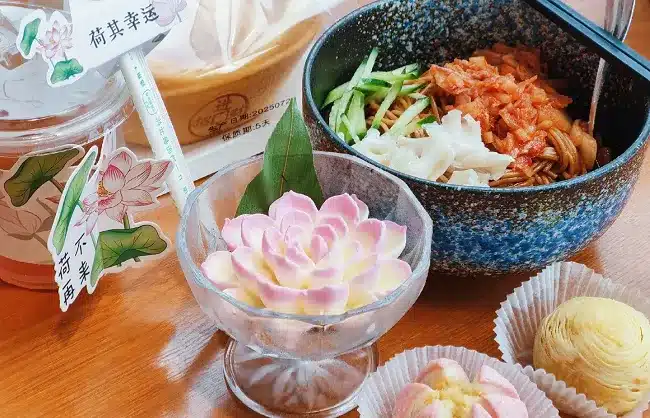
The restaurant, located at the eastern gate of the temple, provide fast food on the first floor and ordering vegetarian food on the second floor. The restaurant mainly uses fresh ingredient such as mushrooms, winter bamboo shoots, soy products etc. to make vegetarian noodles and dishes.
Besides some common dishes, there are also exquisite vegetarian dishes for ordering, for example, Gongdejin, made of various types of mushrooms and bean products, has a meaning of accumulation of virtue. The Luohan vegetarian noodles are made of 18 ingredients, including mushrooms, wheat gluten, black fungus, bamboo shoot slices, etc., which has refreshing soup with distinct layers of flavor.
Recommended tour including Jade Buddha Temple
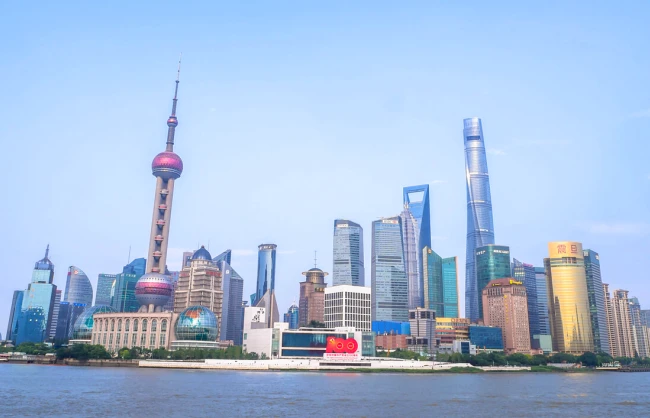
Explore Shanghai's dual identity through the Bund's colonial-meets-modern waterfront, Yuyuan Garden's Ming-Qing elegance, and the atmospheric Former French Concession lanes.
Useful Tips for Visiting the Jade Buddha Temple
- Incense burning: Visitors will get three free incense sticks provided by the temple for free. You need to hold the incense in both hands and above your head, bow down facing the Buddha statue, and insert the incense into the incense burner.
- Dressing code: Visitors should wear pants over the knees and tops that do not expose the shoulders. When entering the hall, you should remove your hats to show your respect for the buddha.
- Camera use regulations: You are not allowed to take photos for the buddhas inside the halls and cultural relics in the exhibition area. You can feel free to take photos of architecture, courtyard and landscape outside the halls.
- Tips for entering the hall: You should enter the temple and halls through the doors on both sides because the middle entrance door is for monks only.You are also not allowed to stand or sit on the threshold that represents your disrespect for the buddhas.
- Tips for kneeling and bowing: When other people are kneeling and bowing the buddha, you are not allowed to walk right past them.
Recommended Time for Visiting the Jade Buddha Temple
The best time to visit the temple is the spring or autumn because these two seasons have comfortable weather and cozy temperatures that about 15 to 25 Celsius degrees. The best time to visit the temple is early morning about 8:00 to 10 :00 that avoids crowded people and has opportunity to observe the morning rituals. In the afternoon that after 15:00 is also a good choice because at this time the sunlight shines on the jade Buddha and has the best appreciation experience.
How to Get to the Jade Buddha Temple?
- Metros:
The nearest metro stations are the Jiangning Road station on line 13 and the Changshou Road station on line 7. From the Jiangning Road station, you need to walk for about 5 minutes (about 600 meters) to arrive at the temple. From the Changshou road station, 8 minutes (about 800 meters) are required to get to the temple.
- Getting There by Taxi or Private Tour
Taxi tips: The distance between Shanghai Pudong Airport and the temple is about 50 km, taking about 70 minutes and 150 yuan by taxi. Hongqiao Airport is 15 km far away from the temple which takes about 30 minutes and 50 yuan by taxi.
- Visit the temple withChina Xian Tour: If you travel to Shanghai with us and want to visit the Jade Buddha Temple, we will provide free shuttle service for you. Wherever your hotel is, we will drive you to the temple for free whenever you want.
Jade Buddha Temple v.s. Jing’an Temple v.s. Longhua Temple
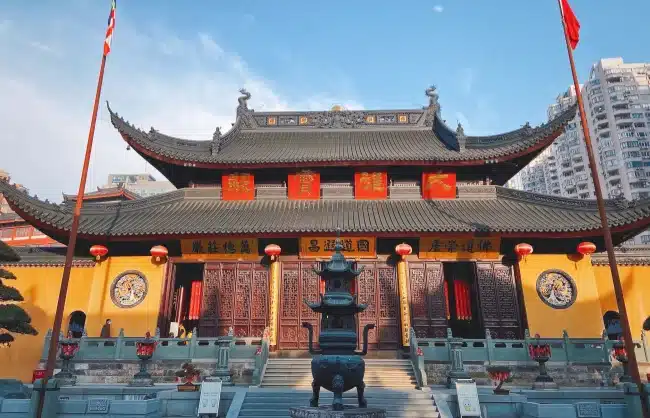
The Jade Buddha Temple, Jing’an Temple and Longhua Temple are known as the three ancient temples of Shanghai, but each of them has its own unique features. They have different architecture styles, unique Buddha and cultural relics, and different aspects for pray for blessing.
Temple |
Architecture Style |
Buddhas and Cultural Relics |
Pray for Blessing |
Tickets |
Jade Buddha Temple |
Imperial style of the Song Dynasty |
Two jade Buddhas made by Myanmar white jade |
Good financial luck and marital relationship |
20 yuan |
Jing’an Temple |
Layout of Fronting the hall and rear being the pagoda |
Zhu Zai’s masterpieces, The genuine work of Pipa Xing by Wen Zhengming |
Safe and Healthy |
50 yuan |
Longhua Temple |
Styles of ancient temples in Jiangnan region |
Blue Dragon Bronze Bell and Ancient Inscriptions |
Health, longevity and career success |
10 yuan |
Have An Essential Shanghai Jade Buddha Temple Experience with China Xian Tour
If you are interested in Chinese Buddhism and plan to travel to Shanghai, why not visit the Jade Buddha Temple? Contact us for a smooth and knowledgeable tour under the guidance of our professional tour guide. You will get to know more about Chinese Buddhist culture and the general layout of a traditional temple. Besides, if you would like to participate in some religious activities, our guide will help you to reserve in advance. Are you ready to start your Jade Buddha Temple tour with us? Just contact China Xian Tour and join us now!