
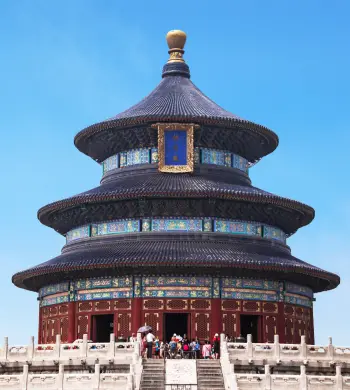

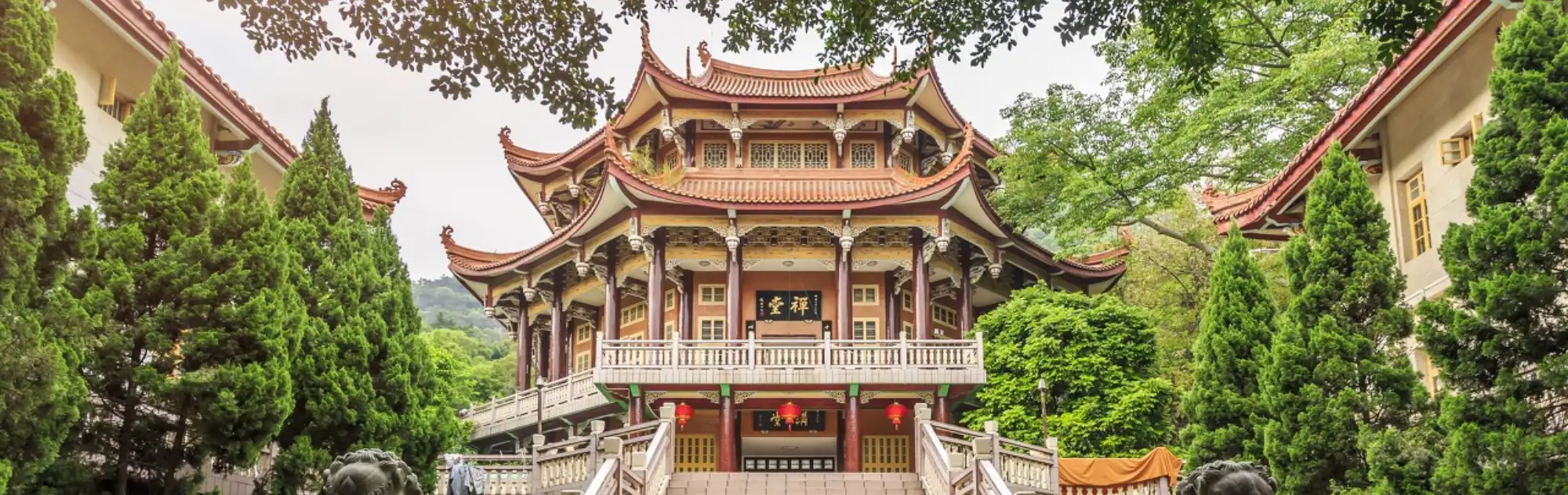
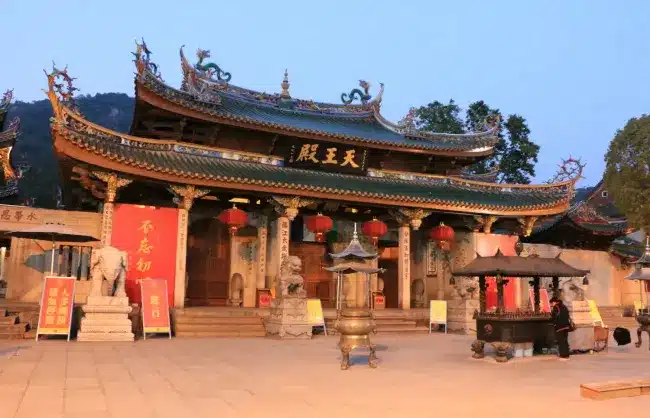
The South Putuo Temple in Xiamen, China has a history of over 1000 years. It was first built during the Tang Dynasty but was destroyed in war in the Ming Dynasty. The temple was then rebuilt in the Qing Dynasty.
The South Putuo Temple, Xiamen is really magnificent in size, and covers about 300,000 square yards (258,000 square meters) of land. It is a famous Buddhist temple in China because of its history, size, architecture, and spirituality. It sits at the foot of Wulaofeng (Five Old Men Mountain), next to Xiamen University, has an amazing view of the area.
Make a trip to South Putuo Temple, to experience the Buddhist culture, try the vegetarian food, and if you want, hike the Wulaofeng. It will be a fulfilling cultural and spiritual experience whether you’re interested in Buddhism or not.
Content Preview
- South Putuo Temple Facts
- What to See and Do in South Putuo Temple
- Getting to South Putuo Temple
- Travel Tips for South Putuo Temple
- Attractions Nearby South Putuo Temple
- Enjoy a Xiamen Tour with China Xian Tour
South Putuo Temple Facts
- Location: in Siming District of Xiamen, China
- Opening time: temple area: 08:00 – 18:00; back hill area: 08:00 – 16:00
- Tickets: Free admission, but some places cost a fee
- Recommended visit time: about 2 or 3 hours
- Best time to visit: pretty much all year round, but especially Spring (from March to May) and Fall (from September to November); avoid summer, August is usually typhoon season
- Features: you should definitely visit, if you’re interested in religion, Buddhism, culture, history, spirituality, and Chinese architecture
What to See and Do in South Putuo Temple
South Putuo Temple has many attractions and activities for visitors. Here are some of the highlights.
1. Explore the Architecture Complex along the Central Axis
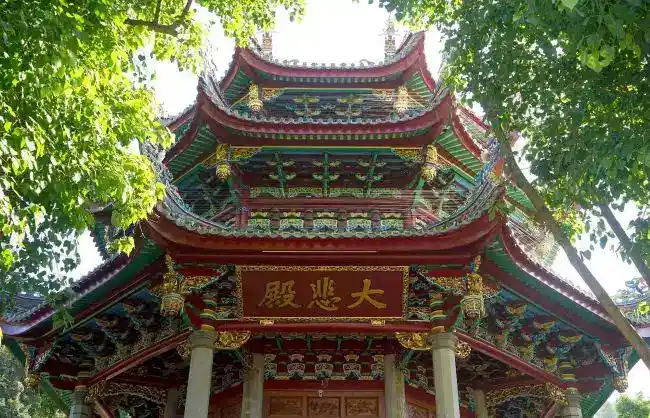
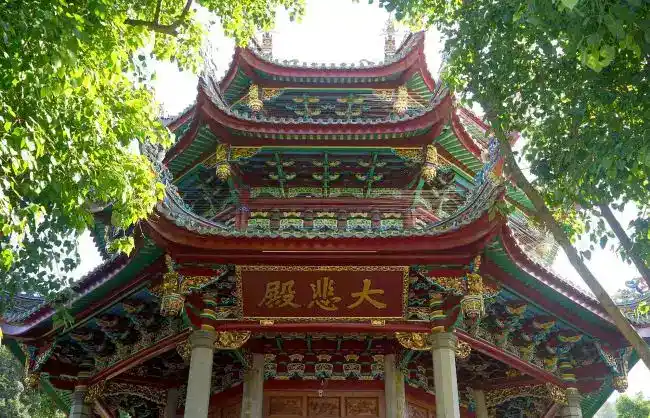
Along the central axis, there are four main buildings in sequence: Hall of Heavenly Kings, Great Buddha’s Hall, Hall of Great Compassion and Depositary of Buddhist Texts. Their design has integrated the traditional architectural arts in southern Fujian. All the architecture features an ancient palace-style large roof with double eaves, flying ridges and yellow glazed tiles. The intangible cultural heritage crafts, like Cutting Porcelain Carving and Lacquer Thread Sculpture, are also widely used in decorations.
2. Hike along the Back Mountain
The back mountain, known as Wulao Mountain, offers a classic hiking route that connects cultural and historical sites with breathtaking mountain, sea and city views. Behind Depositary of Buddhist Texts, there is a stone carving of a golden Chinese character “佛”. It is the entrance of the mountain.
The path consists of stone steps and is about 1 – 1.5 km long. Most of the path is shaded by trees, so it will be quite pleasant to hike. Along the way, you will pass by many cliff carvings and historic relics like Puzhao Temple, Taixu Pavilion, Fuyun Rock, etc. After ascending to the viewing platform, Xiamen University, Twin Towers and the bay will come into your view.
3. Experience Special Cultural Activities
Every tourist can receive three incense sticks for free at the entrance. Then burn the incense in the incense burner within the courtyard and pray for yourself and your family. In Nanputuo Post Office and near the Hall of Heavenly Kings and the Hall of Great Compassion, there are stores selling various bracelets. Abundant styles are available, you can try on and buy the one you like. Another unique experience is to copy Buddhist scriptures. The temple will provide pen and paper. It can be an immersive experience and will make you feel peaceful.
4. Taste the Vegetarian Dishes
The vegetarian cuisine at South Putuo Temple is very famous. Both Puzhao Building and Haihui Building serve authentic Chinese vegetarian dishes. While the dining experience is different. Puzhao Building offers buffet and a la carte service. You can taste various delicious and exquisite dishes here. The environment is serene and elegant and the service is premium, perfect for relaxing and enjoying a meal. Haihui Building mainly offers several kinds of vegetarian noodles, snacks and set meals. It is more cost-effective. Vegetarian mixed dishes, vegetarian chicken wings, and vegetarian shrimp are the characteristic dishes.
Getting to South Putuo Temple
South Putuo Temple is just a short walk from Xiamen University and is easily accessible by public transportation. To get to the temple, visitors can take a bus or taxi from the Xiamen city center. Take buses line 1, 32, 45, 47, B1, B9, B11, B91, B100 or D520 to Xiamen University, the entrance is only about 30 m west of the bus stop.
Another way is to combine the metro with a bus. First, get to Zhenhai Rd Station by metro line 1, then leave through Exit 3A and take bus line 1 from Zhonghuacheng to Xiamen University.
You can also take a taxi from wherever you are. The cost and travel time from major spots are listed below.
Major Spots |
Travel Time |
Cost |
Downtown |
About 30 minutes |
About CNY 20 |
Xiamen Railway Station |
About 25 minutes |
About CNY 20 |
Xiamen North Railway Station |
About 50 minutes |
About CNY 90 |
Xiamen Gaoqi Airport |
About 35 minutes |
About CNY 45 |
Travel Tips for South Putuo Temple
- The temple has two gates, the east gate and the west gate. But tourists can only enter from the east gate. When exiting, both gates are accessible. If you plan to take the bus after the tour, it is advised to exit from the east gate.
- The luggage depository is on the right of the entrance and it is free.
- Most roads inside the temple are flat, but there are also sections involving climbs, so it is recommended to wear comfortable sports shoes.
- It is basic etiquette not to wear shorts, skirts, slippers, and remember to take off the sunglasses and hat before entering the temple.
- According to local tradition, when entering the temple, females should step in with their right foot first, and males should step in with their left foot first. Please do not step on the threshold.
- It is not allowed to take photos of the Buddhist statues.
- There are no trash bins in the temple, please prepare a rubbish bag in advance.
- The vegetarian cake is one of the most representative specialties in Xiamen. It has 5 kinds of fillings and costs about CNY 20 – 30. It is very suitable as a gift for families.
Attractions Nearby South Putuo Temple
There are many other attractions near South Putuo Temple. Here are some of the most popular ones to include in your Xiamen tour.
- Xiamen University: Visit one of the most gorgeous university campuses in China at Xiamen University. It is just a short walk from South Putuo Temple. Its unique style of architecture has attracted many visitors. The university sits against Wulaofeng, facing Xiamen Bay. There is really nothing else you can ask for.
- Hulishan Fortress: The Hulishan Fortress is on the coast, less than a mile (1.5km) from South Putuo Temple. You’ll get a glimpse into Xiamen’s military history. The fortress was built in 1894 to defend the island against invasion. Today, it still preserves more than 50 iron cannons from Ming and Qing dynasties. Walk around the fortress, learn about its history, and enjoy the view of the sea.
- Xiamen Botanical Garden (also known as Wanshi Botanical Garden): The peaceful Xiamen Botanical Garden is about 2 miles (3.3km) from South Putuo Temple. It is a great place for seeing and learning about the local trees and flora while enjoying the natural beauty of the area.
Enjoy a Xiamen Tour with China Xian Tour
After visiting South Putuo Temple, it is a popular to continue the tour to the nearby Xiamen University and Shapowei Art District. Besides, Gulangyu Island is also a must-visit scenic area in Xiamen. If you are interested in these attractions, we are glad to tailor a trip for you. Our travel consultant will offer 1-to-1 service and make all your demands clear before planning the itinerary. To ensure your travel experience, we will also provide 24-hour support and assistance throughout the trip. So your tour will be smooth and hassle-free if you travel with us. Just contact China Xian Tour now.