

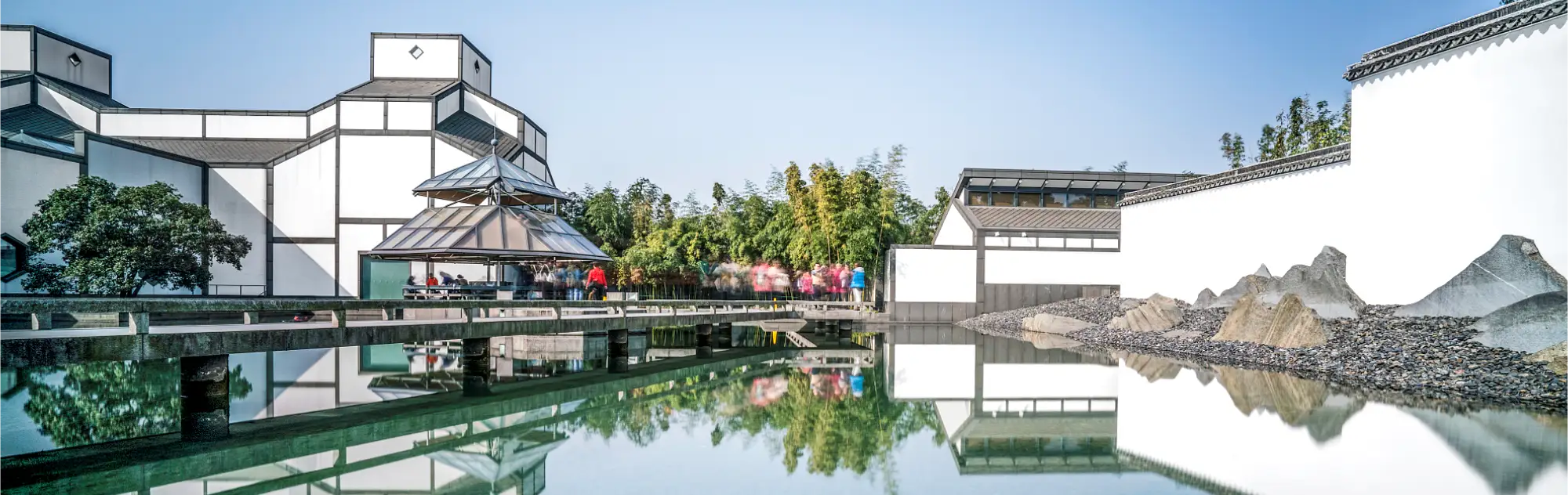
Suzhou Museum of China is a local comprehensive museum dedicated to the collection, display, research, and promotion of Suzhou‘s history, culture, and art. Being a masterpiece of I.M.Pei, the new museum was completed and officially opened to the public on October 6, 2006. It covers an area of about 10,700 square meters, with a construction area of over 19,000 square meters.
Facts of Suzhou Museum
- Location: 204 NortheastStreet, Gusu District, Suzhou City, Jiangsu Province (Next to Humble Administrator’s Garden)
- Opening hours: 9:00 am – 5:00 pm (closed Mondays, except for national holidays)
- Ticket price: Free
- Time needed: 1-2 hours
- Best time to visit: All seasons
- Suited to: Anyone, especially architecture and history lovers
Design and Layout of Suzhou Museum
Design of Suzhou Museum
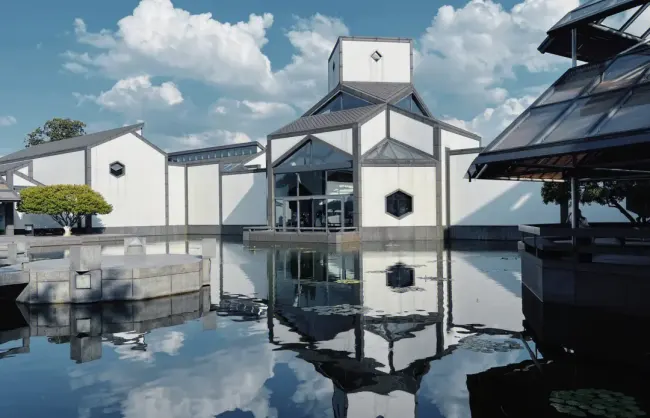
The Suzhou Museum architecture was designed by the world-famous architect Mr. Ieoh Ming Pei, and it combines modern exhibition halls and classical garden architectural styles. The roof’s design is inspired by Suzhou’s traditional sloping roof landscape, presenting a novel geometric effect. What’s more, the glass roof contrasts with the stone roof, allowing natural light to enter the activity areas and exhibition spaces of the museum.
Layout of Suzhou Museum
The Suzhou Museum complex contains three floors and is centered around the central hall. To the south of the central hall are the main entrance, a courtyard, and an art shop, and to the north lies the main courtyard, featuring garden landscapes. On the east side, the central hall is connected by a corridor extending to the Wisteria Garden, the Modern Art Gallery, and Prince Zhong’s Mansion. While on the west side, a corridor connects it to the exhibition halls.
What to See and Do in Suzhou Museum
1. Exhibits of Suzhou Museum
Suzhou Museum has four basic exhibition halls, including the Wu Treasures Hall, the Wu Pagoda Relics Hall, the Wu Elegant Life Style Hall, and the Wu Paintings and Calligraphy Hall. They have nearly 30,000 pieces of collections exhibited to the public, including paintings and calligraphy, ceramics, handicrafts, bronze wares, and more. Besides, there are also special exhibitions and folk exhibitions held from time to time.
2. Buddhist Relics
Suzhou Museum exhibits national treasures in Wu pagodas, many of which are Buddhist relics. Visiting the museum, you’ll be amazed by the number and quality of the Buddhist relics. Notable relics are the large bronze gilded pagoda from the Five Dynasties period, the Five-Tier Stone Casket, and a bronze seated Buddha statue from the Song Dynasty.
3. Calligraphy and Paintings
Another highlighted collection of Suzhou Museum is its calligraphy and paintings. There, the Scroll of Seven Bamboo Paintings from the Yuan Dynasty, Spring Mountain by Wang Chong, and Misty Waters by Liu Yu from the Ming Dynasty are well-known ones. You can take a stroll around the halls and appreciate the rare paintings to learn more about Chinese painting from the past.

4. Ceramics
Don’t miss the valuable and high-standard ceramics during your Suzhou tours at Suzhou Museum. You’ll find a Blue-and-White Plate with Flowers and Fruit Patterns, a Globular Shape Vase with Peaches, and many other porcelain items from the Ming and Qing Dynasties. What’s more, the Olive Green Lotus-Shaped Bowl from the Five Dynasties period cannot be ignored, which was found on the third floor of Yunyan Pagoda on Tiger Hill.
5. Bronze
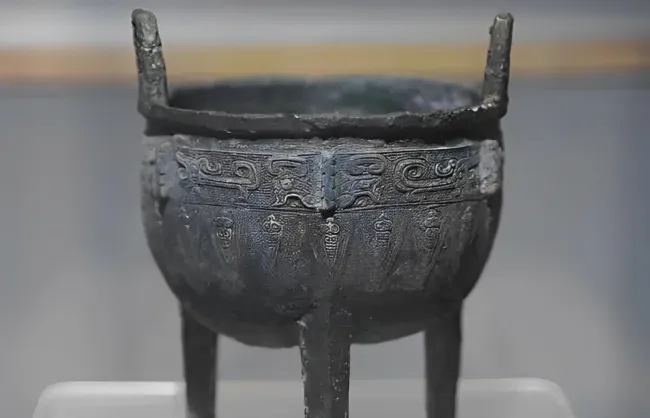
Suzhou Museum surprises visitors with its high-level bronze wares. There are Huiwen Bozi Vessel, Three Ram Tripod Censer, and many other bronze tripods, vessels, and goblets. And most of them bear inscriptions at the bottom. By exploring these bronze wares, you’ll better understand the skill of bronze making in the ancient Wu region.
6. Inner Garden of Suzhou Museum
Outside the exhibition area, there is a garden in Suzhou Museum, where you can take a walk along the long corridors by the lakeside, appreciating the bamboo trees and beautiful flowers. Although there are not so many trees in the garden, all of them are in elegant shapes to enhance the beauty of the garden. Besides, pavilions with modern design can also be seen during your trip to Suzhou at the museum.
7. Prince Zhong’s Mansion
Located between the Suzhou Museum and Humble Administrator’s Garden, Prince Zhong’s Mansion was the royal residence of Li Xiucheng, Prince Zhong of the Taiping Heavenly Kingdom. It is the most well-preserved royal residence of a peasant uprising leader remaining in Chinese history. Visiting there, you’ll discover precious old furniture, valuable paintings, and other cultural relics.
Best Time to Visit Suzhou Museum
Suzhou Museum is open all year round from Tuesdays to Sundays, and you can visit there in all seasons. Morning or early afternoon tend to be the best times in the day, as there are fewer crowds, so you can immerse yourself in the displays and experience the tranquility of the garden.
How to Get to Suzhou Museum
To get to Suzhou Museum, take Metro Line 4 and disembark at Beisita Metro Station, or Take Metro Line 6 and get off at Zhuozhengyuan Subo Metro Station. Then walk for several minutes, and you’ll be there. Besides, if you prefer bus travel, take tourist buses 1 or 5, or regular buses 202, 925, and 9009, and get off at Suzhou Museum Station.
Attractions Nearby Suzhou Museum
- Suzhou Garden Museum: Located to the west of Humble Administrator’s Garden, this museum allows you to learn about the techniques used in garden design, including rockery building, water management, planting, and architecture.
- Suzhou Silk Museum: This specialized silk museum is situated close to Suzhou Museum, and it houses over 700 artifact-grade items and more than 3,000 specimens and other collections.
- Suzhou Embroidery Museum: It provides a comprehensive overview of the history of Suzhou embroidery.
- Suzhou Art Museum: The new art museum features a borderless design. There, visitors can appreciate many styles of paintings and attend various exhibitions.


