


Traveling by train in China is more and more popular and convenient thanks to its vast and modern railway network. It is fast and economical, and can conveniently connect most of the major cities and tourist destinations in China.
The two main train types in China are high-speed trains (or bullet trains) and normal trains (or ordinary trains). In this article, we’ll introduce you to the differences between different train types in China, and the seat classes on each train type.
Content Preview
- Overview of the Train Types in China
- China High-speed Trains – Types, Seat Classes, Popular Routes
- China Normal Trains – Types & Seat Classes
- Special Ticket Types for Both High-Speed Trains and Normal Trains
- How to Choose a Train Type & Seat Class
- China Train Tours with CXT
Overview of the Train Types in China
The high-speed trains are represented by the letters G, D, or C which are followed by 2-4 digits. Generally, the high-speed train can run a speed of 200-350 km/h, and are furnished with modern facilities to bring passengers more comfort.
While the normal trains are represented by the letters Z, T, or K, or by four-digit numbers. Most ordinary trains run a lower speed of about 120-160 km/h, and are equipped with basic facilities.
The following table is a brief introduction of some common train types in China:
Main High-speed Train Types
Train type |
Speed |
Features |
Seat classes |
G |
300-350 km/h, some can reach 420 km/h |
Fastest, modern, punctual, convenient |
Business, superior (certain trains have), first, second |
D |
200-250 km/h |
Second-fastest, comfortable, some overnight |
Business, first, second, soft sleeper, deluxe soft sleeper |
C |
200 km/h or 300 km/h |
Run between neighboring cities |
Business, first, second |
Normal Train Types
Train type |
Speed |
Features |
Seat classes |
Z |
160 km/h |
Non-stop or few stops, basic facilities, overnight |
Deluxe soft sleeper, soft sleeper, hard sleeper, soft sleeper, hard seat |
T |
140-160 km/h |
Express, more stops, basic facilities, overnight |
Deluxe soft sleeper, soft sleeper, soft seat, hard sleeper, hard seat |
K |
120 km/h |
Fast, many stops, basic facilities, overnight |
Deluxe soft sleeper, soft sleeper, soft seat, hard sleeper, hard seat |
L, Y, S or only 4 digits trains |
100 km/h or lower |
Slowest but cheapest, stop almost at every station |
Hard seat, hard sleeper, soft sleeper |
Note:
- In addition, L trains are usually added during the Spring Festival travel rush or during peak passenger flow periods; Y trains are operated based on special tourism demands, such as those requested by tourist attractions, and S trains usually head to the suburbs.
- There are still about 80green trains in China, mainly operating in remote areas such as the northwest and southwest regions.
- Steam trains smaller than standard gauge, such as the Jiayang small train in Sichuan, the Jianshui small train in Yunnan, and the Wuyuan small train in Jiangxi, are mainly used for
China High-speed Trains – Types, Seat Classes, Popular Routes
High-speed Train Types & Brief Introduction
China boasts the longest high-speed rail network in the world, making China tours by train very convenient and comfortable. Its high-speed trains can be divided into three main types, which are G trains, D trains, and C Trains. The locomotive of the high-speed train looks like bullet, hence its another name bullet train. The train codes begin with the letters G, D, and C, and are followed by 2-4 digits which indicate the route number of the train. All the high-speed trains are air-conditioned.
- G-series trains: G trains are the fastest as well as the latest generation of China Railway High-speed series. With a designed top speed of 350-400 km/h, G trains connect big and major cities in China, and usually stop at fewer stations. They usually cease operations from 0:00 to 6:00 in the morning and need to run on dedicated high-speed tracks.
- D-series trains:D trains are the second fastest high-speed trains, with its top speed reaching 200-250 km/h. This type of trains usually run on middle and short-distance lines, stop at more stations, and serve more destinations. They can run on both high-speed and conventional tracks. Some D trains operate overnight with sleeper seats.
- C-series trains:C trains are a type of intercity trains connecting neighboring cities or a major city and its nearby areas. They serve for short-distance travelers and stop at a few stations or are non-stop. The speed of C trains can reach to 160-300 km/h.
Facilities on China High-speed Trains
- Seats:The high-speed train seats are more spacious and equipped with power sockets, and foldable tables. Usually, there are 3 or more seat classes available, offering different levels of comfort.
- Luggage racks and closets:The luggage racks are above the seat, for small suitcases and bags. The luggage closets are usually at the end of each carriage, for big and heavy suitcases and items.
- Wi-Fi:Free Wi-Fi service is available on most high-speed trains. Passengers just need to turn on the Wi-Fi switch and connect to the high-speed train Wi-Fi (高铁WIFI), then follow the prompts to open the official High-Speed Rail app
- Water: There is a water dispenser at the end of each carriage providing free boiled water. Passengers can to bring their own cup.
- Western-style and squat toilets:The restroom is available at the end of each carriage, usually at the connecting area between two carriages. Besides the toilets, there is also a sink for passengers to wash up.
Fuxing Hao Vs. Hexie Hao
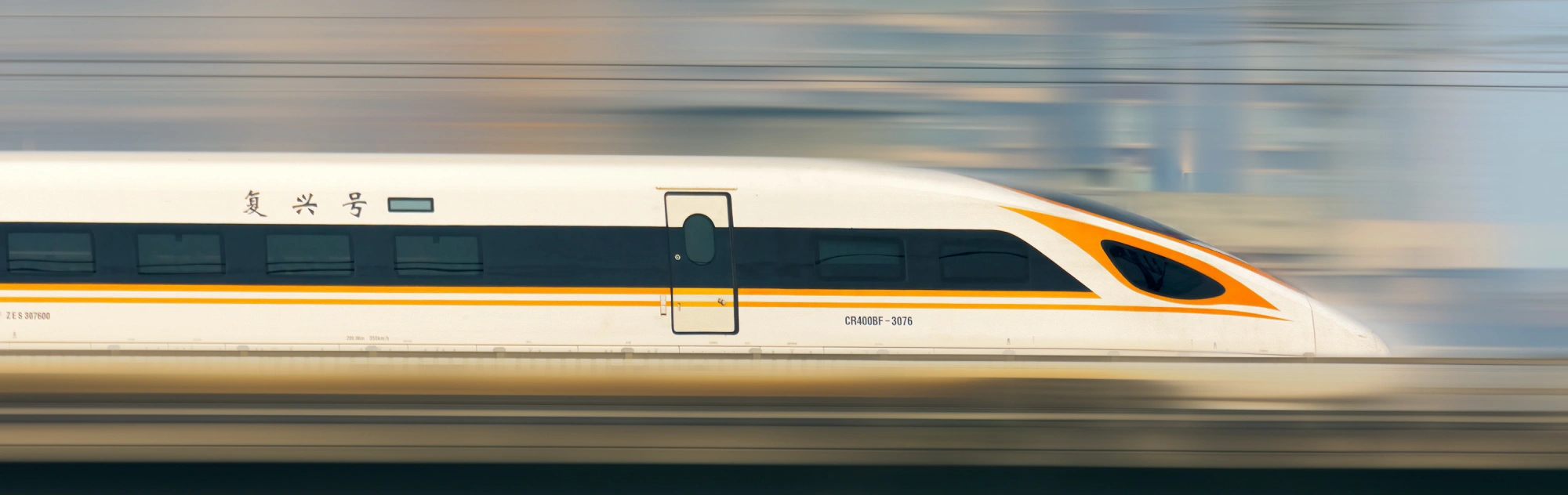
Both Fuxing Hao (复兴号) and Hexie Hao (和谐号) train series are developed to operate on high-speed rail lines. Fuxing Hao trains are the newest high-speed trains in China which went into operation in June, 2017. Averagely, its maximum speed can reach 350 km/h and the designed top speed is over 400 km/h, which is more faster than the first-generation Hexie Hao train (runs at a speed of 200-250 km/h).
Compared to the first-generation Hexie Hao train, the seats on Fuxing Hao trains are more spacious, and more comfortable.
Currently, most G trains are Fuxing Hao while Hexiao Hao mainly serve for D trains.
Seat Classes of High-speed Trains in China
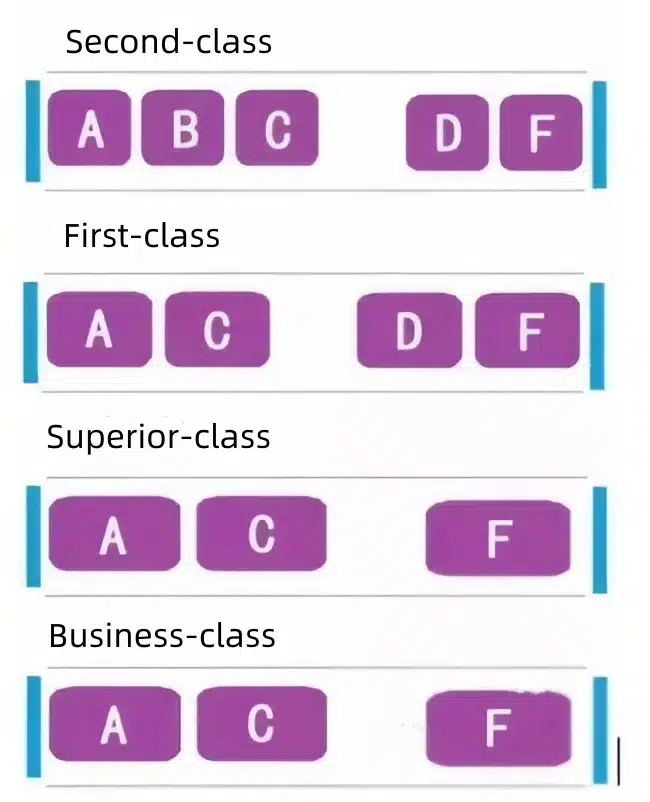
The three main seat classes on most high-speed trains are second class, first class, and business class. Depending on the train type and travel distance, certain D trains may have no business class seats, while some G trains may have superior seats available. Overnight D trains often have sleepers of different classes option for passengers. Below are detailed features and services of each seat class on the high-speed trains.
Second Class Seats
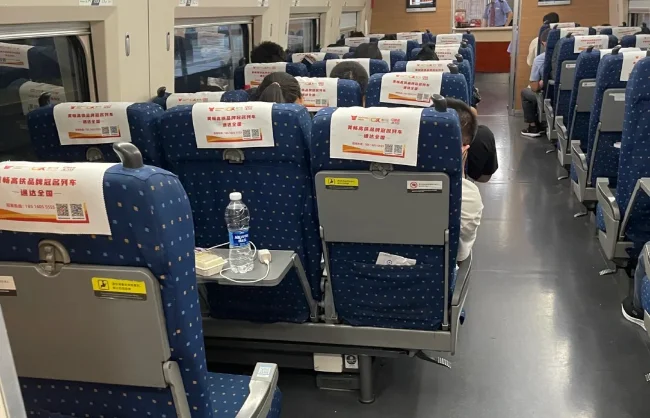
The second class seats are similar to the economy seats on flights, but more spacious and comfortable. This kind of seat is the most common on high-speed trains, and the ticket price is also the cheapest among other high-speed train tickets.>>How to Buy Train Tickets in China
Passengers can recline the seat to 90-135 degrees angle for comfort. There is a foldable dining table on the seat back, no footrest is available.
Regarding the size of a second class seat, it is about 43-43.5 cm wide and about 100 cm between two rows. The seats are in a 3-2 configuration, with a center aisle for easy access.
1-2 free sockets are provided in each row.
First Class Seats
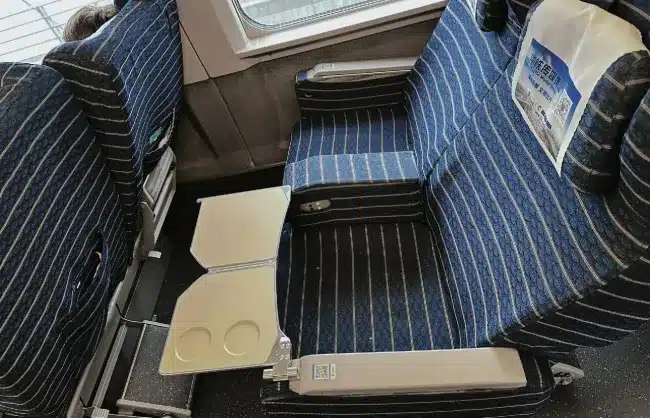
The first class seats are in a 2-2 configuration with a seat pitch of about 110 cm. The ticket fare is about 1.6-1.8 times of the second class.
Each seat of the first class is about 55 cm wide, and equipped with a foldable footrest, and a dining table on the right armrest.
Passengers can recline the seat to an angle of about 150 degrees for added comfort.
Free snacks and bottled water are usually provided, and the toilets are larger than the second class.
Superior Class Seats
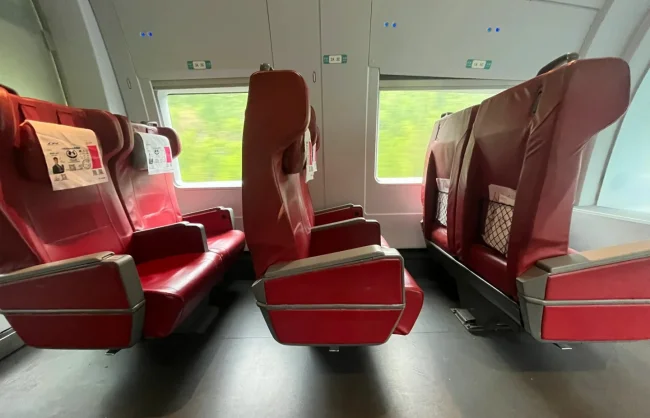
Some older high-speed trains have 12-18 superior seats available, which are close to the driver’s cabin, enjoying quieter space. They are considered comparable to the first-class cabin on an airplane, with the ticket being about 1.8 times the second-class seat (usually lower than the business class but higher than the first-class).
The seats are in a 1-2 configuration and are equipped with an audio system and foldable tables.
The superior seat area is also referred to as the observation area where passengers can press a button to clearly observe the scenery in front of the high-speed train.
Business Class Seats
The business class seats on high-speed trains can be described as luxurious, comparable to the business class cabin on airplanes. The ticket fare is about 2-3 times of the second class seat.
The seats are sofa-like leather armchairs, in a 1-2 configuration (some in 1-1 configuration), and can be adjustable to a fully reclined position of 180 degrees, creating exceptional space and comfort. Passengers can adjust the seat to upright, seated, and fully reclined with a simple press of a button.
Each seat is equipped with a mini LCD television (concealed within the left armrest) and a reading light, allowing passengers watch movie or enjoy other entertainment. Free disposable slippers and snacks are also provided.
A 220V power outlet is available underneath the seat.
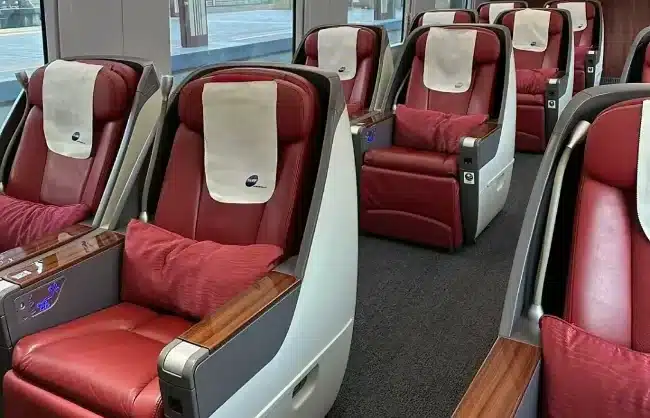
Good to know: on certain new intelligent high-speed trains, the business class seats are more luxurious. There is a door to seperate your seat from the aisle, offering more privacy.
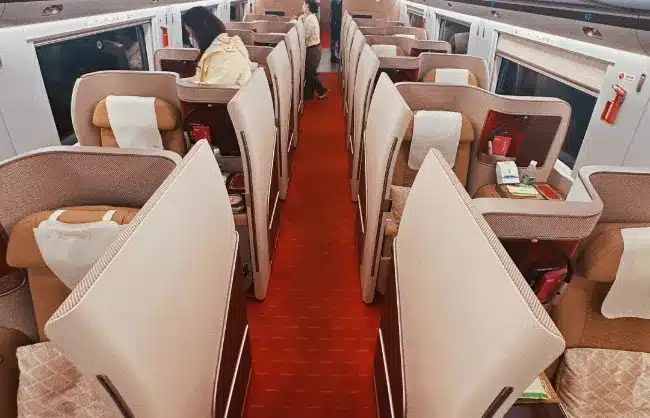
Sleepers on the High-speed Trains
Sleepers are available on some overnight or long-distance high-speed trains. There are three classes of sleepers based on the train types.
- New sleeper EMU (动卧)
Different from the ordinary sleepers, the new sleeper on the high-speed train is flanked by double-decker sleeping berths that is parallel to the direction of the train’s movement. This configuration makes each berth like a private compartments, creating more individualized spaces.
Thanks to its double-layered windows, passengers on both upper and lower berths can enjoy independent views.
Additionally, each berth of the new sleeper is equipped with amenities such as the little table, curtain, armrest, and pants hangers to improve passengers’ comfort.
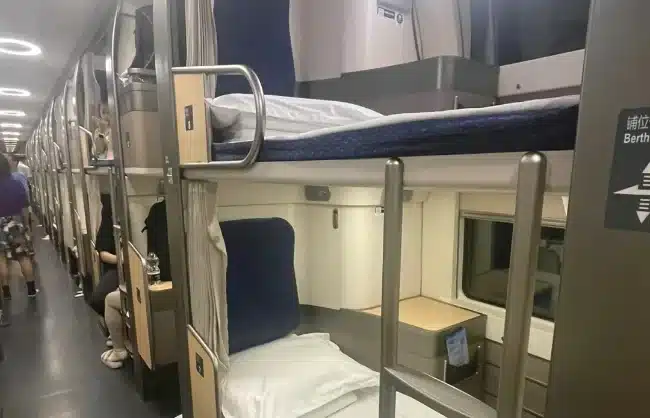
- Traditional Style Soft Sleeper (软卧)
On the high-speed train, the soft sleeper carriages are divided into small compartments, each with four berths, and a sliding door to seperate the compartment from the aisle.
The berths are in a double-decker configuration, each is equipped with a LCD TV above the foot place, a reading lamp, clothes hangers, socket, etc. Disposable slippers and headphone are also available.
Each berth is about 190cm long and 75cm wide, with adjustable sleeper back.
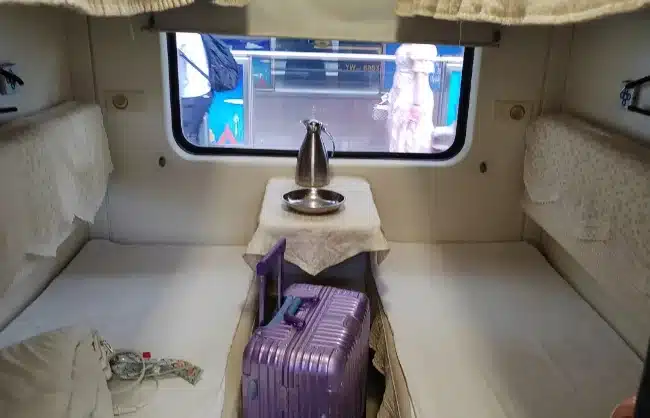
- Deluxe Soft Sleepers
The most luxury and expensive sleeper type, the deluxe soft sleepers are available on a few Chinese high-speed trains.
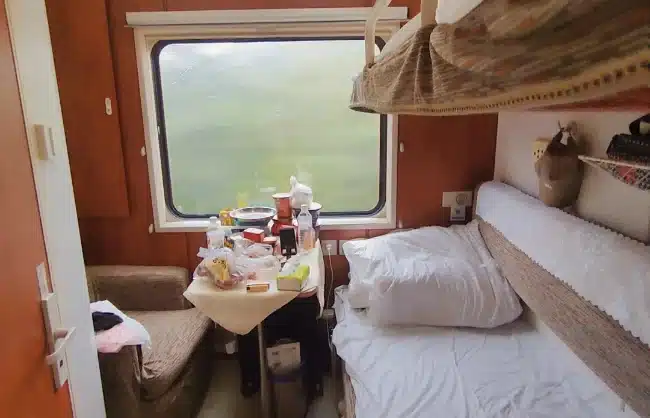
Each deluxe soft sleeper cabin has a double-deck berth, and equipped with a private washroom, providing wash-basin and western-style toilet. The cabin is just like a hotel room, with much larger space than the soft sleeper.
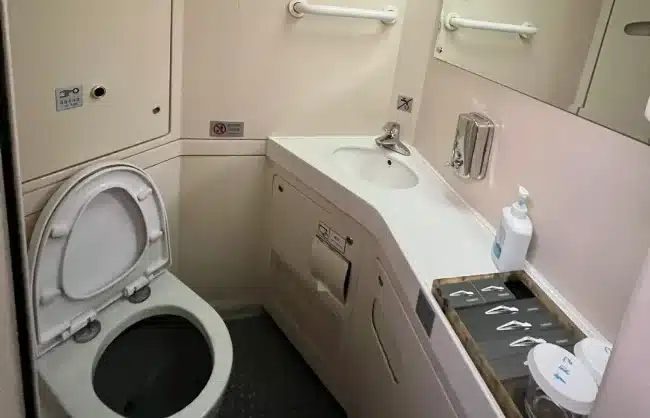
Each cabin has a door for privacy. Besides the berth and washroom, each cabin has a sofa and wardrobe. Disposable slippers are also provided.
Popular High-speed Train Routes for Travel
On certain routes, it is more recommended to take the high-speed train rather than the airport, since airports are often far from the city center, and the airport security may add a few hours. Usually, train stations are in or near the city center, and passengers don’t need to arrive at the station one or two hours in advance for check-in and security check.
Below are some of the recommended high-speed train routes connecting popular travel destinations:
- Beijing – Xi’an
- Beijing – Shanghai
- Shanghai – Xi’an
- Xi’an – Chengdu
- Xi’an – Luoyang
- Beijing – Xi’an – Shanghai
- Shanghai – Suzhou – Hangzhou – Huangshan
- Xi’an – Dunhuang
- Guangzhou – Shenzhen High-speed Train
We have more China train travels to inspire you.
China Normal Trains – Types & Seat Classes
Main Types of Chinese Normal Trains
Different from the high-speed trains, normal trains or ordinary trains in China offer a slower speed and simple facilities, but with cheaper ticket prices. It is a more traditional travel way, with the trains being identified by the letters Z, T, K, or L, Y, S with digits or by four-digit numbers.
- Z trains (直达列车): express trains run between major cities, with no stops or a few stops during the journey. It is the fastest normal train, with a speed of about 160 km/h. Have hard seats, soft seats, and soft sleepers available.
- T trains (特快列车): another kind of express normal trains with a speed of about 140-160 km/h. With fewer stops, typically only stop at provincial capitals, vice-provincial cities, and some major prefecture-level cities through the journey.
- K trains (快速列车): with moderate speed (about 120 km/h), stops at more stations than the T trains, mainly stop at middle-sized and large stations along the route. It is one of the most versatile types of trains in China.
- L, Y, S trains: slow trains with a speed of no more than100 km/h, stop at almost every station along the journey. The least comfortable trains among normal trains.
Facilities on Chinese Normal Trains
Some common facilities on the normal trains include luggage racks above the seat, dining car serving simple Chinese food, food trolley selling snacks and drinks, boiled water, squat toilets or sit toilet on sleeper carriages. There is no Wi-Fi service on the normal trains and the sockets are also limited.
Seat Classes on Normal Trains in China
Hard Seat:
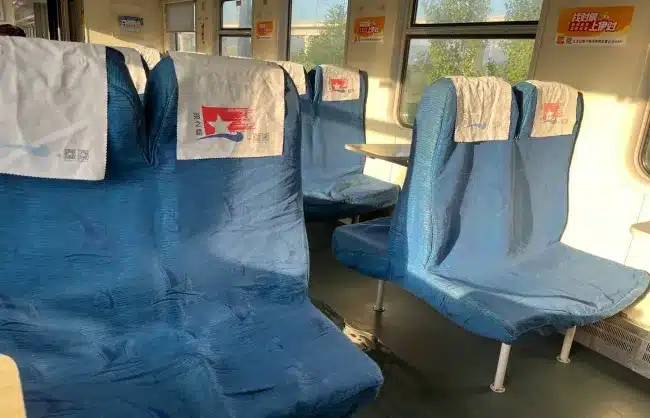
The least comfortable but the cheapest option. The seats are in a 3-2 configuration, each seat is about 40 cm wide and 70-80 cm between two rows. Hard seat carriages may exceed the intended capacity, and with standing passengers. It is usually crowded and not so clean.
Soft Seat:
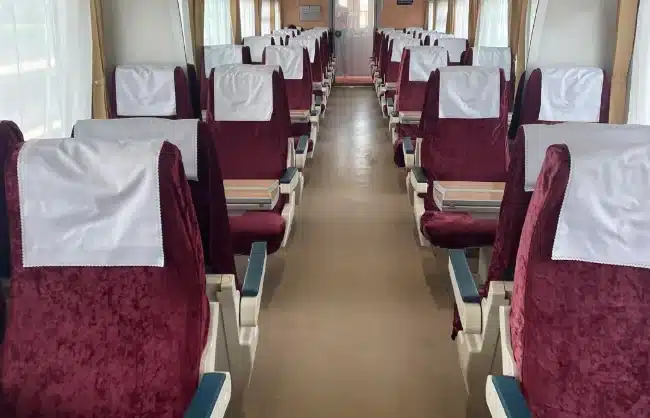
The seats are in a 2-2 configuration, with an aisle in the center. Certain soft seats have armrests. Passengers without soft seat tickets are not allowed to enter the carriage. The ticket fare is about 1.5 times of the hard seat. Usually available on T and Z trains.
Hard Sleeper:
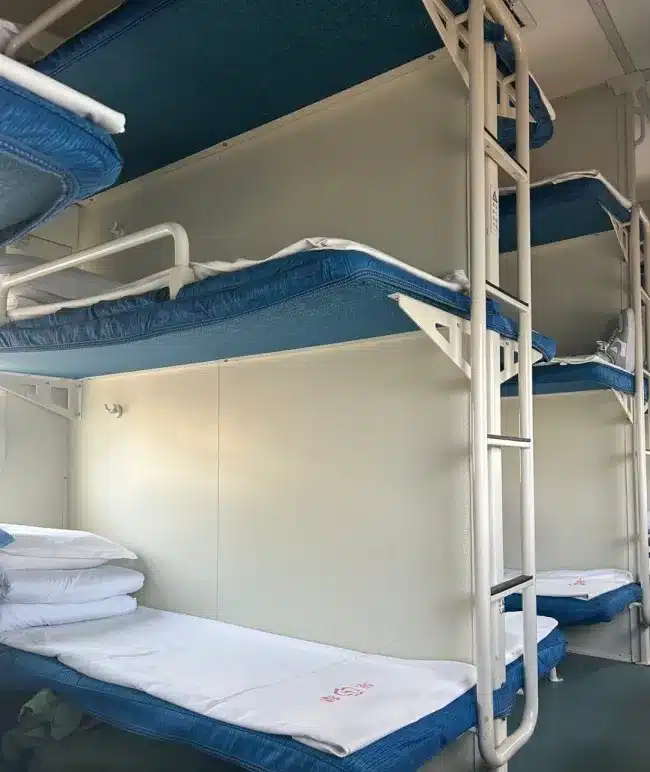
An economical option for overnight trips. Each cabin has six berths (two three-decker sleeping berths), each of which is narrow and hard. The cabin has no curtain or door on most trains.
Soft Sleeper
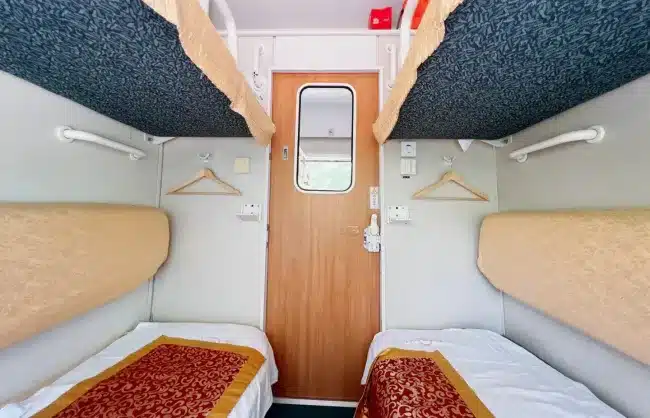
With wider and softer berths than the hard sleepers. Each cabin has 4 berths (two double-decker sleeping berths), and the berth is equipped with a reading light. There is a sliding door to separate the cabin from the aisle, allowing more privacy.
Deluxe Soft Sleeper
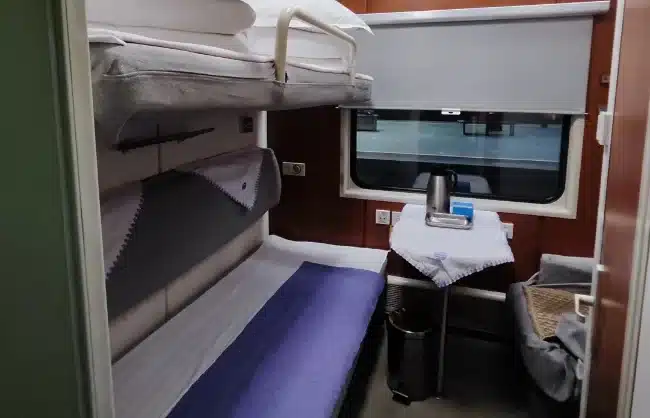
The most expensive and luxurious class of sleepers, with two berths in each cabin. Each cabin has a door that can be locked. Private washroom with toilet and wash-basin is available, just like a hotel room. The deluxe soft sleepers on the normal trains are similar to the ones on the high-speed trains, it’s just that the facilities is somewhat outdated.
Special Ticket Types for Both High-Speed Trains and Normal Trains
Standing Ticket (without a seat)
Sometimes, there are standing tickets available for second class seats on the high-speed trains and hard seats on the normal trains. It is at the same price of the second-class seat or the hard seat. This kind of ticket is issued when the train travel demand is high (especially in peak travel seasons), allowing passengers to travel by train without a seat (standing on the train). It’s only recommended for short journey or urgent travel.
Children Train Ticket Regulations
- Children below 6 years old can travel by train for free (no separate seat), but need to be accompanied by an adult. If an adult accompany 2 or more children below 6 years old, only one child can travel for free, others need to buy children’s ticket which is about 50% of the full fare, and have their own seat.
- Children between 6-14 (not included) years old need to buy children’s ticket, but with their own seat. The age of the child is determined based on the travel date.
- People aged 14 or above need to buy the full-price ticket.
- A child ticket is required if a free-traveling child need to use a seat independently.
So, How to Choose a Train Type & Seat Class for Your China Travel
High-speed Train or Regular Train
If you have plenty of time, taking a regular train is more cost-effective. But for your tour of China, time is limited. So, don’t hesitate. Choose the high-speed rail. It is comfortable, punctual and fast. Do you need an example? Travel from Beijing to Shanghai. The regular train takes 13-19 hours and costs around 170 RMB. The high-speed rail takes about 5-6 hours and costs around 600 RMB.
Daytime Train or Overnight Train
This can be based on your preference, but more importantly, it depends on your China travel itinerary. The advantage of an overnight train? You can fully utilize the daytime for exploration and save one day’s accommodation cost. Taking a daytime train, you can enjoy the scenery along the way as you pass through cities and villages.
First-class Seat or Second-class Seat When Taking a Bullet Train
A first-class or even a business-class seat is, of course, more expensive. But it also has many benefits, such as a more reasonable seat layout, more space, quieter carriages, free snacks and beverages, and better facilities and services. So if your travel budget is high, you can consider a first-class seat or business class — especially for trips over 3 hours. If you have a low budget, a second-class seat is already very good.
Please note: You can contact a travel advisor of Chinaxiantour to reserve seats near the window, aisle, door, or near the baby and mother room in advance.
Seating or Sleeper
How long is your train journey? Whether it’s a high-speed train or a regular train, if it’s over 7 hours, book a sleeper.
For Train Travel Enthusiasts
Take the high-speed rail for travel between big cities, such as from Beijing to Xi’an. But for special scenic train lines, especially the Qinghai-Tibet Railway, you can choose a regular train. Or you can choose tourist special trains, such as the luxurious Panda Train crossing the Silk Road.
Recommended China Tours by Train with CXT
Whether you’re traveling to big cities or craving a quick escape to Tibet, China’s trains, especially high-speed trains, are a great choice for domestic travel. Our China train tours are ideal for those who prefer to travel in China by train. Check the detailed itinerary, or simply contact us to get a custom trip.