
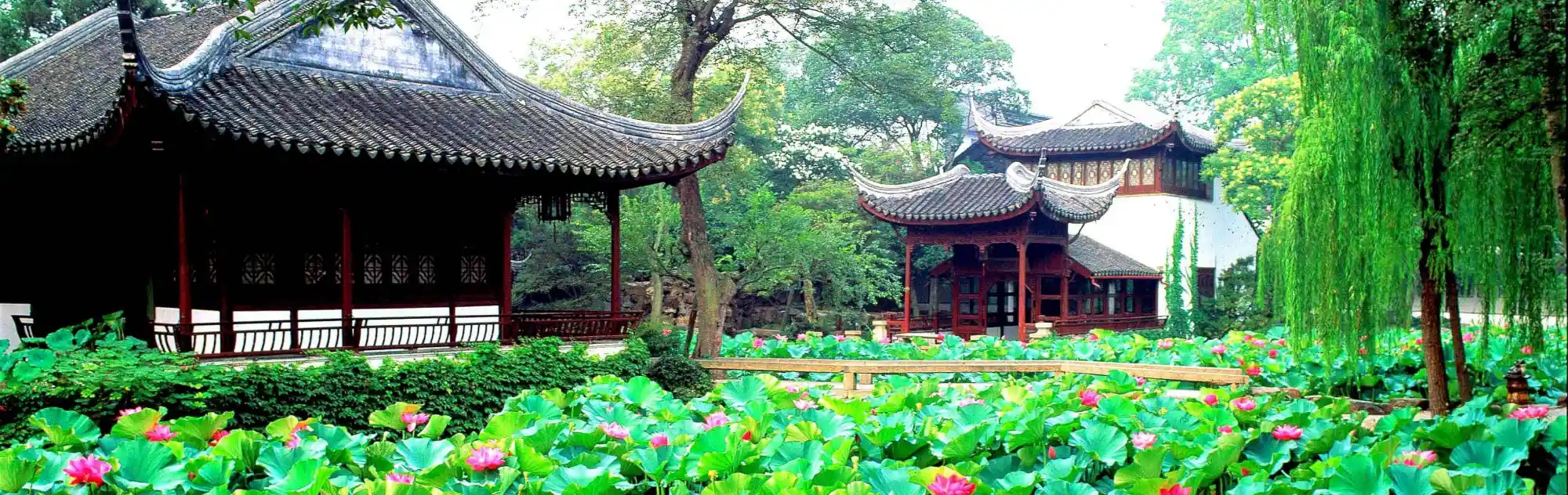
Humble Administrator’s Garden, or Zhuo Zheng Yuan (拙政园) in Chinese, is the most representative, as well as the largest classical garden of Suzhou, among others such as the Lingering Garden, Master of the Nets Garden, and the Lion Grove Garden. It is also regarded as one of the top four classical gardens in China, together with the Summer Palace of Beijing, Chengde Mountain Resort, and the Lingering Garden.
Humble Administrator’s Garden was built in the year 1509 by Wang Xiancheng, a retired Ming Dynasty official. He had encountered obstacles in his political career and decided to return home. He built this garden with the intention of returning to a simpler, pastoral life among nature.
Humble Administrator’s Garden now has a history of over 500 years, covers an impressive area of 5.2 hectares (559,723 square feet). Its brilliant layout plan and architectural design have earned it the title of a UNESCO World Heritage Site. Here is some key information for those planning a Suzhou tour to Humble Administrator’s Garden.
Content Preview
- Fast Facts about Humble Administrator’s Garden
- Layout of Humble Administrator’s Garden
- Highlights of Humble Administrator’s Garden
- Top Recommended Activities & Experiences
- Recommended Travel Route in the Garden
- Best Time to Visit Humble Administrator’s Garden
- How to Get to Humble Administrator’s Garden
- Attractions Nearby Humble Administrator’s Garden
- FAQs about Humble Administrator’s Garden
- Plan Your Travel in Suzhou with China Xian Tour
Fast Facts about Humble Administrator’s Garden
- Location: No.178 Northeastern Street, Gusu District, Suzhou
- Hours: 7:30 ~ 17:30 in summer; 7:30 ~ 17:00 in winter
- Tickets: CNY 80 on season; CNY 70 off season
- Recommended Visit Time: 2-3 hours
- Best Time to Visit: March to November
- Suited to: architecture and garden lovers, photographers
- Area: About 52,000 square meters.
- Age: Over 500 years old
- Recommended activities: Savor a cup of tea, visit Suzhou Garden Museum, experience a night tour, wear traditional Chinese clothes to take photos
Layout of Humble Administrator’s Garden
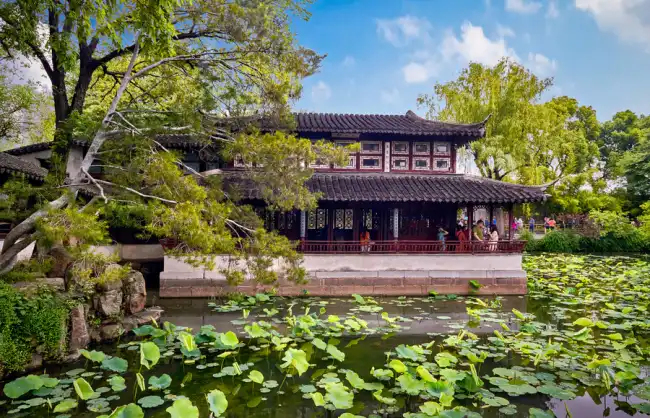
Humble Administrator’s Garden is divided into three parts: the eastern, the central, and the western garden. The central garden is the main attraction site. Situated in the northeast corner of Suzhou City, Humble Administrator’s Garden has often been praised for its location and layout by experts.
Although the garden sits in an urban area, on the inside, it is a haven completely devoid of the city atmosphere, and on the outside, it seems to blend in with the urban landscape.
Eastern Garden
Eastern garden is also called “Pastoral Home.” It consists mainly of a waterscape, with well-designed stone bridges, corridors, pavilions, and other buildings. Its style puts an emphasis on simplicity. In the center of the garden, there is a huge rockery named “Taihu Stone.” Other main structures include Lanxue Hall and Lotus Pavilion.
Central Garden
Central garden is the main area of Humble Administrator’s Garden. Drifting Fragrance Hall is the center of the whole garden. The central garden is dominated by landscape with well-proportioned rockery, winding paths, and clear lakes. Water takes up 3/5 of the garden area. All the structures are built by water, taking into account their position in relationship to each other and the other two gardens.
Western Garden
Western garden is also named the “Complementary Garden.” It is the last part of the Humble Administrator’s Garden. Its main structure is the 36 Mandarin Duck Hall, where the host entertains the guests with performances.
Highlights of Humble Administrator’s Garden
Orchid and Snow Hall of Eastern Garden
The name of Orchid and Snow Hall comes from a verse by the famous poet Li Bai. It is a symbol of elegance and purity. On the folding screen in the center, there is a panoramic map of Humble Administrator’s Garden.
Lotus Pavilion of Eastern Garden
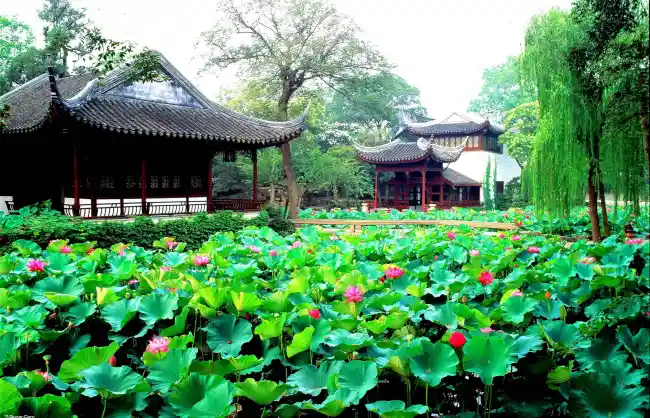
The Lotus Pavilion sits on the northeast side of the lotus pond in the eastern garden. It appears light and elegant above the water. Half of the structure is built on the bank, the half reaching over the water. It is a great place for admiring the lotus and fish below.
Drifting Fragrance Hall of Central Garden
Drifting Fragrance Hall, as the center of the whole Humble Administrator’s Garden, is surrounded by rockery and water. It is open on all four sides, with no pillars to block the view of the outside. On its east side is the peony garden. The north side is the lotus pond. There is an osmanthus bush in the west and rockery in the south. It was once an important structure for entertaining guests.
Fragrance Isle of Central Garden
The word “Isle” is pronounced the same as “boat” in Chinese. Fragrance Isle is in fact a boat-like structure that seems to be floating among the lotus in the water. It consists of a small bridge, a platform, a pavilion, all of which are different in height, and support one another.
Secluded Pavilion of Phoenix Tree and Bamboo of Central Garden
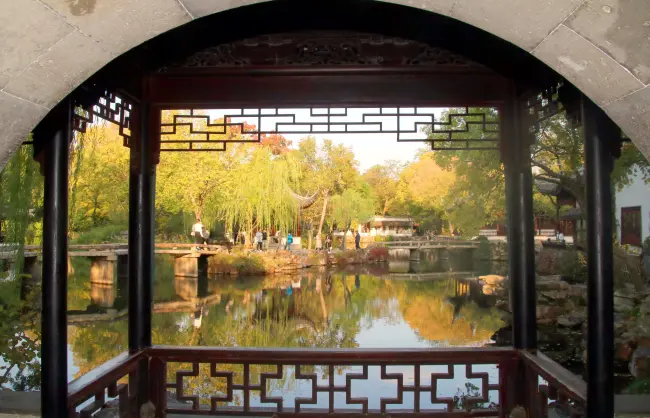
This pavilion is a key viewing spot in Humble Administrator’s Garden. There are four arched doorways each offering different views of the surrounding areas from different perspectives. You’ll discover exciting elements of the garden through these different frames.
36 Mandarin Duck Hall of Western Garden
36 Mandarin Duck Hall is the main structure of the western garden. Its southern part is named the Hall of 18 Camellias, because there’s a row of camellias outside its window. And the northern hall used to have 36 pairs of mandarin ducks in the pond. The architectural design of this hall allows great sound effects for performances.
Another highlight of 36 Mandarin Duck Hall lies in its blue and white diamond glass-tiled windows. Through these colored glass tiles, the sunlight becomes different colored beams. As you look outside through the windows, you see the lotus, leaves, and pond in a different light.
Top Recommended Activities & Experiences
Visiting the Nearby Suzhou Garden Museum
Suzhou Garden Museum is on the west of the garden and is free to enter. Before visiting the garden, you can go to this museum to learn about the landscape planning techniques and cultural meanings of Suzhou gardens. After having a rough understanding of the garden art, you will enjoy a more impressive tour in the garden.
Experiencing an Immersive Night Tour
The night tour in Humble Administrator’s Garden is not a simple light show. It integrates technology with the classic arts to create an immersive tour. By utilizing the lights and shadows, the ancient paintings on the wall are brought to life. In the waters of the central garden, there is also a real-scene Kunqu Opera performance. You will feel like experiencing the ancient life.
Wearing Traditional Chinese Clothes for Photography
Do you want to be an ancient person in the Chinese painting? Try on traditional clothes to take memorable photos in this classic garden. All the pavilions, waters and corridors are the best backdrops. You do not need to seek for a special spot. Perfect composition can be found almost at every corner. And try to hold an oil-paper umbrella, a circular fan or an antique book in your hands, which will enhance the ancient charm to your photos.
Recommended Travel Route in the Garden
According to the visiting duration, the two main travel routes of the Humble Administrator’s Garden are recommended below.
1. In-depth Tour
- Route: South Entrance – Orchid and Snow Pavilion – Lotus Pavilion – The Hall of Distant Fragrance – The Small Flying Rainbow Bridge – The Hall of 36 Pair of Mandarin Ducks – The Stay and Listen Pavilion – The Mountain-in-View Tower – The With Whom Shall I Sit Pavilion – South/East Exit
- Time: 3 – 4 hours
- Best for: tourists with enough time
2. Essence Tour
- Route: South Entrance – The Hall of Distant Fragrance – Listening on Jade Pavilion – The Small Flying Rainbow Bridge – The Hall of 36 Pair of Mandarin Ducks – The Stay and Listen Pavilion – The With Whom Shall I Sit Pavilion – The Mountain-in-View Tower – The Pavilion in the Lotus Breezes – Exit
- Time: 5 – 2 hours
- Best for: tourists withlimited time
Best Time to Visit Humble Administrator’s Garden
Spring and early summer are the best time to travel to Suzhou and visit Humble Administrator’s Garden. You’ll find the plants and flowers in bloom, including azaleas and lotuses. The garden is the most colorful and exciting for taking photos and enjoying the view.
How to Get to Humble Administrator’s Garden
By Train: Take a train from other cities in China to Suzhou Railway Station or Suzhou North Railway Station. From there, you can take the metro, a bus, or a taxi to Humble Administrator’s Garden.
By Metro: Take metro line 4 to Beisita Station (北寺塔站). From there, it’s a short walk to the garden.
By Bus: Take one of the buses No. 40, 55, 178, 202, 309, 313, 518, 529, 811, and 923, to Beiyuan Road Station (北园路站), which is also a short walk to the garden.
By Taxi: You can get a taxi to Humble Administrator’s Garden from pretty much anywhere in the city.
Attractions Nearby Humble Administrator’s Garden
The Suzhou Museum is designed by the well-known Chinese American architect Mr. Ieoh Ming Pei (贝聿铭). Pei lived in Suzhou during his childhood, so you’ll find many typical elements of Suzhou gardens and Jiangnan architecture at the museum. With an area of 12,797 square yards (10,700 square meters), Suzhou Museum is home to over 40,000 historical and cultural, including jade, ceramics, bronze, stone, and ivory.
Lion Grove Garden is a renowned classical garden with a history dating back to the Yuan Dynasty in 1342. It stands among the four most celebrated Chinese gardens in Suzhou, and is famous for its amazing collections of rocks.
Couple’s Retreat Garden consists of a large mansion and smaller houses with two gardens. On three sides it is surrounded by a canal. The garden has 24 buildings, 21 tablets and couplets, brick carvings, and precious ancient trees. It is about 0.6 miles (1 kilometer) west of Lion Grove Garden.
Suzhou Silk Museum reveals the fascinating history and intricate craftsmanship behind Suzhou’s renowned silk industry through engaging exhibits and captivating demonstrations.
FAQs about Humble Administrator’s Garden
Is Humble Administrator’s Garden a UNESCO World Heritage Site?
Yes, it was listed on the UNESCO World Heritage List in 1997.
How much time should I allocate for a thorough visit?
About 3 – 4 hours is a more recommended duration.
When is the best season or time of day to visit for flowers and fewer crowds?
There is the Azalea Festival, the Lotus Festival and the chrysanthemum exhibition in spring, summer and autumn, respectively. To avoid crowds, you can visit there in the early morning when the garden is just opened.
Are there tea houses or rest areas within the garden?
Yes, the tea house is in The Hall of Kaoliang Fragrance and The Hall of Distant Fragrance and the rest areas are distributed everywhere in the garden.
Are there areas of the garden that are easy to miss?
The Listening to the Rain Pavilion, Loquat Garden and ornamental perforated windows are easy to miss.
Plan Your Travel in Suzhou with China Xian Tour
In Suzhou, there are many hidden details in classic gardens and many stories and cultural connotations behind the historic sites. With a professional guide, you will enjoy an in-depth explanation and a more impressive tour. China Xian Tour is glad to arrange a guide for you. Also, we can customize a trip based on your preferences and help you book the hotels and tickets. Just feel free to contact us at any time.
Recommended Suzhou Tours to Humble Administrator’s Garden