
Suzhou is the hometown of silk, so it is worthwhile and meaningful to visit Suzhou Silk Factory, or Suzhou No. 1 Silk Factory. As the first state-owned factory in Suzhou, Suzhou Silk Factory is a witness to the development of China’s silk industry.
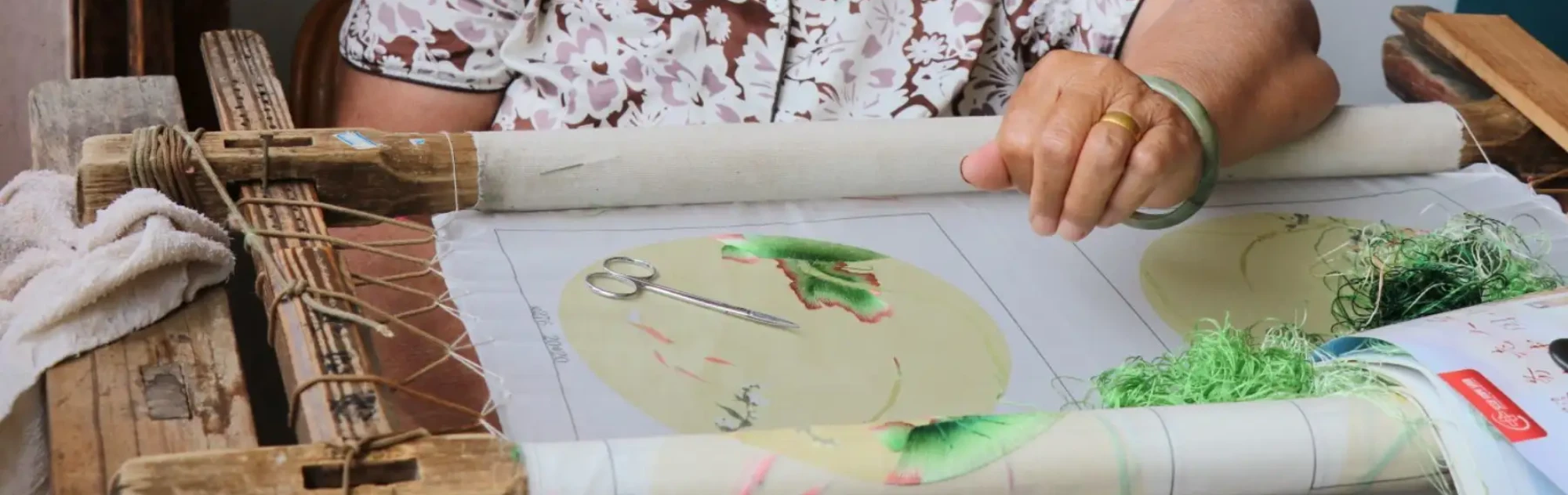
Today’s Suzhou Silk Factory is not only a silk enterprise, but a comprehensive enterprise integrating silk reeling, weaving, garment production, tourism shopping malls, and hotels. Visitors in Suzhou Silk Factory can not only see the whole production process from hand-peeling cocoon to drawing silk quilt, but also experience the whole process personally.
Content Preview
- Suzhou Silk Factory Facts
- What to See and Do in Suzhou Silk Factory
- How to Get to Suzhou Silk Factory
- Attractions nearby Suzhou Silk Factory
Suzhou Silk Factory Facts
- Location: No.94, Nanmen Road, Suzhou City
- Opening Time: 8:30-17:30
- Ticket Price: Free of charge
- Recommended Visiting Time: 2-3 hours
What to See and Do in Suzhou Silk Factory
Watch and Experience the Production Process of Silk Quilts
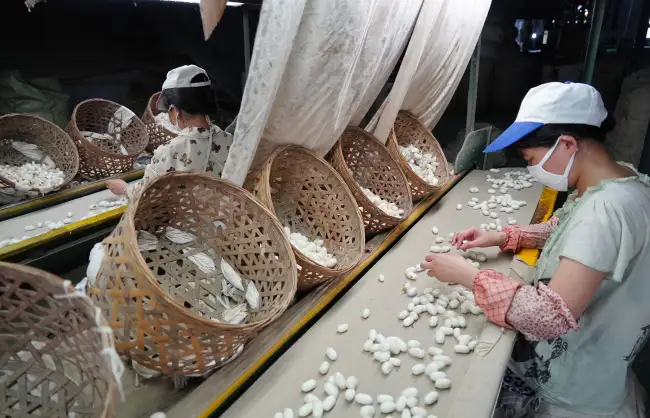
Cocoon selection: It is the first step of production. Workers need to carefully select white, good gloss, uniform thickness of the cocoon. Only quality cocoons that meet these standards can be used for reeling. Even now the automation process has been developed, this step can only rely on manual operation. In addition, yellow and green colored cocoons should be removed to avoid uneven silk color.
Boiling cocoons: This step includes dipping, osmosis, and boiling, in order to properly expand and dissolve the sericin surrounding the cocoon. In this way, the adhesive force between cocoon silk will be weakened, which is conducive to reeling. By boiling the cocoon, the cocoon silk can be separated continuously during the reeling process.
Silk reeling: This step pulls the silk out of the cocoons. Workers need to sort the boiled cocoons by hand and categorize them according to different sizes. Finally, the cocoons are combined to make raw silk or tussah silk.
Silk quilt making: First cut one side of the organized silkworm silk with scissors, and then four people pull each side, to pull the silk together to spread on the board. Repeat this process until the amount of silk needed for a quilt is complete. Finally, the silk core is covered with a quilt cover and sewn by hand. If the last step is made by machinery, the toughness of the silk will be damaged.
Previous Site of Japanese Consulate
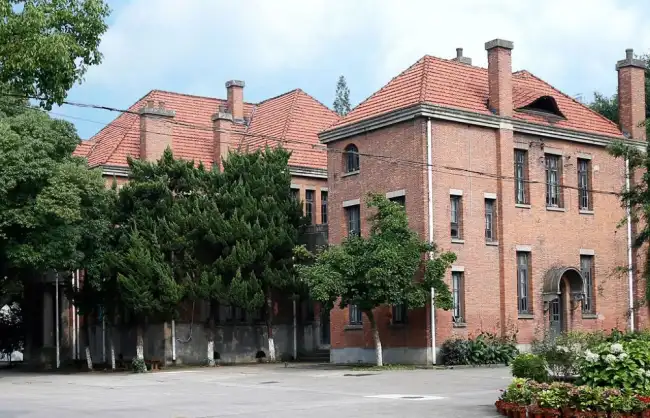
After the Sino-Japanese War, the Qing government signed the humiliating Treaty of Shimonoseki with the Japanese government in 1895. Suzhou was therefore forced to become a treaty port, and the following year the Japanese opened a Japanese concession in Qingyangdi, Suzhou.
The consulate covers an area of about 939 square meters and is a Western-style building with a mixed structure of brick and wood. The three villas, which consist of red tiles, spires and Roman columns, are well preserved. The east is a two-story small building, the middle house is a bungalow, and the west is a three-story building with a western-style fireplace. These three buildings form a “凹” shape. Today it is a place for tourists to take photos in Suzhou Silk Factory.
History of Suzhou No.1 Silk Factory
Located at No. 94 Nanmen Road, Suzhou, Suzhou No.1 Silk Factory—formerly Rui Feng Silk Factory—was established in 1926. Nationalized in 1949, it became China’s longest-running silk reeling enterprise, blending traditional manual techniques with early industrial innovation.
As technology advanced, the factory struggled to compete with its counterparts for its reliance on traditional methods, leading to declining profits and even its industrial buildings were becoming idle by the late 20th century. To revitalize the site, the Suzhou Cultural Investment Development Group renovated the factory in recent years.
They dedicated to preserve the factory’s heritage, while developing and adapting it for modern use. Today, Suzhou No.1 Silk Factory stands as a cultural-industrial landmark, bridging Suzhou’s silk legacy with contemporary vitality.
Learn about Culture & History of Silk
Visitors can learn about the millennia-old legacy of Chinese silk at the factory’s exhibition area. Discover how generations of Chinese people make silk thread into a fabric and then clothes that people can wear, and also see the development of textile technology in the past decades. Displays include vintage silk artifacts (such as imperial robe in Qing dynasty), traditional reeling tools, and historical photos documenting the factory’s role in China’s industrialization.
Pick Some Silk Items as Souvenirs
While exhibits at Suzhou No.1 Silk Factory are display-only, the factory’s on-site store still offers a curated selection of authentic silk items which are perfect for you to take home as a piece of Suzhou’s silk legacy.
From daily essentials to elegant gifts, the store provides high-quality silk products, such as lightweight, intricately patterned scarves to luxuriously soft 100% mulberry silk pajamas and bathrobes. With clear pricing, genuine quality, and even mailing services for international visitors, it’s the ideal spot to wrap up your silk journey in style.
How to Get to Suzhou Silk Factory
By bus: You can take the bus No. 70/513/94/27/308/933/101 from different stops to get to Suzhou Silk Factory.
By metro: First, you need to take line 4 to Renminqiao South Station, then exit the subway station at exit 2b. After that, you can walk around 600 meters to Suzhou Silk Factory.
Travel Time & Distance from Nearby Attractions
Attraction |
Distance from Factory |
Estimated Travel Time (by car) |
Humble Administrator’s Garden |
~8 km |
15–20 minutes |
Tiger Hill |
~11 km |
30–35 minutes |
Master of the Nets Garden |
~3.5 km |
15–20 minutes |
Suzhou Silk Museum |
~7 km |
20–25 minutes |
Attractions nearby Suzhou Silk Factory
- Humble Administrator’s Garden: Known as the mother of Chinese gardens, it is famous for its ingenious spatial layout, rich vegetation and exquisite architecture.
- Tiger Hill: It has a long history of more than 2500 years and is hailed as the No.1 attraction in Suzhou city. It is a must-see spot for Chinese history lovers.
- Zhouzhuang Water Town: It is renowned as China’s No.1 water town, featuring winding water lanes, quaint bridges and ancient buildings.