

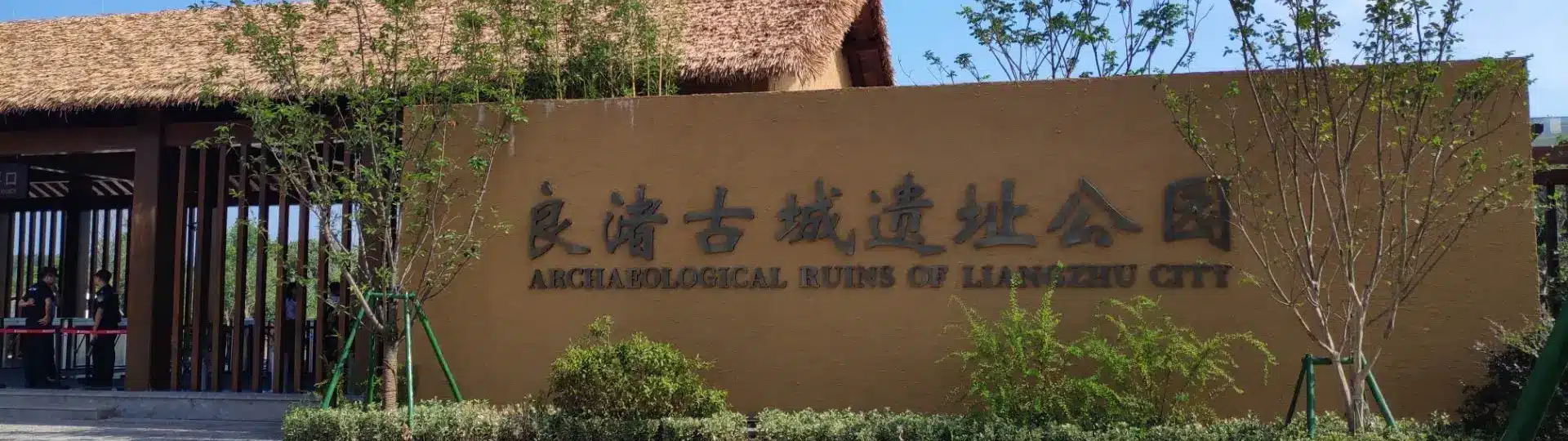
Nestled in the fertile plains of Hangzhou‘s Yuhang District, the Liangzhu ruins stand as the earliest known Neolithic urban center in the Yangtze River basin and China’s most ancient prehistoric capital before the discovery of Shimao. Visitors here can see the world’s oldest large-scale hydraulic engineering system, where sophisticated networks of dams and canals cutting through the landscape. Exploring the remains of quarters adorned with exquisite ritual jades, these physical traces of a 1,000-year continuous occupation (5300-4300 BP) reveal the culture’s progressive development.
What makes ruins of Liangzhu city truly extraordinary is how its water management system predates comparable Mesopotamian engineering by centuries, while the intricate symbolism of its jade artifacts – particularly the jade cong and bi discs – reflects the socioreligious hierarchy. The site’s carefully planned urban layout, with its distinct palace complex and residential zones surrounded by massive earthen walls, offers tangible evidence of China’s 5,000-year civilizational continuity that UNESCO recognized when inscribing it as a World Heritage Site in 2019.
Content Preview
- Fast Facts
- History of Liangzhu City
- Must-Visit Attractions in Archaeological Ruins of Liangzhu City
- Recommended Itinerary (1-Day Highlights)
- Nearby Liangzhu Culture Related Sites
- FAQs
- Transportation Guide
Fast Facts
- Chinese Name: 良渚古城遗址(Liáng zhǔ Gǔ chéng Yí zhǐ)
- Address: Pingyao Town, Yuhang District, Hangzhou, Zhejiang, China
- Entry Requirement: Ticket required. 80rmb/person.
- Opening Hours: 9:00一17:00
- Best Visit Time: All year round.
- Recomended Visiting Hours: 3-4 hours
History of Liangzhu City
Archaeological Excavations & World Heritage Journey
- 1936: First discovery by scholar Shi Xingeng
- 1986: Fanshan Cemetery’s jade treasures astound academia
- 2007: City walls confirmed, establishing urban scale
- 2015: Peripheral water system discovery rewrites global hydraulic history
- July 6, 2019: UNESCO World Heritage inscription
Why Liangzhu Qualifies as a “Civilization”?
Advanced Social Organization
- The construction of large-scale water management systems and city walls demonstrates sophisticated planning and labor mobilization capabilities
- Evidence of social hierarchy through differentiated burial practices
Remarkable Cultural Achievements
- Exquisite jade artifacts (especially cong and bi) showing masterful craftsmanship
- Early development of silk production and rice cultivation techniques
State-Level Society
- Archaeologists confirm Liangzhu had reached the “early state” phase
- Challenges traditional views on the origins of Chinese civilization
International Recognition
- UNESCO describes Liangzhu as “a center of power and belief”
- Officially recognized as proof of China’s 5000-year continuous civilization
Together, these elements establish Liangzhu not just as a significant Neolithic culture, but as one of humanity’s earliest civilizations, offering new perspectives on the dawn of Chinese history.
Cultural Timeline
Period |
Date (BCE) |
Key Features |
Early Period |
3300–3000 BCE |
Settlement formation, jade craftsmanship emergence |
Flourishing Period |
3000–2600 BCE |
City construction, water system completion |
Late Period |
2600–2300 BCE |
Gradual decline, possibly due to climate change or flooding. |
Must-Visit Attractions in Archaeological Ruins of Liangzhu City
Jade Artifacts: The Spiritual Core of Liangzhu
The jade artifacts of Liangzhu represent not only the pinnacle of Neolithic craftsmanship but also the spiritual foundation of early Chinese civilization. As the most significant cultural legacy, Liangzhu’s jade culture profoundly influenced contemporaneous and subsequent cultures, including the Longshan period, with its impact reaching across vast regions of ancient China. Among all pieces, three masterpieces stand out:
Jade Cong
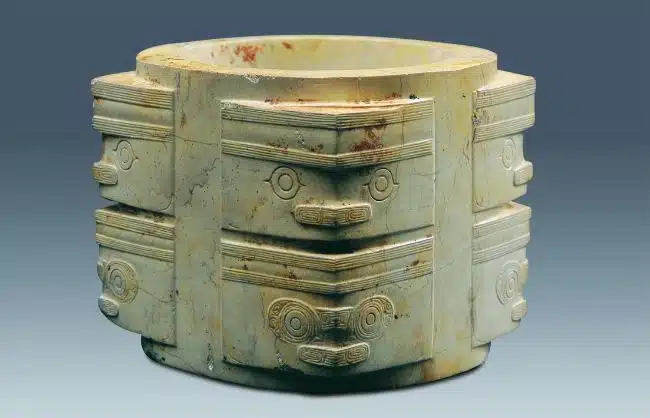
The Jade Cong stands as one of the most famous piece of Liangzhu jade artistry. The renowned “King of Cong” from Fanshan Tomb 12, weighing 6.5kg, showcases extraordinary carving techniques with its intricate deity-mask motif. These ritual cylinders, with their perfect symmetry and precise proportions, demonstrate remarkable technical sophistication that would influence Chinese jade craftsmanship for millennia.
Jade Yue & Bi
Equally important are the Jade Yue (ceremonial axes), symbols of military authority and power. Often inlaid with turquoise, these artifacts formed part of the core jade ritual system alongside cong and bi. Equally significant are the Jade Bi discs, some measuring up to 20cm in diameter, which served as astronomical instruments and objects of celestial worship.
Deity-Beast Motif
The Deity-and-Animal Motif, Liangzhu’s spiritual signature, appears consistently across jade artifacts. This intricate design, combining divine facial features with animal characteristics in a space as small as 3×4 cm, represents one of humanity’s earliest standardized religious iconographies. Its widespread use on various jade objects underscores the cultural unity across the Liangzhu sphere of influence.
Fanshan Mausoleum
This exclusive burial ground contains 11 tombs that display Liangzhu’s social stratification. The most opulent, Tomb M12, likely belonged to a Liangzhu ruler and contains funerary objects comprising over 90% jade artifacts. The presence of sacrificed human attendants offers poignant evidence of the culture’s complex spiritual beliefs and the absolute power wielded by its elite.
Mojiaoshan Palace Complex
The 300,000-square-meter artificial platform formed Liangzhu’s administrative and ceremonial center. Archaeologists have uncovered seven massive granaries that could store approximately 100 metric tons of rice – demonstrating experienced food management. The architectural layout, with its “court-behind-hall” design, remarkably foreshadows later Chinese imperial palace configurations.
Water Management System
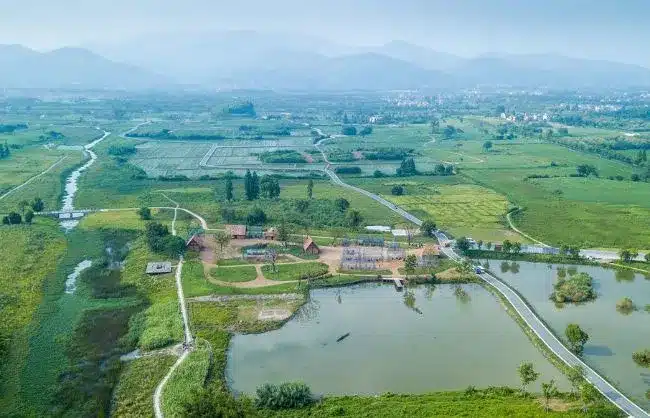
This groundbreaking network of 11 dams controlled a 100-square-kilometer watershed, providing comprehensive flood control, irrigation, and transportation capabilities. Remarkably, this system predates comparable Mesopotamian engineering by three centuries, establishing Liangzhu as a pioneer in large-scale water control technology.
Ancient City Walls
Stretching an impressive 6 kilometers around the city, these defensive walls feature a massive 40-60 meter wide base and were constructed using the innovative “grass-wrapped mud” ramming technique. The walls’ scale and durability testify to Liangzhu’s advanced construction capabilities and organizational power.

Recommended Itinerary (1-Day Highlights)
- Morning:
Liangzhu Museum (1.5 hours)
Mojiaoshan Platform (40 mins)
- Afternoon:
Fanshan Cemetery (1 hour)
City Wall Remains (30 mins)
Deer Park (20 mins)
- Tips:
Free electric shuttles included in ticket
Closed Mondays (except holidays)
Nearby Liangzhu Culture Related Sites
Liangzhu Culture Park
Located just minutes from the archaeological site, this modern cultural complex blends contemporary architecture with Neolithic heritage:
- Architectural Highlights: Features Tadao Ando’s Mesa Art Center with its signature geometric concrete design
- Cultural Spaces: Includes the award-winning Xiaoshugang Library and Liangzhu Art Center’s interactive exhibits
Liangzhu Culture Museum
The official museum offers unparalleled insights into Liangzhu civilization:
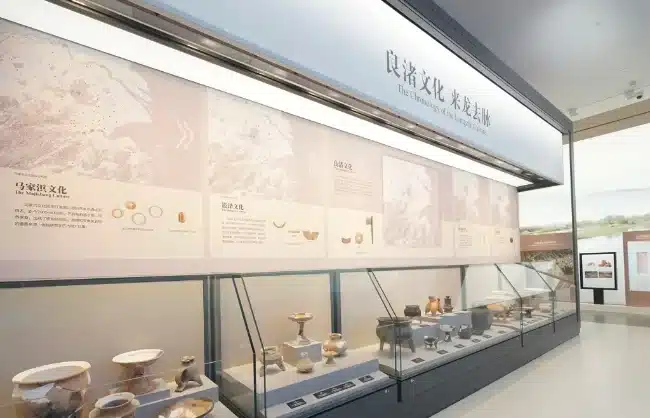
- Artifact Collection: Displays over 1,000 excavated objects including the famous “King of Cong” jade
- Immersive Exhibits: Features VR reconstructions of the ancient city at its peak
- Hands-on Activities: Regular jade-carving and pottery workshops using traditional methods
Visitor Tip: Allocate at least 2 hours to explore both sites thoroughly. The museum offers free English audio guides.
FAQs
Why is Liangzhu called “China’s Earliest City”?
- First urban planning evidence
- World’s earliest large-scale water management
- Developed social hierarchy
What makes Liangzhu jade unique?
- Nephrite sourced 200km away
- 1mm precision carvings
- Unified deity iconography
What lies at the center of Liangzhu?
The city’s center is marked by a large, organized urban structure, including a series of canals, monumental architecture, and ceremonial areas. The site reveals a complex society with evidence of social stratification, sophisticated engineering, and ritualistic practices.
What is the symbol of Liangzhu?
The symbol of the Liangzhu culture would be the Deity-and-Animal Motif, often seen on jade objects like cong and bi. This motif likely represented a deity or ancestral spirits, with large, stylized eyes and a symmetrical face.
What was the principal decoration on cong of the Liangzhu period?
The principal decoration on the cong (a square-tubed jade artifact) during the Liangzhu period was the Deity-and-Animal Motif—a highly stylized human or spirit face with large eyes, signifying the spiritual significance and ceremonial use of these items.
Transportation Guide
By Metro
Take Hangzhou Metro Line 2 to Liangzhu Station, then transfer to: Bus 430 or 1222 to Liangzhu Ancient City Ruins Park
By Bus
- Liangzhu Ancient City Ruins Park Station
1222 (to/from Liangzhu Metro Station)
313, 348, 428, 430, 437, 495B, 7437
- Fengdu Industrial Park Station
348 (to/from Wulinmen North)
495, 495B
Key Routes Summary
Bus No. |
Route |
Main Stops |
1222 |
Circular |
Liangzhu Ruins Park ↔ Liangzhu Metro Station |
430 |
North-South |
Liangzhu Metro Station ↔ Pingyao Bus Terminal |
348 |
Downtown |
Wulinmen North ↔ Pingyao |
495B |
Local |
Changming Jiayuan ↔ Shatangfan |


