





Already got the basic information and booked your Chinese high-speed train tickets? Great! This guide will walk you through exactly how to board and get off the train. Don’t worry if this is your first time using the train system in China. The general process is easier than you expected, since most stations have clear directional signs in both Chinese and English.
To ensure you a more stress-free boarding experience, we carefully prepared this detailed step-by-step guide on “how to take high-speed train in china ” for every international tourist who is embarking on a China train tour. Details about how to navigate the platforms and how to find your coach and seat are all included. Continue reading to see the detailed process.
Content Preview
- Preparation before Getting to the Train Station
- Step-by-Step Guide to Boarding Your China High-Speed Train
- How to Get Off the High-speed Train
- How to Transfer at the Arrival Station
- Essential Tips for Train Travel in China
- Common Expressions for Taking the Train
- FAQs about Taking a High-speed Train in China
- Plan a China train tour with China Xian Tour
Preparation before Getting to the Train Station
Check the Your Ticket Information
No matter you buy the ticket on 12306 China Railway or third-platforms like Ctrip, you can find the e-ticket in the order column. The ticket will show the Train Number, Departure Station, Arrival Station, Departure Time, Arrival Time, Coach Number, Seat Number and Boarding Gate.
The information will be displayed on the home page of 12306 China Railway app and the detail page of your ticket order. Besides, you can also find it on the screen in the train station and search on the machines in the waiting hall.
Note: Please double check your Departure Station to avoid getting to the wrong station. In many big cities, like Beijing, Shanghai, Xian, Chengdu, there are usually several train stations.

Documents Needed
Passport is a must for foreign passengers and no paper ticket is needed. Some stations may also check the e-ticket, you can get the screenshot of your ticket ready in advance.
Step-by-Step Guide to Boarding Your China High-Speed Train
Step 1: Arrive at the Right Station Early (30+ Minutes Before)
In China, most large cities have over 2 train stations, so going to the wrong station is the most common cause of missing a train. On your ticket, the full name of the departure station is clearly stated. Do check word for word carefully. For instance, in Beijing, Beijing South Train Station (北京南站) and Beijing West Train Station (北京西站) are both high-speed train stations, but they are quite far from each other.
To ensure you can catch up the train, leaving ample time is also essential. The ticket checking will stop 3 to 5 minutes before departure. But considering that you are not familiar with the station layout and process, it is better to arrive at least 30 minutes earlier. If you depart from large train stations like Beijing West, Shanghai Hongqiao, or travel during the peak season, there are usually long queues for luggage check and ticket check. It is thus essential to arrive at least 1-2 hours in advance.
Step 2: Identity Verification at the Entrance
As far as we know, different from the Chinese ID card, the majority of automatic fare gates at China’s high-speed train stations cannot scan foreign passports, so it is better to pass through the manual verification channel directly. The manual channel is right next to the automatic fare gates. Usually, there is a clerk in uniform standing nearby.
Note: if you hold a Foreign Permanent Resident ID Card and buy the ticket with it, you can scan the card at the automatic fare gate directly.
Step 3: Security and Luggage Check

After the identity verification, you will go through the security and luggage check. The process is similar to that in airport, but simpler. First, put all your luggage on the conveyor belt, including the backpack and handbag. Then pass the metal detector door. The inspector will use handheld metal detectors for quick scans. Finally, retrieve all your luggage at the end of the conveyor belt and check for any omissions.
Unlike the security check in airport, you do not need to take off your coat, belt and shoes or take out your laptop. Sometimes, the clerk may check the water cups and beverages separately. Don’t worry, it is a routine and the process is very fast.
Luggage Allowance and Prohibited Items
A frequently asked question is “Can i take luggage on bullet train?” The answer is yes, but its requirements are somewhat different from taking the plane. Generally, it is not that strict. According to the regulation, the luggage allowance for children and kids is 20 kg and 10 kg, respectively and the maximum dimension is 130 cm. Folding wheelchairs and baby carriages can be carried free of charge and are not counted into the allowance. And most daily cosmetics can be taken without a strict capacity limit.
The commonly prohibited items include restricted knives, firearms and ammunition, inflammable and explosive articles, corrosive and toxic substances, etc. What you need to specially note is the restricted daily products that have a specific limit. For example, the flammable daily items, like perfume, sprays, gels, should be less than 100 ml with only one piece permitted for each type. Hair dyes, hair styling mousses and hair sprays should be less than 150 ml and a total volume of no more than 600 ml. Also, one item per type is permitted.
Step 4: Find Your Waiting Room and Boarding Gate
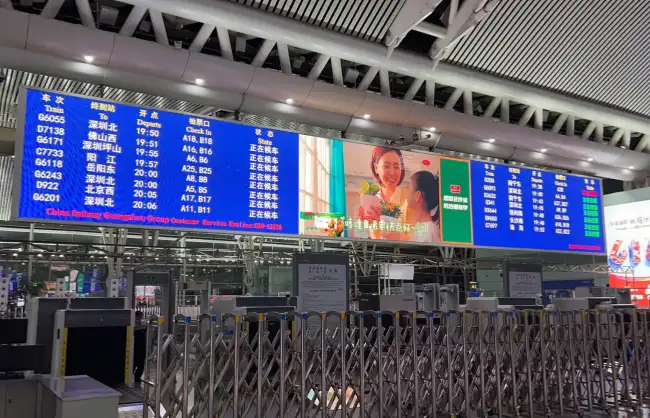
This is a critical step to take the correct train. After entering the waiting lounge, please look up for the huge LED display. All the information of the departing trains is displayed on the scrolling screen, including train No., departure time, terminal, waiting room, boarding gate, status, etc. Just find your train No. and check the waiting room and boarding gate displayed after it. Then follow the clear ground signs and overhead indicators to the correct place. Usually, this information is also displayed on the ticket purchasing apps.
* Tips: Many large high-speed train stations have two entrances, A and B, for each ticket gate, like 7A and 7B. It actually refers to the different areas of the same platform. Usually, the entrance A corresponds to the front half of the train carriages and entrance B corresponds to the rear half. You can choose the closer one based on the carriage number, which will save you a few steps to get on the train.
Step 5: Ticket Check and Reach the Platform
How to distinguish whether your train starts to check in or not if you are in a train station without an English screen? Through the color of the characters under the status column (basically the last column). If it is white, you still need to wait. When it turns green, you can check in. The ticket check process is the same as that in step 2, go to the manual verification channel and show your passport and e-ticket.
Then you will pass through a sky bridge or a tunnel to reach the platform.
Special note:
Sometimes, you may see two trains stop on the opposite sides of the same platform. Please note that, the two trains may be headed for different destinations. Be sure to check the overhead digital displays and the platform markers to confirm your train number before boarding.

Step 6: Find Your Carriage and Seat on the Train
Each carriage of the bullet train has an external electronic display showing the train No. and coach No. right next to the doors. Just find the correct one to board. The staff and indicators on the platform will also guide the passengers to their coaches. At the gate, the clerk may also check your passport.
Then enter the cabin to find your seat. Seat numbers are typically marked above the window or along the edge of the luggage racks. The seat number is composed of a digital number and a letter, such as “07A”. The digital number refers to the row and the letter refers to the exact seat on this row (window, center, or aisle).
About seat configuration:
The seat on each high-speed train in China is typically on a “3+2” or “2+2” configuration. “3+2” layout is common for second-class seats. There are five seats in one row with A, B, C on one side and D, F on the other side. A & F are the window seats, C & D are aisle seats, and B is the middle seat.
“2+2” layout is common for first-class and business class seats. There are four seats in one row with A, C on one side and D, F on the other side. A and F are window seats; C and D are aisle seats. So the above 07A is a window seat on the 7th row in the carriage. After finding your seat, put your luggage on the rack above your seat and enjoy your journey.
Tips: If you have a standing ticket, it is also okay to sit in any unoccupied seat. But please be prepared to move if the rightful owner arrives.
How to Get Off the High-speed Train
When the train is approaching your destination, the last step is to gathering your belongings and getting off the train. To avoid missing your stop, pay attention to the LED screen on both sides inside the carriage, where you will see the Chinese and English names of the next station. There is also on-board announcements provide arrival details in English. The following process is detailed below.
- Carry all your luggage and wait near the door of your carriage in advance before the train In this way, you can save time and avoid congestion when getting off.
- Then look for the green or white “Exit” sign (usually accompanied by arrows) on the platform, and follow the signs to the exit gate. Generally speaking, you can follow the crowds directly.
- At the exit gate, also, find the manual channel and show your passport one last time.
In most big cities, such as Beijing, Shanghai, etc., there are metro lines connected to high-speed railway stations directly. You can head to the metro stations according to the signs. Also, there are also signs lead you to the special area for taxis.

How to Transfer at the Arrival Station
If you need to transfer at the arrival station, there are usually three situations:
- The first one is you take the same train and just change the seat. In this case, just take your luggage and head to the right seat. You can move inside the carriage directly. There is an exception that carriage No. 8 and carriage No. 9 are not connected inside the vehicle, then you need to get off the carriage, walk to the correct carriage and get back on.
- The second situation is to transfer to another train at the same station. Nowadays, the train stations are usually equipped with dedicated in-station transfer passages for connecting trains. After getting off the train, find the green or blue “Transfer” sign (usually accompanied by arrows), which is generally at the entrance of the staircase, elevator or passage. The sign usually will guide you to the waiting hall. The following process is the same as the above step-by-step guide to board the train.
- The last case is to transfer to other train stations in the city. Just follow the above normal procedures to get off and exit the station and head to your next station.

Essential Tips for Train Travel in China
- Both the official website and app, 12306 China Railway, and the third platforms, like Ctrip, offer the ticket booking service. The official app also has an English version
- There are second-class seats, first-class seats and business-class seats for a high-speed train in China. The higher the seat class is, the better the facilities and service are. For instance, business-class seat passengers can enjoy free meals, priority boarding and a dedicated rest area at the station.
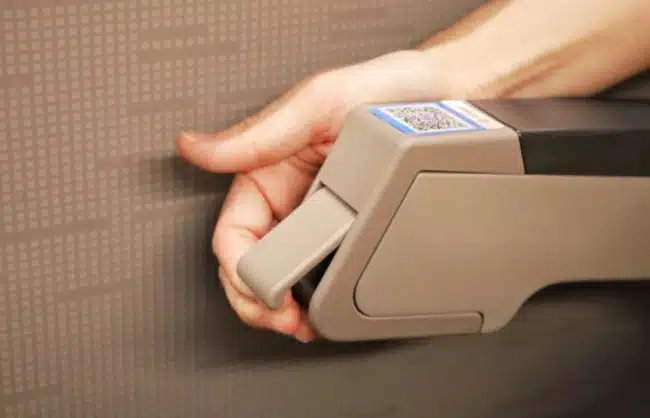
- Want to adjust the backrest? There is a small button below your armrest. Gently press and lean your body backward, the seat will slowly tilt.
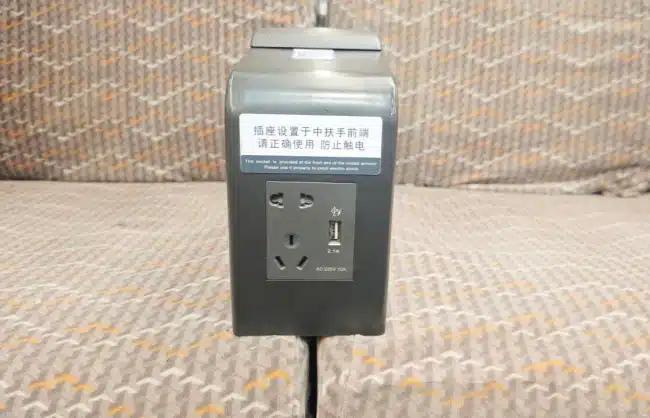
- All the carriages are equipped with power sockets. You can find it below the armrest of the seat or between the adjacent seats.
- The train usually serves boxed meals, snacks and drinks, you can order by scanning the QR code on the armrest or waiting for the food truck waiter to pass by. But the price is higher. So if you take a train for a long time, it is better to prepare some food for yourself.
- On both ends of the carriage, there is one watering place and one toilet.
Common Expressions for Taking the Train
In case you meet problems when taking the bullet train, we share some essential phrases to help you get the assistance you need. You can save a screenshot on your phone and show it to the clerk or person around you to ask for help.
Chinese |
English |
你好,我用护照乘车。 |
Hello, I’m traveling with a passport. |
请问,这个可以带吗? |
Excuse me, can I take this? |
请问,G123次列车在哪个候车室/检票口? |
Excuse me, which waiting room/boarding gate is for train G123 (change to your own Train No.)? |
你好,请问这是我的座位吗? |
Hello, is this my seat? (You can point to your ticket/phone) |
请问,便捷换乘通道怎么走? |
Excuse me, how do I get to the transfer channel? |
我需要改签/退票。 |
I need to change/refund my ticket. |
请问,出口 / 地铁 / 出租车在哪里? |
Excuse me, where is the exit/subway/taxi stand? |
FAQs about Taking a High-speed Train in China
Is there any difference between boarding the high-speed train and regular train?
If you have understood the process of how to take a high-speed train in China, then you already know how to take a regular train. The procedures are basically the same. The only difference is that the seat number of a regular train is only composed of digital numbers, such as 001.
How to use the 12306 app for boarding and gate info?
After opening the app, click “order” in the middle of the bottom column to find your own ticket and search for the information you need.
Plan a China train tour with China Xian Tour
After reading the above guide about how to take a high-speed train in China, you must be better prepared for a China tour by train. For a more hassle-free trip, please contact China Xian Tour for a guided tour with all the travel logistics handled. With over 20 years of experience, we are experts to customize personalized trips for different travel styles and preferences. Also, we have over 1,000 preset itineraries which are expertly crafted to guarantee you the most classic and authentic experiences.