

Sanxingdui Museum, opened in 1997, with the expansive grounds covering 1,000 mu (165 acres) of meticulously maintained landscape, the museum showcases relics of the mysterious Sanxingdui civilization that thrived over 3,000-5,000 years ago, including an extraordinary collection of bronze, gold, jade, and ivory artifacts, many featuring unique artistic styles unlike anything else in Chinese history.
Recognized as a key archaeological discovery of the 20th century, the Sanxingdui ruin offers visitors a glimpse into a lost culture and reveals a previously unknown chapter of civilization—one that challenges the old belief that Chinese culture originated solely in the Yellow River basin. With Sanxingdui artifacts captivating more and more audiences worldwide through international exhibitions, the museum has now become a must-visit destination for history enthusiasts and travelers from all over the world.
Fast Facts about Sanxingdui Museum
- Chinese Name: 三星堆博物馆
- Location: No.133, Xian Road, Guanghan, Deyang, Sichuan
- Entry Requirement: Booking could be made up to five days in advance. 72rmb (main exhibition hall), 80rmb (including the new Cultural Relics Restoration Hall)
- Opening Hours: Exhibition Hall: 08:30–18:00 (Last entry at 17:00). Restoration Hall: 09:00–17:00
- Closure Notice: The museum will close annually on Chinese New Year’s Eve. Regular opening is maintained throughout the year unless otherwise announced for special circumstances.
- Extended Hours: Opening hours will be extended during peak seasons (8:30AM–8:00PM, with last entry at 6:00PM). For accurate information, please check the museum’s official website.
- Best Seasons: All year round
- Recommended Visiting Time: 2-3 hours
History & Mysteries of Sanxingdui Civilization
Sanxingdui’s name (Three-Star Mounds) is said to originate from a nearby village called Sanxingcun (Three-Star Village), which in turn was named after three distinctive small earthen mounds in that region. The triangular shape of these mounds is remarkably similar to three stars in the sky.
Sanxingdui ruin is an archaeological marvel which fundamentally challenged our understanding of early Chinese civilization and academic views that the ancient Ba-Shu region was an isolated backwater. Instead, it was likely to be an advanced society with connections to Central Plains civilizations. Recent excavations in six newly discovered pits have unearthed more relics that strongly suggest the Yangtze River region was home to a civilization as sophisticated as Yellow River, potentially corresponding to the ancient Shu Kingdom mentioned in historical sources.
Timeline & Discovery:
- 1929: A farmer accidentally discovers jade relics while digging a ditch.
- 1934: Initial small-scale excavations begin.
- 1986: Major excavations reveal Pit 1 and Pit 2, containing 1,000+ artifacts, including the famous bronze masks and sacred trees.
- 2020–2023: Six new sacrificial pits are discovered, yielding gold masks, bronze sculptures, and ivory carvings.
Theories on Its Origins:
- Connection to the Ancient Shu Kingdom: Some scholars believe Sanxingdui was the heart of the legendary Shu Kingdom mentioned in ancient texts.
- Independent Bronze Age Culture: Its distinctive artistic style suggests it developed separately from the Yellow River civilizations (e.g., Shang Dynasty).
- Possible Links to Neighboring Cultures: Similarities with Jinsha(Chengdu) and Liangzhu (Hangzhou) hint at trade or cultural exchange.
Mysteries of Sanxingdui:
Despite decades of research, Sanxingdui remains one of archaeology’s greatest enigmas. Key unsolved questions include:
Why Did It Suddenly Disappear?
Around 1200 BCE, the civilization vanished without clear evidence of war or natural disaster. Some speculate climate change, political collapse, or migration led to its decline.
What Was the Purpose of Its Artifacts?
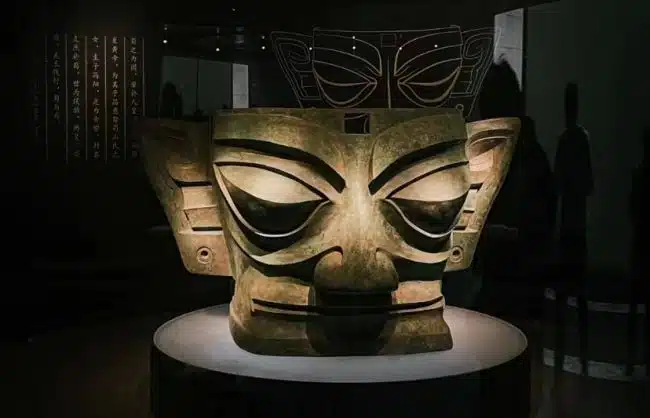
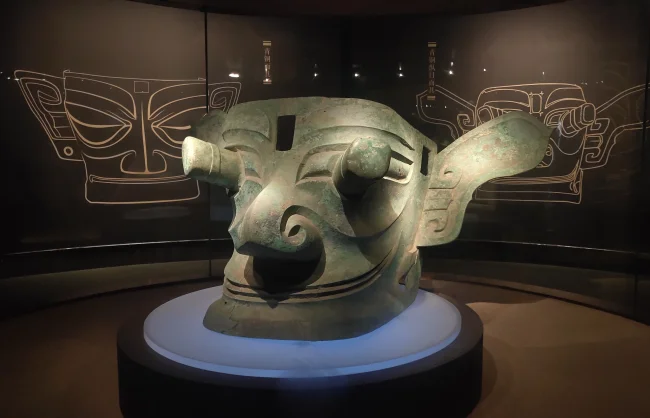
The bronze masks with bulging eyes and oversized ears may represent gods, ancestors—but their exact meaning is unknown. The Bronze Sacred Tree (4m tall) could symbolize a cosmic axis or mythological world tree.
Why Are There No Written Records?
Unlike the Shang Dynasty (which had oracle bones), Sanxingdui left no written language, forcing historians to interpret its culture purely through artifacts.
Was It Connected to Other Civilizations?
Some artifacts resemble those from ancient Mesopotamia and Southeast Asia, raising questions about long-distance trade or cultural influence.

What to See in Sanxingdui Museum
As one of the top museums in Chengdu, Sanxingdui has different halls of permanent exhibitions where visitors can view many representative Sanxingdui relics – bronze sculptures to delicate gold masks – that reveal a sophisticated culture with unique artistic traditions. Here are some of the must-see artifacts you cannot miss.
Comprehensive Exhibition Hall |
Bronze Exhibition Hall |
Gold Scepter |
Bronze Standing Figure |
Bronze Head with Gold Foil |
Giant Bronze Mask |
Jade Zhang |
Bronze Sacred Tree |
Comprehensive Exhibition Hall
The Comprehensive Hall offers a chronological journey through Sanxingdui’s archaeological wonders across four immersive galleries. Visitors begin with “Echoes of the Ancient Kingdom,” exploring early settlement artifacts, then progress to “Spiritual Beliefs” showcasing ritual objects. The “Mysterious Bronze Art” section reveals preliminary metalwork, while “Cultural Exchange” demonstrates connections with contemporaneous civilizations. This hall’s thoughtful curation, blending physical artifacts with augmented reality displays, provides essential context before viewing the bronze masterpieces.
Gold scepter
Discovered in Pit 1, this 1.42-meter hammered gold staff features exquisite fish and bird engravings that may represent royal insignia or divine communication symbols. It’s the largest surviving gold artifact of its period in China, was crafted by hammering gold into sheets wrapped around a wooden staff (since carbonized).
Bronze Head with Gold Foil
This life-sized bronze head features a distinctive braided hairstyle and a perfectly fitted gold mask with openwork eyes, embodying both advanced craftsmanship and divine authority. The luminous gold overlay (85% purity) and solemn facial expression suggest it represented sacred figures in ritual ceremonies.
Jade Zhang
This exceptional jade blade from Pit 2, considered the finest of Sanxingdui’s ritual objects, features intricate carvings depicting sacred mountain worship ceremonies. The symmetrical scenes show worshippers in ceremonial dress flanking symbolic mountains with inserted zhang blades, conclusively demonstrating its use in southern-facing earth rituals.
Bronze Exhibition Hall
This awe-inspiring hall presents Sanxingdui’s most celebrated bronze creations. The hall’s innovative lighting design accentuates the monumental Standing Bronze Figure at its center, surrounded by an impressive array of Giant Bronze Masks along the walls. A dedicated chamber houses the magnificent Bronze Sacred Tree, where projected animations bring its mythological significance to life. Interactive kiosks detail the advanced lost-wax casting techniques used in these 3,000-year-old masterpieces.
Bronze Standing Figure
This 1.8-meter tall statue wears an ornate three-layered robe adorned with intricate dragon and bird motifs, its hands clasped in a ritual pose. Standing barefoot on a mythical beast pedestal.
Giant Bronze Mask with Protruding Eyes
This monumental 1.38-meter mask astonishes with 16cm cylindrical eye protrusions and dramatically extended ears, embodying an “all-seeing” divine presence. Its precisely angled sockets (17°) and mysterious smiling lips with exposed tongue suggest a supernatural mediator between earthly and spiritual realms.
Bronze Sacred Tree
The 3.96-meter Bronze Sacred Tree, China’s tallest ancient bronze artifact, features nine tiers of sunbirds and a coiling dragon above a cosmic mountain base. This masterpiece likely served as a ritual “world tree” connecting heaven and earth in Shu cosmology.
How to Visit Sanxingdui Museum?
For the best experience, start at the Comprehensive Exhibition Hall to understand Sanxingdui’s historical context, then proceed to the Bronze Exhibition Hall to admire its iconic artifacts. Allow 2-3 hours total, with optional visits to the Conservation Hall to see ongoing archaeological work.
How to Get to Sanxingdui Museum? (From Chengdu)
- By train: Take a 20-min high-speed rail to Guanghan North Station (¥18), then a 10-min taxi (¥15-20)
- By bus: Direct shuttle buses depart from Chengdu’s Xinnanmen Station (¥15, 1-hour ride)
- By car: 40-min drive via Chengdu-Guanghan Expressway (toll: ¥25)
Nearby Attractions
- Jinsha Site Museum(20km): Chengdu’s counterpart to Sanxingdui, showcasing later Shu Kingdom relics
- Panda Base(50km): Visit in the morning to see active giant pandas
- Dujiangyan Irrigation System (80km): UNESCO-listed 2,300-year-old hydraulic engineering marvel


