

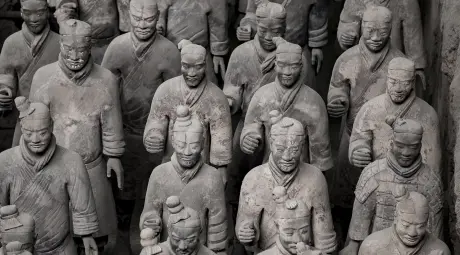


Shanxi Province of China has a heritage listed by UNESCO named “One City and Two Temples.” The city refers to Pingyao Ancient City, and the temples refer to Shuanglin Temple and Zhenguo Temple. Many visitors travel to Pingyao while in Shanxi but might have neglected the two ancient temples. So Shuanglin Temple is generally still left untouched by tourists and can assure you a pleasant travel experience.
Shuanglin Temple, or formerly known as Zhongdu Temple, is one of the best-preserved ancient Buddhist temples in China, with a history of over 1,450 years. It is most renowned for its collection of over 2,000 colorful painted sculptures from Song, Yuan, Ming, and Qing Dynasties. It has the reputation of being the “Oriental Treasure House of Painted Sculptures.”
Fast Facts about Shuanglin Temple
- Location: Qiaotou Village, about 6 km (3.7 miles) southwest of Pingyao Ancient City and 100 km (62 miles) from Taiyuan
- Hours: 8 am – 6 pm
- Tickets: CNY 33
- Recommended Visit Time: 1-2 hours
- Best Time to Visit: all year round, especially summer and fall
- Suited to: those interested in Buddhist culture, art, sculpture, and history
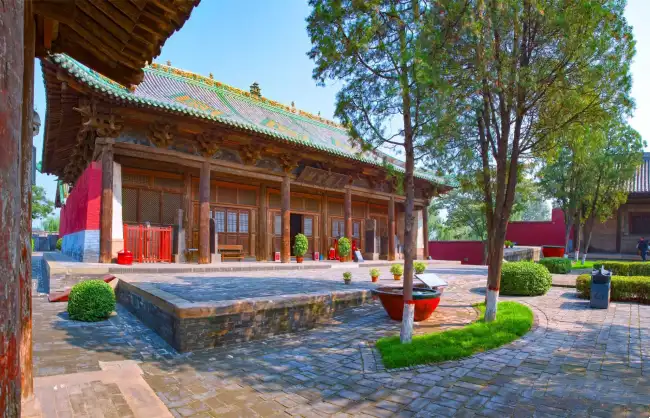
Highlights of Shuanglin Temple
Hall of Heavenly Kings
The Hall of Heavenly Kings is the first structure you’ll encounter entering Shuanglin Temple. On the veranda outside, you’ll see painted statues of the four protectors of the temple, standing at about 3 meters (9.8 feet) tall. It is said that they examine everyone that steps into the temple ground. Their size and expressions are intimidating and awe-inspiring.
Inside the hall, a magnificent sculpture of Maitreya Buddha sits in the center, looking solemn and dignified. On the sides are four Heavenly Kings and eight Bodhisattvas. Each of the Heavenly Kings holds a sword, pipa, umbrella, snake, symbolizing their heavenly power to manipulate nature.
Hall of the Arhats
The Arhats’ Hall houses the oldest set of sculptures of Shuanglin Temple, the central statue of Guanyin and the 18 arhats, with a history of almost 1,000 years. The 18 arhats are made after the common folks, each with unique facial expressions and gestures. It’s clear to see the artists’ skill and imagination behind these statues.
Sakyamuni Hall
Sakyamuni Hall is another one of the main halls of Shuanglin Temple, devoted to Sakyamuni. On his sides are Manjushri, the Bodhisattva of wisdom, and Samantabhadra (the Universal Worthy Bodhisattva). Around the hall, a series of sculpted art depicts the narrative of Sakyamuni’s life. 48 individual stories are presented like 3-dimensional comics. It’s an amazing art form in itself.
Hall of One Thousand Buddhas
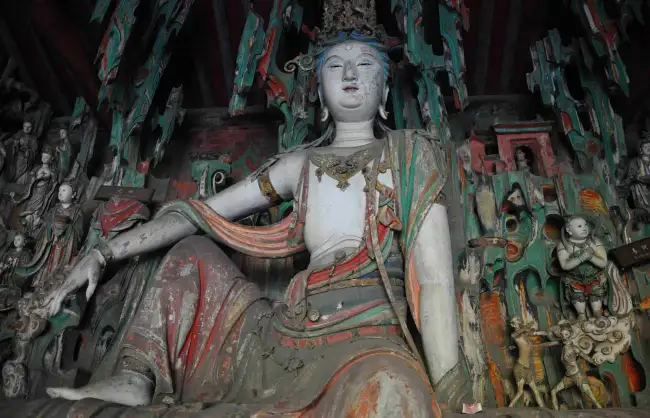
Like its name suggests, this hall houses a large number of sculptures, over 500 different ones, including two of the most famous of Shuanglin Temple. One of them is the sitting Avalokitesvara. She sits with her right foot up. Her expression and posture appear so natural, like an actual woman from Ming Dynasty.
The other famous sculpture is a Wei Tuo (a protector of Buddhas). He is even named the best of all Wei Tuos in China. His body is curved to show off his shape and might, while his eyes and expression appear astute and wise. His armor is also crafted and colored in great detail. Seeing Wei Tuo will definitely be a highlight of your Pingyao tour.
Related reading: Top 13 Temples and Monasteries in China
How to Get to Shuanglin Temple
By Flight: Pingyao does not have an airport, so if you need to travel to Shanxi, fly into Taiyuan Wusu International Airport. Then take a train to Pingyao.
By Train: Take a train to Pingyao Railway Station or Pingyao Ancient City Railway Station.
By Bus: Bus No. 108 will take you to Shuanglin Temple from main stops including Pingyao Bus Station, North Gate of Pingyao Ancient City, Pingyao Railway Station, and Pingyao Ancient City Railway Station.
By Taxi: You might also take a taxi from pretty much anywhere in Pingyao.
Attractions Nearby Shuanglin Temple
- Pingyao Ancient Cityis a well-preserved ancient city with architecture and history of Ming and Qing Dynasties.
- Zhenguo Templeis a UNESCO World Heritage Site with some of the oldest wooden buildings and sculptures in China. Its history dates all the way back to the 10th century.
- Qiao’s Family Compoundis a Qing Dynasty courtyard house with exquisite carvings, historical relics, cultural exhibitions.
- Wang’s Family Compoundis a well-preserved Qing Dynasty courtyard house. It is one of the largest and most classic residential complexes in Shanxi province.


