



Empress Wu Zetian, the only one female monarch in Chinese history. She reigned the country as an imperator in the Tang dynasty for 15 years. If taken into account the actual time when she manipulated the government, it’s almost 50 years. The Empress Wu Zetian influenced the whole history of the Tang dynasty.
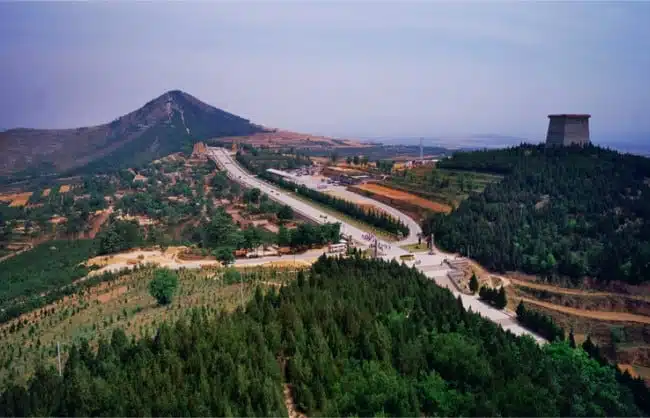
In 705 AD, she died of disease and was buried in Qianling Mausoleum in Qianxian County nearby Xian. The most impressive of her mausoleum is the Wordless Tomb Stele, the reason of no words has been a controversial topic till now. Nowadays, Qianling Mausoleum has become one of the hot attractions for Xian trip.
Content Preview
- Why Wu Zetian Still Fascinates Us
- The Enigma of the Wordless Stele
- Why No Words? The Enduring Theories
- Practical Tips for Visiting Wu Zetian’s Wordless Stele
- FAQs about Wuzetian and Her Wordless Tomb Stele
- Explore Empress Wu Zetian’s Wordless Stele with China Xian Tour

Why Wu Zetian Still Fascinates Us
During the long history of ancient China, Wu Zetian is the only one female emperor, which indicates the breakthrough of gender barriers. Her rise to power, innovative policies, controversial image has captivate not only Chinese, but also people all over the world.
From Concubine to Emperor
At 14, Wu Zetian was chosen as a concubine of Emperor Taizong, but was not favored. After the emperor died, she was forced to become a nun. Because of Emperor Gaozong, she returned to the palace. And thanks to her political wisdom and strategies, she became the empress finally in 655 through year of struggle.
In the later years of life, Emperor Gaozong was in weak health, so Wu Zetian took part in and played an important role in decision-making of national matters and polices. During this time, she took the actual control of the government. After the Emperor Gaozong died, she dethroned her sons and ruled as Empress Dowager.
In 690, she declared herself as Emperor, meanwhile change the country’s name to “Zhou”.
A Reign of Achievement and Controversy
In the reign of Wu Zetian, in aspects of achievements of politics, she reformed the imperial examination system, promoted talents from poor families and broke the monopoly of the nobility. In economy, professional document was issued to guide agricultural production and the population increased from 3.8 million to 6.15 million. In culture, she promoted Buddhism and supported the development of culture.
However, her ways to consolidate the power was too cruel that caused controversies. She appointed cruel officials, suppressed the royal family of Li and even sacrificed her own kids. In the last decades, she also lived a luxurious life and built extravagant structures.
The Enigma of the Wordless Stele
The gravestone is quite tall and spectacular with a height of 7.53 meters, width of 2.1 meters, and thickness of 1.49 meters. Carved from a single piece of large limestone, its total weight is about 98.8 tons.
Since there is even no one word on the gravestone, the Wordless Stele has been the one of the most unique gravestones in China and even in the world, especially when compared with the Shushengji Stele on the opposite of it. This stele consists of over 5,600 characters filled with gold powder, mainly praising government achievements of Emperor Gaozong.
Why No Words? The Enduring Theories
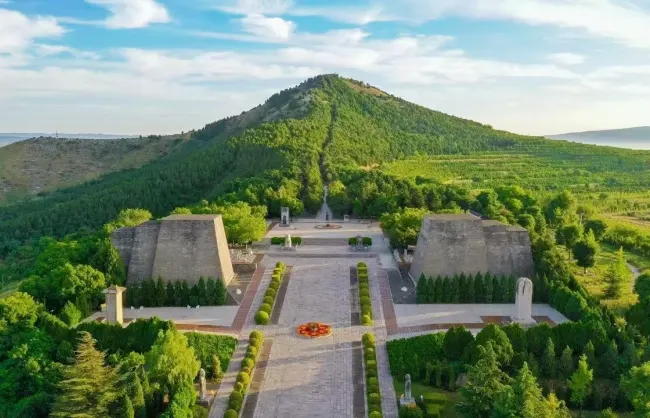
Over the past thousands years, Qianling was split by the swords in the Cold Weapon Era, and was bombarded by machine guns and heavy shelling in the Hot Weapon Era. In the past 1200 years, the tomb robbers are endless, and the largest population of stealing are up to 400,000. Mountain Liang where the mausoleum locates was nearly destroyed in half. However, Qianling remained intact. It is the most complete and well-preserved imperial tomb in China with the richest cultural relics and without being stolen. In front of her grave, there’s a stone monument erected by Wu Zetian when she’s alive. It’s an enigma as no inscriptions were cut on that tablet, which is called “Wordless Stone Stele”. There are mainly four kinds of explanation about why Wu Zetian erected this Wordless Stone Stele for herself.
Show Off Her Achievements
The first version: The reason why Wu Zetian left this Tablet is to show off her achievements, and in her view, what she did can not be fully expressed on such a tablet. Though as a woman, she believed that her talent and ability are much higher than her husband, Emperor Gao Zong. It is truth that Wu Zetian made great contribution, such as assisting the poor and weak, striking the bureaucracy, developing the imperial examination. People live and work in peace and contentment during her reign. Besides, there were scarce rebellions at that time, which few emperors could make it, and yet she was just a female emperor. Therefore, Wu Zetian left an empty tablet to mark her indescribable accomplishment.
No Such Etiquette and Rite
The second version: Wu Zetian once believed in Taoism, so she killed many Confucian scholars in order to maintain the rule of Taoism and prevent Confucianism from taking her stage. She was aware that the history was recorded by Confucians. In order not to let the Confucian wantonly revenge and smear herself, she just erected a wordless tablet to eradicate the Confucian attempts. In addition, Emperor Zhong Zong (Son of Gao Zong) inherited the throne when Wu Zetian died, he could neither name Wu as the Last Emperor, because his father was also the emperor. He could nor name Wu as Queen Mother, because she was an empress as well. For the Tang dynasty, the era “Wu Zhou” established by Wu Zetian was more than a great humiliation. For the sake of etiquette and rite, there was no inscription on the tablet of Wu Zetian.
To Forget Her Tyranny
The third version: The sin of Wu Zetian is heinous. She understoon what she had done went against tradition and knew it was better to not write any words on her tablet. Despite the great contributions, she was meantime a cruel female monarch. To suppress those who were against her, she appointed a few merciless persons to be punished severely. Many innocent people got killed in her hands. This female emperor’s private life is also very messy, but she was never ashamed of that.
Buddhism Philosophy
The fourth version: Wu Zetian believed in Buddhism in her later years. As Buddhism disseminated, life and death are trifles, and there’s no right or wrong in one’s life. Hence she left the Wordless Stone Stele.
Wu Zetian, the first and only female ruler in the history of China, who breached the restriction of man’s superior to woman, broke the shackle of the feudal age, and rose to the throne of the emperor on her own. She was overweening in her live days, and left nothing on her monument when she died. Isn’t it intriguing and enigmatic?
Practical Tips for Visiting Wu Zetian’s Wordless Stele
How to get there?
- From Xian downtown:
- Metro + High-speed train + Taxi: First, take metro line 2 o 4 to Xi’an North Railway Station, then take a high-speed train to Qianxian Station with a duration of about 30 minutes and ticket price of CNY 24 – 26. After arrival, go to the scenic area by taxi directly, which takes about 15 minutes and CNY 15.
- Intercity Bus + Taxi: Xian West Passenger Station provides intercity bus to Qianxian County, the bus takes about 2 hours and CNY 22 – 27 per person. After getting there, take a taxi to the Qianling Mausoleum directly, which will take about 10 minutes and CNY 10 in total.
- From Xian Airport:
- Metro + High-speed train + Taxi (recommended): Take metro line 14 from airport to Xi’an North Railway Station, and then get to Qianxian Station by high-speed train. After arrival, take a taxi to the destination.
- Airport Bus + Intercity Bus + Taxi: First, go to the Xian West Passenger Station by airport bus Bell Tower West Line. This route takes about 40 minutes and CNY 25. Then take the intercity bus to Qianxian County and transfer to a taxi to the scenic area.
Qianling Mausoleum at a Glance
- Opening hours:
Peak Season (March 1st – November 30th ): 08:00 – 18:00 (The latest time to enter is 17:00)
Off Season (December 1st – end of February): 08:30 – 17:30 (The latest time to enter is 16:30)
- ticket price: CNY 100 for peak season and 80 for off season.
- recommended visiting duration: The basic travel route including the main mausoleum and 1 -2 subordinate tombs will take about 2 – 3 hours. If you have sufficient time and plan to tour the main mausoleum, all the subordinate tombs and the museum, it will take about 4 – 5 hours.
Other Essential Travel Tips
- Best timeto visit: April – June & September – October: During this period of time, the climate is pleasant and you can avoid the high temperatures of summer vacation and the severe cold of winter vacation. In spring, the peony garden is in full bloom; while in autumn, the forests on Liangshan Mountain are looked dyed. But it is also advised to avoid the May Day and National Day holiday.
- The distance between the scenic spots are a little bit far, so wearing a pair of flat shoes and preparing enough water is essential.
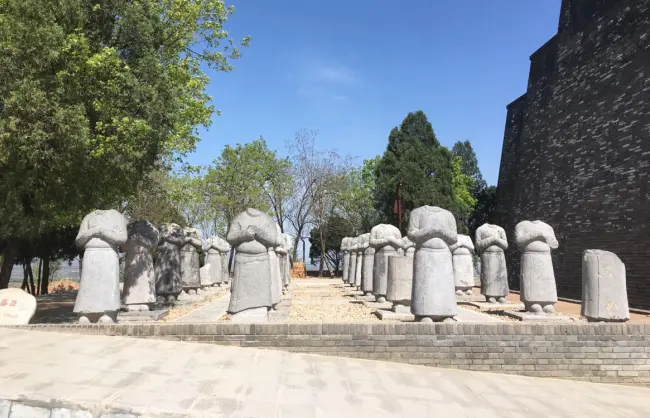
- Entering from north entrance will arrive at the stone carving group directly, which will save about 30 minutes compared with entering from south entrance.
FAQs about Wuzetian and Her Wordless Tomb Stele
How does the Wordless Stele compare to the one for her husband, Emperor Gaozong?
Though only about 100 meters away from each other, the two tombs are quite different. The Shushengji Stele for Emperor Gaozong was set by Wu Zetian to praise his political and military achievements with over 5,600 characters. It is a traditional imperial monument representing the virtues and deeds of emperors. Made of seven interlocking sections, it is also called “Seven-Section Stele”.
While, the Wordless Stele for Wu Zetian is the only monument for the only female emperor in Chinese history. It represents a breakthrough of tradition, power, gender and historical evaluation. The stele is carved from an entire giant stone and is larger than the Shushengji Stele.
What is the significance of the stele’s size and the material it’s made from?
The wordless stele is taller and heavier than the Shushengji Stele. It might have been intentional to highlight the uniqueness and authority of Wu Zetian as the only female emperor in history. The stele is carved from a single stone, demonstrating the national strength during her reign.
Are there any other “wordless” steles in Chinese history, or is hers the only one?
The wordless stele is not unique to Wu Zetian, but a distinctive cultural phenomenon in Chinese history. And the reasons for wordlessness are various, including the difficulty of evaluating merits and demerits, inconsistent praise and criticism, political struggles, or even historical accidents. Other famous wordless steles are at the tombs of the renowned Eastern Jin minister Xie An and Southern Song official Qin Hui.
Does the stele make Wu Zetian’s tomb more popular with tourists?
Yes, the Wordless Stele is the most attractive and talked-about symbol of the tomb. Almost every tourist will stop for a visit and debate about her achievements and faults, which enhances the travel experience. And its strong contrast to the nearby Shushengji Stele also forms an unparalleled cultural symbol.
Explore Empress Wu Zetian’s Wordless Stele with China Xian Tour
If you are interested in exploring the Empress Wu Zetian’s Wordless Stele, our travel agency is pleased to offer help in planing a trip or arranging a tour guide at any time. Our knowledgeable guide will introduce the legendary life of Wu Zetian and stories about the Wordless Stele in detail during the tour. So just contact with China Xian Tour to plan your tour.