



10 Days Ethnic Yunnan Tour to Kunming Chuxiong Dali Lijiang
Tour Overview
Yunnan is a prefecture of 25 officially acknowledged ethnic groups. Consequently, it is one of the most diverse regions in China from a cultural point of view. The 10 days tour is a well-planned Yunnan Ethnic Minority Tour that combines the different cultures of the minorities, the dramatic landscapes, and the historical trade routes into one immersive experience.
In the first place, you will be able to spot the Yi customs in Kunming and the outlandish Stone Forest. After that, pass through Yuanmou’s Earth Forest and Chuxiong’s Yi heartland to meet the villagers up close and personal. In Dali and Shaxi, experience Bai culture and trace Tea-Horse Road heritage. Finally, Lijiang will be the last destination of the trip, where you will get to know Naxi traditions, Dongba pictograms, and will be mesmerized by stunning white snow mountain views.
Travel destinations: Kunming, Yuanmou, Chuxiong, Dali, Lijiang
Suitable for: Culture Lovers, Leisure Travelers
Tour type: Private
Highlights of this tour:
- Learn about ethnic diversity through in-depth visits to Yi, Bai, Hui, and Naxi houses, villages, temples.
- Be amazed by some natural landscapes, from the UNESCO-listed Stone Forest and Yuanmou Earth Forest to Erhai Lake and Jade Dragon Snow Mountain views.
- Walk the old Tea-Horse Road in Shaxi and Lijiang. Also, chill out and enjoy a slower pace of life.
- Try some fun stuff like a Bai Three-Course Tea, tie-dye, Dongba writing, and museums where you can learn about Yunnan’s awesome ethnic culture.
Day-by-day Itinerary
- Day 1: Kuming Arrival
Welcome to Kunming, the capital city of Yunnan Province. Upon arrival, the driver will pick you up at the airport or high-speed railway station exit and take you to the hotel in the city center for check-in. For the rest of the time, you can either have a good rest in your comfortable bed or explore the city by yourself.
It is recommended to take a stroll around Dianchi Lake or visit the Yunnan Nationalities Village, which is a window showing the cultural customs of the 26 ethnic groups in Yunnan.

Yunnan Nationalities Village - Day 2: Kunming's Must-seesYi Ethnic Village & Stone Forest Exploration
Your guided Kunming trip officially begins after breakfast. The Stone Forest is the biggest highlight today. On the way there, we will stop at an Yi ethnic village (the sixth largest ethnic minority in China) to learn about the customs of this ethnic group. After driving for another few dozen minutes, you will arrive at the Stone Forest Scenic Area.
The ecological zone is rather widely distributed with Great and Lesser Stone Forests being the focal point. The topography includes not only stone forests but also lakes, hidden valleys and waterfalls. One of the main features of the Great Stone Forest is that it is made up of thickly set stone peaks. These peaks are all differently shaped and the color is a bit lighter grayish-blue. Among them, the tallest independent rock pillar rises more than 40 meters above the ground.
The Small Stone Forest is situated in the northeast of the Great Stone Forest. The most popular stone here is the Ashima Stone. Ashima is a young girl from the myths and legends of the Sani people who is not afraid of power or money. Besides, one should not miss the "Tang Seng's Journey to the West". The stone peak has a height of about 3 meters. Its impressive monk's hat and meditative position are very much like that of Tang Seng (the protagonist of the famous Chinese novel Journey to the West).
After the visit, we drive back to the urban area of Kunming. Later in the afternoon, if you are interested, you can go to Cuihu Park on your own to take a look at the daily life of the local people.
Note: You have to walk a long way in Stone Forest. Remember to wear a pair of comfortable shoes.
Kunming Stone Forest - Day 3: Kunming to YuanmouTake Amazing Photos of Earth Forest
After breakfast, it takes about three hours to drive from Kunming to Yuanmou County. After arriving, we'll have lunch first. In the afternoon, you are going to visit the Earth Forest.
As one of the "Three Forests of Yunnan", it is a paradise for photography enthusiasts. Many famous Chinese films have shot scenes here. The scenic area is filled with towering earth pillars of all shapes and sizes, some resembling cones and swords. Some are like imposing warriors; Some are like graceful young girls; Some earthen columns are overgrown with weeds, and occasionally wildflowers grow on them... The quartz, agate and other substances mixed in the soil pillar reflect strange luster under the sunlight. Check into a hotel in Yuanmou County after the visit.
Earth Forest in Yuanmou - Day 4: Yuanmou to ChuxiongThree Pools Waterfall & Conversation with Yi Ethnic People
In the morning, it takes two hours to drive to Dayao. Here, you will be taken to visit the ancient town of Shiyang. Formerly known as Yanfeng County, it had a prosperous salt trade from the Western Han Dynasty to the Ming and Qing Dynasties. Even today, you can still see the salt drying sheds and the ruins of salt wells. The people in this small town still use the ancient salt-making methods. The tour guide will give you a general explanation. After lunch, we go to visit an Yi ethnic village. First, visit the Three Pools Waterfall on the way.
The Ancient Town of Shiyang Shuanggou Waterfall or "the highest waterfall in Southwest China" is its title at best. The waterfall cluster comprises 33 tiers which are located along a river that is less than 4 kilometers long. The three tiers that have the highest drop among them form the main part: the first one is 19 meters high, the second one is 121 meters high, and the third one is 82 meters high. It is covered by a light mist and accompanied by a soft “rain”. Then it is time to visit a Yi minority village where one can not just tour the local inhabitantsъ homes but also see the very colorful ethnic costumes of the people and even talk to them through the tour guide. Night stay in Chuxiong.
- Day 5: Chuxiong to DaliIn-depth Into Yi Culture and One of 13 Famous Taoist Mountains
After breakfast, your guide will take you to visit the Chuxiong Yi Autonomous Prefecture Museum, the best place to learn about Yi culture. Built along the mountainside, the museum features eight main exhibition halls. You'll see a topographical sand table of Chuxiong Prefecture, fossil specimens of ancient creatures like dinosaurs and apes unearthed locally, historical artifacts including stone tools, bronze ware, and ceramics from the Yuanmou Man era, as well as Yi ethnic tools for production and daily life, and traditional Yi clothing.
Chuxiong Yi Autonomous Prefecture Museum Afterwards, drive approximately 3 hours to Weishan. You'll visit Dong Lianhua Village, a Hui ethnic village. This area once served as the economic hub for caravans in Southwest China. The village still preserves well-maintained watchtowers and mosques.
Continue on to Weibao Mountain, one of the 13 famous Taoist mountains in China and the birthplace of the Nanzhao Kingdom (738-902). The height of its major peak is 2,569 meters, and it is opposite Cangshan Mountain across the valley. The area is completely covered by the picturesque view of ancient trees, temples, and shrines. The Guanyin Hall and Ganlu Pavilion are among a few Buddhist places that co-exist with Taoist temples. The Jade Emperor Pavilion is the center of a large number of Taoist temples that contain almost 50% of the mountain's Taoist shrines. This is where we will concentrate our exploration. After the tour, it is a 1.5 hour drive to Dali Old Town for hotel check-in. Have a lovely free evening and take a walk in the ancient town.
Weibao Mountain - Day 6: Dali HighlightsExperience of Bai Culture - Three-Course Tea & Tie-Dye
After breakfast, drive to Xizhou Village, located north of Dali. Bordering Erhai Lake to the east, it is a Bai ethnic village. Here you can see the most well-preserved and finest collection of Bai ethnic residential architecture. Your guide will take you inside several residences to explore the distinctive features of Bai architecture. Next, experience the Three-Course Tea ceremony, a nationally recognized intangible cultural heritage. Typically it’s served during celebrations like festivals, birthdays, weddings, or when welcoming guests.
In the afternoon, travel to Shuanglang to get acquainted with the local fishing village and get a better understanding of the Bai people's way of living. Then, walk around the different sides of Erhai Lake to let the soft wind caress you while you enjoy the blue lake and the green mountains far away. A very nice thing is going to happen to you - a trip to a local tie-dye workshop is where you will witness the indigo dyeing process. If you are interested, you can make your own piece to keep as a souvenir. In the late afternoon, the Three Pagodas of Chongsheng Temple will be on your list of places to visit. Positioned on the east side of Erhai Lake and Cangshan Mountain at its back, it is regarded as Dali's landmark. During the Dali Kingdom, it was a place for the royal family. Your guide will share the historical stories behind each of the three pagodas. After that, go back to the hotel.
Three-Course Tea Performance in Dali - Day 7: Dali to ShaxiVisit a Hidden Bai Village and Learn about Tea-Horse Road History
After breakfast, we'll drive from Dali to Nuodeng Village. Here, many Bai ethnic houses are located in the middle of thick mountain woods. The village was an important stopping point along the old Tea Horse Road. Its salt production made it a very lively trading place, which attracted traders from long distances. Your tour leader will bring you to the ruins of the ancient salt well at the entrance of the village, the giant tree that is halfway up the mountain, the gate tower, the Confucian temple, and other places. You will also go to a Bai family house to understand the real daily life of the local Bai people.
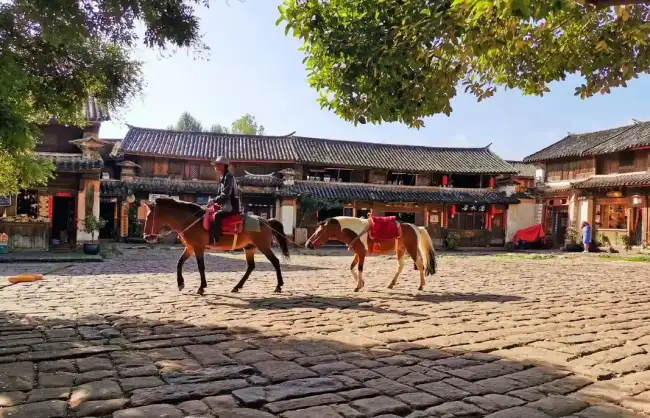
Next, proceed to another important post station along the ancient Tea-Horse Road: Shaxi Ancient Town. Compared to Dali Ancient Town, Shaxi is quieter and more rustic, less commercialized. Sideng Street forms the town's center, lined with shops on both sides. Xingjiao Temple is another major highlight of Shaxi. It is the only surviving Ming Dynasty Bai Buddhist temple in China, and its murals and carvings are quite worth savoring. In the evening, stay at a comfortable hotel in Shaxi.
Sideng Street in Shaxi Ancient Town - Day 8: Shaxi to LijiangWander around the Bustling Ancient Town of Lijiang
This morning, you can explore the Shaxi Ancient Town on your own. After lunch, we drive for two hours to reach the Old Town of Lijiang. After checking into the hotel, the tour guide will take you to visit the ancient city.
Lijiang Old Town, also known as Dayan Town, was once one of the most prosperous trading markets on the ancient Tea Horse Road. Four main roads extend from Sifang Street within the town. Strolling along them, you can enjoy the ancient and elegant buildings, stone arch Bridges, gurgling streams, and the distant Jade Dragon Snow Mountain.
Sifang Street is the center of the ancient city and rectangular in shape. The street is densely lined with shops, restaurants and bars, and is popular among tourists. It is the liveliest place in the town. There are snack shops everywhere. Don't miss the Naxi ethnic cuisine. The Xinhua Street next to it is the bar street of Lijiang. Every night, it is brightly lit and bustling with activity. If you are interested in handicrafts, spend more time visiting small stores, which sell ethnic ornaments, tea, silverware, shawls and so on.
Lijiang Old Town - Day 9: Lijiang ExplorationShoot the Beautiful Snow Peaks and Learn about Dongba Hieroglyphics
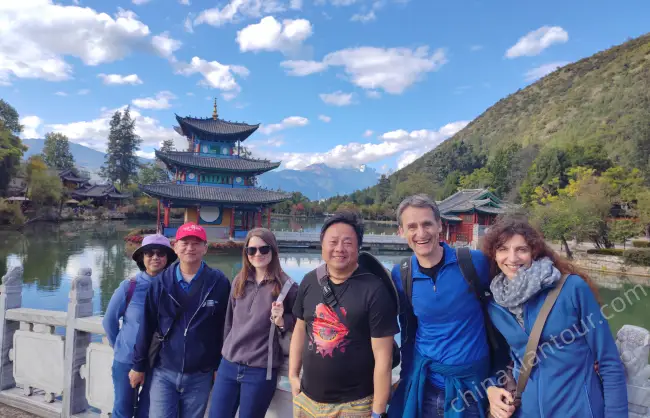
Today you will spend the whole day visiting the highlights of Lijiang, starting from the Black Dragon Pool Park located at the foot of Elephant Mountain. This park is an excellent spot for photographing the Jade Dragon Snow Mountain, along with the Five-Arch Bridge, the Deyue Tower and the reflections in the pool. This place was originally a Dragon King Temple, with numerous springs beside it. Eventually, the water accumulated and formed a pool. Because the spring water is like jade and can reflect the Jade Dragon Snow Mountain, it is also called "Jade Spring Park".
Note: If you come during the rainy season in June or July, the chance of seeing the reflection of snow-capped mountains is also relatively low.
Next, we will explore the mysterious culture of the Naxi people and the Dongba hieroglyphics at the Dongba Culture Museum. There are over 12,000 cultural relics in the collection, including more than 2,500 Dongba cultural relics, covering Dongba pictographic classics, sacrificial ritual implements and production and living utensils.
Black Dragon Pool In the afternoon, we drive for 30 minutes to Puji Village. After getting off the vehicle, follow the tour guide and walk a short distance through a pine forest to reach Puji Temple. In front of the main hall, you can see two cherry blossom trees, which have a history of over 200 years. If you happen to come here in spring, enjoy the bright red cherry blossoms and the pure white pear blossoms around the temple. The roof of the main hall is covered with copper tiles, making it the only remaining copper-tiled building in Yunnan. After the visit, return to the hotel to rest.
- Day 10: Lijiang Departure
After breakfast, it’s time to say goodbye to Lijiang and Yunnan. The driver will pick you up at your hotel lobby and send you to the airport. Hope you had a great time with China Xian Tour. Safe travels.





Tour Price Per Person
The price varies depending on the activity, number of people, travel date, and selected hotel. Please contact us for a specific price.
Accommodation For This Yunnan Ethnic Minority Tour




For your China private tour, the choice is in your hands: you can select luxury 5-star hotels for unparalleled comfort, cozy 4-star accommodations, or value-for-money 3-star options.
All our partner hotels are handpicked for their prime locations, conveniently situated near bustling commercial areas. Every room is equipped with standard amenities like air conditioning, hot water, 24-hour showers, reliable Wi-Fi, and windows for natural light.
In some hotels, there are English-speaking staff who are committed to providing attentive service. Should you have any special requests, feel free to ask - they are always ready to assist.


