

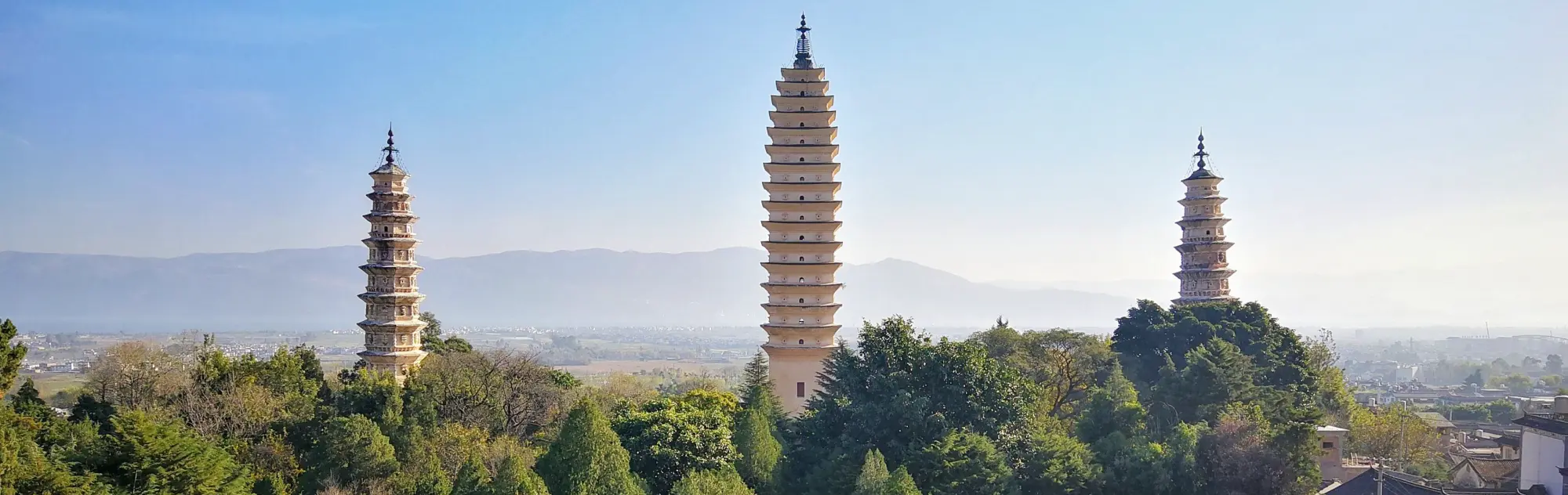
Located about 1.5 kilometers northwest of Dali Ancient Town, the Three Pagodas of Chongsheng Temple (崇圣寺三塔 / 3 Pagodas) stand in a symmetrical tripod arrangement between Cangshan Mountain and Erhai Lake. Originally one of the five great treasures of the ancient Chongsheng Temple complex, the pagodas are the only original structures to survive intact, standing resiliently for over 1,200 years.
During the Nanzhao and Dali Kingdoms (8th to 13th centuries), Buddhism flourished in the region, earning Dali the reputation of a “Buddhist Kingdom of the East.” The construction of the Three Pagodas marked this golden religious age. Today, the three towers serve as the premier cultural icon of Dali. Their balanced geometry, detailed brickwork, and deep history draw visitors from around the world to travel to Dali.
📍 Fast Facts & Visitor Info: Dali Three Pagodas
- Chinese Name: 崇圣寺三塔 (Chóngshèng Sì Sāntǎ / 3 Pagodas of Dali)
- Location: National Highway 214, northern suburbs of Dali Ancient City, eastern foot of Cangshan Mountain, Dali, Yunnan
- Main Tower Specs (Qianxun Pagoda): 69.13 meters high; 16 tiers, square brick; built 824–859 AD (Nanzhao Kingdom)
- Flanking Twin Towers Specs: 42.19 meters high each; 10 tiers, octagonal brick; built 10th century (Dali Kingdom)
- Opening Hours: 07:10 – 19:00 (May 1 – Oct 7); 07:30 – 18:30 (Oct 8 – April 30 next year)
- Entrance Ticket Price: CNY 75 – 120 per person (Covers Three Pagodas + Chongsheng Temple Cultural Zone; internal shuttle bus separate)
- Recommended Visiting Duration: Around 3 hours
- Best Time to Visit: Year-round; March to April is highly recommended for local Bai ethnic festivals
🗺️ Key Coordinates for Maps & Didi Rides:
Landmark |
GPS Coordinates |
|---|---|
Main Entrance & Ticket Office |
25.7061° N, 100.1472° E |
Three Pagodas Reflection Park (三塔倒影公园) |
25.7028° N, 100.1485° E |
Chongsheng Temple Daxiong Hall (大雄宝殿) |
25.7089° N, 100.1412° E |
📸 Reflection Lake Photo Spot
👑 Royal Temple of 9 Dali Kings
⛰️ Cangshan Mountain Backdrop
📖 Content Preview
- 1. History of Three Pagodas & Chongsheng Temple
- 2. 1978 Cultural Relics Discovery
- 3. Architectural Features of the Three Towers
- 4. Exploring Chongsheng Temple Complex
- 5. Reflection Park Photography Guide
- 6. How to Get There & Internal Transportation
- 7. Best Time to Visit & Local Festivals
- 8. Attractions Nearby
- 9. Frequently Asked Questions
History of Dali Three Pagodas and Chongsheng Temple
From the Nanzhao Kingdom onward, Buddhism took deep root in Dali. At its peak, over 3,800 temples of various sizes dotted the valley. Historical records note that most residents of Dali, regardless of age or wealth, were devoted Buddhists due to the region’s geographical proximity and trade links with India.
During the reign of the 10th king of Nanzhao (824–859 AD), the king ordered the construction of the vast Chongsheng Temple complex, anchored by the central Qianxun Pagoda. The smaller North and South Pagodas were added roughly a century later during the Dali Kingdom. In addition to the three pagodas, the ancient Chongsheng Temple complex featured 7 towers, 9 halls, over 890 rooms, and 11,400 Buddha statues. It served as the official spiritual center for the Nanzhao and Dali Kingdoms—and as a royal sanctuary where 9 emperors abdicated their thrones to become monks.
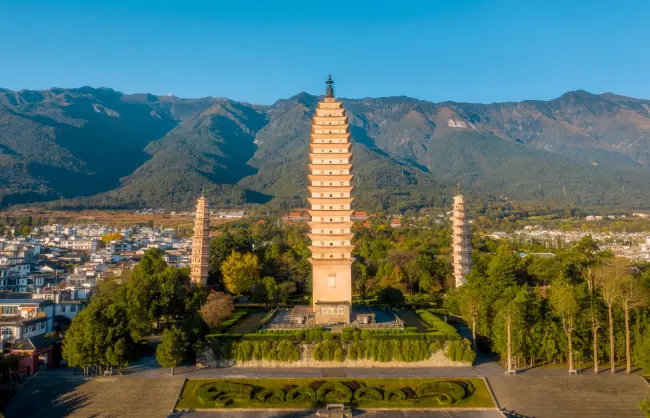
Over the centuries, many wooden structures of Chongsheng Temple were lost to conflict and earthquakes, including a major Qing Dynasty earthquake. However, the Three Pagodas survived intact after enduring more than 30 major earthquakes over 1,200 years.
The 1978 Cultural Relics Discovery
In 1978, cultural relic specialists conducting restoration work uncovered more than 680 historical artifacts hidden inside the Qianxun Pagoda. dating from the Nanzhao and Dali Kingdoms. The cache included fine metalwork, Buddhist scriptures, gold and silver statues, jewelry, and ancient medicinal herbs. These items offered invaluable insights into the religious art and craftsmanship of Tang and Song Dynasty China. Key artifacts from this discovery are now displayed in the Yunnan Provincial Museum and the on-site temple exhibition hall.
What to See around the Three Pagodas and Chongsheng Temple
1. Three Pagodas – Architectural Specifications
The Three Pagodas are positioned in a balanced tripod formation. The central Qianxun Pagoda stands 69.13 meters high at the front, flanked by two smaller octagonal towers standing 42.19 meters tall. All three pagodas face Erhai Lake to the east with the 19 peaks of Cangshan Mountain rising directly behind them.
Pagoda Name |
Height |
Tiers & Shape |
Construction Era |
Architectural Features |
|---|---|---|---|---|
Qianxun Pagoda (Central Main) |
69.13 meters |
16 Tiers, Square Brick |
Tang Dynasty (Nanzhao Kingdom, 824–859 AD) |
Hollow brick structure, dense eaves, carved stone Buddha niches on each level. |
North Sister Pagoda |
42.19 meters |
10 Tiers, Octagonal Brick |
Song Dynasty (Dali Kingdom, 10th Century) |
Hollow brick body, decorative eaves, carved floral patterns and Buddha images. |
South Sister Pagoda |
42.19 meters |
10 Tiers, Octagonal Brick |
Song Dynasty (Dali Kingdom, 10th Century) |
Hollow brick body, carved lotus base, slight structural tilt due to earthquakes. |
2. Chongsheng Temple Complex
Although the original wooden temple halls were destroyed during the Qing Dynasty, a major restoration project in 2004 rebuilt Chongsheng Temple to its historic scale. Spanning a building area of 20,080 square meters, the halls, pavilions, and corridors are arranged along three central axes behind the Three Pagodas:
- Mahavira Hall (Daxiong Baodian 大雄宝殿): The largest hall in the complex, housing a bronze statue of Shakyamuni Buddha and large murals depicting Buddhist narratives from the Dali Kingdom.
- Rain Copper Guanyin Hall (雨铜观音殿): Enshrines a tall bronze Guanyin statue styled in the classic artistic aesthetic of the Nanzhao Kingdom.
- Dapeng Golden Wing Bird Plaza (大鹏金翅鸟广场): Features a golden statue of the mythical Garuda bird—a famous cultural symbol believed by ancient locals to protect Dali from lake floods.
- Nanzhao Jianji Great Bell Tower (南诏建极大钟楼): Houses the largest cast bronze bell in Yunnan, re-cast according to historical Nanzhao Kingdom dimensions.
- Wanghai Tower (望海楼): Located at the highest elevation of the temple complex, offering panoramic views over the Three Pagodas, Dali Old Town, and Erhai Lake.
3. Reflection Park of the Three Pagodas (三塔倒影公园)
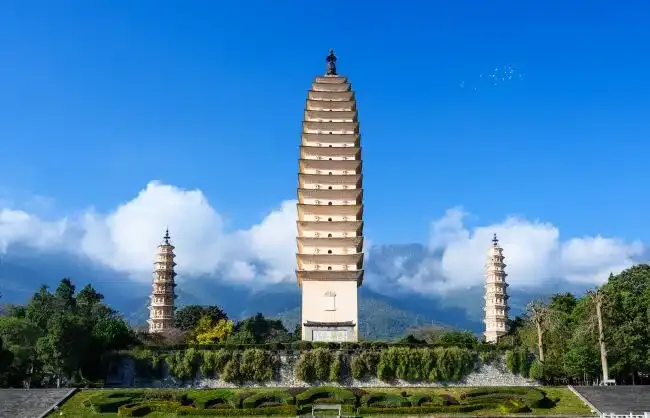
Located about 1 kilometer south of the main entrance plaza, Reflection Park is named after the clear reflections created on its central pond. The oval pond covers roughly 10 acres, and its still water reflects the complete image of the Three Pagodas alongside the Cangshan ridge behind them. It is the primary spot for landscape photography.
Recommended Yunnan Tours including Dali Three Pagodas:
- 3-Day Dali Tour Package with Memorable Experience
- 4 Days Dali Essence Tour
- 8 Days Classic Yunnan Minority Tour (Kunming-Dali-Lijiang-Shangri-La)
Photography Tips for the Three Pagodas in Dali
📸 Top Photo Angles & Timing:
- Morning Light (08:30 – 10:30): Visit in the morning for clear air and front-lit skies over the eastern brick facades.
- Reflection Park (三塔倒影公园): Stand at the southern shore of Reflection Pond using a wide-angle lens (16–24mm equivalent) to frame all three towers and their reflections on the water.
- Front Plaza: Offers a direct low-angle view highlighting the sheer height of Qianxun Pagoda.
- Wanghai Tower (望海楼): The highest vantage point inside Chongsheng Temple; ideal for telephoto shots overlooking the pagodas with Erhai Lake in the distance.
How to Get to and Travel Around
Transport to the Three Pagodas
- From Dali Ancient Town: Located just 1.5 km north of Cangshan Gate. Visitors can take Bus No. 19 or Bus C10 from the North Gate (5–10 mins), take a short taxi/Didi (~CNY 10–15), or walk north along Highway 214 (~20 minutes).
- From Dali Railway Station (Xiaguan): Take Bus No. 4 directly to the Three Pagodas (~40 mins, CNY 3). A direct taxi from the train station costs ~CNY 40–50 (35 minutes).
- From Dali Fengyi Airport: Take the airport shuttle bus to Dali Ancient City (~25 CNY, 45 mins), then transfer by bus or taxi.
Exploring Inside the Scenic Area
The Chongsheng Temple Scenic Area extends uphill along the mountain slope. Walking the full round-trip route on foot covers about 7 kilometers and takes 3 to 5 hours.
Electric Shuttle Service: Electric cart rides are available to save energy (CNY 35 round-trip / CNY 20 one-way). Main boarding stations include:
- Visitor Center
- Three Pagodas Plaza (Shanmen)
- Daxiong Hall (Top Station)
Related Reading: Main Pagoda Types in China and Top Famous Chinese Pagodas
Best Time to Visit & Bai Minority Festivals
The Three Pagodas and Chongsheng Temple can be visited comfortably year-round, with an average annual temperature of 15°C (59°F) in Dali.
Visiting during March and April (Spring) provides an opportunity to experience local Bai minority festivals:
- March Street Festival (月街 / 三月街): Held annually from the 15th to 21st days of the third lunar month at the foot of Cangshan Mountain. Features traditional horse racing, Bai music, and regional trade markets.
- Butterfly Festival (蝴蝶会): Celebrated on the 15th day of the fourth lunar month at nearby Butterfly Spring, featuring Bai folk singing and traditional dress.
Attractions Nearby
- Dali Ancient Town: Located 1.5 km (0.9 miles) south. Known for ancient city walls, preserved Bai courtyard architecture, and local street food.
- Cangshan Mountain: Located 2 km (1.2 miles) west. A 19-peak mountain range featuring cableways, waterfalls, and the flat Jade Belt Road hiking trail.
- Erhai Lake: Located 5 km (3.1 miles) east. An alpine freshwater lake featuring a 129 km (80.2 miles) car-free cycling corridor and boat cruises.
- Xizhou Ancient Town: Around 19 km (11.8 miles) north of the Three Pagodas. Hailed as the Museum of Bai Architecture, it boasts well-preserved Bai courtyards and a lively morning market famous for Xizhou Baba pastry.
- Zhoucheng Village: Approximately 22 km (13.7 miles) north. Famous as the hometown of traditional Bai tie-dye, where visitors can join hands-on tie-dye workshops.
- Shuanglang Village: About 50 km (31 miles) northeast on Erhai’s east shore. A picturesque lakeside hamlet renowned for panoramic Cangshan-Erhai sunset views and stylish lake-view homestays.
- Butterfly Spring: Roughly 24 km (14.9 miles) northwest at the foot of Cangshan Mountain. A clear mountain spring with ancient trees and a butterfly exhibition hall for local species.
- Shaxi Ancient Town: Around 115 km (71.5 miles) north. A well-preserved ancient Tea Horse Road market town with Ming-Qing Bai buildings and the iconic weekly Friday village market.
- Shibao Mountain: Approximately 136 km (80.8 miles) north near Shaxi. Nicknamed the Southwest Dunhuang, famous for well-preserved Nanzhao-Dali Buddhist grottoes and annual Bai folk song festival.
Frequently Asked Questions
How much is the entrance ticket for the Three Pagodas in Dali?
The combined admission ticket costs CNY 75 to 120 per person (depending on seasonal combos and inclusions), which covers access to the Three Pagodas, Chongsheng Temple complex, and Reflection Park. Internal battery shuttle cars cost an extra CNY 35 round-trip.
What are the opening hours for the Three Pagodas?
The site is open from 07:10 to 19:00 during peak season (May 1 – Oct 7) and 07:30 to 18:30 during low season (Oct 8 – April 30). Ticket sales close one hour before park closure.
Can visitors climb or go inside the Three Pagodas?
No. To preserve these 1,200-year-old national cultural relics, visitors are not permitted to enter or climb inside the pagodas. They can be viewed and photographed from the surrounding plazas and gardens.
Where is the best place to photograph the Three Pagodas reflection?
The best location is Three Pagodas Reflection Park (三塔倒影公园), situated 1 kilometer south of the main entrance. Visit in the morning when the water on Reflection Pond is calmest.
How far are the Three Pagodas from Dali Ancient Town?
The Three Pagodas are located 1.5 km north of Dali Ancient Town. It takes about 20 minutes to walk, 10 minutes by bicycle, or 5 minutes by taxi or Bus No. 19.


