
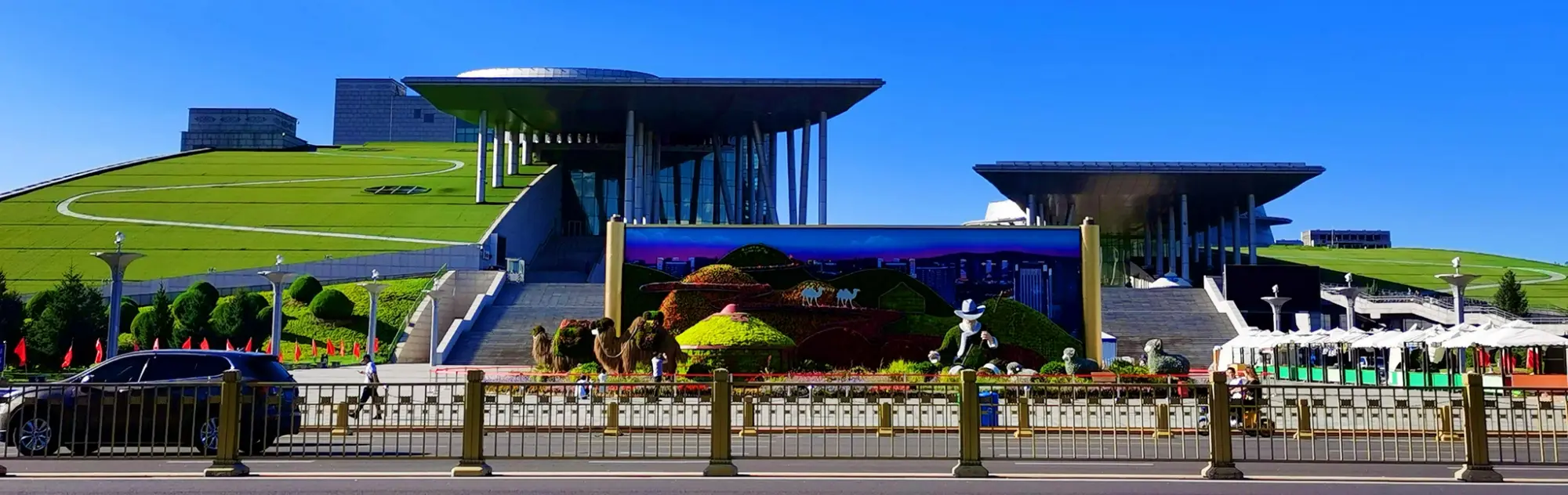
The Inner Mongolia Museum is located in Hohhot City and was founded in 1957. It is the only provincial comprehensive museum in Inner Mongolia and the earliest museum in the five ethnic autonomous regions of China. With a main building area of 64,000 square meters and an exhibition area of 15,000 square meters, Inner Mongolia Museum is a national first-class museum.
In 2008, the new building of Inner Mongolia Museum was completed and opened. It has a unique design that combines modern elements, regional representations, and ethnic characteristics. The rooftop is sculpted with a galloping horse, symbolizing the auspiciousness and soaring of Inner Mongolia, and is one of the iconic buildings in Hohhot.
Characterized by its collection of fossils of ancient organisms and cultural relics of northern ethnic groups in China, Inner Mongolia Museum currently has more than 150,000 collections, most of which have a strong grassland ethnic atmosphere. Inner Mongolia Museum is an important “post station” for domestic and foreign tourists to experience the history and culture of grassland during their Inner Mongolia tours.
Facts About Inner Mongolia Museum
- Location: No.27 Xinhua East Street, Xincheng District, Hohhot City, Inner Mongolia, China
- Opening hours: 09:00-17:00 (closed on Mondays)
- Ticket: free, advance reservation required
- Time needed: about 2-3 hours
Exhibition Halls of Inner Mongolia Museum
Basic Display
- “Ancient World”, showcasing natural paleontological fossils from Inner Mongolia and the ancient ecological environment of Inner Mongolia from 3 billion years ago to 10,000 years ago. There are many animals, plants, geological and mineral specimens displayed here, especially various dinosaur fossils which are very popular with children.
- “Dawn of Civilization”, introducing the history of the Stone Age and Bronze Age.
- “Border Years”, introducing the history from Eastern Zhou to Southern and Northern Dynasties,revealing the interplay between agricultural civilization and nomadic civilization on this land.
- “Great Liao (Khitan)”, introducing the history of the Liao Dynasty.
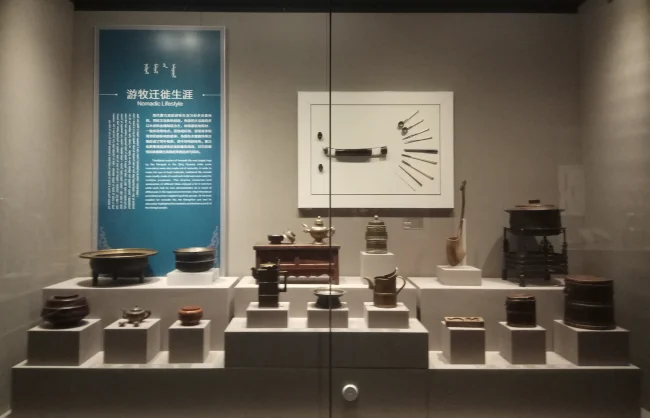
- “Integration and Convergence”, showcasing the diverse and integrated pattern of various ethnic minorities from the 8th to 19th centuries.
- “Road of Liberation”, showing the revolutionary history of Inner Mongolia from 1840 to 1949.
Special Exhibition
- “Beautiful Inner Mongolia”, taking you on a tour of Inner Mongolia’s natural beauty, ecological landscape, and rich cultural heritage.
- “Flying Shenzhou”, showcasing Inner Mongolia’s enormous contribution to China’s aerospace industry.
- “Songs of Northern Border”, showcasing the rich and diverse ethnic culture of Inner Mongolia.
Treasures of Inner Mongolia Museum
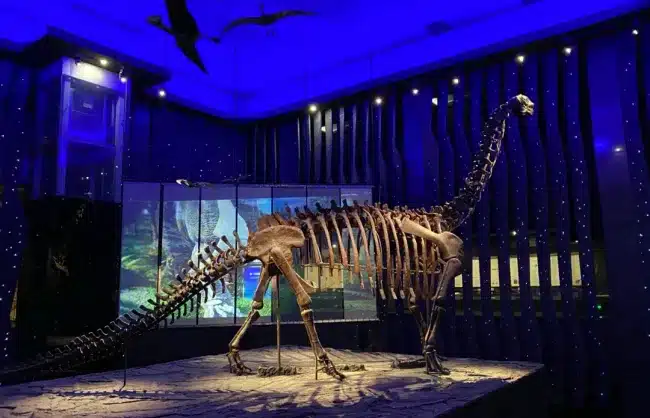
- The Chaganuoer dinosaur fossil from the Cretaceous period is particularly precious, with 60% of its skeletal fossils well preserved. With a length of 26 meters and a height of 0.6 meters at the shoulder, it is the largest dinosaur fossil in Asia. The huge fossil skeleton of this prehistoric animal will surely leave you amazed.
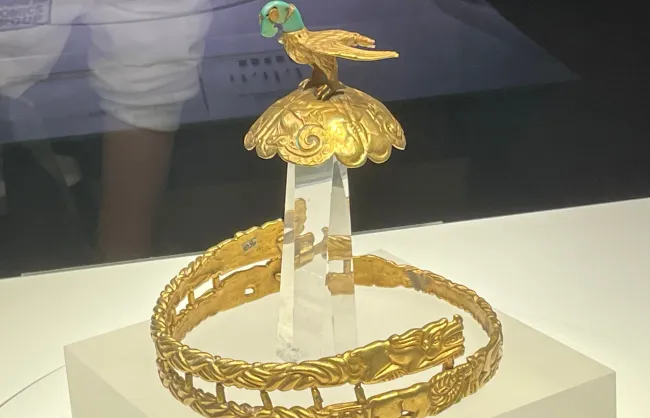
- The Golden Crown of the Xiongnu King during the Warring States Period: It is currently the only Xiongnu noble golden crown discovered in China, and the most luxurious among all the gold artifacts in Inner Mongolia Museum. Unearthed from the tomb of the Xiongnu king in Arukaiden, Hangjin Banner, Ordos City in 1972, the golden crown is composed of an eagle shaped crown decoration, a hemispherical crown top, and three crown belts, showcasing the ecology and king style on the grassland.
- The Painted Wooden Coffin during the Liao Dynasty: It has been well preserved for over 1,000 years. The wooden coffin is 2.31 meters long, 1.31 meters wide, and 0.9 meters high. It is exquisitely painted and has become a work of art, which is the prototype of the wooden coffin in the movie “The Ghouls”.
- The “Xiao Song Self made(小宋自造)” Incense Burner from Jun Kiln during the Yuan Dynasty: This incense burner was unearthed in 1970, with a height of 42.7 centimeters and a diameter of 25.5 centimeters. It is the largest, most complete, and exquisitely crafted Jun kiln incense burner discovered in China so far.
Visiting Tips
- Inner Mongolia Museum has 9 regular exhibition halls, and it is recommended to visit them from the fourth floor downwards. You can choose exhibition halls and hire a docent according to your preferences.
- On the second floor of Inner Mongolia Museum, there is a cultural and creative store with unique cultural and creative products that are worth a visit.
- If you want to visit other museums when you travel to Inner Mongolia, Ordos Museum and Genghis Khan Museum are good choices too.
Getting to Inner Mongolia Museum
After arriving in Hohhot, you can take a taxi or drive there.
Or take the bus No. 2/3/16/27/53/59/66 and get off at the Museum Station to reach the Inner Mongolia Museum.
Alternatively, take Hohhot Metro Line 1 and get off at Inner Mongolia Museum Station.
Attractions Nearby Inner Mongolia Museum
- Dazhao Temple: a stunning Buddhist temple located in the heart of Hohhot, Inner Mongolia, and is considered one of the most important cultural landmarks in the region.
- Zhaojun Tomb: a historic burial site located in Hohhot, Inner Mongolia, which is believed to be the final resting place of Wang Zhaojun, a legendary female figure in Chinese history.
- Xilitu Zhao Temple: a magnificent temple located in Baotou, Inner Mongolia, which is renowned for its beautiful architecture, intricate carvings, and spectacular natural surroundings.
- Five Pagoda Temple: a unique Buddhist temple located in Hohhot, Inner Mongolia, featuring five pagodas of varying sizes and styles, each with its own historical and cultural significance.


