







Before setting off on your trip, there are some China travel documents that foreign visitors must prepare. Although in recent years, China has been making travel easier for visitors from more and more countries around the world with fewer restrictions and more visa-free policies, documents like passports, visas, customs declaration, and travel permits are still essential to guarantee a smooth entry.
This article will give you a run-down of the China travel documents required as well as the application and entry process for 2026.
Content Preview
- Essential Documents for Traveling to China
- How to Fill out the Arrival Card When Entering China
- Arrival Card vs. Arrival Card for Temporary Entry Foreigners
- How to Apply for a China Tourist (L) Visa
- How to Apply for a Tibet Travel Permit
Essential Documents for Traveling to China
Whether this is your first time traveling to China or not, you should confirm your status for entry before departure, should you need a visa, be eligible for 30-day visa-free travel, or 240-hour visa-free transit. Under different circumstances, you will need different China travel documents.
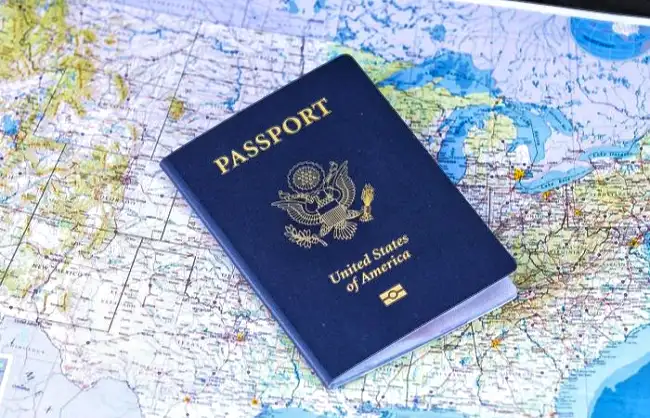
1. Valid Passport
Your passport is the most important identification document for entering China.
It needs to meet the following requirements:
- Valid for six months or longer beyond the time of arrival
- With at least two blank pages
- No serious damage or blemish
- Clearly shows your basic information such as name and date of birth
Some airlines may check the validity of your passport at airport check-in.
Travel Tip: If you’re traveling with children, they must hold their own individual passports.
2. China Tourist (L) Visa
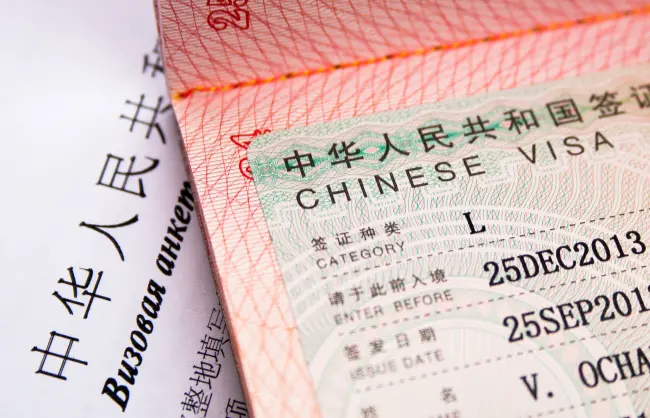
If you’re not qualified for traveling to China visa-free, you will need to apply for a China tourist visa (L Visa) in advance. It usually allows visitors to stay in the country for up to 30 days on a single visit with a 3-month period of validity. Foreign travelers with an L Visa can visit most places in the mainland of China.
You can apply for either single entry or multiple entries on an L Visa.
3. Visa-Free Travel
China currently has a few visa-free travel policies that can make your entry a lot easier if you qualify.
- 30-Day Visa-Free Policy
As of 2026, China has opened up the 30-Day Visa-Free Policy to many countries.
Travelers eligible for the policy can enter China with a valid passport and round-trip flight tickets or follow-up plans without applying for a visa.
This policy currently applies to travelers from the United Kingdom, France, Germany, Italy, Spain, Australia, New Zealand, Canada, and a total of 48 countries.
Maximum Length of Stay: 30 days
- 240-Hour Visa-Free Transit
The 240-Hour Visa-Free Transit Policy has been one of the most popular options for foreign travelers in recent years.
It applies to travel plans like:
Country A – China – Country or Region B
Travel Tip: Country or Region B could be any third country or region other than your point of origin (Country A) or the mainland of China, including Hong Kong, Macau, and Taiwan.
For example:
✅️ The United States – Beijing – Japan
✅️ Canada – Shanghai – Hong Kong
❌️ The United States – Guangzhou – The United States
To be eligible for this policy, you must
- Be a passport holder of one of the eligible countries
- Hold an international travel identification (passport or equivalent) valid for at least three months
- Have a confirmed date and seat on a flight (or other forms of transportation) to a third country or region after your stay in the mainland of China
Travel Tip: For a visa-free China tour under this policy, you can only travel within the designated 24 provinces or cities. Currently, Tibet, Xinjiang, Gansu, Qinghai, Ningxia, Inner Mongolia, and Jilin are not included in the approved regions.
Maximum Length of Stay: 240 hours (10 days)
How to Fill out the Arrival Card When Entering China
Upon arriving at the immigration inspection site after you land, you need to complete an Arrival Card. By 2026, many international airports in China accept both physical and digital formats.
What Does the Declaration Form (the Arrival Card) Consist of?
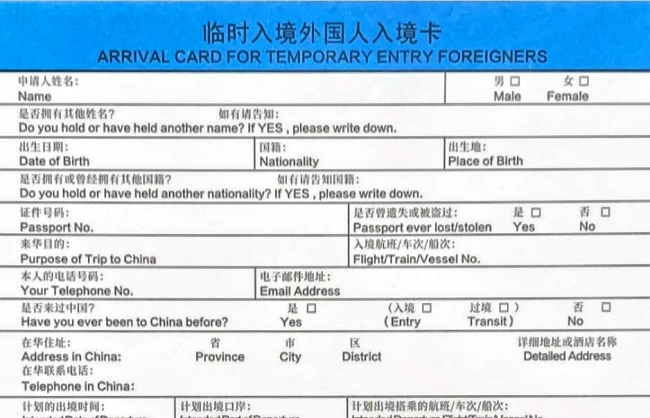
The Arrival Card, i.e. the declaration form, requires your basic information as foreign travelers enter China at the border control. You need to fill out this form within 3 days before your arrival in China. Required information includes your name, nationality, passport number, flight number, purpose of entry, address in China, and phone number.
What’s the Difference Between the Digital and Physical Formats?
China Digital Arrival Card has now been approved at many international airports.
Travelers can fill out the form on the official website, by scanning the QR code, or on the WeChat/Alipay mini program. After you complete the form, a QR code will be generated for you to present at the border.
To fill out the Arrival Card on your phone, you can search for the National Immigration Administration (NIA) 12367 mini program on either WeChat or Alipay to find the portal for it.
Travel Tip: Once you receive your confirmation QR code, take a screenshot of it and save it to your phone. Present it to the officer as you go through border inspection. There’s no need to upload photos or have it printed.
- What to do if I hadn’t filled out the form online before arrival?
When you arrive at the port in China, you’ll find a QR code that you can scan, or you can also find it in the mini programs. Filling out a physical form is also an option, but the queues for border inspection might be long. We highly recommend completing the form before you land.
The physical Arrival Card can be obtained on the plane or at the border inspection counter. You also won’t need to attach photos for the physical form.
Travel Tip: The Arrival Card is for registering your information at border inspection. It does not include customs declaration for belongings. If you carry cash exceeding the permitted amount, valuable items, food, medicine, or other special items, you still need to complete the health/customs declaration process after you go through border inspection (read more about it below).
Arrival Card vs. Arrival Card for Temporary Entry Foreigners
Foreign travelers will see two different kinds of Arrival Cards, the Arrival Card and Arrival Card for Temporary Entry Foreigners. They are used for different circumstances.
Arrival Card
Used for travelers
- holding a China visa
- visiting China visa-free
- entering China for purposes of tourism, business, and family visit
The Arrival Card mainly serves to register travelers’ basic information. It applies to most foreign visitors.
Arrival Card for Temporary Entry Foreigners
Used for travelers
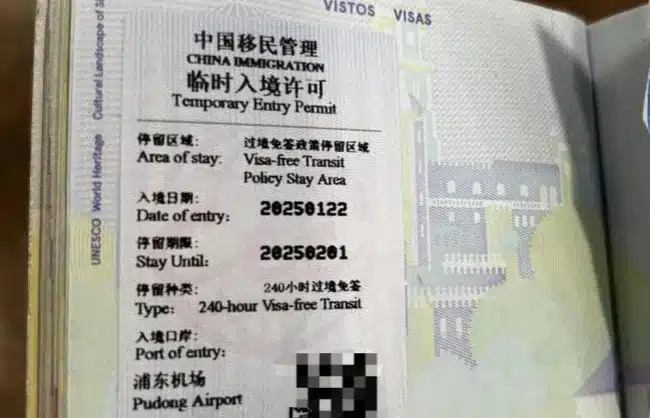
- transiting through China visa-free within 240 hours
- applying for a China temporary entry permit
- with special circumstances
Once the border inspection officer approves your entry, you will be issued a Temporary Entry Permit, which you should keep until your departure from China.
How to Apply for a China Tourist (L) Visa
If you’re not eligible for traveling to China without a visa, you will need to apply for a China tourist visa (L Visa) before your trip. We recommend that you start preparing for the application process at least a month before departure.
Application process:
Steps |
What to do |
Additional information |
1. Complete the application form online |
Register and complete the application form on the official website |
Choose L (tourism) type of China visa; once you’ve completed the form, download and print it out with the confirmation page |
2. Get your application materials ready |
• Original passport (valid for at least 6 months with more than 2 blank pages) and a photocopy of the personal information page
• The completed, printed application form and confirmation page • 1-2 recently taken photo (colored photo with a white background, dress in a dark-colored top, size: 48mm×33mm) • Round-trip flight bookings, hotel reservations, invitation letter issued by units or individuals in China if applicable • Some applicants may need to present bank statements and proof of work |
If you hold residency in a third country, you need to present a photocopy of your resident card |
3. Submission of application and materials |
Bring your materials to the Chinese visa application service center or visa sectors at the Chinese Embassy or Consulates that serve your residential area |
In most cases, you won’t need to make an appointment for submitting your application, but it may differ between countries. Consult the official website for your area |
4. Record your Biometric information |
After you submit your application, you will be asked to register your biometric information (fingerprints) |
Applicants under the age of 14 and over 70 are exempted from fingerprint collection as well as applicants with severed digits and illegible fingerprints |
5. Wait to pick up your visa |
It usually takes 3-5 working days to process an application |
You can pay an extra fee for an urgent case to shorten your wait time |
- Are interviews required applying for a China tourist visa?
Interviews are usually not required for the application of an L Visa, but the embassy officer has the right to request one depending on the case of your application, for example, if you’re applying for the first time and your itinerary or other materials appear questionable. If you’re asked to attend an interview, bring the original copies of all your materials including booking confirmations, invitation, and proof of funds.

How to Apply for a Tibet Travel Permit
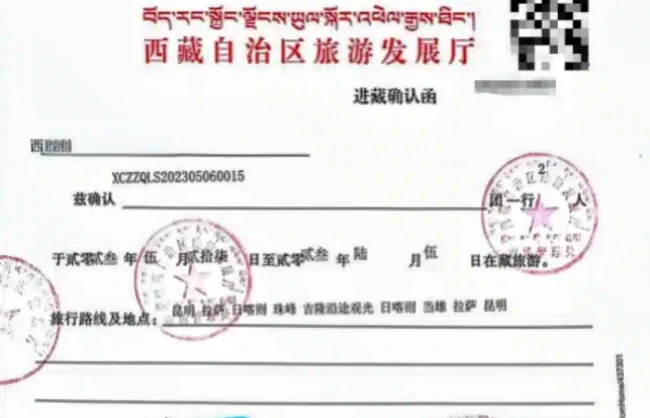
Even if you’ve already obtained a China tourist visa, in order to travel to Tibet, foreign visitors still need to apply for a Tibet Travel Permit. It is mandatory and cannot be obtained on your own.
Who Needs a Tibet Travel Permit?
Almost all visitors with a foreign passport need to apply for a Tibet Travel Permit in order to visit Tibet, including visitors from the United States, United Kingdom, Australia, and Canada.
How to Apply for a Tibet Travel Permit?
Foreign individuals cannot apply for a Tibet Travel Permit on their own. You must do so through a registered travel agency in China. Visitors usually need to provide a scanned copy of your passport, visa, and travel itinerary. The agency will send your information to Tibet Tourism Bureau and the border police for approval.
Note: China Xian Tour is a registered travel agency. Contact us and we can help you obtain your Tibet Travel Permit.
When to Apply for a Tibet Travel Permit?
It usually takes 8-15 working days for a Tibet Travel Permit to be issued. We recommend that you start preparing for it at least a month in advance.
Can I Visit Tibet without a Tibet Travel Permit?
No, no matter what form of transportation you take, by plane or train, you will be asked to present your permit.
Travel Tips for Entering China
Apart from getting your China travel documents ready, learning about payment methods and the network situation in China can ensure a smooth China tour.
- Health Declaration Requirements: Foreign travelers are technically exempted from regular health declaration. If you experience symptoms of fever or travel from countries or regions affected by pandemics like Dengue, please declare your case on https://htdecl.chinaport.gov.cn and cooperate with necessary checkup procedures.
- Set up a VPN in Advance: Network in the mainland of China cannot access some overseas websites or applications like Google, YouTube, Facebook, Instagram, and WhatsApp. Make sure you purchase a VPN service before your trip to continue using these sites.
- Install a Translation App: The majority of people in China cannot communicate fluently in English. You will likely need translation services or a local guide to help you navigate. We recommend that you download an app like Google Translate beforehand. Though many attractions and hotels provide services in English, translation apps can still come in handy.
- Payment Methods: Payment in China has moved almost entirely onto digital platforms. You can download international versions of Alipay or WeChat and link your bank cards (Visa or Mastercard supported). It’s also a good idea to bring a UnionPay card from your country if possible, so you can retrieve cash in Chinese Yuan at ATMs, or to exchange for cash at the airport. Hotels and malls support payments through credit cards, but many places like night markets, food stalls, and some attractions may only accept cash or electronic payments.
- Purchase a SIM Card: You can purchase a local SIM card at the airport when you arrive in China. There are China Mobile, China Unicom, and China Telecom counters where you can quickly buy a card with your passport information. Plans may be for 7 or 30 days. You can also do so at a flagship store in the city.
Conclusion
The most important China travel documents for international visitors are a valid passport, China tourist visa (L Visa) if needed, proof of eligibility for visa-free travel, the Arrival Card, and travel permit for special regions like Tibet Travel Permit. At the same time, set up mobile payment, network and service, and translation apps beforehand for a smooth trip.
Before setting off, we suggest that you double-check if you’re eligible for the 30-day visa-free policy or 240-hour visa-free transit policy. China has been expanding the range of countries eligible for visa-free travel. The policies may continue to be adjusted.


