

Longyou Caves were called “The Ninth Wonder of the World”. Since being discovered underground in 1992, many mysteries remain about the Longyou caves in Zhejiang, China: when were they constructed, why were they built, and who built them? This treasure of human wisdom and strength holds immense multidisciplinary research and development value. This guide will introduce the history, mysteries, construction theories, best visit time, and other travel tips of these schematic Longyou caves.
Basic Travel Information
- Location: Longyou County of Quzhou City, Zhejiang Province
- Chinese name: 龙游石窟 (Longyou Shiku)
- Local/historical name: 小南海石室 (XiaonanhaiShishi)
- Opening hours: 08:00-16:30 (every day, including weekends)
- Tickets: 85 CNY (adults), free for children below 1.2 meters
- Best time to visit: summer
- Time needed: 2~4 hours recommended

What is Special about Longyou Caves in Zhejiang
- Unprecedented structure and scale
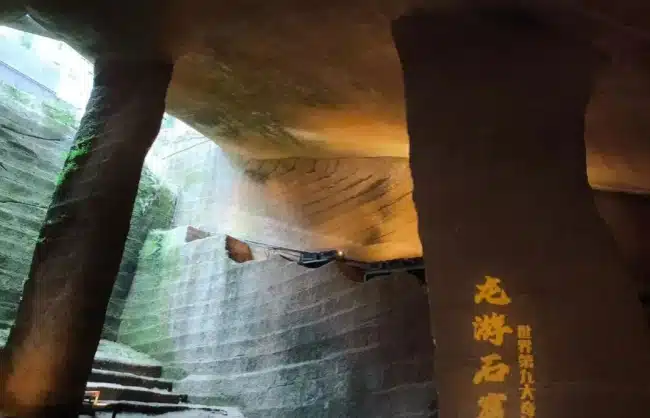
Longyou Caves China is one of the biggest extant underground architecture complexes, with each grotto measuring 1200-3000 square meters in area and 30 meters in depth. The interior structures perfectly align with basic principles of mechanics.
- Miraculous precision
The chiselling technique is so refined as to the extent of machine processing. Some adjacent caves are separated by walls as thin as 50 centimeters, but they remain parallel without penetrating each other.
- Unique location with unknown construction time and function
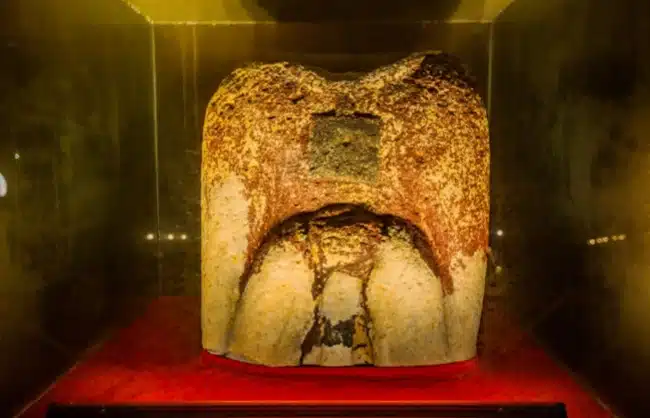
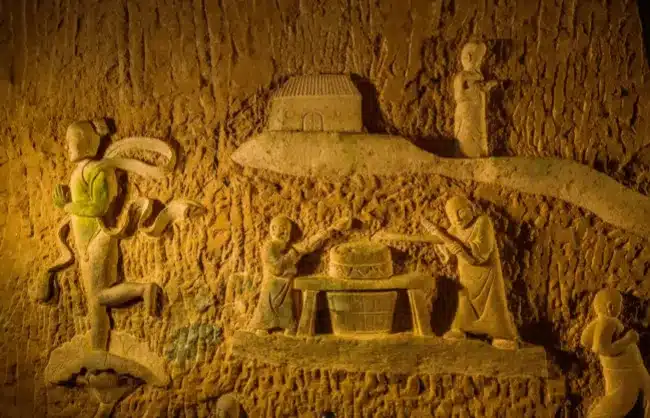
Longyou Caves formed an enormous, manually constructed underground space. But seldom any other relics or living remains, except a headless statue and a few carved patterns, could indicate the construction time and the purpose of these caves that require such heavy and risky work.
The History and Discovery of the Longyou Shiku
Who Built the Longyou Caves and When?
Based on the carvings and the chisel marks in the caves, most archaeologists agree on one period: the Spring and Autumn Period (770-476 BCE) to the Western Han dynasty (202 BCE-8 AD). Firstly, the chiselling tools are likely to be bronze, which means they were built in/after the Bronze Age; secondly, the carvings contain the realistic style of Han stone carving arts. Therefore, Longyou Caves have a history of at least more than 2000 years. During that specific period, the area where the Caves are found was inhabited by the Xu ethnicity, which built houses by chiselling stones. Some researchers believed it was the Xu people who built the Caves.
Why were the Longyou Caves Built?
There are some popular hypotheses on the purposes of the Longyou Caves, though all of them are rejected: one says that they were built as the tomb of the emperor of Wu-Yue in the Five Dynasties (907-979 AD), but it is not supported by substantial evidence of funerary objects or sacrificial remains; another one speculates that they served as a troop’s hideout, but some reject that the entrance was too narrow for an army and easily besieged by their enemy; the rest one insists that it was simply a quarry, but it cannot explain the exquisite carvings and chiselling techniques.
The Stunning Lack of Historical Records
Such a grand project might have taken a whole nation’s manpower, and Longyou County has been established for 2000 years, but no exclusive records are available in annals, local chronicles, or folk tales. It seems to be forgotten by history.
How were the Longyou Caves Discovered in 1992
In 1992, several workers on a construction site in Longyou County of Quzhou City heard a gurgling sound of water from under the ground. In June that year, four villagers drained the water, and the Longyou Caves emerged.
Longyou Caves History and Timeline
Time period |
Dynasty |
Notes |
770 BCE-8 AD |
The Spring and Autumn Period to the Western Han dynasty |
This is the most agreed construction time and supported by the carving style and the chiselling techniques. |
the 3rd century AD- the early 20th century |
The three Kingdoms to the Qing dynasty |
The caves were submerged by water and unrecorded in history. |
1992 |
The caves were discovered by four villagers from the Shiyanbei Village. |
|
1998 |
The name “Longyou Shiku” has been officially approved. And this “wonder” was known to the public. |
How were the Longyou Caves Constructed?
Longyou Caves consist of 7 interlinked grottoes (another 20 more grottoes are undeveloped). All these grottos have a rectangular entrance carved vertically downwards from the ground and are funnel-shaped at the top. Each of them is supported by 3-4 massive “fishtail-shaped” stone pillars, which look like growing out from the ceiling.
Neat, fine, and parallel chiselled stripes are found throughout the caves, covering the walls, ceiling, and the stone pillars. In some of the caves, the stripes appear as horizontal and create a rhythmic sense of waves.
Although archaeologists tend to believe that these stripes can be caused by bronze hammers and chisels, their mechanical precision and regularity are still unimaginable during the potential construction time.
Related reading: Top Caves and Grottoes in China
Main Cave Chambers– Must-See Highlights by Cave
One of the reasons for Longyou Caves to become a “wonder” is that each cave has its unique feature and content. Among the 24 discovered caves, five are safely open to the public.
Cave number |
Features |
Cave one |
It is the smallest one among the five developed caves, but it has the most intricate patterns. |
Cave two |
It is supported by four stone pillars in total and has a rectangular pond |
Cave three |
It features a 45-degree slope between the ceiling and the ground, and spiral chisel marks. |
Cave four |
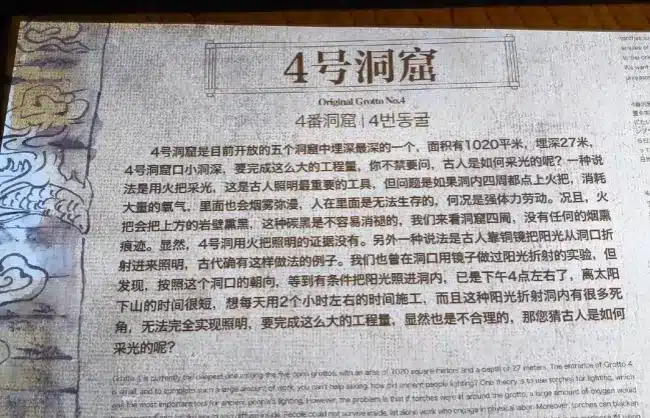
It is the biggest cave among the five, which is 2000 square meters in area. There is a 50-meter-long stone staircase at the entrance. |
Cave five |
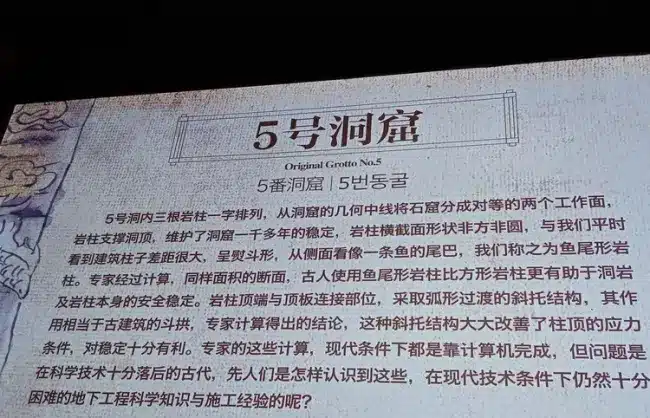
It is an unfinished cave that keeps the original look. |
Cave One
It is approximately 300 square meters in area, the smallest of the five caves, but it features the richest carving patterns. Relief carvings of fish, birds, and horses are arranged irregularly on the northern wall. These patterns were believed to be related to the totem worship of the ancient Yue people.
The diameter of the fishtail stone pillar at the center of the cave reaches 1.5 meters. When the sunlight enters the cave from a diagonal angle, tourists can see the extraordinary scene of “skyscraper rising from the water”.
Cave Two
It can be a paradigm of ancient Chinese architectural aesthetics. Four fishtail stone pillars are arranged symmetrically in this 900-square-meter space. The error margin of the parallel textures of the chisel marks is no more than 0.5 centimeters.
As mentioned above, the southern wall stands only 50 centimeters from Cave One, but it remains unconnected. This miracle of “closeness without connection” remains unexplained to this day. A pond of 2 meters in depth lies at the northwestern corner. The water is crystal clear and maintains a constant temperature of 18 ℃ in summer.
Cave Three
The ceiling and ground form a 45-degree slope. It is a unique design among all the developed caves. What else is unique is the spiral chisel marks covering the space. There are three stone pillars in this cave. The thickest one is nearly 10 meters in circumference. That means it requires three people to encircle it.
Cave Four
The entrance features a 50-meter-long jagged stone staircase, with each step spaced 30 centimeters apart. Tourists need to pay extra attention while walking on it. Although the left to the staircase is a rock face, the right side plunges into a bottomless abyss. It creates a striking visual contrast. The rectangular pool at the center measures 5 meters on each side, with traces carved into the walls. Archaeologists suggest that these are water level marks, and this cave may have served as a water storage or flood prevention facility.
Cave Five
It seems to be mostly left in its original condition, with piles of soil and rock burying the stairway. One of the stone pillars has a conspicuous unfinished mark at its top, as if the work was suddenly halted. And unlike the delicate strips in the other caves, the chisel marks on the northern wall vary in depth. These traces spark guesses that the project had been pushed forward in a rush and then had to stop due to an unknown emergency.
Hypotheses about Longyou Grottoes
Tomb
Some believe that the funnel-shaped top of the Caves and the large scale of the project match the characteristics of an emperor’s “underground palaces” for his afterlife.
Quarry
Some researchers have discovered that the caves are carved by separating the rock from the bedrock. This technique is frequently used for stone extraction. Considering that the caves are close to the Qu River, they are likely to be the result of a large-scale quarrying activity.
Hideout
At that time, Emperor Goujian of Yue was defeated by Emperor Fuchai of Wu. After years of captivity, he returned to his empire and secretly trained his troops for a comeback. Since Longyou Caves’ location was within the State of Yue and far from the State of Wu, it became an ideal place for training the troops. To avoid Emperor Fuchai’s suspicion, Emperor Goujian sent civilians to build these caves to conceal his troops.
Granary
Another hypothesis is that Longyou Caves were used as a “Changping Granary”. The so-called “Changping Granary” refers to a grain storage facility established by the imperial courts to regulate grain prices and stock grain to supply both official and civilian needs during famine. The Longyou County Annals record that the “Changping Granary” is located north of the state. Local archaeologists have once found a Ming Longyou map marking a “Northern Changping Granary”. The location corresponds to where the Caves are now. Also, the entrances of the caves are all vertical to the ground, and the caves are rectangular in shape.
According to historical records, rectangular structures are typically used as storage facilities. And granaries could be one of the types. This explanation is supported by historical records, so it is the most widely accepted hypothesis.
Ongoing Research about the Longyou Caves
Since its discovery, Longyou Caves have been receiving heated attention from sociology, history, archaeology, architecture, engineering geology, rock mechanics, and other spheres. In 2013, Longyou caves were listed as a National Key Cultural Heritage Site, and there has been ongoing research that tries to solve those mysteries. For example, at a symposium in 2023, over a dozen experts and scholars conducted on-site investigations and discussed the function of the Caves, as well as their future excavation, development, and preservation. It helped to advance the “decoding” and “revitalization” of Longyou Caves’ cultural genes.
How to Get to Longyou Caves
Longyou Caves are located in Quzhou City, Zhejiang Province. You can get there from nearby cities, such as Shanghai and Hangzhou. Below are the details:
From Shanghai:
- By High-Speed Rail
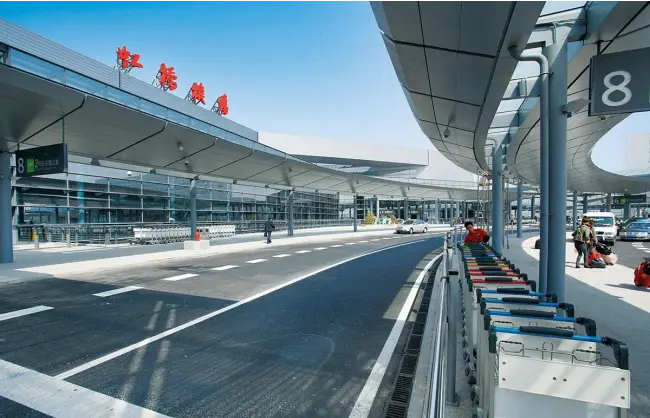
Shanghai Hongqiao Station – (2 hrs) — Longyou Station – Taxi (20 mins/30 CNY) or Route 1/8/K8 Bus – Longyou Caves
- By Long-distance Bus
Shanghai Bus Central/Southern Terminal – (5 hrs) – Quzhou City – Taxi or Bus (40 mins) – Longyou Caves
- By Car
Through Hu-Kun Expressway (5 hrs) – Longyou Caves

From Hangzhou:
- By High-Speed Rail
Hangzhou Eastern Station – (1 hr 10 mins) – Longyou Station — Taxi (20 mins/30 CNY) or Route 1/8/K8 Bus – Longyou Caves
- By Long-distance Bus
Hangzhou Bus Western Terminal – (Express Bus runs 16 times daily) – Quzhou City – Taxi or Bus (40 mins) – Longyou Caves
- By Car
Through Hang Xin Jing Expressway (2.5 hrs) – Longyou Caves
Recommended tour
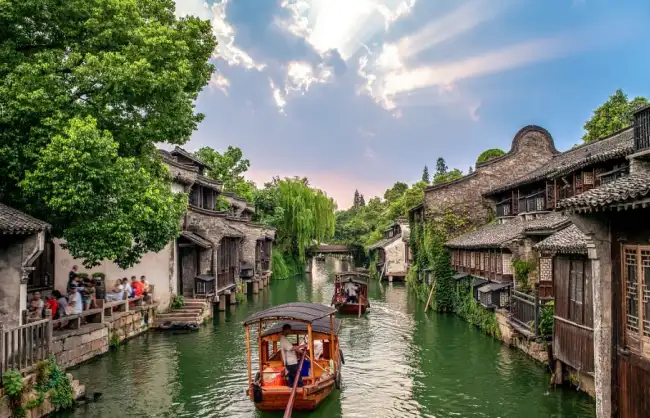
This six-day trip to Shanghai, Suzhou, and Hangzhou will allow you to experience the most beautiful scenery in eastern China. In the bustling metropolis of Shanghai, enjoy the towering city skyline...
Best Time to Visit
Comparatively, the best time to visit Longyou Caves would be summer. Due to their location underground, the temperatures inside the caves would be a little lower than on the ground. It makes them perfect places for avoiding the summer heat. However, the interior could be wet and slippery on rainy days, so make sure you take caution while walking on the wet steps. If you are interested in the scene of “skyscraper rising from the water”, it is recommended that you arrive around 8 am to catch the view.
Plan a Tour with China Xian Tour
Longyou Caves, together with other mysterious caves and grottoes in China, constitute not only beautiful natural landscapes but also intriguing cultural heritage and anecdotes that evoke countless imaginative interpretations. Now, your tour of Longyou Caves can be made to the utmost by combining them with other attractions nearby. For example, the Longyou Shiku – Fengxiangzhou Integrated Tourism Unit encompasses two 4A-rated attractions– Longyou Caves and Redwood Town, a thousand-year-old Buddhist temple, a Water Culture Park, and so on. If you are interested, explore the mysterious Longyou Caves and more charming attractions with China Xian Tour today!