
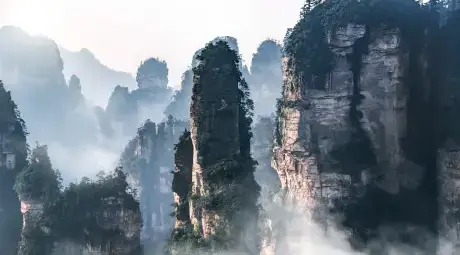


Mount Taibai (or Taibai Shan) is the main mountain peak of the Qinling Mountain Range. About 120 kilometers away from Xi’an, it is a mountain peak of great magnificence, situated in the adjoining area of Meixian, Taibai, and Zhouzhi counties of Shaanxi Provinces. With its highest peak-the Immortal Terrace thrusting 3, 767 meters high up into the sky, it is now a nature reserve of about 54,000 hectares.
Content Preview
- Travel Information
- History of Taibai Mountain
- Height of Mount Taibai
- What to See on Mount Taibai: Rich Natural Marvels
- How to Get to Taibai Mountain National Forest Park
- Attractions Nearby
Travel Information
- Location: Taibai Mountain National Forest Park, the intersection of Zhongxin Avenue and Yingbin Avenue in Tangyu Town, Meixian County, Baoji City, Shaanxi Province.
- Opening hours: 8:00-18:00 (Mar. – Nov.); 8:00-17:30 (Dec. – Feb.)
- Entrance fee: CNY 90 per person, the sightseeing bus in the park costs CNY 60 per person
- Highlights: Natural landscapes, historic sites, rich flora, thrilling hiking experience
- Recommended visiting time: 1-2 days
History of Taibai Mountain
Taibai Shan got its name quite a long time ago. According to a book entitled “Notes to Water-channels,” “During the reign of Emperor Wu of the Western Han Dynasty(206 B.C.-24 A.D.) there already was a sacred temple for the immortal Taibai in the consecration of Guchun, a deity in the list of immortals.” The “Jolts-down of Things Strange” says: The spirit of Venus failed down by the west of the main peak of Zhongnan Mountain, hence the peak was known as Taibai.
Height of Mount Taibai
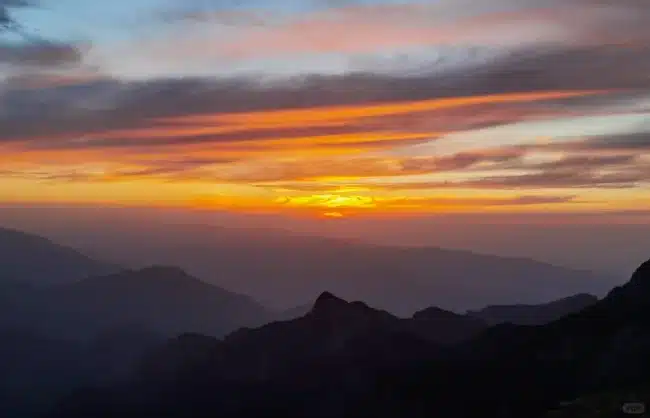
Thrusting very high into the sky, the mountain is covered luxuriantly with various kinds of trees and grasses. At a height of 3, 000 meters above sea level there has developed a glacier of the ending period of the fourth geological era. On the rely summit, four alpine lakes named the Pool of Jade Emperor are unfathomably deep filled with limpid and serene water. As the mountain is very high and with thin air, it enjoys a very cold climate with the peak clad in snow even in sweltering summer days.
What to See on Mount Taibai: Rich Natural Marvels
Various Plants & Rare Wild Animals
With silvery rays glistening in its surroundings, the scenery on the mountain is incomparably beautiful, hence known as Eternal White Mr. Taibai, one of the “Eight Scenic Wonders of Guanzhong Area. ” Covered with luxuriant forests crisscrossed by gurgling streams abounding in various kinds of birds and plants, the Taibai Mountain enjoys a charming scenery known as a natural treasure house of flora.
As it has a very high drop, the climate, soil and vegetation all see a rule of vertical distribution. Regarding the climate, it features a different of warm-temperate, cold-temperate and severe cold belts from the foothill upwards, and correspondingly it offers varied landscape of forests that consist of six belts growing with oriental arborvitae, oak, birch, spruce and larch as well as alpine bushes. The plant is rich in species that include 1, 500 kinds of seed plant and over 510 medicinal plants.
In addition, there are still varieties of such plants as larix potaninii, cercidiphyllum, japonocum var, sinense, 、azalea on Mount Taibai, most of which are classified into the second category under the state protection. Living in this area are 270 species of wild animals country. The fifth-five of the wild animals, such as giant panda, golden-halt monkey, antelope, salamander and golden pheasant are the very rare animals under the slate protection.
Unique Rock Formation & Natural Landscapes
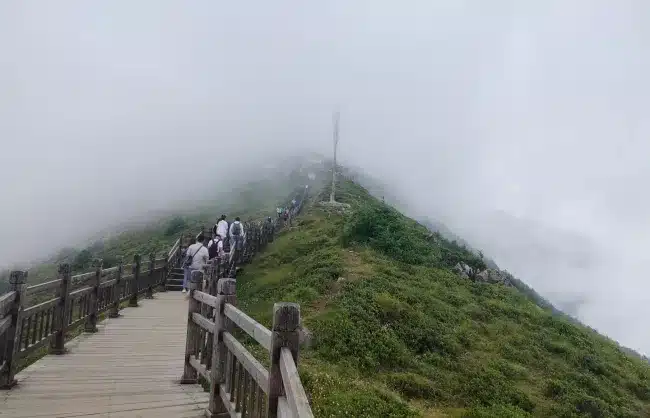
Studded in the Taibai Mountain National Forest Park are many grotesque attractions wrought by nature. You’ll find three forms of geomorphic terrain in the park, such as low, medium and high mountains consisting of deep Ravines, thrusting and weird peaks, and gurgling streams and brooks set off pretty scenic beauties.
Some of the notable geomorphic landscapes include the ” Cave of Guiguzi,” ever a dwelling place for the Old Master Wang Shan in the ” Period of Spring and Autumn and Warring States”, “Zhonglu Terrace” said to be the abode for Eight Immortals of Han Zhongli and Lu Dongbin, “Blue Ox Cave” which once been a reposing place at Tangling for Laozi, the founding master of Taoism in China when he was crossing Xuanguan on an ox.
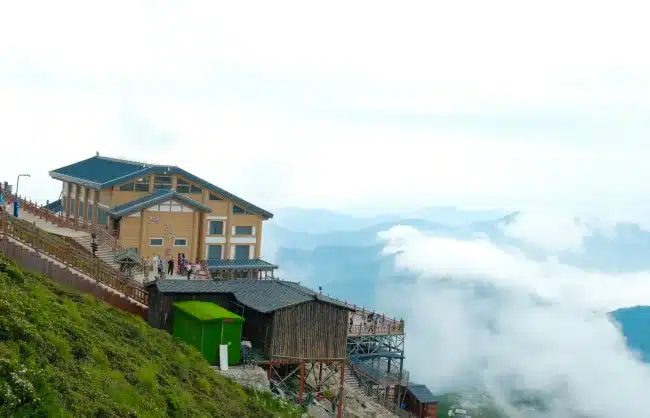
After undergoing planning and construction efforts in recent years, the Taibai Mountain National Forest Park has been enhanced with necessary facilities. It now boasts captivating scenic spots such as the Red River with Scarlet Cliff, Magnificent Pass in a Slanting Valley, Old Maples by a Stone Cavern, Peach Clouds and Brilliant Pearl at Taibai Mountain, and Summit of a Piercing Peak. These sites have long been revered as the Eight Scenic Spots, attracting tourists from far and wide to admire the natural beauty they offer.
Historic Sites
There is “Tangzicheng,” constructed by Emperor Xuanzong of the Tang Dynasty during his visit to the Tang Valley with his imperial consort Yang. Also, you will encounter a section of a ruined plank road, once used by Sun Simiao, a renowned master of medicine, to gather herbs in Taibai Mountain, among other historical sites.
Wonderful Hot Springs
At the entrance of the Forest Park there is a hot spring of three spring-mouths with an emitting volume of over 400 tons a day. With a temperature of approximately 60°C, this hot spring is known for its therapeutic properties, beneficial for treating various ailments.
How to Get to Taibai Mountain National Forest Park
- Take the Taibai Mountain Tourist Line from Xi’an Bus Station (opposite Xi’an Railway Station) to reach the forest park.
- Alternatively, from Xi’an West Bus Station, take a bus to Meixian County and then transfer to a public bus or taxi to reach Taibai Mountain.
Recommended driving routes:
- Route 1: Lianhuo Expressway – Jiangtang Road – Yingbin Avenue, with various speed limits and restrictions.
- Route 2: Lianhuo Expressway – Nanhuang Road – Xibao Middle Line – Lianhuo Expressway – Jiangtang Road, with fewer tolls but longer travel time.
- Route 3: Xixing Expressway – Lianhuo Expressway – Jiangtang Road, with shorter travel time.