







Jingbian Wave Valley is nestled in northern Shaanxi, offering a different kind of landscape from the classic attractions in Xi’an. It is renowned for its red sandstone Danxia landforms, especially the wave-like patterns and canyons. The landscape there looks quite similar to The Wave in Arizona, USA, attracting geology enthusiasts, photographers, and hikers.
However, Jingbian Wave Valley is too far from Xi’an for a day trip, since the drive takes about 5 hours. When you get there, you’ll need around 1.5–4 hours to explore the scenic area, depending on which route you choose and your walking pace. So it’s best to allow at least 2 days for the trip.
This guide covers what to see at Jingbian Wave Valley, how to get there from Xi’an, the best time to visit, itineraries, and travel tips.

Content Preview
- Facts
- What Is Jingbian Wave Valley?
- Is Jingbian Wave Valley Worth Visiting from Xi’an?
- What to See in Jingbian Wave Valley
- Which Wave Valley Route Should You Choose?
- How to Get to Jingbian Wave Valley from Xi’an?
- How to Combine Jingbian Wave Valley with Xi’an and Northern Shaanxi
- Best Time to Visit Jingbian Wave Valley
- Practical Tips for International Travelers
- Explore Jingbian Wave Valley with China Xian Tour
Facts
- Chinese Name: 靖边波浪谷
- Address: South of Wuyang Road, Jingbian County, Yulin City, Shaanxi Province
- Recommended Visit Duration:5–4 hours
- Ticket Price: CNY 90 (about US$ 13)
- Opening Hours: 8:30 – 17:00
What Is Jingbian Wave Valley?
Jingbian Wave Valley is a red sandstone Danxia landform, with curved and undulating rock layers. These wave-like formations are the result of weathering and water erosion over time.
One of the valley’s most distinctive features is the continuous pattern of curved lines and layers across the rock surfaces. These patterns look different depending on your viewing angle and the lighting.
If you’ve visited The Wave or Antelope Canyon in Arizona, some of the red rock formations and flowing lines here may look familiar. However, Jingbian Wave Valley is not simply a copy of either one. Its landscape ranges from broad Danxia formations and canyons to narrow rock crevices, surrounded by the Loess Plateau.
Is Jingbian Wave Valley Worth Visiting from Xi’an?
Whether Jingbian Wave Valley is worth visiting mainly comes down to how much time you have.
If you have 7–10 days or more in Shaanxi or are taking a longer trip around China, you can add it to a northern Shaanxi itinerary, especially if you enjoy natural landscapes, photography, or less-visited destinations.
With only 2–3 days for your trip to Xi’an, however, it’s usually not worth spending most of a day on the road just to visit Jingbian Wave Valley.
Here is a simple way to decide:
If You |
Recommendation |
Enjoy natural landscapes and photography |
It’s worth visiting. |
Are already planning to visit Yan’an or Hukou Waterfall |
It can easily fit into your northern Shaanxi trip. |
Only have a short stay in Xi’an |
It’s better to skip it.
With only 2–3 days in Xi’an, it’s better to focus on attractions like the Terracotta Warriors and Xi’an City Wall. |
Are traveling with elderly people or kids |
You can still visit, but choose a shorter trail. |
Simply put, Jingbian Wave Valley is better suited to a northern Shaanxi trip than a typical day trip from Xi’an.
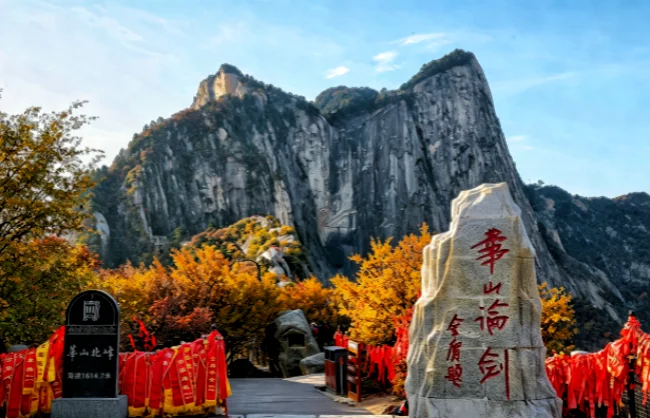
An 8-day Xian tour extending to Yan'an for Terracotta Warriors, Mount Huashan challenge, Hukou Waterfall and the stunning Wave Valley.
What to See in Jingbian Wave Valley
Flame Danxia
This is one of the best places to see the wave-like formations that give Jingbian Wave Valley its name. The red sandstone is covered with numerous curved, wave-like patterns, which are ideal for close-up observation and photography.
In the afternoon, the softer light makes the undulations of the rock layers more noticeable. It’s also a good time for photography.

Red Cliff Danxia
Here you can see larger red cliffs and canyons. Compared to Flame Danxia, this area is better for photographing the landscape as a whole rather than just rock details.

Earth Core Danxia & One Line Sky
The highlights here are the narrow canyon and the One Line Sky formed between the rock walls. When sunlight comes through the narrow opening above, it creates a strong contrast between light and shadow.
If you enjoy canyon photography, you’ll find this area more immersive than the Wave Viewpoint.
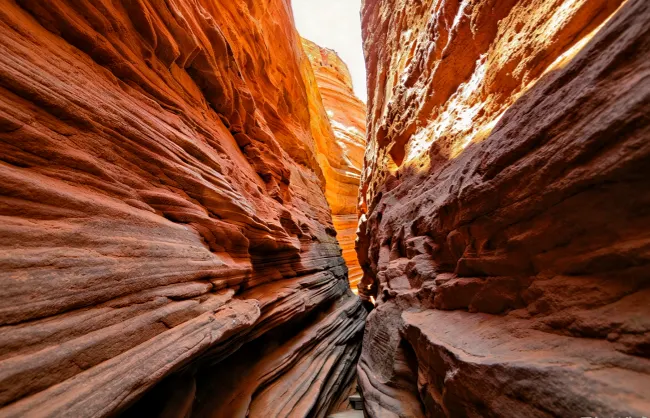
Kilometer Gallery
As the trail unfolds, the scenery changes along the way, bringing together red sandstone, canyons, and the surrounding Loess Plateau landscape.
The real highlight is seeing how the rock layers and landforms shift from the foreground to the distance.

Which Wave Valley Route Should You Choose?
There are two routes to choose from at Jingbian Wave Valley. One is a shorter route, while the other is a longer loop trail. Allow about 1.5 to 4 hours, depending on the route you take.
Short Route: About 1.5–2 Hours
Entrance → Glass Bridge → Flame Danxia → Flowing Wave Viewpoint → Wave Viewpoint → Return the same way
This route mainly follows flat wooden boardwalks. Taking around 1.5–2 hours, it suits visitors who prefer less walking. Yet, it does not cover all the scenic spots.
It is ideal for:
- The elderly and children
- Visitors who want to follow an easier route
- Visitors who are short on time
- Visitors who are mainly interested in photographing the main attractions

Main/Long Route: About 2.5–4 Hours
Entrance → Flame Danxia → Red Cliff Danxia → One Line Sky → Earth Core Danxia → Kilometer Gallery → Dragon Heart Bridge → Exit
This is a one-way loop of about 5.8 km, so you won’t need to retrace your steps.
It is ideal for:
- First-time visitors
- Visitors who are comfortable with longer walks
- Photography enthusiasts
- Visitors who want to see a wider variety of landscapes
If you’ve already spent several hours traveling from Xi’an, the longer route makes the journey more worthwhile if your schedule allows.
For those having knee problems or little experience with long walks, the shorter route is easier to handle.

How to Get to Jingbian Wave Valley from Xi’an?
Transportation is the top thing you should plan in advance.
Option 1: Private Car / Chartered Vehicle
The drive from Xi’an to Jingbian Wave Valley takes about 5 hours. In the case of heavy traffic or bad weather, the drive may take even longer.
For first-time visitors to China who don’t speak Chinese, a private car or chartered vehicle makes it easier to manage your time while visiting Jingbian Wave Valley and other northern Shaanxi attractions.
If you need a private car service, please feel free to contact us.
Option 2: High-Speed Train + Local Transfer
You can take a high-speed train from Xi’an North Railway Station to Jingbian Railway Station, and then transfer to a local vehicle for the rest of the journey. The train ride is about 2.5–3 hours. After that, it’s about a 30-minute drive to the scenic area. Train schedules and local transfer options may vary, so it’s best to check them for your travel date in advance.
This option is doable, but the train only covers the main part of the journey. From Jingbian Station, you’ll still need a local ride to the scenic area.
So, even though taking a high-speed train can shave off some travel time, it doesn’t necessarily make the entire trip easier. The transportation back to the station or onward to your next destination should also be planned in advance.
How to Combine Jingbian Wave Valley with Xi’an and Northern Shaanxi
The biggest challenge with Jingbian Wave Valley is that it sits quite far from Xi’an. It’s easier to fit Jingbian Wave Valley into a longer northern Shaanxi trip than to visit it on its own.
3 Days: Xi’an → Yan’an → Jingbian Wave Valley → Xi’an
For first-time visitors to northern Shaanxi, this itinerary is a solid choice. It combines Yan’an’s revolutionary history and culture with the natural scenery of Jingbian Wave Valley.
4 Days: Xi’an → Yan’an → Jingbian Wave Valley → Hukou Waterfall
With four days, you can head north from Xi’an to get a fuller picture of northern Shaanxi. Along the way, you can learn about Yan’an’s revolutionary history, see the Danxia landscape at Jingbian Wave Valley, and take in the Yellow River at Hukou Waterfall.
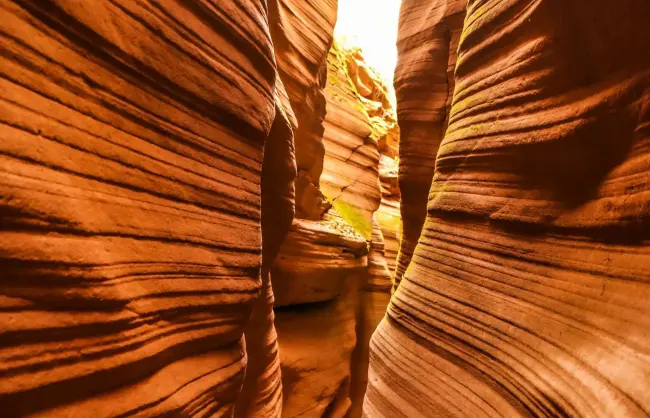
A 4-day Shaanxi exploration of Yucha Grand Canyon, Wave Valley, Flaming Danxia and the thunderous Hukou Waterfall.
Best Time to Visit Jingbian Wave Valley
Best Seasons: Spring and Autumn
Spring and autumn have milder weather than summer, so it’s more comfortable to spend several hours outdoors.
Summer
The summer sun can be intense, and there is limited shade in the scenic area. Try to avoid long walks around midday, and bring a sunhat, sunscreen, and plenty of water.
Winter
Winter is cold and can be windy, but there are usually fewer visitors. When visiting in this season, always check the weather and road conditions before you set out.
What Is the Best Time of Day for Photos?
For the best photos, visit Jingbian Wave Valley in the early morning or late afternoon, and try to avoid the middle of the day. With the sun lower in the sky, the rock formations cast stronger shadows, bringing out more of their texture. Flame Danxia, in particular, can look stunning in the warm light around sunset.
Once the weather clears after rain, the rock colors often look more saturated, though the trails can turn slippery at the same time.
Practical Tips for International Travelers
Wear proper shoes.
Some trails may have loose gravel, and the ground can get slippery after rain. Skip flip-flops and smooth-soled shoes. Sneakers or hiking shoes with good traction will serve you better.
Bring water and snacks.
There aren’t many food options inside the scenic area, so bring enough water and some simple food.
Stay protected from the sun.
There’s little shade in the scenic area, so bring sunscreen, sunglasses, a sunhat, and a light jacket.
Save your route offline.
Cell phone reception may be unreliable in some of the canyons. It’s safer to save the scenic area map, your hotel address, and your return transportation information in advance rather than rely on an Internet connection when you need them.
Stay on official trails.
Red sandstone is relatively fragile, so please don’t climb over railings, scale rock faces, or walk into areas that are not open to the public. Recent visitor notices have also specifically warned visitors not to follow anyone into undeveloped areas that are closed to the public.
Consider skipping optional paid attractions.
Based on the feedback from our guests, the view of the Flame Danxia from the trail below is very similar to what you see from the Glass Bridge, so you can skip the Glass Bridge if you want to save the extra cost (CNY 50 / US$ 7).
Check the weather before you go.
This is more important than simply knowing the best month to visit. Jingbian Wave Valley is a typical outdoor natural attraction, so the weather directly affects lighting, photography conditions, perceived temperature, trail conditions, and your long journey to and from the scenic area.
Therefore, on the day of your trip, it’s best to check the weather forecast for Xi’an, Jingbian, and the Wave Valley before heading out.
Explore Jingbian Wave Valley with China Xian Tour
Jingbian Wave Valley is a great choice for travelers who enjoy natural landscapes, photography, and in-depth travel experiences.
If you’d like to explore more of northern Shaanxi from Xi’an, China Xian Tour can help you plan an efficient itinerary that includes Jingbian Wave Valley, Yan’an, Hukou Waterfall, and other nearby attractions, so you don’t have to worry about transportation or planning your time.


