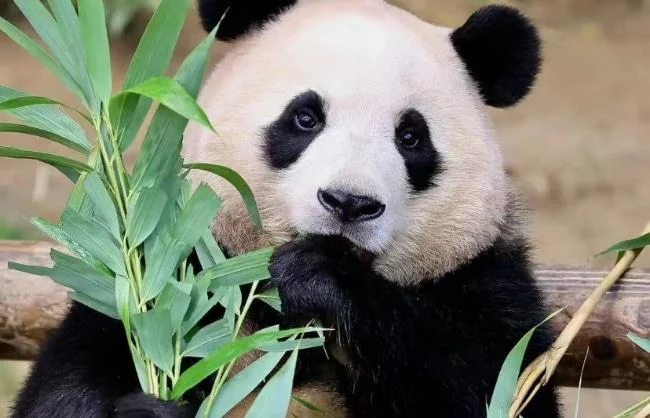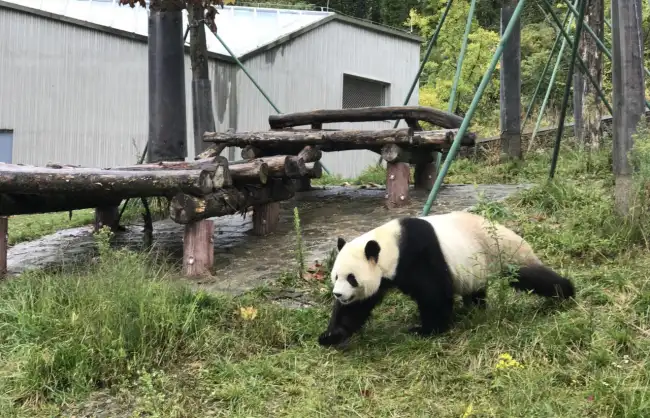






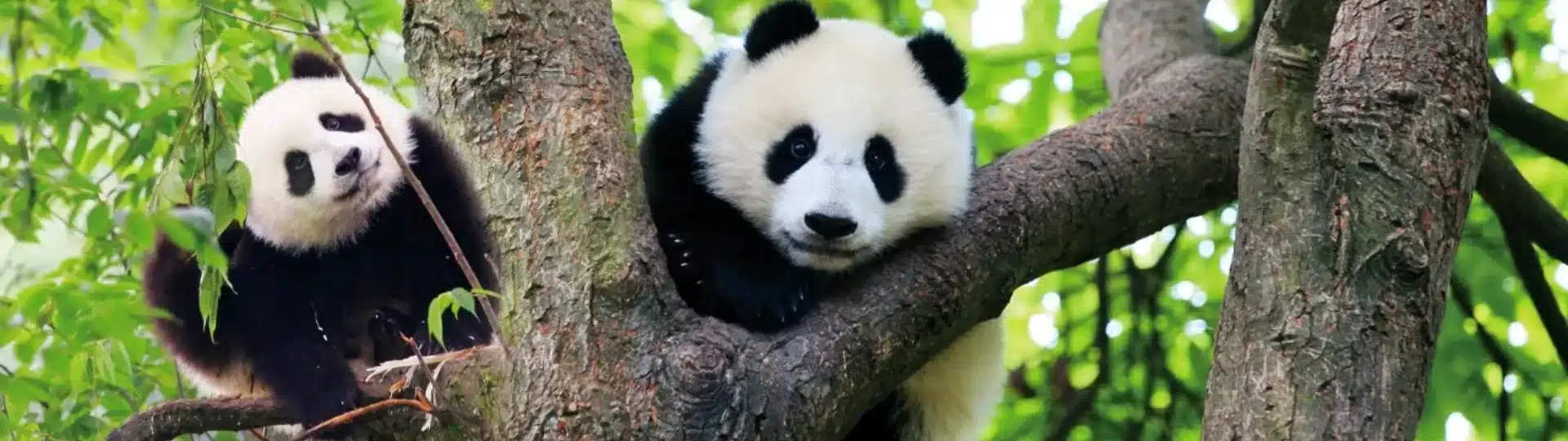
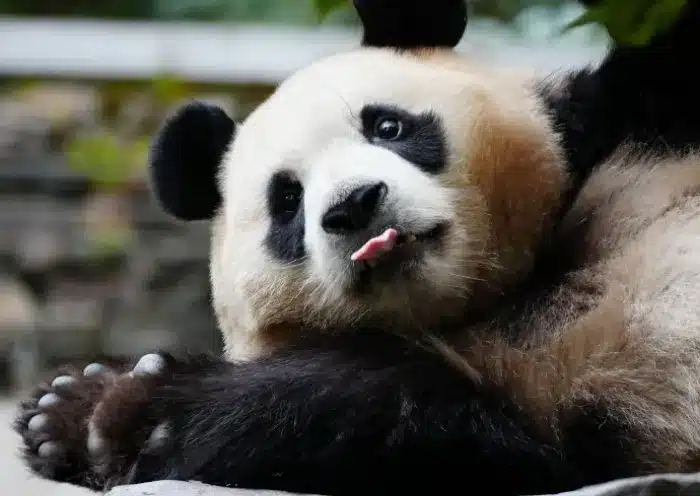
Giant panda is a rare animal exclusive to China. It, as a national treasure, is widely known for its black and white fur, round body, and tame personality. The daily diet of giant pandas is dominated by bamboo. They are mainly distributed in bamboo forest in Sichuan, Shaanxi and Gansu.
Studying the facts of Giant pandas’ behaviors has a big role to play in environmental protection, ecotourism and panda’s conservation. As an umbrella species, it can maintain biological diversity.
For those who are planning a panda tour in China, this article about pandas’ behaviors should be an informative guide for you to get more educated and enhance your panda experience. Read on to learn its daily habits, behaviors of sleeping, eating and communication.
Content Preview
- Why Study Giant Pandas’ Behavior?
- Daily Habits of Giant Pandas – Core Survival Behaviors
- Pandas’ Sleeping Behaviors
- Movement & Physical Behaviors
- Feeding Behavior of Giant Pandas
- Social Behavior and Communication
- Mating and Parenting Behavior
- Play and Enrichment Behavior
- Giant Panda Behavioral Adaptations
- Giant Pandas Seldom Attack Men or Other Animals – With Docile Temperament
- Wild vs. Captive Panda Behavior
- Where to Observe Panda Behaviors in China
- FAQs about Panda Behaviors
- Plan Your Panda Tour with China Xian Tour
Why Study Giant Pandas’ Behavior?
China now boasts six major panda bases and they are mainly distributed in Sichuan Province. The research of giant panda’s behaviors is of great significant to the panda’s conservation. Their living habits, eating behaviors and ways of looking for food provide valuable insights for choosing locations of panda bases and are conducive of their daily care. With the progress of the research, the rate of success of artificial breeding is correspondently improved largely.
For common visitors, learning about giant panda’s behaviors can largely enhance your experience. For example, if you want to meet baby pandas, you should know the time when they matting and giving birth. If you want to see the pandas when they are most active, learning their eating and sleeping patterns will help you choose the right time.
Daily Habits of Giant Pandas – Core Survival Behaviors
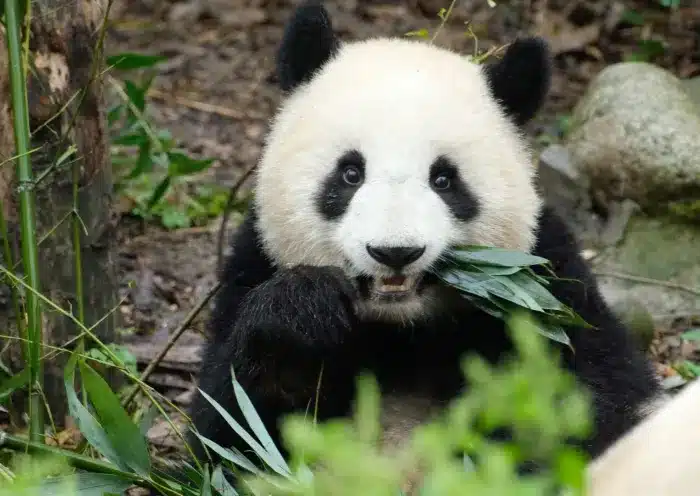
Giant pandas will spend 10-16 hours on eating food each day so as to maintain enough energy. They generally consume 10-40 kilograms of bamboo shoots, leaves and stems per day. Of course, they also prey on bamboo rats or pick berries.
After meals, they often fall asleep for two to four hours, with a total sleeping time of about 10-12 hours per day.
Adult panda will climb a tree to take a nap, but their cubs will sleep in tree holes or caves for safety.
Giant pandas have a pigeon-toed walking to reduce bone pressure. They have fewer daily activities and move slowly to lower consumption. When the weather is hot, they like to go for a paddle or swim.
Giant pandas get accustomed to living alone unless they are breeding. The territory scope is about 5-10 square kilometers.
Learn more details about giant pandas’ facts if your are interested.
Pandas’ Sleeping Behaviors
Adult pandas will sleep 10-16 hours each day. Affected by oestrus, their sleep will be decreased to 8-10 hours. Panda cubs will have a longer sleep time up to 18 hours each day. Wild giant pandas usually sleep 2-4 hours after feeding, with a total sleeping time up to 10-12 hours.
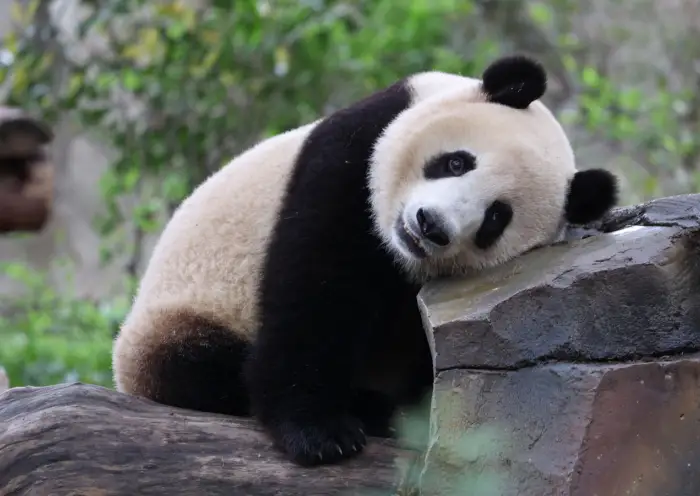
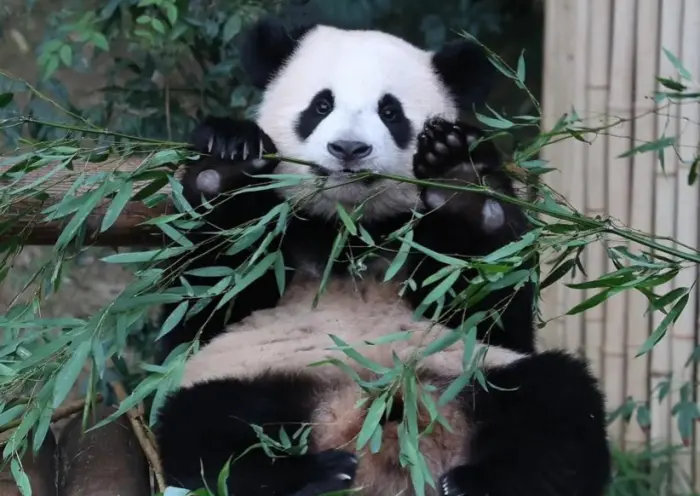
When they sleep, giant pandas will curl into a ball, lie down in tree holes or on the rocks, lie on the side, or hang on the trees. You may find that captive pandas snooze with a bamboo clamped between its teeth.
The sleep habits of giant pandas can slash metabolic consumption and make up energy gap. The intestinal peristalsis will get slow while sleeping, thus keeping food and raising the digestive efficiency of fibres.
Comparing with pandas, other bears are more omnivorous and eat meats and plants. They have a flexible habit of hibernation. And, their energy distribution is more effective.
Movement & Physical Behaviors
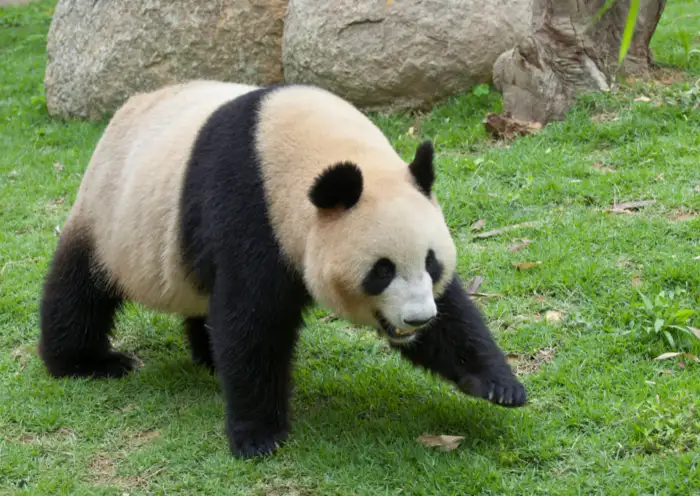
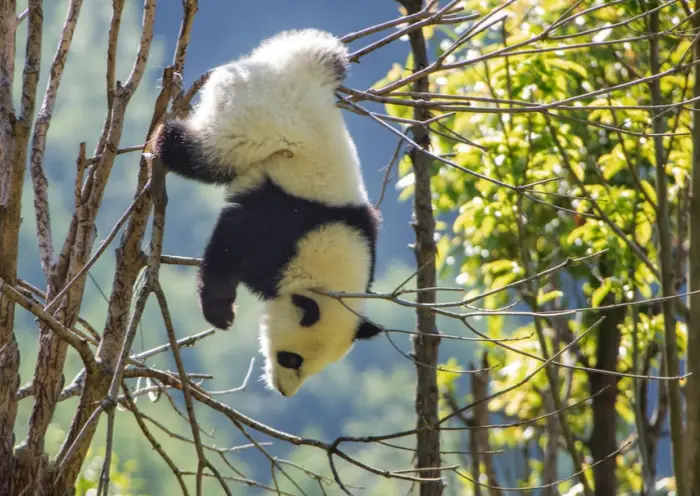
Pandas have pigeon toe. It can help pandas consume less energy and reduce pressure on skeletons. If pandas climb abrupt slopes, this gait can improve balance and protect them against slip. Also, giant pandas frequently climb tress to dodge dangers or have fun.
In dense bamboo forest, giant pandas will mark territory with urine and perianal gland secretion. They even intensify signs by peeling barks or leaving scratches. Their odor is conducive to keeping away from the same kind or seeking for spouse.
Feeding Behavior of Giant Pandas
The feeding behavior of giant pandas is a highly specialized adaptation strategy. They have an overlong feeding time, supersize appetite, and inefficient digestion.
Panda Eating Behavior: What do Giant Pandas Eat?
Giant pandas mainly feed on bamboo, which account for over 95% of total food consumption. Pandas’ food preferences vary due to seasonal changes. They favor bamboo shoots in spring. They like bamboo leaves in summer and autumn. They prefer bamboo stems in winter. Besides, they will eat berries and small animals.
How Often and How Much Do They Eat?
Giant pandas will spend 12-16 hours on eating 17-40 kilograms of bamboo each day. But, it doesn’t mean they are lazy. Due to special digestive system, they can only absorb 17%-20% of nutrition from bamboos. This is why they have to keep eating five or six times per day.
Social Behavior and Communication
Giant pandas follow the energy-saving social strategy. They have perianal gland secretion and urine mixed to have a non-contact social interaction.
The model of 99% solitude + 1% a high-intensity social contact strike a perfect balance between energy limitation and reproductive demand. They can be rated as the evolutionary masterpiece of lonely survivors.
Are Giant Pandas Solitary or Social? – They Like Being Alone
Giant pandas are solitary animal. They like stay alone and have a strong territorial instincts. Generally, they begin to live independently when they are 1.5-2 years old.
The captive pandas in panda bases and zoos are usually raised separately when they’re just over 3 years old. Yes, there is not always the case, with some exceptions, like the famous panda, Hua Hua.
How Pandas Communicate
There are three main ways to have communication among giant pandas.
The first is scent marking. They will have urine to mark territory, disseminate individual information and even avoid conflicts.
The second is vocalization. Giant pandas will make different sounds to express their intentions, such as starvation, courtship and terror, etc.
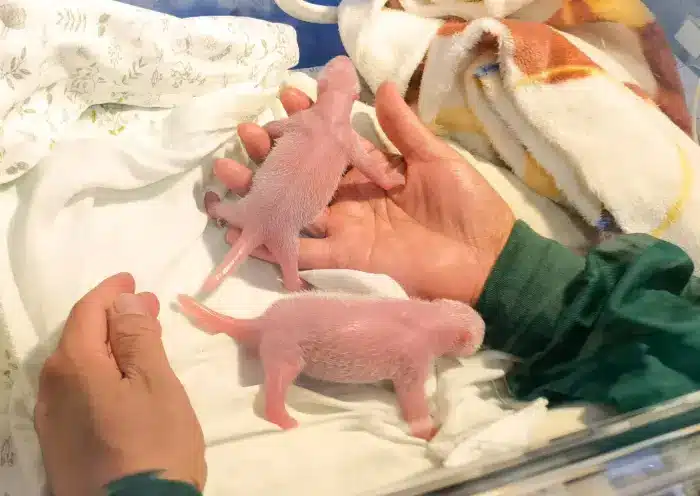
The third is tactile sensation. This is particularly important for the nurturing period. The newborn cubs completely depend on mother’s body temperature, lick and hug.
Mating and Parenting Behavior
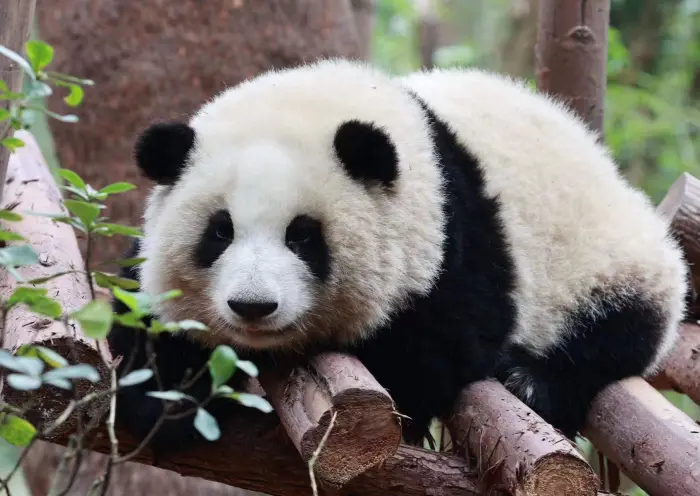
The mating and parenting behaviors of giant pandas is characterized by the demanding mate selection and ultra-long term of parenting.
Female pandas will precisely screen out spouse based on odor and sound. They will take care of their cubs for 24 months from the birth until their cubs stay independent.
Brief Annual Mating Window (March-May)
The mating window of giant pandas is mostly from March to May each year. The oestrus of female pandas only lasts 2-3 days. The best mating window is even as short as 1-3 days.
Female pandas will lure male pandas by means of scent marking and the sound of bleat. Male pandas will fight for the right of mating, but the final mating is decided by female pandas.
Mother’s Intensive Cub Care (18-24 Months)
Taking care of newborn cub is not an easy task. Panda mother’s behaviors may change during this time. Here is a table for your reference.
Time |
Care |
5-6 days after delivery |
Panda mother continuously keeps a cub in its arms to avoid hypothermia. It neither eats food nor drinks water during this time. |
6-8 weeks |
Panda baby can feel external light. |
1month |
Panda baby will have black fluff around ears and eye rims. |
3 months |
Panda baby can budge within a short distance. |
6 months |
Panda baby can imitate mother to eat and learn climbing trees. |
1-2 years old |
Panda mother will bring its cub to a large region and teach it how to look for food and water, and avoid dangers and predators. Panda baby will develop permanent teeth and mainly feed on bamboo. |
One and a half years old |
Panda baby gains weight more than 50 kilograms and feel less dependent on mother. |
2 years old |
Panda baby can stay independent completely. |
Play and Enrichment Behavior
In natural environment, pandas will have many playful behaviors. They like to climb trees, hang themselves upside down in trees, plash around along the stream, roll in the snow, or play alone.
The captive surroundings are relatively mundane. Captive pandas may have stereotypic behaviors and further suffer from anxiety and depression. The enrichment activities in captive settings can help pandas alleviate psychological pressure, improve immunity to avoid diseases, and acquire survival skills.
Giant Panda Behavioral Adaptations
To find out optimal bamboo, giant pandas will have seasonal migration in the area with an elevation of 2500-3500 meters. In winter, giant pandas have no habit of hibernation. They will go to regions with low elevation so that they can get enough foods and water. To avoid heat, giant pandas will have a rest more than six hours in summer.
The pseudo-thumb of giant panda is a case in point of functional specialization. It is a meat structure on sesamoid bone of radial side. Although it is not a real finger and cannot function independently, it can work with other five fingers to grasp bamboo stems, buffer pressure and reduce energy consumption.
Giant Pandas Seldom Attack Men or Other Animals – With Docile Temperament
Giant pandas live mainly on bamboo. They don’t need to prey on meats, so they are less aggressive towards other animals.
Wild giant pandas often live alone in the bamboo forest and stay cautious. They actively stay away from areas with insidious threats. Besides, they partly take men as innocence and even ask for help since forest rangers regularly provide food.
Giant pandas in captive are generally mild because they are frequently exposed to body odor o human.
Wild vs. Captive Panda Behavior
Daily Activities of Wild and Captive Pandas
Wild giant pandas are adept at climbing cliff and crossing a river. They will trek to look for food, so they have a strong physique. Giant pandas in captivity heavily depend on artificial feeding. Due to a limited space and the lack of exercise, zookeepers usually employ various “enrichment” measures similar to wild habitats of pandas to avoid their stereotypic behaviors and obesity.
To maintain natural habits of giant pandas, efforts are made to optimize captive environment, such s providing steep slopes, rocks, trees and shrubs to copy complex terrain in the wild, giving a sense of security by spraying urine and feces of giant pandas to cover human odor, supplying various fresh bamboo species, and hiding foods to simulate foraging.
Eating Behavior Difference
The wild pandas need to spend around 12-16 hours to search for their favored bamboo. They need to walk for sevearl kilometers per day to search for food. Since the distribution of bamboo changes with seasons, they don’t always search for food or in the same place. Also, they often don’t have a fixed residence and migrate with the change of season.
Compared to wild pandas, captive pandas can get nutritious and diverse meals easily from zookeepers. They don’t need to search for food, thus have shorter feeding time (usually 6-8 hours) and longer time for playing and sleeping.
Difference in Social Habit
Wild pandas are quite isloated and have very little contact with each other. They establish their territory by scent markings and only seek out a partner during the mating season. When other pandas enter their territory, they will be wary and chase the other away.
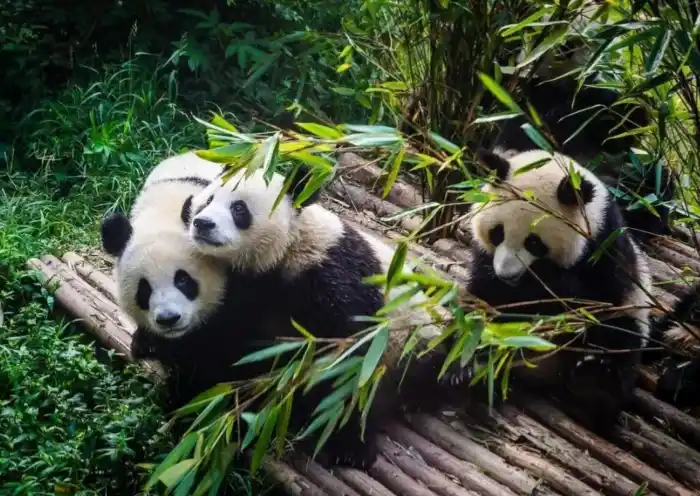
In contrast, captive pandas have lively social interaction with their companions. They often share food and toys to add enjoyment.

Where to Observe Panda Behaviors in China
The best places to observe panda behaviors in China are natural reserves and research bases in Sichuan, Shaanxi and Gansu. You will have a chance to see different behaviors and habits of wild and captive pandas.
Best Research Bases for Behavior Watching
If you are interested in captive pandas, you are recommended to visit Chengdu Panda Base in Sichuan. You can have a close look at the way that giant pandas grip bamboos with pseudo-thumb, nurture cubs, climb trees, eat foods and fall asleep. In the nursery room, you can find interactions between mother pandas and baby pandas.
If you are interested in wild pandas, Bifengxia Panda Base in Ya’an city will be a nice choice. You will find that panda cubs learn the way to climb trees. On your journey of pandas, you can make an attempt to be a volunteer. This will give you an opportunity to clean the living room of giant pandas, feed pandas under the instructions of workers, and disseminate knowledge of raising giant pandas.
If you want to learn the preparation work for pandas’ wilderness survival training, you can go to Dujiangyan Panda Valley. You can find pandas play out in the open and splash around along the river.
Optimal Viewing Times
Giant pandas have their own activity-rest rhythm. If you want o observe pandas as much as possible, you need to focus on the optimal viewing times. Here is a time table for your reference. To avoid peak period, you are advised to watch giant pandas in the morning of working days during spring and autumn.
Season |
Optimal Time |
Highlights |
Spring and Autumn |
8:00-10:00 |
potential mating behaviors, eat food, climb trees, play active |
Summer |
7:30-9:00 and 15:30-17:00 |
Indoor activities to avoid summer heat |
Winter |
10:00-12:00 |
Play in the snow |
FAQs about Panda Behaviors
Why do pandas eat so much bamboo if it’s not very nutritious for them?
In general, it is the result of adapting to the environment during the process of evolution. In the wild, bamboo is widely distributed and easily accessible, and pandas do not have to compete for food with other fierce animals. Compared with other plants, bamboo also has a higher content of starch, which can provide more energy for pandas.
Do pandas ever eat anything besides bamboo?
Yes. Although bamboo accounts for about 99% of the total food for giant pandas, they also eat something else. Pandas living in the wild also eat other plants and animals. While for pandas under artificial captivity conditions, concentrated feed, fruits and vegetables will also be offered to them to ensure a balanced diet.
How do pandas conserve energy to survive on their low-energy diet?
Through thousands of years of evolution, pandas retain the short digestive tract, resulting in low digestive efficiency. And some of the organs requiring high energy consumption were significantly shrunk, such as the brain, liver and kidney. To save energy, pandas also spend more than half of the day resting. Therefore, their daily energy consumption is extremely low. The metabolic level is even less than half that of humans of the same weight. Their thick fur can effectively reduce the loss of body heat, help maintain body temperature and further lower the energy consumed for keeping warm.
Why do pandas engage in “handstands” when they urinate?
In fact, it is a kind of communication method. In mating season, the male giant panda will sprinkle urine onto tree trunks by doing handstands. The higher it urinates, the more likely it is strong and tall. Through this way, they can attract the attention of the female pandas. Another important function is to declare their own territory. By sprinkling urine onto a higher place, they can mark their smell in a more prominent position and warn other male pandas to stay away.
Do pandas hibernate like other bears?
No, pandas do not hibernate, because the bamboo can still be found in winter, so they do not have to hibernate to avoid food shortages. And pandas are very clever, they usually eat the sections with relatively high starch content in winter, such as bamboo poles. So they are able to get through the cold winter.
Do pandas ever attack humans?
Although pandas are lovely and look mild, they are wild animals. So if they are threatened, want to protect their cubs, or during estrus period, they may attack humans. No matter you encounter them in the wild or go sightseeing in the park, keep a safe distance and do not try to feed them.
Plan Your Panda Tour with China Xian Tour
The pictures and videos can’t compare to real life. Meeting the adorable pandas in close proximity will surely give you once-in-a-lifetime experience. As China insiders and panda lovers ourselves, we know where to see the giant pandas in wild and semi wild habitats, and how to arrange a convenient and efficient panda visit based on your preferred destinations and special requirements. We have carefully crafted a wide range of China panda tours to satisfy travelers of different style, and also welcome you to contact China Xian Tour to customize your exclusive panda experience.