

Real Colors of the Terracotta Warriors and Horses
Written by Clementine |
In 1974, Chinese archaeologists carefully removed a thick layer of more than 2,200-year-old loess in Lintong District, Xi’an, by using shovels, brushes, and cotton swabs and revealed a mysterious underground army that shocked the entire world. Yes, you must have guessed, this underground army is none other than the world-famous Terracotta Army, which is regarded as one of the greatest archaeological finds of the 20th century.
Content Preview
- The Terracotta Warriors Used to be Colorful
- Why Were They Painted in the First Place?
- How Many Colors Do the Terracotta Warriors Have?
- What Materials Were Used to Create These Pigments?
- What Caused the Color Fading
- Protection for the Terracotta Army
- Why Have Excavations of the Terracotta Army Mostly stopped?
- Colorful Pictures of the Terracotta Warriors
- Explore More Stories behind the Terracotta Army with Chianxiantour
The Terracotta Warriors Used to be Colorful
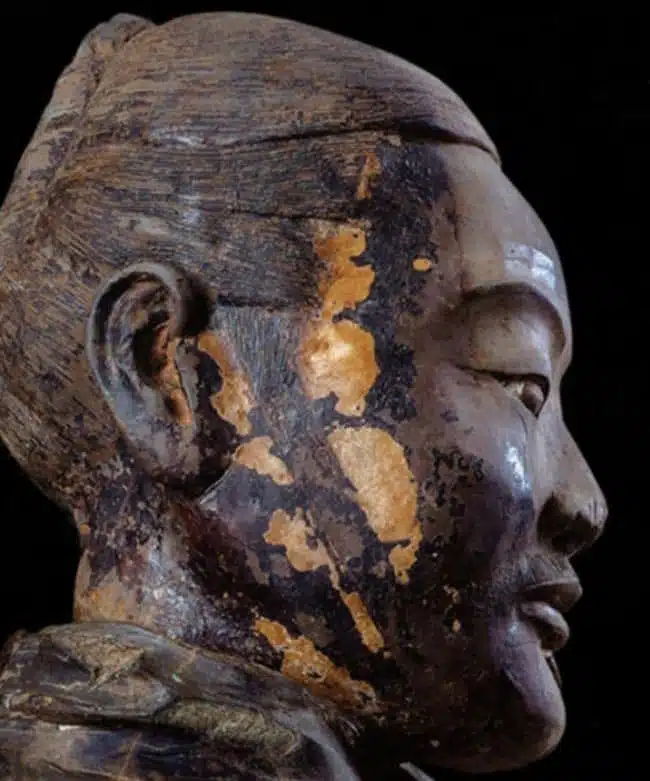
The first time when they are excavated, the terracotta warriors with different facial expressions seemed to be still protecting the Great Qin Empire. However, one regret in this remarkable discovery is that the pigments on the clay warriors began to change in 15 seconds after they were unearthed, and what followed was serious dehydration, warping and peeling.
According to the director of the Department of Cultural Relics Protection at the Terracotta Warriors and Horses Museum, “The only thing one could do was standing in awe, and you didn’t even have time to take photos before the colors vanished into the air”.
So, are there any warriors that still have some of their original color? Can you see them when you visit the museum?
Yes, but it is very rare, so to make up for the pity of on-site visits, the Museum has a permanent exhibition of “True Color of Terracotta Army” or similar themes. Through high-resolution pictures, physical restorations, restored painted fragments and multimedia technology, it vividly presents the original, colorful appearance of warriors.
Why Were They Painted in the First Place?
The fundamental objective is to simulate a real army. So the appearance, attire, and weapons are all aimed to replicate a real military formation. And the color can enhance the visual impact and liveliness. Besides, it can reflect the hierarchical system of the army. The colors of the high-ranking officers are more diverse and vivid, while those of ordinary soldiers are relatively simple.
How Many Colors Do the Terracotta Warriors Have?
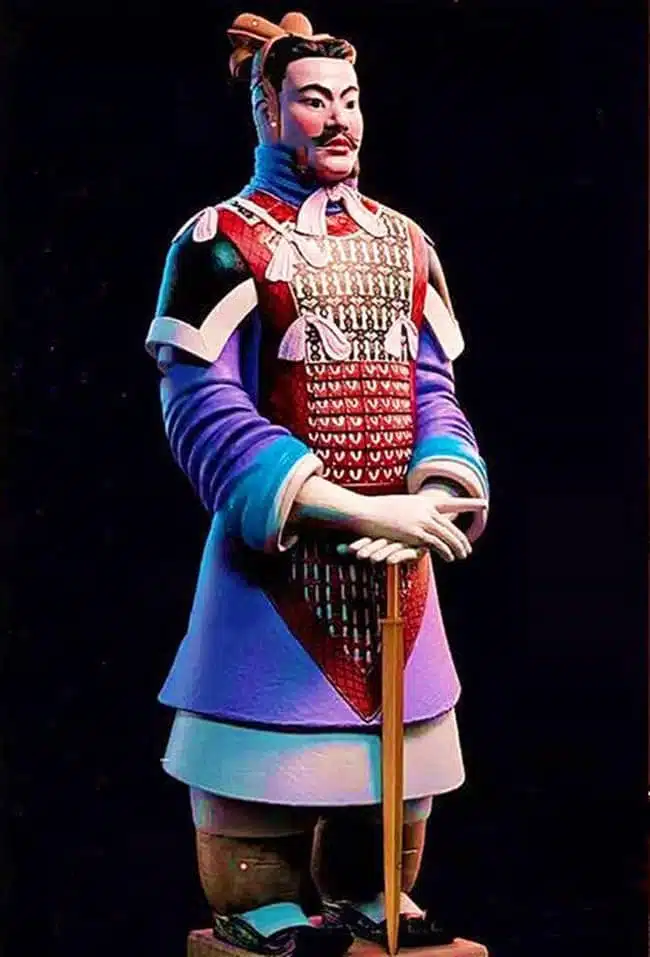
Originally, when the Terracotta Warriors were made, they were painted in vibrant colors, with their surfaces adorned in shades of vermilion red, purple, pink, green, lavender, blue, orange, black, white, and more. But, after excavation the beautiful colors only lasted for a few minutes.
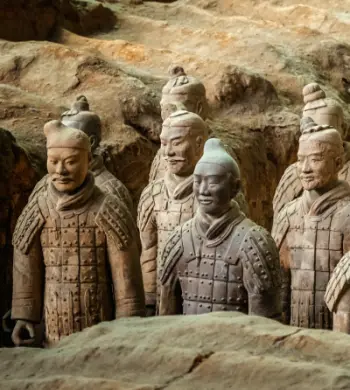
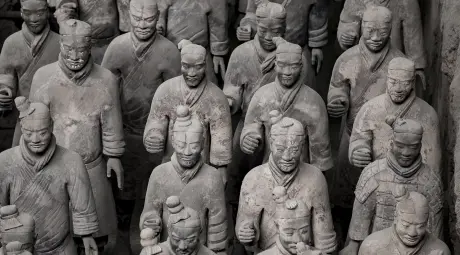
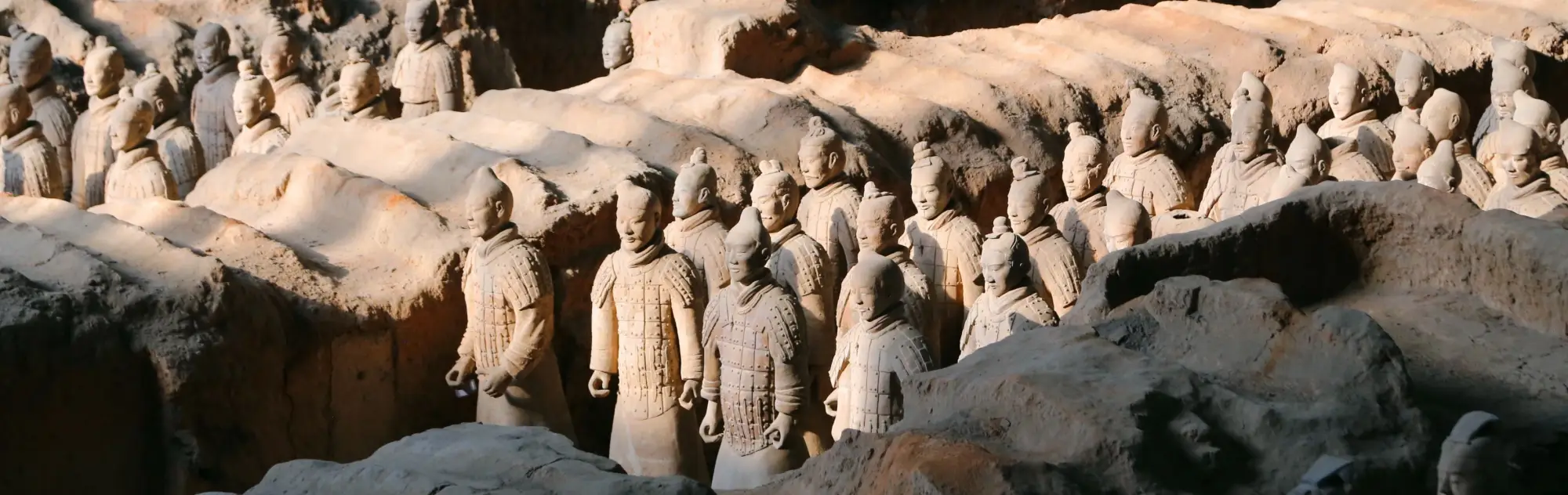
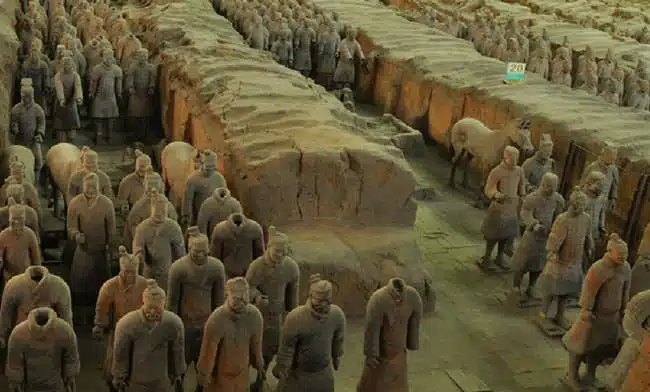
Now what we can see in the museum is rows and rows of gray life-size terracotta warriors standing in the giant pits. Although the warriors themselves are of significant value and definitely worth a visit, they look a bit too monotonous in color. If we could turn back the hands of time, we would see terracotta warriors in different colors, such as red, green, blue, white, purple, etc.
What Materials Were Used to Create These Pigments?
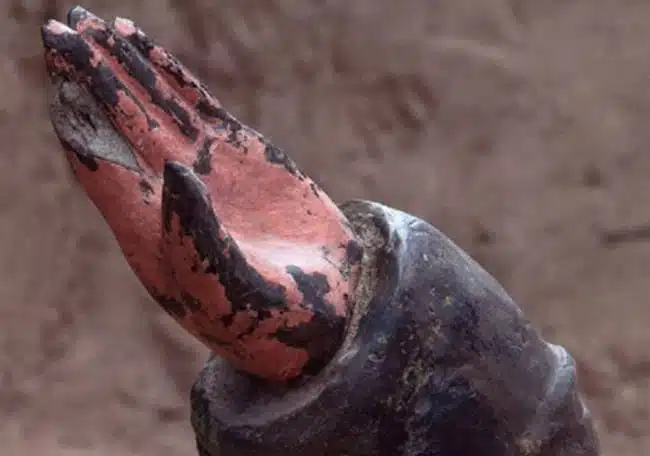
Almost all pigments are derived from natural minerals, including Cinnabar, Malachite, Azurite, Carbon Black, Bone White, Ochre, etc. And only some require complex artificial synthesis, such as Chinese Purple, which has not been discovered in nature till now.
What Caused the Color Fading
What caused the color fading of the Terracotta Warriors? The main reason is environmental change, and subsequent preservation efforts have also faced challenges from microorganisms and soluble salts.
The Terracotta Warriors were buried underground for over 2,200 years in a relatively stable environment. After excavation, the oxygen in the surrounding air reacted with the pigments soon. Additionally, the dramatic fluctuations in temperature, humidity, and light also damaged the pigments.
The colors on the warriors were painted with pigments and raw lacquer. Though the raw lacquer is resistant to corrosion, heat, and moisture, the durability and preservation properties of the raw lacquer are limited. Over time, it tends to lose moisture and shrink, resulting in the pigment layers peeling off.
Under an electron microscope, researchers can observe clusters of white “flowers” bloom on the surface of cultural relics. That is mold spore. It widely exists in the air and soil, and it will grow rapidly at certain temperature and humidity. Some molds will secrete pigments and produce harmful substances like acid and alkali which get deposited on the surface of cultural relics, affecting the appearance of cultural relics and causing damages.
In addition, there is a layer of frost-like soluble salt on the surface of painted ceramic relics which can do irreversible damage to cultural relics. A slight change in temperature and humidity will make soluble salt repeatedly crystallize and dissolve, aggravating the peeling off of the surface.
Protection for the Terracotta Army
Because the colors tend to fade easily, colored terracotta figures are rarely put on public display. Therefore, normal tourists have little chance to admire those with colors.
When the terracotta warriors were first excavated, there were no proper solutions to keep the colors.
How do scientists and conservators preserve the colors today? To prevent the fading of the Terracotta Warriors’ colors, conservation experts have implemented several effective measures, such as using high-molecular polymers to moisturize the figures and employing advanced technologies to monitor and protect the figures.
A refined method that combines “rescue” on-site protection with laboratory restoration has been developed by the scientists and conservators. That is to say, at the time a painted warrior or fragment is unearthed, they will use moisturizers, consolidation solution and plastic film to delay its degeneration. After being transferred to the laboratory, experts will analyze the composition and conservation status through technological means like microscopes, chemical analysis, and X-ray fluorescence spectrometers. Then clean, reinforce and reattach the pigment carefully.
Why Have Excavations of the Terracotta Army Mostly stopped?
Although significant progress has been made in conservation technology, it is still impossible to guarantee that all excavated artifacts will be perfectly preserved. Irreversible damages will be caused, so it is better to let them temporarily stay safely in the original stable underground environment. For this reason, the entire Terracotta Army has not been fully excavated yet.
When future technology becomes more advanced, it may be able to preserve these treasures in less destructive ways. And we can expect to see more of the warriors revealed to the world.
Colorful Pictures of the Terracotta Warriors
To help us better understand the original colors of the terracotta warriors, scholars have reproduced some colorful pictures. We can feel how magnificent they were. Of course, the terracotta warriors we see today are also stunning.
Here we will introduce you to colored terracotta warriors in detail to make up for this pity.
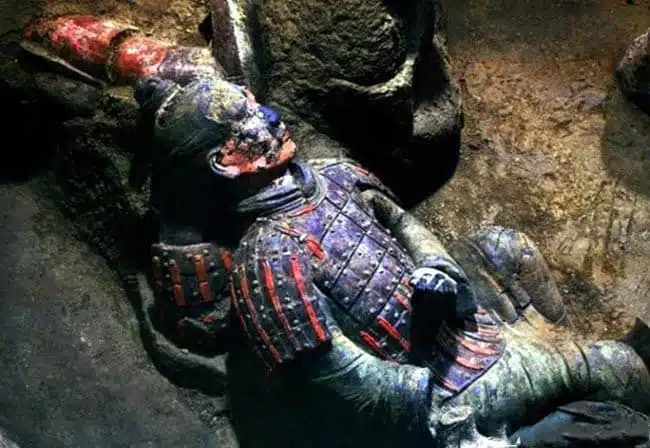
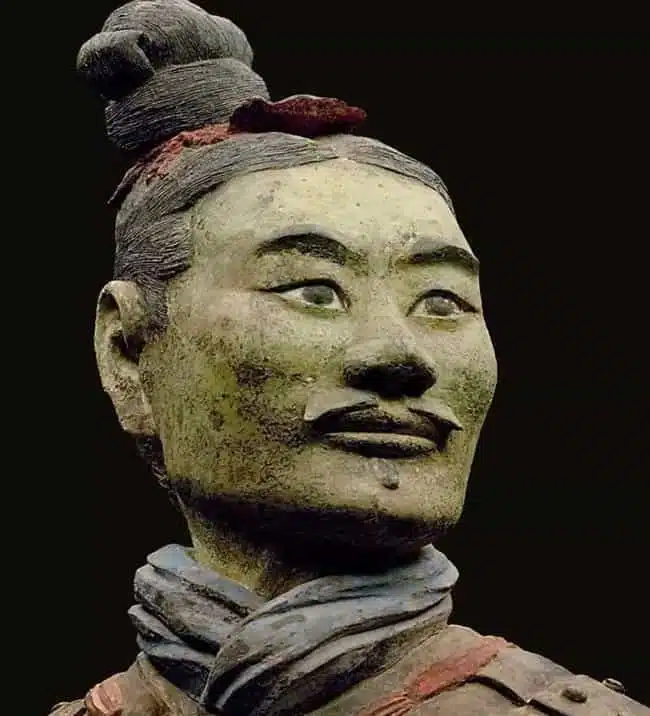
In the picture below is Green-faced Kneeling Warrior. According to his posture, he once had a crossbow in right hand. With his right knee on the ground, he seems well prepared to join in a battle. He is the only one with green face among all the unearthed over 2,000 terracotta warriors, which won him great fame, and he is not allowed to be exhibited overseas. Then why he has a green face? There are many guesses about this. Some experts think he is a necromancer in the troop, and some believe his green face is to frighten enemy. Some people even deem that the craftsman applied green because flesh color happened to be used up.
And even after more than 2,200 years, those remaining colors can still help us recognize the eyeballs and white part of the eyes. The red hair band wrapped around the bun is very distinct. Besides his face, the colors on the rest of the body also haven’t completely faded. You can see there is something blue around his neck. That is not a scarf but the collar of his jerkin.
The other famous colored terracotta warrior is Smiling General. So far, only 9 high-ranking officers have been excavated from the pits, and each of them is top national treasure of China. The general’s hands are put together and placed in front of his belly. It’s said that there used to be a sword in his hand.
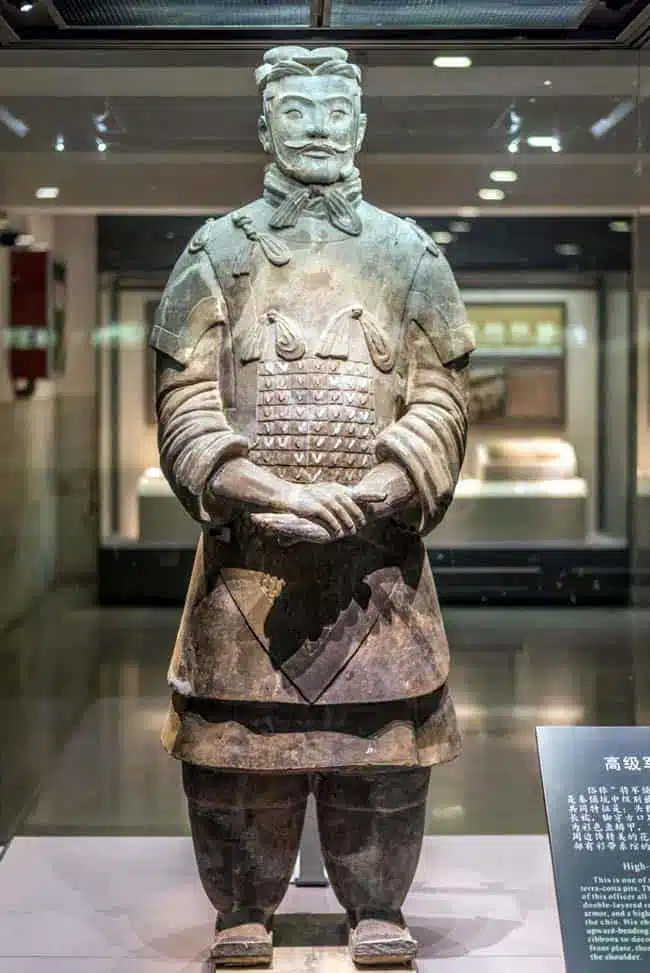
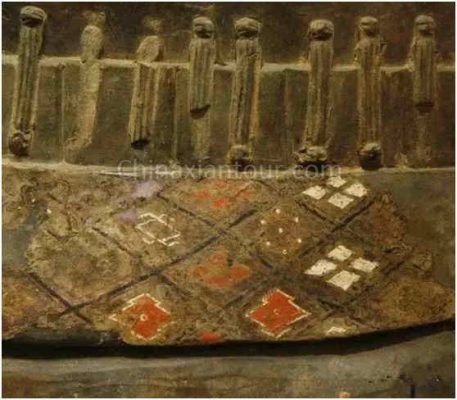
You may wonder where the color is. Here is a close-up look at his waist. You can notice that the armor’s edge is still clearly visible, and there are brightly-colored rhombus patterns.
Related Reading: 10 Interesting Facts about the Terracotta Army in China
Explore More Stories behind the Terracotta Army with Chian Xian Tour
The Qin Dynasty (221–207 BC) lasted less than 20 years. It is truly astonishing to think that China’s first Emperor, Qin Shi Huang, managed to marshal enough labor and resources to create this massive underground empire in such a short time. It is simply a feat unlike anything seen before or since.
Are you excited to learn more about Terracotta Warriors and Horses? The fascinating history behind it and the enormous scale will definitely blow your mind. If you need any help planning your Terracotta Warriors tours, please feel free to contact China Xian Tour. Now, you can get inspired by some of our Xian tours with the Terracotta Warriors.
Recommended Related Tours You May Like