
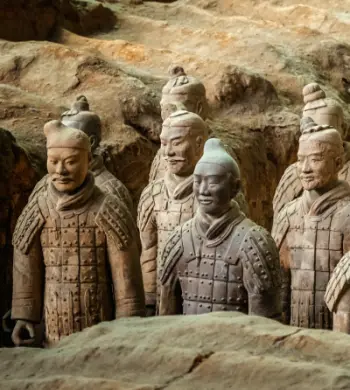

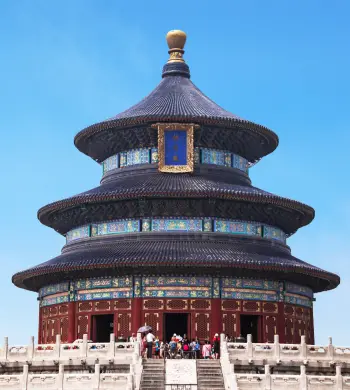
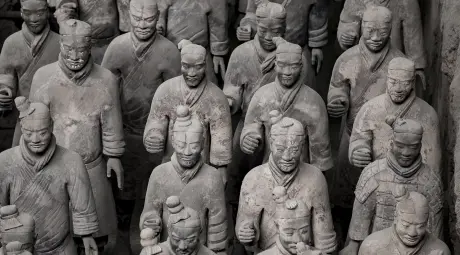
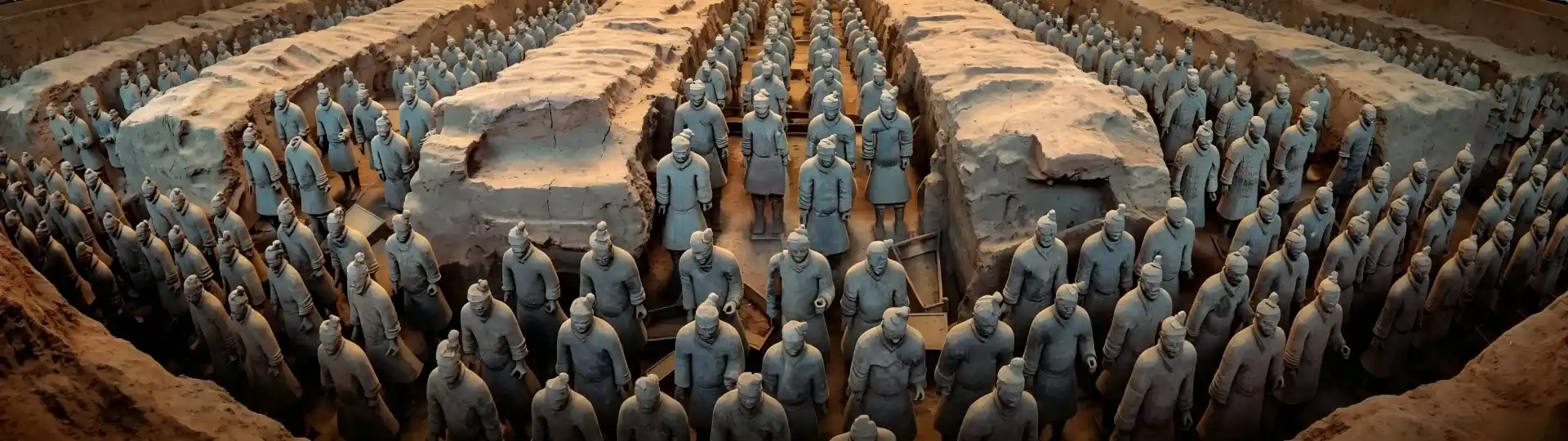
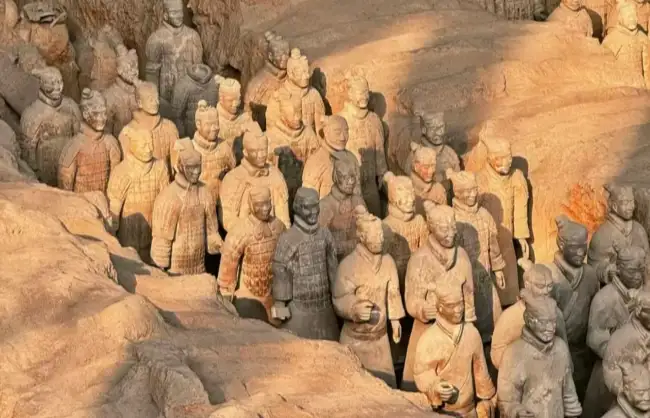
Terracotta Army, aka Terracotta Warriors and Horses, is a vast collection of thousands of life-sized terracotta statues of soldiers, chariots and horses. An important part of the Mausoleum of Qin Shi Huang, it mirrors the real troop of the Qin Dynasty and was constructed to guard Qinshihuang (the first emperor in Chinese history) in his afterlife.
It was listed as a World Cultural Heritage Site by UNESCO in December 1987 and was also praised to be the Eighth Wonder of the World, making it a must-see for any Xi’an tour.
Follow this guide to discover what you can see in the museum and practical information like recommended visiting route, ticket booking guide and transportation guide.
Content Preview
- Quick Terracotta Army Facts
- What to See
- Practical travel information
- History
- the Mausoleum of Qin Shi Huang
- Interesting Facts
- Travel Tips
- FAQs
- Tour Terracotta Army with China Xi’an Tour
Quick Terracotta Army Facts
- In Chinese: 秦始皇兵马俑
- Location: in Lintong District, Xi’an, Shaanxi Province; about 40 kilometers (24.9 miles) northeast of Xi’an downtown
- Type: World Cultural Heritage, Historical Site, Specialty Museum
- Period: Qin Dynasty (221-207 BC)
- When it was unearthed : In March 1974
- Time Needed: About 3 hours in the museum and 1.5 – 2 hours in Lishan Garden
- Opening Hours: March 16th–November 15th (Peak Season): 8:30 -18:30 (last entry: 17:00); November 16th–March 15th the next year (Off Season): 8:30 – 18:00 (last entry: 16:30)
- Ticket: CNY 120/USD 18 (including the three main pits and Lishan Garden)
- Highlights: the Eighth Wonder of the World; vivid life-size terracotta warriors; exquisite bronze chariots and horses
- Best Seasons: All Seasons
- Commended for: history lovers, Chinese culture lovers

Discover Xi'an's imperial past at the Terracotta Warriors Museum, dress in Tang dynasty costumes for photography, and explore the city's ancient streets and landmarks.
What to See in the Terracotta Warriors and Horses Museum
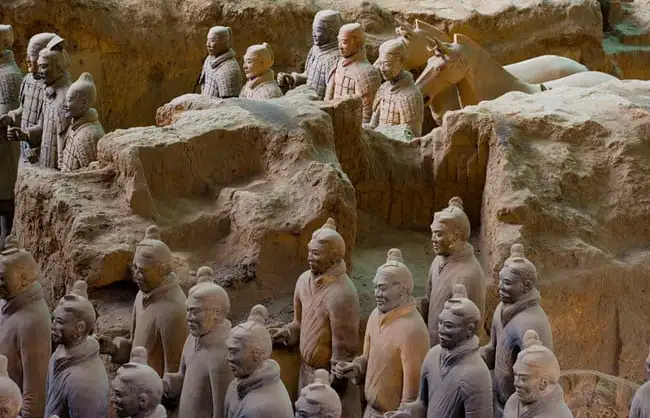
There are three major pits for the Qin Amy of Terracotta Warriors China, covering over 20, 000 square meters (5 acres) in total. Nearly 8,000 pieces of terracotta warriors have been unearthed from the three pits, all being the same size of a real man and horse. Meanwhile, the bronze chariots and horses, and Qin weaponry are also very stunning to see. Usually, 3 hours is recommended to explore the four main exhibition areas, which are the Exhibition Hall of the Bronze Chariots, Pit 1, Pit 2, and Pit 3.
No.1 Pit – The Largest
In No.1 Pit, apart from the life-size terracotta warriors, chariots and horses, bronze swords, hooks, crossbow machines, halberds and so on have also been unearthed. At the east end of this pit, there are 210 terracotta warriors in different facial expressions, dress styles, and hairstyles, lining up in three rows, like the forward force on standby. Behind that, it is the main part composed of 6000 armored terracotta soldiers, holding long weapons such as a spear, dagger-ax, and halberd. They lined up with 35 chariots in a 38 rows. On both north and south sides, there is a row of terracotta guard warriors to prevent the side from being attacked.
The warriors and horses in this pit are neat with complete equipment, which are the expressive representation of the mighty army of Qin Shi Huang.
Excavations show that the wooden structure of the No. 1 pit is a frame-type structure composed of tifu – pillar – Fangwood – shed wood, which is technically primitive compared with the chamber type composed of bedding wood – floor – pillar – chamber wood – shed wood. Therefore, the burial pit of terracotta warriors and horses should be a group of burial pits built earlier in the cemetery.
No.2 Pit – More Kinds of Warriors
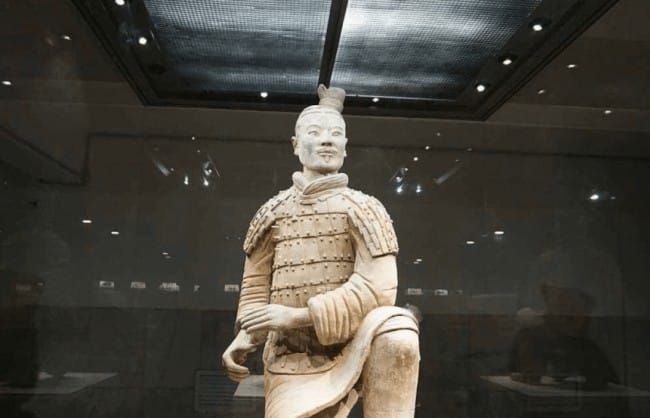
On the northeast side of the No.1 Pit is the No.2 Pit, 96 meters (105 yards) long from east to west and 84 meters (92 yards) wide from north to south. The layout of the terracotta troop is more complicated and the types of terracotta warriors are more complete, including standing terracotta archers, kneeling terracotta archers, terracotta warriors leading the horses, terracotta infantry, and cavalry. Totally, there are more than 1,300 terracotta warriors and horses, more than 80 chariots, and tens of thousands of bronze weapons in No.2 Pit.
The warriors, light chariot soldiers and cavalry figures unearthed from the second pit of Terracotta Warriors Museum show for the first time the image data of ancient cavalry, light chariot soldiers and archers 2200 years ago. It is of great significance in the study of ancient military history.
No.3 Pit – The Smallest, Headquarter of the Troop
No.3 Pit is 25 meters (27 yards) from the west end of No.1 Pit, with an area of about 520 square meters (622 square yards). It’s the smallest out of the three pits, but it hadn’t been completed. There is a chariot in front of the door with 68 terracotta soldiers inside. Judging from the layout, No.3 Pit seems to be the general headquarters, commanding the whole army.
It provides valuable research materials for the study of the shape, occupation and battle ceremony of the ancient Chinese headquarters, the command system and the clothing and equipment of the dependent uniforms.
Spend four days exploring Xi'an's greatest treasures — the Terracotta Warriors, ancient pagodas, and City Wall — plus a thrilling day on Mount Huashan's precipitous peaks.
Practical travel information
Recommended Visiting Route
Route: No. 1 Pit – No. 3 Pit – No. 2 Pit – Take a shuttle bus to Lishan Garden – Bronze Chariots and Horses Exhibition Hall – Pit of the Hundred Entertainers and Pit of Civil Official Figurine – the actual tomb mound
This route offers you a grand overview first and then the finer details. So, you will gain a deeper appreciation of the underground kingdom of Emperor Qin Shi Huang instead of a simple sightseeing.
It starts at the most spectacular No. 1 Pit, offering you a visual shock at first glance. Continue to No. 3 Pit. Believed to have served as the command center of the army, it helps you understand the military hierarchy at that time.
With the general understanding in mind, you will feel like observing the crucial details that bring the army to life during the visit to No. 2 Pit. Finally, take your time to explore the cultural relics in the quieter Lishan Garden.
How to Book Terracotta Army Tickets?
To manage visitor flow, the Terracotta Army Museum has implemented real-name ticketing. To avoid the queues and guarantee your admission to one of the eight wonders of the world, it is advised that you purchase your ticket in advance.
For international travelers, you can purchase via the English version of official website or the official WeChat account, “秦始皇帝陵博物院” and “兵马俑票务在线” using your passport. Tickets are released 7 days in advance.
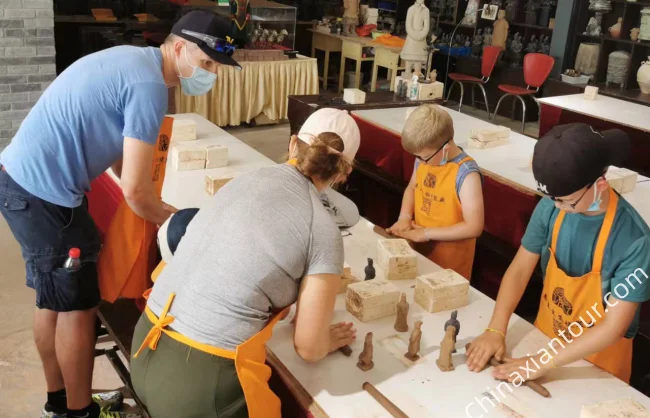
You can also book the Terracotta Army tickets with us, as well as the best local guide, transfers, and the hands-on activity of making a mini clay warrior yourself.
How to Get to Terracotta Army from Xi’an?
From Downtown Xi’an:
- Metro Line 1/6+ Metro Line 9 + Lintong Tourist Bus 602/613/Terracotta Army Shuttle Bus
From downtown Xi’an, you can take the Metro Line 1 or 6 first to the terminal Fangzhicheng Station, then transfer to Metro Line 9 to get off at Huaqingchi (Huaqing Palace) Station. Come out from the Exit B or C and transfer to Lintong Tourist Bus 602, 613 or Terracotta Army Shuttle Bus, which will take you to the museum.
- Cost: about CNY 12/USD 2
- Travel Time:about 2 hours
- Metro Line 1 + Tourist Bus Line 5(Bus 306)/Terracotta Army Shuttle Bus
Take Xi’an Metro Line 1 to Fangzhicheng Station. Come out from the Exit B, walk north for a few distance to the Fangzhicheng Bus Station. You can find the getting-on spot of Tourist Bus Line 5 (Bus 306) or Terracotta Army Shuttle Bus in front of the bus station, which will take you to the Terracotta Army directly.
- Cost: about CNY 10/USD 1.5
- Travel Time:about 2 hours
- Tourist Direct Bus:
At Bell Tower and Big Wild Goose Pagoda, there are direct tourist buses to the Terracotta Army. It operates from 07:35 to 13:35 with an interval of 30 minutes – 1 hour. You can purchase it on the WeChat mini program of “西安旅游景区直通车”.
- Cost: CNY 25/USD 4 for a single trip and CNY 49/USD 7 for a round trip.
- Travel Time:1 – 1.5 hours
From Xi’an Xiyang International Airport: Airport Bus
There are ticket offices in the building opposite exit 314 of T3 Terminal and in the comprehensive transportation hub of T5 Terminal. After purchasing the ticket, find the bus to Lintong and show your ticket to the driver. It operates from 09:30 – 21:00 with a ticket price of CNY 45/USD 7.
Capture the essence of Xi'an in two days — stand before the vast Terracotta Army, cycle the ancient City Wall, explore the unique Great Mosque, and taste the Muslim Quarter's famous street food.
History of the Terracotta Army
- 246 BC: Qin Shi Huang ascended the throne and ordered the construction of his mausoleum complex, including the Terracotta Army, which was built to serve as his guard after his death.
- 221 – 209 BC: In 221 BC, emperor Qin Shi Huang unified China and the construction entered the most intensive phase.
- 208 BC: Forced to stop due to a huge peasant uprising. Over the course of 39 years, about 700,000 workers were conscripted to make the terracotta figurines and horses.
- 1974: In March, avillager in Lintong discovered several broken terracotta warriors accidentally when digging a well. The site was named the No. 1 Pit later.
- 1974 – 1979: Shaanxi Provincial Archaeological Team carried out extensive excavation. No. 2 and No. 3 Pits were excavated one after another in 1976.
- 1979: The Terracotta Army Museum was built on the original site and was opened to the public on Oct. 1.
- 1987: It was listed as a UNESCO World Heritage Site.
Beyond the museum: the Mausoleum of Qin Shi Huange
Besides the three pits in the museum, the Mausoleum of Qin Shi Huang also includes the Lishan Garden. Actually, the pits presents the burial army of Emperor Qin Shi Huang, while Lishan Garden is the core area of the mausoleum complex itself. Compared with the museum, Lishan Garden is less crowded.
The entrance ticket has included the garden, so no additional fee is charged. And free shuttle buses are available for tourists between the museum and the garden. The journey takes about 5 to 10 minutes and the intervals between buses are approximately 15 minutes.
Must-see highlights:
- The actual pyramid-shaped tomb mound of the mausoleum
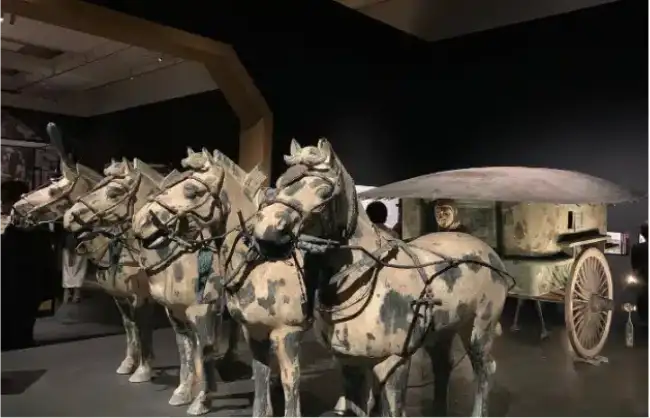
- Two large, well-preserved and lifelike painted bronze chariots with horses in the Bronze Chariots and Horses Exhibition Hall
- Various terracotta figurines in the Pit of the Hundred Entertainers and Pit of Civil Official Figurine
Interesting Facts about Terracotta Warriors and Horses
- There areover 8,000 terracotta warriors in the museum and most are 180-190 cm in height.
- Thematerial for the making of terracotta warriors and horses was the yellow soil and white quartzite gravel taken from the northern foothills of the Lishan Mountain.
- The warriors were molded in sectionsfirst and then fixed up into a whole piece.
- To make the terracotta warriors morestable for better safekeeping, the lower parts of the figures and horses were made solid and heavier while the upper parts were hollowed and lighter.
- At the end of the Qin Dynasty,it was wartime with endless battles and uprisings. In that period, the Terracotta Army was buried after being flooded.
- Each of the terracotta warriors and horses is unique. And each soldier has a unique face with different facial features.
- The Terracotta Warriors and Horseswere in bright colors when they were made, but the colors faded due to the fires, floods, and natural erosion. Some lost their colors only a few minutes after being unearthed and exposed to air.
- It is rarely known that between No. 2 and No. 3 Pits lies the 4 Pit. However, there is no terracotta warrior or horse but the backfilled soil.
- There is a terra-cotta warrior kneeling in the second pit of the Terracotta Army museum that has a distinctive pale green face.
- These terracotta soldiersare not made of real people. It was revealed by numerous shattered terracotta warriors during the excavation.
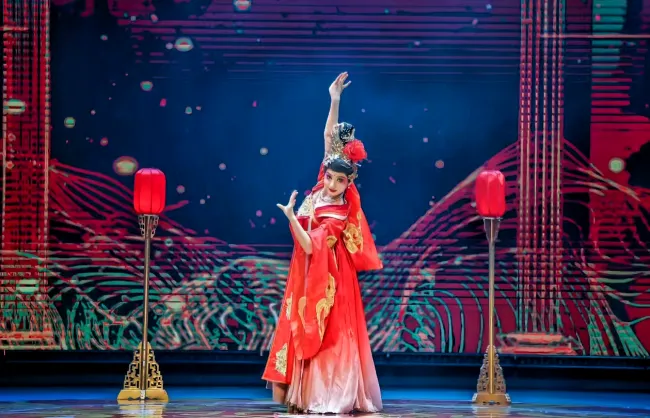
Delve into Xi'an across four days — witness the Terracotta Warriors, explore the City Wall and museum treasures, and enjoy a spectacular Tang Dynasty music and dance show with a dumpling feast.
Terracotta Army Travel Tips
- Enter the museum at the reserved time slot and bring your original passport. Photocopies or photos are not acceptable.
- To avoid crowds, the best time of the year is the off-season during winter when the number of tourists is relatively less. As for the best time of the day, there are less tourists during one hour after it opens, lunchtime, and one hour before it closes.
- The foreign language guided tour service is available. The duration is about 1 – 1.5 hours and the cost is CNY 500/USD 74 per group (up to 5 people). Overtime charge is CNY 200/USD 30 per hour. The audio guide is about CNY 30 – 40/USD 4 – 6. You can reserve at the tour guide service desk.
- To protect these relics of Terracotta Army, don’t touch them. No flash when you take pictures.
- You cannot step into the pits. Remember to take a telescope or telephoto lens for your camera to watch the Terracotta Warriors and Horses more clearly.
- At the entrance of Terracotta Army site, there are sometimes enthusiastic people who will lead you the wrong way. These men are frauds, and you would be directed to take a fake shuttle bus to a false “terracotta warriors and horses pit”. Stay away from these persons and ignore them.
- Near the Fangzhicheng Bus Station, there are some fake Tourist Bus Line 5 buses. The staff of the real buses wear uniforms with armbands, and you need to line up at the designated area to board the bus.
Related Reading:
FAQs about Terracotta Army
What is the difference between a guided tour and an audio guide? Is it worth it?
A guided tour can provide more vivid and in-depth explanation of the relics and tourists can have interactions with guide at any time. While the advantages for an audio guide is flexible and its clear and standard explanations. And you can stop at will and tour by yourself freely.
For first-time visitors, tour groups and tourists seeking for in-depth understanding of its history and culture, a guided tour is best. And for tourists who prefer controlling their own pace, an audio guide is better. No matter a guided tour or an audio guide, professional explanations can greatly enhance the visiting experience and help you understand the relics before your eyes, rather than just looking at the clay figurines and pits.
Are there luggage storage facilities available at the museum?
Yes. The depository is on the east side of the ticket lobby and offered for free.
What dining options are available inside or near the museum complex?
Inside the museum, there is a restaurant on the second floor of the comprehensive building. Although the choices are less, several characteristic local foods are offered in reasonable price. Around the museum, plenty of chain restaurants and local flavor eateries can be found, such as Weijia Cold Noodle, KFC, Zhang Ji Roujiamo, etc.
Are there any nearby attractions worth visiting after the Terracotta Warriors?
Huaqing Palace is about 10 kilometers east to Terracotta Warriors. It integrates historical relics, hot spring culture, natural scenery and live performances. The famous show Song Of Everlasting Sorrow is performed here. Bus line 603 and 612 connect the two scenic areas.
Tour Terracotta Army with China Xi’an Tour
We are based in Xian, and no one knows the city better than China Xian Tour, including the Terracotta Warriors and Horses. We know how to avoid the large crowds and our professional local guide will introduce you all history and interesting stories about this site and the First Qin Emperor. More than that, we will offer many in-depth experiences other than simply sightseeing. If you want to follow a master to make your own mini terracotta soldiers, watch an exclusive shadow puppet show, or join in a Taichi class, contact us to make your ideas come true.