


2000-Year Bronze Chariots and Horses – More Valuable Than Terracotta Warriors, Honored as the “King of the Bronzes”
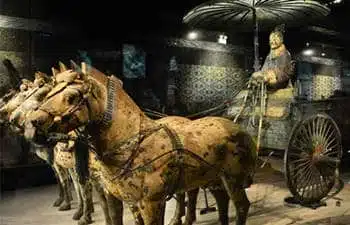
In Xian Terracotta Warriors and Horses Museum scenic area, there are two world-famous bronze chariots and horses whose sizes are about a half of that of real chariots and horses. The chariots, horses, and drivers were all made of bronze with paint all over the body, and chariot horses as well as some decorations were made of gold and silver. This is the earliest-discovered, largest, and most well-preserved bronze chariots and horses in the history of archaeology in China.
It is honored as the “king of the bronzes” and is currently housed in the Bronze Chariots and Horses Museum of Emperor Qinshihuang’s Mausoleum Site Museum in nearby Lishan Garden, but not in the three pits in Terracotta Warriors and Horses Museum. Both museum are in the same scenic area, so if you have bought the ticket, you can take the free shuttle bus to the Emperor Qinshihuang’s Mausoleum Site Museum directly.
Content Preview
- How Were the Bronze Chariots and Horses Discovered
- What to See at the Bronze Chariots & Horses Exhibition Hall
- Deeper Dive into the Two Chariots (Liche & An Che)
- Advanced Manufacturing Techniques in Qin Bronze Chariots
- Historical Value of Bronze Chariots and Horses
- How to Book the Ticket
- How to Get to
- FAQs about The Bronze Chariots and Horses
- Plan Your In-depth Xian Discovery with China Xian Tour
How Were the Bronze Chariots and Horses Discovered
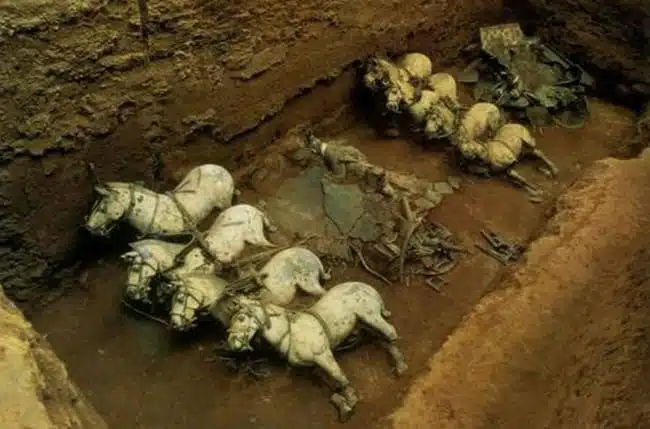
The funeral pit of bronze chariots and horses was discovered by accident. In June 1978, the archaeological team drilled a gilded trapping made of metal in the soil layer more than 7 meters underground on the west side of the Mausoleum of the First Qin Emperor. It was a metal ornament carved with flowers and used for decorating the horse’s head. Its discovery opened the prelude to the tomb of bronze chariots and horses in the Mausoleum of the First Qin Emperor. In 1980, when a local pit was partially excavated, two large bronze chariots and horses were unearthed in a wooden tomb which was broken when came up out of the ground but got back to its original shape after restoration.
What to See at the Bronze Chariots & Horses Exhibition Hall
Due to its long history, the two chariots and horses were broken into more than 3,000 pieces when unearthed and after nearly 8 years of careful restoration, they were finally exhibited in 1989. These bronze chariots and horses in the Mausoleum of the First Qin Emperor have two rows of cars. One was the “Li Che” (a standing driving car) and the other was the “An Che” (a sitting driving car) both of which were far-back single-shaft two-wheeled vehicles and produced according to the half ratio of real horses and chariots in the Qin Dynasty.
Liche – No.1 Bronze Chariots and Horses
- Length: 255 cm
- Height: 152 cm
- Weight: 1061 kg
- Top features: open carriage, equipped with various weapons.
“Liche” was the lead car of the Royal convoy, which was like a modern armed guard vehicle. It was mainly used for vigilance, conquest and honor guard. A shield was placed on the right side of the carriage of the “Li Che”, and a copper bow and arrowhead hung on the front of the car. And a round umbrella stood on the car with a 91cm-high copper terracotta figure stood under it. Moreover, the driver in the car was dressed in Qin clothes thousands of years ago, with a crown on his head. The texture of the clothes was clear, neat, and decent.
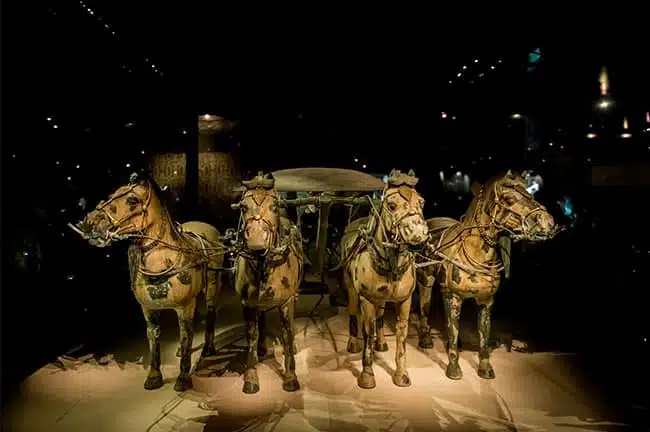
The casting of bronze horses was very exquisite for their facial expressions were rich, and the figures were vivid. The horses had different heads and hairstyles and also differed in the heights of the heads. The decoration on the head of the bronze horses was very delicate with an inverted triangular metal sheet on the top of the head of each horse, on which the fine patterns were carved. Also, the harness on the horse’s head was all kinds kept in stock.
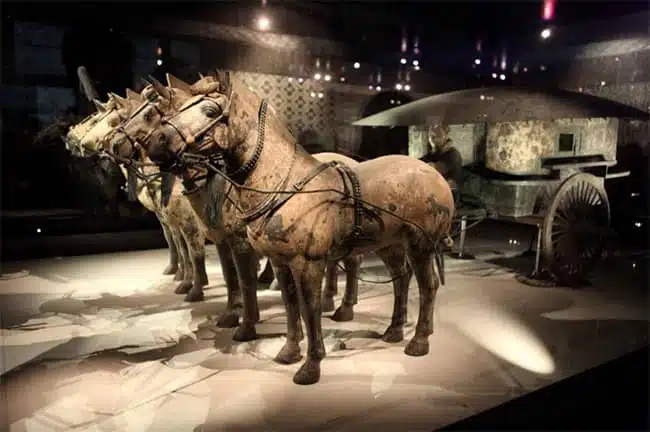
Anche – No. 2 Bronze Chariots and Horses
- Length: 317 cm
- Height: 106 cm
- Weight: 1241 kg
- Top features: enclosed carriage with windows, the temperature inside the carriage can be regulated
“An Che” was an air-conditioned vehicle for emperors and concubines. It was a saddle car drawn with four horses whose shape was seen exactly like the “Tu” character (凸, it meant an “inverted-T” shape in Chinese characters). It was divided into the front and rear compartments, and the car had a dome-shaped oval cover. The front compartment was for the driver who was supposed to drive with his knees on the ground, and the rear room was for the master. The bronze chariots and horses were lifelike in shape and colorful in decoration, moreover, the ties and harness were all made of gold and silver.
The front window can be lifted upwards and the side windows can be slide open, achieving a temperature control effect of “warm when closed and cool when opened”. The window panels are diamond-shaped and hollow out, providing both ventilation and privacy protection, thus it is known as “air-conditioned vehicles from 2000 years ago”. They are precious national treasures for their sophisticated workmanship.
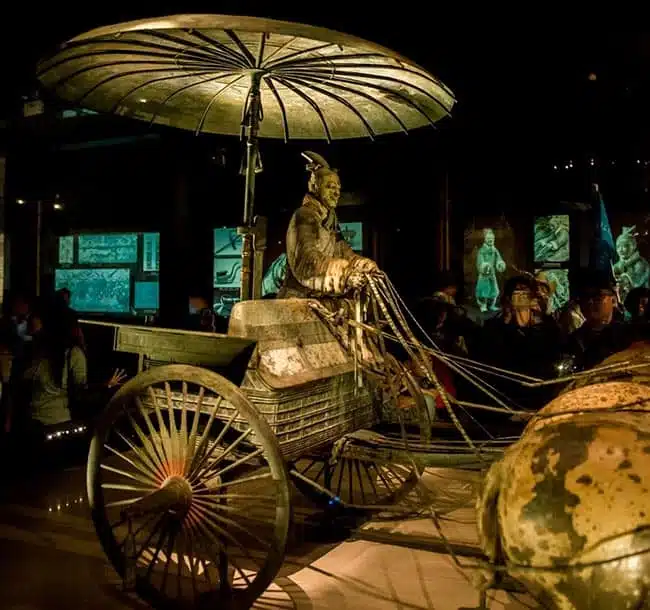
Details Display of Bronze Chariots and Horses
With AR technology, tourists can “revive” the craftsmen of the Qin Dynasty after wearing the equipment who will dynamically demonstrate the process of making terracotta figurines and casting bronze chariots and horses. The color Laboratory displays mineral pigments remaining from the time of excavation, which reveal that the terracotta figurines are originally rich in color. There are also photos and 3D models showing the restoration of the relics and theme display area showing the details of the exquisite structures of chariots and horses.
Deeper Dive into the Two Chariots (Liche & An Che)
Features |
Liche |
Anche |
Riding Mode |
Standing, open-top |
Sitting, enclosed cabin |
Primary Function |
The leading car used as the symbol of honor, and for guard or military expeditions. |
Used by the emperor and concubine for personal travel or daily activities |
Vehicle Structure |
The chariot has a shallow cabin, open on all sides, with a bronze umbrella in the center. |
The cabin is divided into two areas: the front (for the driver or attendants), and the rear (for the emperor and concubine), with windows and doors. |
Core Features |
Equipped with weapons such as bows, crossbows, and shields, symbolizing power and military strength. |
The windows can be opened and closed, allowing for temperature control inside |
Advanced Manufacturing Techniques in Qin Bronze Chariots
The casting of bronze horses was very exquisite for their facial expressions were rich, and the figures were vivid. The horses had different heads and hairstyles and also differed in the heights of the heads. The decoration on the head of the bronze horses was very delicate with an inverted triangular metal sheet on the top of the head of each horse, on which the fine patterns were carved. Also, the harness on the horse’s head was all kinds kept in stock.
Bronze chariots and horses in the Mausoleum of the First Qin Emperor were all cast in bronze, and the weight of gold and silver ornaments exceeded 14 kg. They were made up of more than 3500 parts by various technologies such as casting, inlaying, welding, buckle connecting, living hinge connecting, and different kinds of technical skills such as mechanical connection and processing. The copper wire used for the necklace of precious stones and chains on the horse was only about half a millimeter in diameter, and some were even thinner, representing the brilliant achievements of China’s metal manufacturing process for more than 2,000 years ago.
Historical Value of Bronze Chariots and Horses
Today, the bronze chariots and horses’ museum was built in the Mausoleum of the First Qin Emperor, near to the original excavation site of the bronze chariots and horses, with a total construction area of approximately 7,880 square meters. Through the original site display and reasonable layout, the historical, scientific, artistic, and social values of them were fully revealed, and the chariots and horses’ culture of the Qin Dynasty was fully demonstrated. The bronze chariots and horses condense the superb metal manufacturing process more than 2,000 years ago and it can be called a model in the history of ancient Chinese bronze casting and manufacturing technology, occupying an important position in the history of metallurgy and metal manufacturing technology in China and the world. The picture above shows is the “Li Che” (a standing driving car).
How to Book the Ticket
The ticket of the Bronze Chariot and Horse Museum is already included in the entrance ticket of the Terracotta Army, and the cost is CNY 120 per person. So you do not need to buy a separate ticket. About how to book the ticket, the Terracotta Army official website, Wechat official account, the ticket window on site and our travel agency all offer the service. As for the detailed guide, please see Terracotta Warriors Tickets Booking.
How to Get to
The Bronze Chariot and Horse Museum is located in the Lishan Garden and the garden is to the west of the Terracotta Warriors and Horses Museum.
- Metro + Bus: Take metro line 9 and get off Huaqingchi Station. Then leave from exit C and transfer to bus line 602 to Qinshihuanling (Qin Shi Huang’s Tomb) stop. Finally, walk southwest for about 550 meters to the scenic area. It takes about 2 – 2.5 hours and about CNY 10 per person.
- Direct bus to the scenic area: Tourists can also take the bus in some main scenic spots in Xian, including Bell Tower and Big Wild Goose Pagoda. You will reach the Terracotta Warriors and Horses Museum by this bus, then you can transfer to the free shuttle bus in the scenic area to the museum. The ticket is about CNY 25 – 30 for a single trip and the duration is about 1.5 – 2 hours.
After reaching the Terracotta Army Museum, tourists can take the free shuttle bus near the north gate of the museum to Lishan Garden. The two places are a few kilometers away, they can not be reached on foot. So the scenic area arranges the shuttle bus, and its fare is also included in the entrance fee.
FAQs about The Bronze Chariots and Horses
Are the Bronze Chariots and Horses made of terracotta like the warriors?
No, they are not. According to its name, it can be known that the chariots and horses are mainly made of bronze with a large quantity of gold and silver components.
Why are the Bronze Chariots and Horses considered “More Valuable Than Terracotta Warriors”?
The main reason is that the Bronze Chariots and Horses represent the peak of the bronze manufacturing process in Qin Dynasty. Its structure is complete and clear. The cultural relic itself proves the authenticity of the content in ancient books.
How big are the Bronze Chariots and Horses compared to real ancient chariots?
They are exactly half of the real ancient chariots and horses.
What is the significance of the “air-conditioned” feature of the An Che?
The carriage has windows on both sides and a door at the rear. When in the open state, the emperor and concubine can feel cool, and when closed, they can feel warm. This exquisite and practical design shows the wisdom of ancient craftsmen.
Can I take photos of the Bronze Chariots and Horses?
Yes, but using the flashlight is not permitted.
How much time should I allocate to see the Bronze Chariots and Horses Museum?
1 – 1.5 hours is a reasonable time for you to observe more details about it.
How do I get from the main Terracotta Warriors Pits to the Bronze Chariots and Horses exhibition hall?
There are free shuttle buses between the main pits and the Bronze Chariots and Horses Museum.
Is a separate ticket required to see the Bronze Chariots and Horses?
No. The ticket of the Terracotta Army has included it.
When and how were the Bronze Chariots and Horses discovered?
In the winter of 1980, these two chariots and horses were discovered in an underground tunnel about 20 meters west of the Qin Shi Huang Mausoleum by the archaeologists. But they had already crushed them into more than 3,000 pieces. After 8 years’ restoration, they have become what we see now.
What kind of advanced techniques did the ancient Qin artisans use to create these chariots?
Casting, inlaying, welding, buckle connecting, living hinge connecting, mechanical connection, processing and many other technologies and technical skills were used.
Plan Your In-depth Xian Discovery with China Xian Tour
Xian is a city with a long history. So the most important of these scenic areas is the history and culture behind them. Without knowing it, you will feel like watching some ancient terracotta and bricks only. To ensure you have an in-depth Xian tour, China Xian Tour is glad to arrange a knowledgeable local guide for you. And we can customize a trip to cover all the famous cultural and historic sites based on your needs. So contact us right now.