

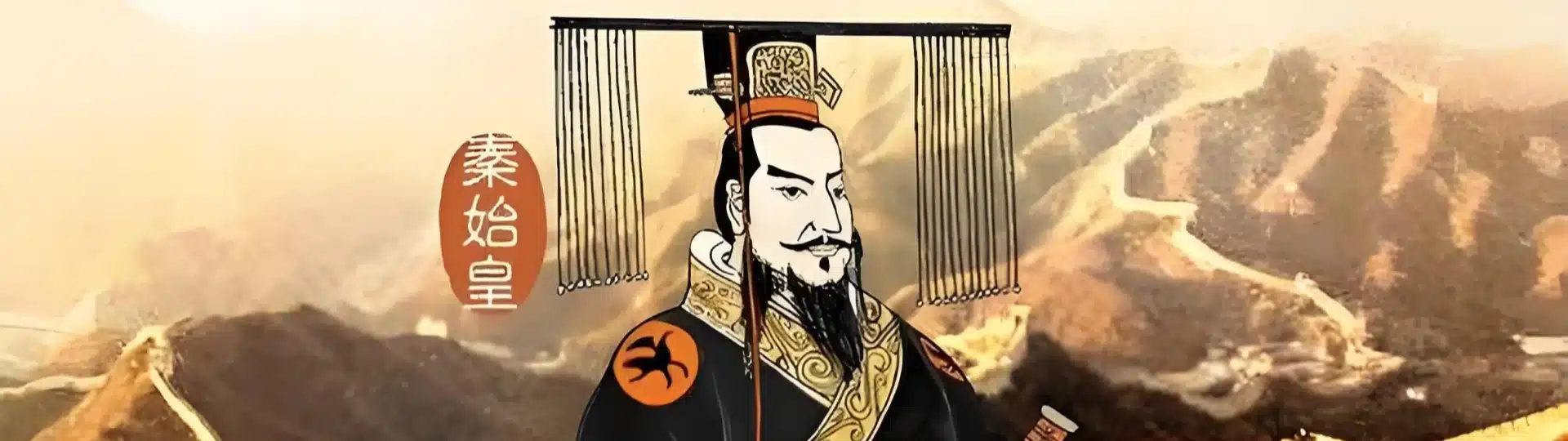
Qin Shi Huang is the founder of the Qin Empire (221-207 BCE). He conquered the six states, ended the turmoil and division of the Warring States (c.475-221 BCE), expanded the territory, and led ancient China to an era of unification. The great deeds made Qin Shi Huang the “Emperor of the Ages”.
Qinshihuang’s achievements left invaluable legacies to contemporary China. For example, the Terracotta Army in Qin Shi Huang’s tomb and his command of constructing the currently extant Great Wall. These legacies make irreplaceable contributions to tourism in China.
This guide includes important facts you need to know about this legendary First Emperor. It will introduce Qin Shi Huang’s life and major achievements during his reign, and provide an overview of the miraculous sculpture arts– the Terracotta Army in his Mausoleum.
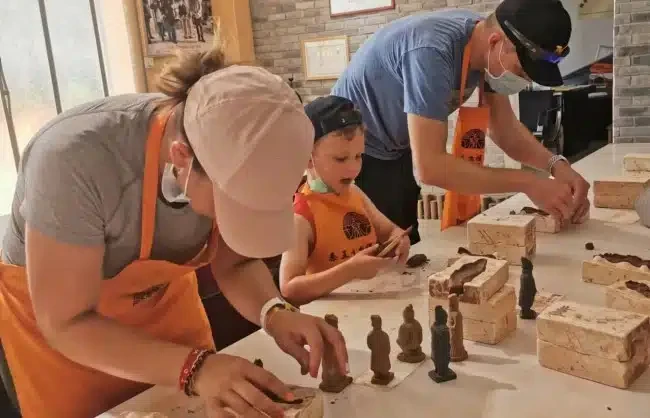
Content Preview
- Who Is Qin Shi Huang– Key Facts
- Qin Shi Huang’s Early Life and Rise to Power
- How and When did Qin Shi Huang Become the Emperor
- Qin Shi Huang’s Major Achievements
- Controversies and Historical Mysteries of Qin Shi Huang
- Qin Shi Huang’s Wife and Children
- Qin Shi Huang’s Death and the Ensuing Chaos
- Qin Shi Huang and the Terracotta Army
- Fun Facts About Qin Shi Huang
- Experience Qin Dynasty History in Xi’an
- Explore Qin Shi Huang’s Eternal Legacy with China Xian Tour
Who Is Qin Shi Huang– Key Facts
- Original name: 嬴政 (Yíng Zhèng)
- Birth and death dates: 259 BCE/ 210 BCE
- Reign period: 247- 210 BCE (proclaimed himself the Emperor in 221 BCE)
- Birthplace: Handan City, Zhao State
- Major reasons for remaining a pivotal figure in Chinese history: unified ancient China; implemented strict laws; improved infrastructure Facilities; promoted a standardized measurement system; established the system of Huang Di (Emperor); Expanded Qin territory; Built the Great Wall to protect the Central Plains; Commanded the construction of the Terracotta Army in his tomb
Qin Shi Huang’s Early Life and Rise to Power
Childhood of Ying Zheng and Succession as King of Qin
Qin Shi Huang was originally known as Ying Zheng. He is the son of King Zhuangxiang of Qin State in the Warring States. When King Zhuangxiang died in 247 BCE, 13-year-old Ying Zheng rose to power as the King of Qin. Due to Ying Zheng’s young age, he revered Lü Buwei as a crucial official and entrusted Lü with the state affairs.
In 239 BCE, when Ying Zheng turned 21 years old, he took charge of the state affairs. In just two years, Ying Zheng eliminated a rebellious force led by Lao Ai and expelled Lü for supporting the inappropriate relationship between Lao and his mother.
Path to Unifying the Warring States
After rising to power, Ying Zheng appointed Wei Liao and Li Si to assist his policy of unification of the Six States. The first key battle took place in 236 BCE– a battle between the Zhao and Yan States.
Under the excuse of rescuing Yan, Ying Zheng sent elite generals like Wang Jian to attack Zhao and captured the Yanyu, Qiyang, Hejian (southeast of Xian County, Hebei), and Anyang (southeast of Yangyuan County, Hebei) areas of Zhao. Two years later (234 BCE), Ying Zheng commanded another attack on Zhao and established Yanmen and Yunzhong Prefectures.
By that time, Qin State’s territory had covered most of the Central Plains and the Southwestern area of current China.
During the ten years from 230 to 221 BCE, Ying Zheng resorted to waging wars to sustain wars when facing the alliance of the Six States. The military power of the Six States was continuously drained while Ying Zheng’s military manoeuvres developed efficiency and organization.
Finally, the Qin State conquered the Six States in the order of Han, Zhao, Wei, Chu, Yan, and Qi.
How and When did Qin Shi Huang Become the Emperor
In 221 BCE, Ying Zheng finished the unification of the six States. At the age of 38, Ying Zheng declared his status as “Shi Huang Di”. “Shi” in Chinese means “first or beginning,” and “Huang (Di)” means “emperor”. That name was passed down and made him the first emperor of Qin, as well as the First Emperor of China.
Qin Shi Huang’s Major Achievements
Unified China
The Unification of the Six States did not only mean that the Qin State got rid of all its rivals, but also marked the establishment of the first centralized autocratic feudal dynasty/empire in Chinese history.
Created “Emperor”
Ying Zheng believed that his achievement in unification matched the greatness of the Three Huang (Sovereign) and Five Di (Emperor) in ancient Chinese myths. That was how he came up with the title “Huang Di” (Emperor). The Chinese imperial system was thus established.
To centralize his authority as the Emperor, Qin Shi Huang set up the system of “Three Councillors and Nine Ministers” in the central government. These officials were directly subordinate to and appointed (or dismissed) by the emperors.
Qinshihuang also adopted Li Si’s advice – replacing the enfeoffment system with the local system of “Prefectures and Counties” to end the division of the vassal states.
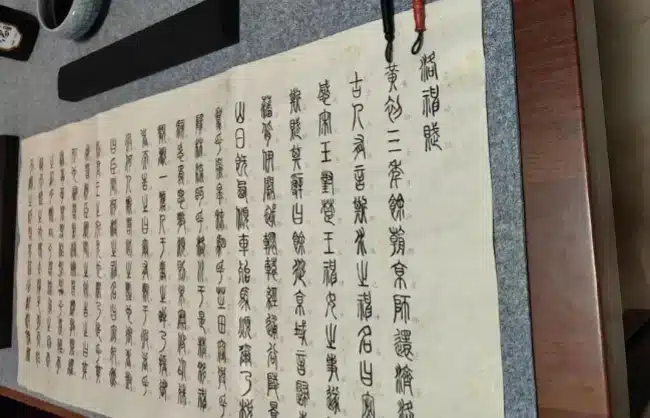
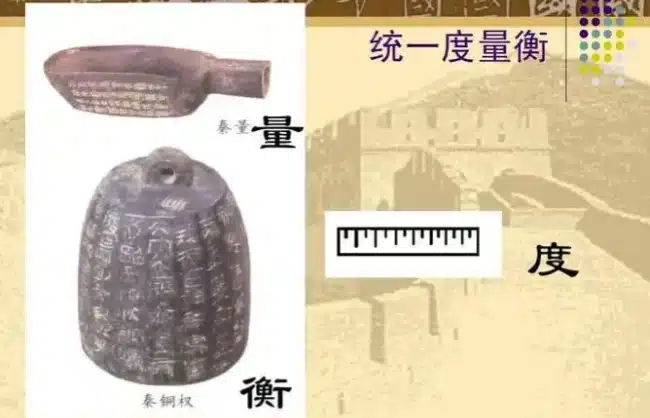
Standardized Script, Measurement, Currency and Rites Systems
Due to the differences in the cultural, economic, and political life of each vassal state during the previous turbulent period of division, one of Qin Shi Huang’s leading policies and achievements was to implement a uniform writing and measurement system.
First of all, Li Si created a simple and artistic character, “Xiao Zhuan”, which was a fusion of characteristics of several different writings. It was officially acknowledged as the common script of the country.
Secondly, only the original measurement units and standards (like weight and length) were allowed throughout the country. Uniform measuring tools were crafted by the official institutions and spread to the local people. The standard measurement facilitated the standardization of the chariot tracks at six feet. Therefore, the same chariot could fit on the road across the country.
Related reading: The Bronze Chariots and Horses in Terracotta Warriors Museum
Next, to make trades more efficient and convenient, Qinshihuang specified two common currencies: gold and copper coins. Gold was considered the “Upper Currency”. It was measured by the unit “Yi” and was often granted as an award by the emperors. Copper coins were called the “Lower Currency”. Each measured half “Liang”. They were the main currency in daily use.
Last but not least, Qin Shi Huang learnt from the “State of Rites”, the Qi State, and established uniform social rites and norms to cultivate ideal gender roles and regulate people’s behaviors.
Improved Infrastructure Facilities
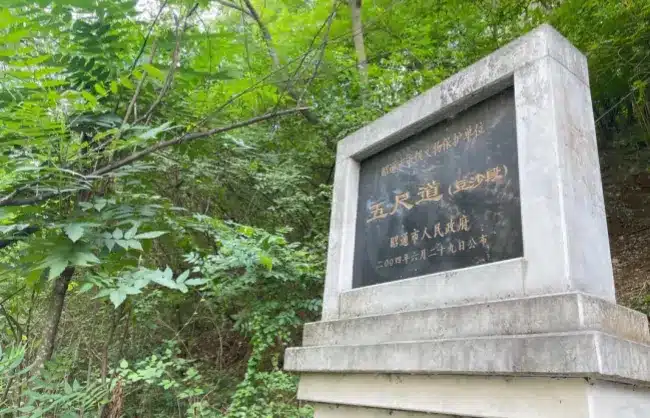
To enhance the communication of people in the southwestern and central areas, Qin Shi Huang ordered a plank road stretching from Yibin in Sichuan to the Dianchi Lake area in Yunnan. Due to its width of five feet and the perilous terrain, it was named “Five-Foot Path”.
Besides the Five-Foot Path, since 222 BCE, Qin Shi Huang commanded the construction of imperial highways radiating outward from the capital city, Xianyang, to facilitate transportation. The network of highways resembles modern expressways.
Meanwhile, Qin Shi Huang ordered Shi Lu to excavate a canal that connected the Xiang River of the Yangtze system with the Lijiang River of the Pearl River system, so that the troops and supplies could be transported to conquer the Lingnan area.
Reforms and Governance
Qin Shi Huang implemented a range of reforms during his reign. One of the major reforms was to establish private ownership of land, which meant distributing land to peasants to encourage high yields.
Also, Qin Shi Huang supported a legal system with the core of Legalism. Conforming to Legalism’s basic principles, Qin Shi Huang revered “rule by law” in the social, political, military, and economic practices. The key feature of the laws was “applying severe punishment to even the most minor offenses”. This legal system effectively suppressed crimes to some extent.
Built the Great Wall and Ling Canal
The early stage of the Great Wall had made significant progress in different vassal states during the Warring States period. But Qinshihuang was the one who initiated the connection of the extant Great Walls in the Qin, Zhao, and Yan States to build a vast defense system against the northern nomadic ethnic group– Xiongnu.
The Great Wall effectively protected the personal and property security of the local residents along the northern border without burdening the military forces.
Another major construction was the canals. On the one hand, building canals facilitated water transport. On the other hand, it significantly benefited agricultural irrigation. The Ling Canal was one of the oldest canals in the world. It continued to serve as the main water channel between Lingnan and the Central Plains for more than 2000 years.
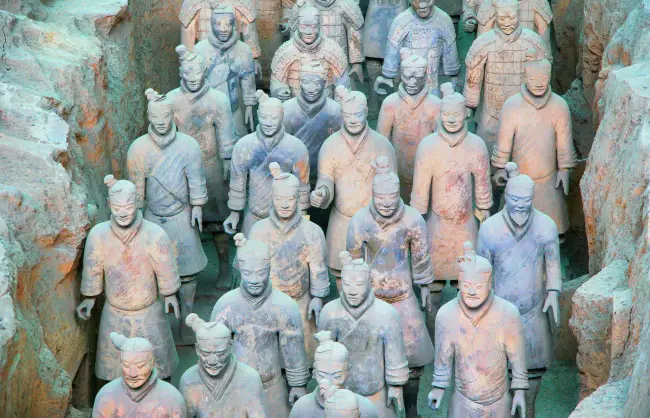
Built the Terracotta Army
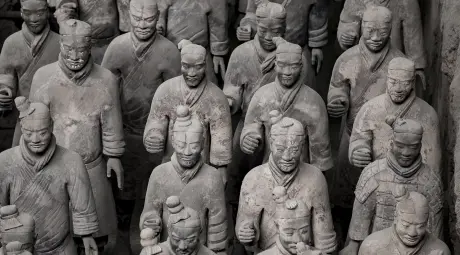
The Terracotta Army/Warriors in Emperor Qinshihuang’s Mausoleum served as substitute funeral objects of the human sacrifices. The Terracotta Army is a symbolic attraction in Xi’an City, Shaanxi Province and has absorbed countless tourists worldwide. It was considered one of the World’s Eight Wonders since its discovery. In 1987, it was listed among the UNESCO World Cultural Heritage sites.
Controversies and Historical Mysteries of Qin Shi Huang
From 219-215 BCE, Emperor Qinshihuang went on consecutive tours to the eastern coastal regions, the Yangtze-Huai River Basin, and the northern frontiers. In each place he visited, inscriptions were carved on stones to extol his achievements.
In his late reign, Qin Shi Huang became obsessed with seeking immortality and believed in fortune. He managed to make ‘immortality elixir’ and look for the three islands of Penglai, Fangzhang, and Yingzhou, where the divinity resided.
Some Confucian scholars tried to persuade Qin Shi Huang to give up the morbid obsession. As a result, Emperor Qinshihuang raged at their suggestions and implemented cruel measures of burning Confucian classics and burying Confucian scholars alive. It becomes the biggest controversy and an indelible stain on Qin Shi Huang’s glorious reputation.
Qin Shi Huang’s Wife and Children
There are no clear records of Qin Shi Huang’s wife (Empress) in historical texts. One hypothesis is that Qin Shi Huang did not establish any empresses in his whole life. Another is that Qin Shi Huang’s Empress was Lady Chu, who was born in an imperial family of the Chu State.
According to available records, Emperor Qingshihuang had 33 children in total (23 males and 10 females). The most well-known children were his two sons: the eldest son, Fu Su, who assisted General Meng Tian in combating the Xiongnu, and the youngest son, Hu Hai, who became the second emperor of Qin.
Qin Shi Huang’s Death and the Ensuing Chaos
In 210 BCE, Emperor Qinshihuang died at Shaqiu Palace during his fifth eastern tour. After Qin Shi Huang’s death, his minister, Zhao Gao, schemed a coup to help Hu Hai take power. Zhao Gao threatened the prime minister Li Si and carried Emperor Qinshihuang’s rotten body back to the capital before forcing Fu Su to commit suicide.
Everything seemed normal after that – Hu Hai took the throne, Li Si assumed the responsibility of the prime minister, except the fact that Zhao Gao was the one who seized the actual administrative authority. Although Li Si eventually discovered and exposed the scheme, Hu Hai chose to execute Li Si and promote Zhao Gao as the special prime minister.
Qin Shi Huang and the Terracotta Army
The Reason for Building the Terracotta Army
- Conforming to Traditional Funeral Practice: In the Era of Qin Shi Huang, the human sacrifice tradition had been replaced by human-shaped terracotta or wooden statues. The Terracotta Army was a legacy of traditional funeral practice in a ruler’s tomb.
- Boasting National Strength and Military Power: Extant historical records prove that the Terracotta Army reflected the actual scene of the Qin army’s expedition, including chariots, cavalry, infantry, and archery. Recreating the scene with terracotta statues meant to show off Qin Shi Huang’s great achievement in his reign and theinfluence of Qin on the world.
- Serving the Dead the Same as Serving the Alive: In ancient Chinese belief, humans would live their afterlife in another world. Anything buried with the dead would be taken to that world with them. Therefore, it is important to serve the dead the way you served them when they were alive.
As an emperor, Qin Shi Huang was protected by a powerful army. And the Terracotta Army was expected to continue its mission of protecting the emperor in his afterlife.
How Long Did it Take to Build the Terracotta Army?
The Terracotta Army and the Emperor Qingshihuang’s Mausoleum were planned and designed by the Prime Minister Li Si, and the construction was supervised by General Zhang Han. It took 39 years to build the Terracotta Army.
The Discovery of the Terracotta Army
In March 1974, some local residents from Xiyang Village, Lishan Town, Lintong County, excavated several fragmented life-size terracotta warrior figurines at 1.5 kilometers east of the Mausoleum. Then, the Shaanxi Provincial Archaeological Team’s excavation brought the Terracotta Army to light.
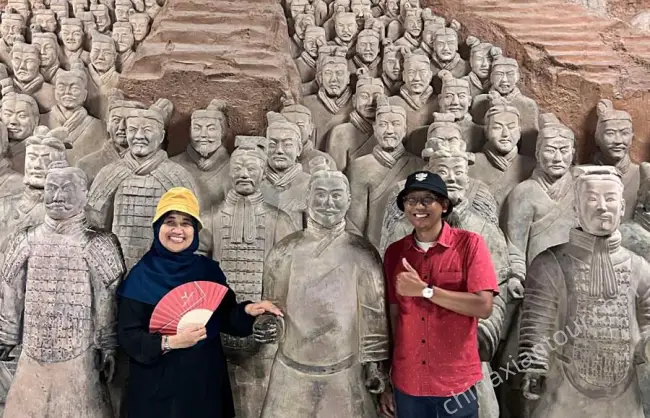
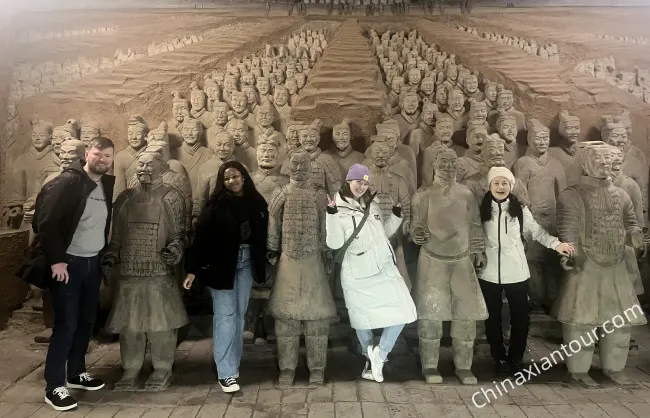
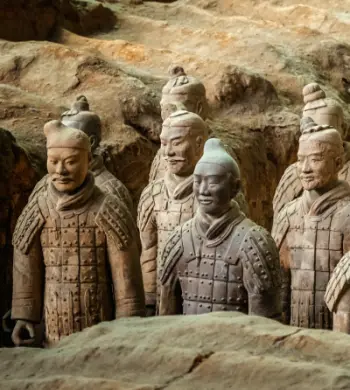
Each warrior in the Terracotta Army varies in attire, hairstyles, movements, and facial expressions. The Terracotta Army represents the glory of ancient Chinese sculptural arts.
The Suspended Excavation of the Mausoleum of Qin Shi Huang
· Complicated Structure and Myth of Life-Threatening Mercury River:
Current research shows that the underground palace of the Mausoleum of Qin Shi Huang has an extremely complicated structure and was equipped with intricate gears to keep away grave robbers.
Archaeologists also prove that there is a flowing mercury river. It may cause severe damage to the surrounding area if a massive leakage takes place accidentally.
· Antiques and Cultural Heritage Preservation
The value of Qin Shi Huang’s Mausoleum is more than a tomb filled with treasures. It is a symbol of Qin culture and Chinese history.
Excessive and/or inappropriate excavation might cause irreversible damage to the texture, color, and completeness of the antiques and the architecture itself. The efforts of cultural preservation should go side by side with excavation.
At the current stage, 180 burial pits have been confirmed by experts. The archaeological research focuses on the investigation of the exposed palaces rather than the underground part of the Mausoleum. And hundreds of the discovered antiques have been displayed in the museums.
Related reading: Real Colors of the Terracotta Warriors and Horses
Fun Facts About Qin Shi Huang
- QinShi Huang made contributions to the arts, including architecture, stone-carving, bronze decoration, textiles and silks, and music.
- Qin Shi Huang valued talentsand assigned them as imperial officials/officers. For example, in 237 BCE, Li Si was on the list when Qin Shi Huang ordered to expel private advisors from the Six States. However, Qin Shi Huang acknowledged his talents after reading Li’s memorial. He revoked the expulsion order and promoted Li to Chief Justice.
- Every coin has two sides. Qin Shi Huang’s order of large-scale construction projects, including his palaces, the Great Wall, and his Mausoleum, brought about lasting, disastrous stress on the labor force and resources. More than a million people died of hunger and exhaustion.
- Qin Shi Huang’s great empire lasted only 14 years. Three years after Qin Shi Huang’s death, the death of the third emperor of Qin marked the end of it.
Experience Qin Dynasty History in Xi’an
Embarking on a Xian tour is the best option to experience the splendid Qin Dynasty history. Xi’an City has a history of 3100 years and has been the capital of different ancient Chinese dynasties. It is respected as the top of the “Four Ancient Capitals” and a sacred birthplace of Chinese civilization.
To the Qin dynasty, Xi’an sits close to the Qin capital, Xianyang. And it is where the Mausoleum of Emperor Qingshuhuang is located. Therefore, for those who are curious about Qin Shi Huang and the Qin dynasty history, Xi’an is a perfect tourist destination on your China tour.
Travel to Xi’an from Major Chinese Cities & Transportation within Xian
Different options are available for tourists to travel to Xi’an directly from major Chinese cities, such as Beijing, Shanghai, Guangzhou, Chengdu, and so on.
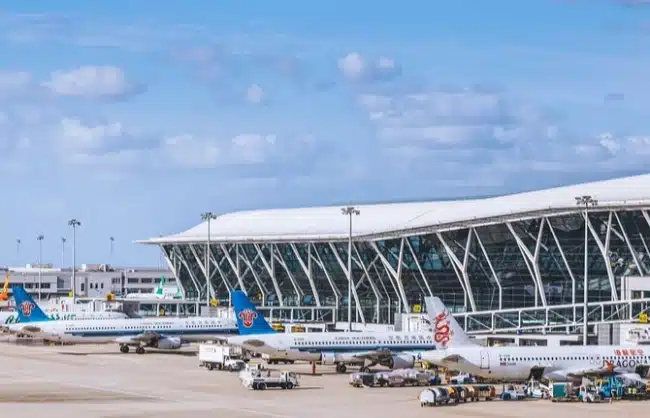
- If you travel by flight, you can arrive at Xi’an-Xianyang International Airport and choose a shuttle bus (25 CNY) or a taxi (120-150 CNY) to the CBD (47 kilometers).
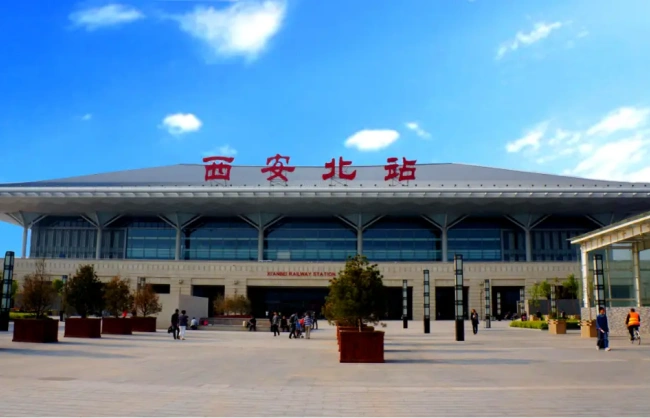
- If you use railways, you may choose either Xi’an Train Station or Xi’an High-Speed North Rail Station, which are both close to the CBD.
Travel Within Xi’an
- If you travel in Xi’an as a tourist, you may consider its metro. So far, there are five metro lines. Lines 2 and 3 are convenient to major attractions like the Xi’an Bell Tower and Dayan Tower. >> Read more details on How to Get to and Travel around Xian
A Tour Combining the Terracotta Army, Qin Shi Huang’s Mausoleum, and Other Highlights
It is recommended to spend 3-5 days on a tour of Xi’an, for most of its major attractions, including the Terracotta Army and Qin Shi Huang’s Mausoleum. Taking a three-day tour as an example:
- Day 1: Terracotta Army, drive about 1 hour to the city center to explore ancient City Wall & Muslim Quarter
- Day 2: Day trip to Mt. Huashan (about 0.5 hours by high-speed train)
- Day 3: Shaanxi History Museum / Xian Museum + Big Wild Goose Pagoda
With more time available, you can consider to add a local cooking class, a visit to Huaqing Gong or Hanyangling Mausoleum, or a side trip to Hukou Waterfall.
Recommended tour
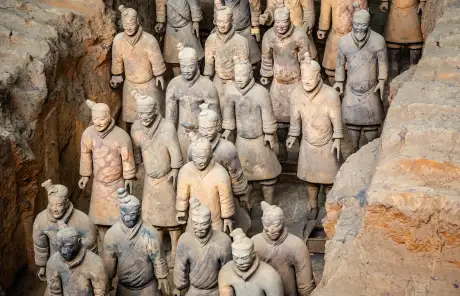
A three-day student-focused tour through Xian's imperial past, from life-size Terracotta Warriors to Tang Dynasty landmarks.
Explore Qin Shi Huang’s Eternal Legacy with China Xian Tour
Based in Xian and with over 20 years of expertise on planning Xian tours, China Xian Tour is the real Xian expert. We have many professional local guide who are familiar with Terracotta Army, Qin Shi Huang’s legend stories, and many other sites in Xian. No matter you want a classic Xian Terracotta Army tour covering iconic sites, or an in-depth discovery with more local culture and life experiences, our expert travel consultant team can make you satisfied. Feel free to contact us regarding your special preferences and detailed requirements. Our travel consultants can either offer a suitable group trip or help you customize your personal journey.