

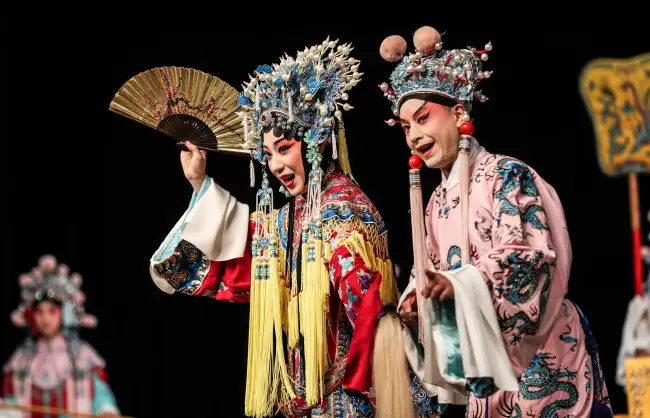
Peking Opera (Beijing Opera) was formed and matured in Beijing, hence its name. Known as the “national opera”, it is an important medium for introducing and disseminating traditional Chinese art and culture.
With a history of more than 200 years, Peking Opera has a standardized set of artistic expressions in various aspects such as literature, performance, music, and stage art.
Peking Opera is not only an important symbol of Chinese cultural traditions, but also an important component of world drama. Its unique artistic form and profound cultural connotation have earned it a high reputation worldwide.
What is Chinese Peking Opera?
Peking Opera is one of China’s “national quintessence”, also known as Pingju, Beijing Opera and Pihuang Opera. It has the main characteristics of Anhui Opera, Han Opera and Shaanxi Opera. With Erhuang and Xipi as the main vocal tunes, it integrates other artistic forms such as Kunqu Opera and Bangzi.
Peking Opera is the epitome and outstanding representative of Chinese traditional culture, and the largest (most influential) type of opera in China. Centered around Beijing, it spreads throughout the country. So don’t miss it when you travel in Beijing.
Peking Opera Facts
- Name: Peking Opera (Beijing Opera)
- Chinese Name: 京剧
- Heritage Status:
- In 2006, Peking Opera was included in the first batch of China’s national intangible cultural heritage
- In 2010, Peking Opera was included in the UNESCO Representative List of the Intangible Cultural Heritage of Humanity.
- Heritage Category: Traditional Drama
- Representative Plays: Farewell My Concubine, The Drunken Beauty, Dingjun Mountain, Silang Visits His Mother, Gathering of Heroes, Empty City Strategy, etc
History of Chinese Peking Opera
The origin of Peking Opera can be traced back to the 55th year of Qianlong reign in the Qing Dynasty (1790), when the four Anhui opera troupes of Sanqing, Sixi, Chuntai, and Hechun, originally performing in South China, entered Beijing in succession. From 1840 to 1860, the artists from Anhui, Han, and Beijing cooperated, absorbed some repertoires, tunes, and performance methods of Kunqu Opera and Shaanxi Opera, and merged some local folk tunes, gradually forming Beijing Opera.
After the formation of Peking Opera, it began to develop rapidly within the Qing Dynasty court, until the Republic of China achieved unprecedented prosperity.
Cultural Characteristics of Peking Opera
Peking Opera of China focuses on historical stories as its main performance content, with about 1,300 traditional plays and over 300-400 frequently performed ones.
Means of Artistic Expression
The four artistic techniques of Peking Opera performance: singing (唱), speaking (念), acting (做), and fighting (打), are also the four basic skills of Peking Opera actors.
“唱” refers to singing according to certain tunes, “念” refers to musical recitation, “做” refers to dance-like physical movements, and “打” refers to acrobatic fighting and somersaults. They constitute the two essential elements of the performance art of Beijing Opera, which are “song” and “dance”.
Opera actors need to be trained in these four aspects from a young age in order to better portray various characters in the opera play.
It is highly recommended that you enjoy a wonderful Peking Opera performance during your Beijing tours.

Types of Roles in Peking Opera
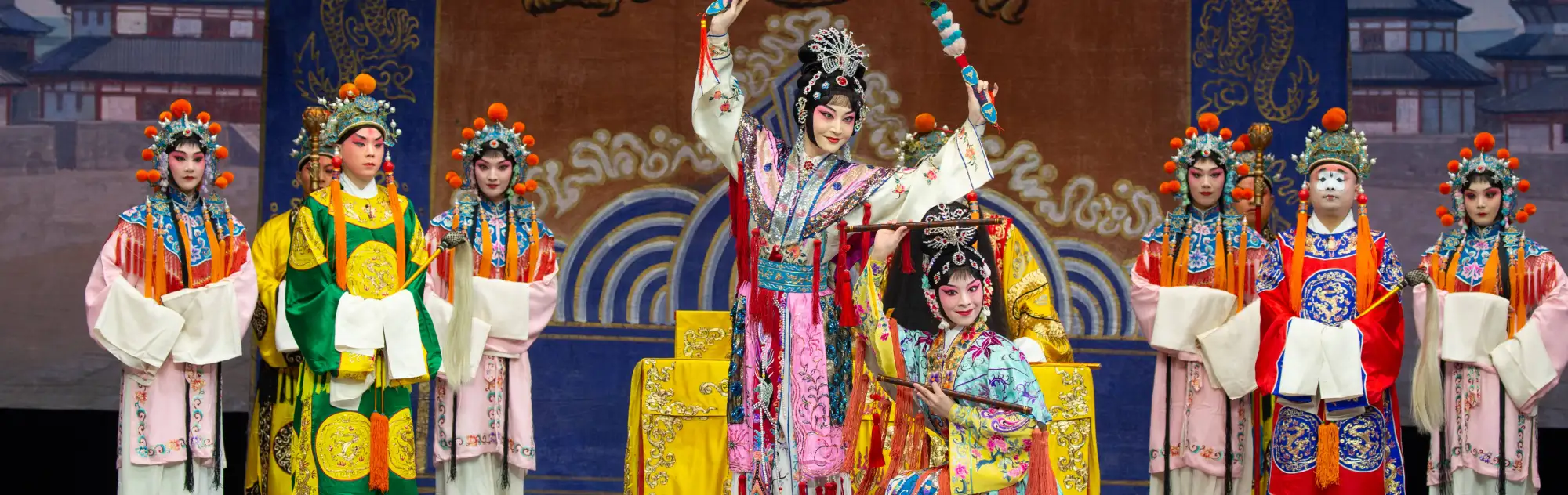
The roles on the Beijing Opera stage are divided based on their personality, gender, age, occupation, and social status, with various artistic exaggerations applied to their makeup and costumes. The specialized term for role types in Peking Opera is “行当”.
The current roles in Peking Opera are divided into four types: Sheng (生), Dan (旦), Jing (净), and Chou (丑).
-
Sheng Role
The general term for male protagonist, excluding those with painted faces and clowns, is divided into Laosheng (elderly men), Wusheng (martial men), and Xiaosheng (young men).
-
Dan Role
The general term for female protagonist, is divided into Qingyi (main female role), Huadan (vivacious women), Guimendan (unmarried young girl), Daomadan (young female warrior), Wudan (martial women), and Caidan (elderly women clown).
-
Jing Role
Commonly known as Painted Face (花脸), it mostly plays male characters with unique personalities, qualities, or appearances. They use facial makeup, have a loud tone, and a rough style.
-
Chou Role
Playing a comedic role, commonly known as “little painted face” due to applying a small amount of white powder on the nose bridge. Divided into Whenchou (civilian clown) and Wuchou (martial clown).
Facial Makeup in Beijing Opera
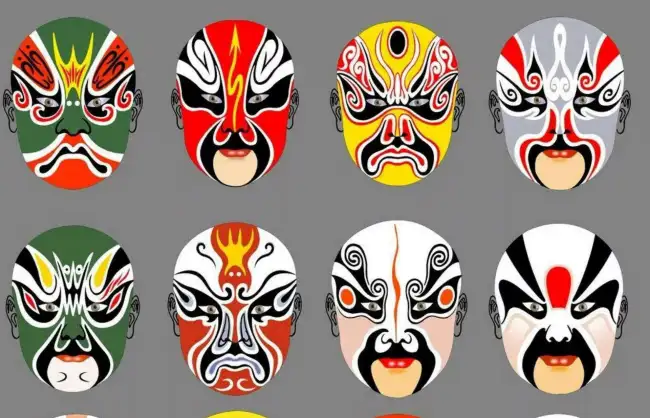
Facial makeup (脸谱) is an important feature of Peking Opera, which is well-known both domestically and internationally and is considered a symbol of traditional Chinese culture. Each historical figure or a certain type of character in Beijing Opera performance has a general notation, so it is called “facial makeup”.
In terms of color, Peking Opera masks come in red, yellow, blue, green, black, white, and so on:
- Red face carries a positive connotation, representing loyalty and bravery;
- Black face is neutral, representing fierce intelligence;
- Blue face and green face are also neutral, representing rebellious heroes;
- Yellow face and white face carry a derogatory connotation, representing wickedness and ferocity;
- Gold face and silver face are mysterious, representing gods and demons.
Peking Opera Costumes
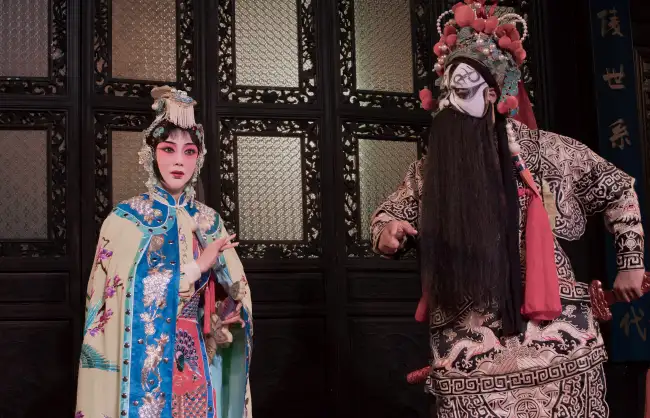
Peking Opera costumes, also known as “行头”, are based on the costumes of the Ming Dynasty and combine the styles of costumes from the Song, Yuan, Qing and other dynasties. They have been formed through a long cultural accumulation and institutional influence of various dynasties.
Peking Opera costumes play a crucial role in role-playing. For example, the embroidered robe (蟒袍) is a commonly used costume for roles such as emperors and officials. In terms of production techniques, Peking Opera costumes pay attention to details and exquisite embroidery. In addition, the design of the costumes also takes into account the comfort of the actors and its durability.
Plan your China tours to learn more about the brilliant culture of Peking Opera in Beijing.
Peking Opera Theaters in Beijing
Liyuan Theater
Liyuan Theater is the first teahouse-style theater in Beijing, jointly established by Beijing Qianmen Hotel and Beijing Opera Theater in 1990. Its auditorium can accommodate over 800 people to watch the Peking Opera performance. You can taste Beijing snacks while enjoying the quintessence of Chinese culture in Liyuan Theater.
Address: 1st Floor, Qianmen Jianguo Hotel, No. 175 Yong’an Road, Xicheng District, Beijing
Mei Lanfang Theater
Mei Lanfang Theater is a modern performance venue named after the Chinese Peking Opera master Mei Lanfang. Its auditorium can accommodate over 1,000 people to watch the performance. The theater environment is very good, with an elegant style, and the on-site sound effects are also excellent. There is a bronze statue of Mr. Mei Lanfang in the theater.
Address: No. 32 Ping’anli West Street, Xicheng District, Beijing
Chang’an Grand Theater
Chang’an Grand Theater, built in the 1930s, is a time-honored theater with regional characteristics of old Beijing. The theater settings continue the ancient and elegant style of the old theater, allowing the audience to experience the original Beijing dialect and flavor, and better understand traditional Chinese culture. The theater is also very affordable in terms of ticket prices.
Address: 1st Floor, Guanghua Chang’an Building, No. 7 Jianguomen Inner Street, Beijing