
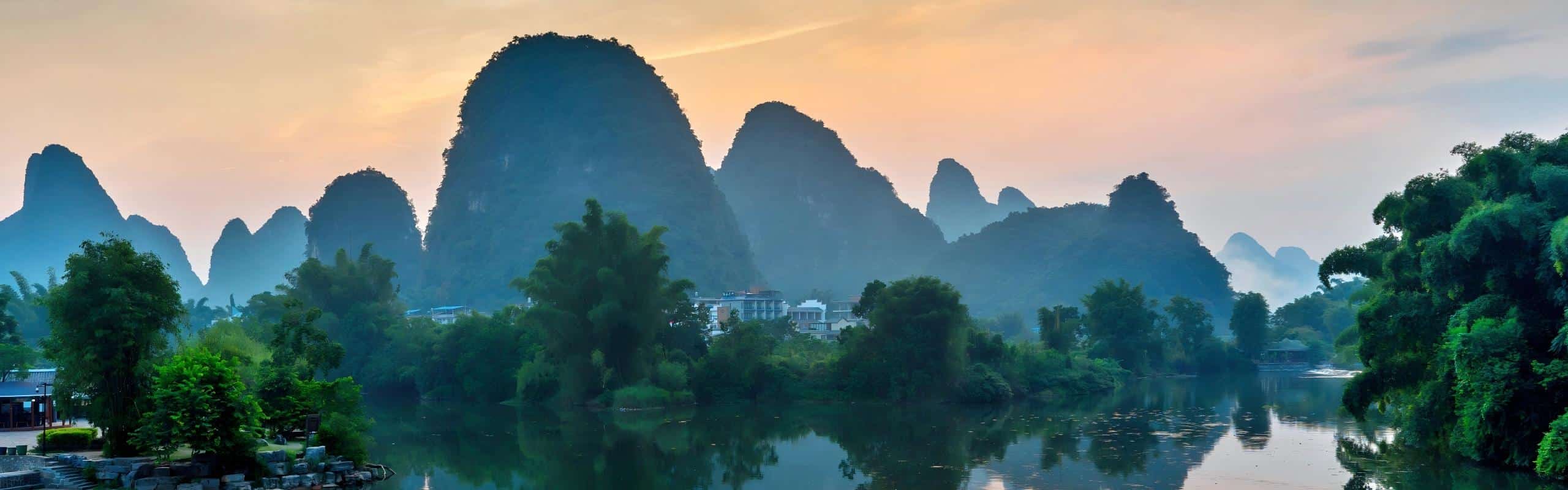
What’s the first thought comes into your mind when mentioning Guangxi? Isn’t it the breathtaking natural beauty in this province, like the karst mountains or Li River in Guilin? But, indeed, this southern Chinese region has far more gems that waiting for people to take a deeper insight into. For example, it is home to China’s largest ethnic minority: the Zhuang ethnic group. After living here for thousands of years, these people has ingrained their vibrant traditions into every inch of the land and every part of living culture.
Beyond culture, the region carries an impressive past, which can date back to the prehistoric settlements to the Lingqu Canal, one of the world’s oldest man-made waterways. And the bold flavors of Guangxi cuisine also a manifest vigorous vitality in people’s hearts. In this article, we’ll share some of the most fun and interesting facts about Guangxi, revealing the reasons of it becoming a destination where natural wonder, history, and tradition come together.
Content Preview
- The Story Behind Guangxi’s Name
- A Landscape Forged in Stone and Water
- Ethnic Groups in Guangxi and Their Traditions
- A Culinary Journey for the Adventurous
- Guangxi’s Millennia of History is Waiting to Be Explored
- Guangxi’s Strategic and Modern Face
- Guangxi is Easily Reachable from Vietnam
- FAQs about Guangxi
- Plan Your Guangxi Tour with China Xian Tour
The Story Behind Guangxi’s Name
A Name from the Song Dynasty
The birth of the name Guangxi can be traced back to the Song Dynasty (960–1279 AD). At that time, to achieve the need of easier governance, China’s southern territories were divided into several parts, and this region, which is now called as Guangxi, was firstly called Guangnan Xilu, in English it means, the “Vast Southwest Region.”The term was later shortened to Guangxi (广西).
The characters themselves are also meaningful: guang (广) can be translated as “expanse” or “vast,” while xi (西) means “west.” Together, they are used to highlight both the size of the territory and its position on the southwestern frontier of the empire.
The Abbreviation “Gui”
Every province in China has a typical abbreviation term, which can be easily noticed in the car license plates (usually the first character). And Guangxi is often referred as Gui (桂), which in fact, comes from the name of Guilin (桂林). A city once served as Guangxi’s capital and still remains one of the most famous cities in the province. So the abbreviation is also a mark designed to remind people of the natural, cultural and historical legacy of this city.
A Landscape Forged in Stone and Water
The Kingdom of Karst
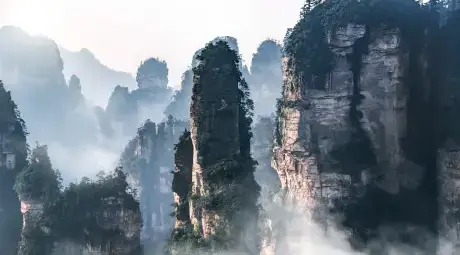
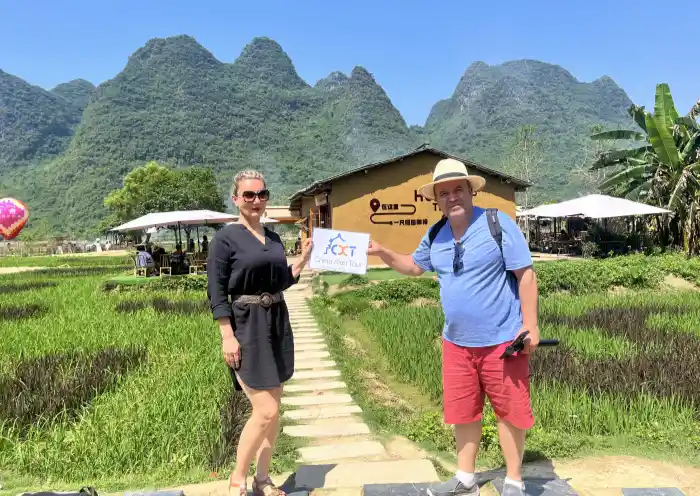
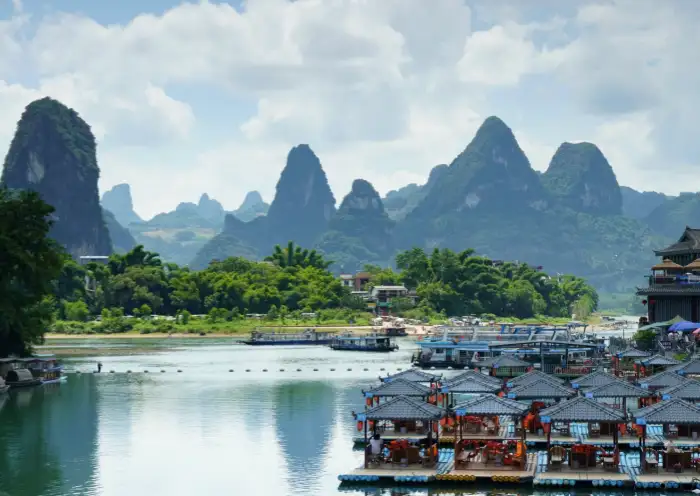
More than half of Guangxi’s surface is made of limestone, giving this region one of the world’s most dramatic karst landscapes. While Guilin’s iconic peaks are the most celebrated, you can discover the equally astonishing sites in Liuzhou, Hechi, and the tranquil Mingshi Countryside.
In the UNESCO-listed South China Karsts, you’ll see the name of Guilin and also Guizhou and Yunnan, where the famous Stone Forest is located. If you want to explore the beauty of the scenery in a more immersive way, then take a Guilin tour which includes a visit to Yangshuo, as such a schedule is capable to fulfill all your imagination about Guilin.

Unique Underground Caves and Canyons
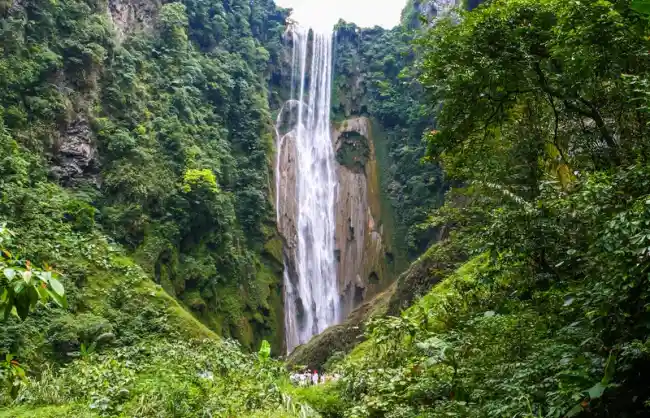
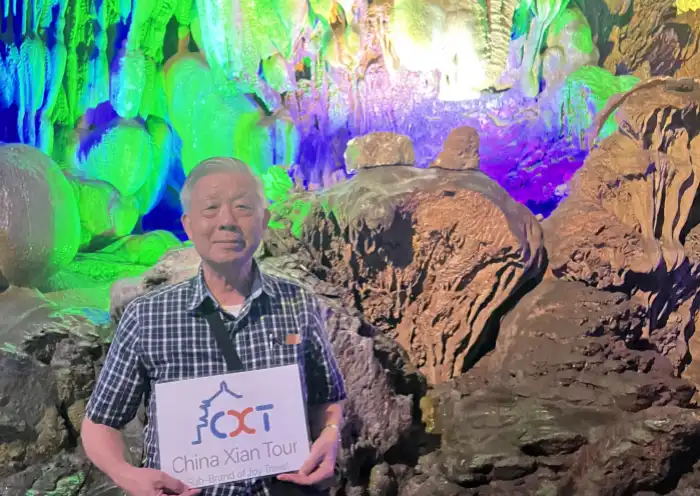
Beneath the limestone peaks, nature with its ultimate magic power has created a hidden world in the deep ground, where the dream-like caves and gorges come into life. There are two of the most famous sites you must visit. The first is the Reed Flute Cave, visitors are expected to be dazzled by its stalactites and colorful lighting. And apart from that, Tongling Grand Canyon in Baise, will use its dramatic towering cliffs, waterfalls, and lush forests to get you feel a purer force of nature.
Recommended Tour: 3 Days Guilin & Yangshuo Tour
The Li River: A Poetry in Motion
The Li River is often called one of the most beautiful waterways on this planet. Just like its mist-shrouded karst peaks has inspire countless Chinese paintings and poems during thousands of years, it has the power to give every visitor an ever-lasting impression in their minds.
Many activities have set with river being the core, and among them, taking a Li River cruise is believed to be one of the most rewarding experiences that one must have when visiting Guilin. It allows travelers to appreciate nature’s awe-inspiring work on the land up close while drifting past scenes that look like living human scrolls.
More Natural Wonders
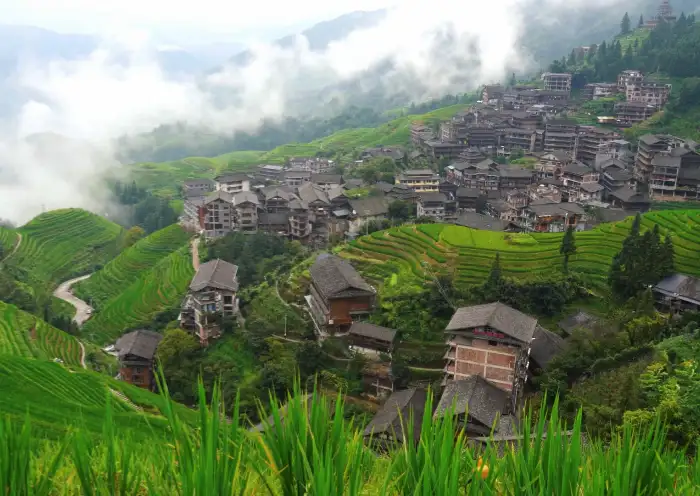
Beyond karst peaks, Guangxi will walk you into some of China’s most remarkable rural and border landscapes. For example, the Longji Rice Terraces, also called the “Dragon’s Backbone,” is an awe-inspiring site that tells how beautiful the cooperation between work of nature and intelligence of human can be. The moment of waves of terraced fields climb the mountain slopes has been captured by countless photographers from all over the world.
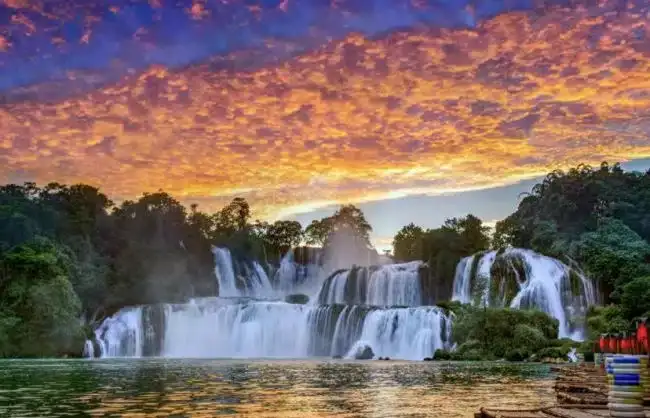
Meanwhile, the Detian Waterfall, located on Guangxi’s border with Vietnam, is the largest transnational waterfall in Asia and a definitely must-see for nature lovers.
Recommended Tour: 3 Days Guilin Tour with Li River Cruise & Longji Terrace
Ethnic Groups in Guangxi and Their Traditions
China’s Largest Ethnic Minority: The Zhuang
Guangxi’s official name is “Guangxi Zhuang Autonomous Region”, with a glance of it and you’ll catch the fact that Guangxi is a region prominently settled by the Zhuang people. With a population of over 16 million, the Zhuang ethnic group is also known as the largest ethnic minority group in China.
And despite such a massive population, their long-standing history is also impressive, they have been building their homes on this land for over two thousand years. Today, many of them still speak the language that developed by their ancestors, and with continues efforts, their strong sense of identity has been preserved in every piece of their music, festivals, and folk traditions.
One of their most important events is the Zhuang “Song Festival” (Sanyuesan Festival), and it’s held on the third day of the third lunar month. During this vibrant gathering, all communities would come together to celebrate with flowers and songs. Indeed, their culture has already melted into every detail of life, and being blended seamlessly into Guangxi’s mountainous landscapes.
A Mosaic of Cultures
Beyond the Zhuang, Guangxi has been the home to more than a dozen of other ethnic groups, and that’s why you can expect to enjoy a wide range of cultures in a Guangxi tour, and with contributions from each one of the group, the region has eventually attained its unique cultural mosaic.
The Dong Ethnic Group
Among all, the Dong people are especially renowned for their architectural achievements. They created the intricate wooden wind-and-rain bridges and towering drum towers, which are some of the most iconic community landmarks. Besides, their polyphonic Grand Song of the Dong has even been recognized by UNESCO as an intangible cultural heritage.
The Yao Ethnic Group
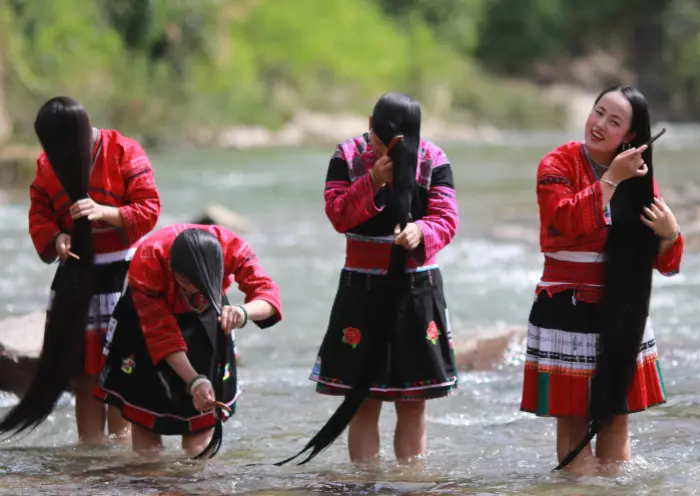
The Yao people are extremely famous for their bold and delicate customs. And one thing extremely interesting about this groups is that Yao women who live Huangluo Village would even grow their hair to more than two meters long and coil it into elaborate styles.
The Miao Ethnic Group
As for the Miao group, you’ll surely be impressed by their mastery in making one of the most elaborate silver jewelry and colorful embroidered costumes in the world. And the Miao people will wear these works of arts during major festivals and their important days.
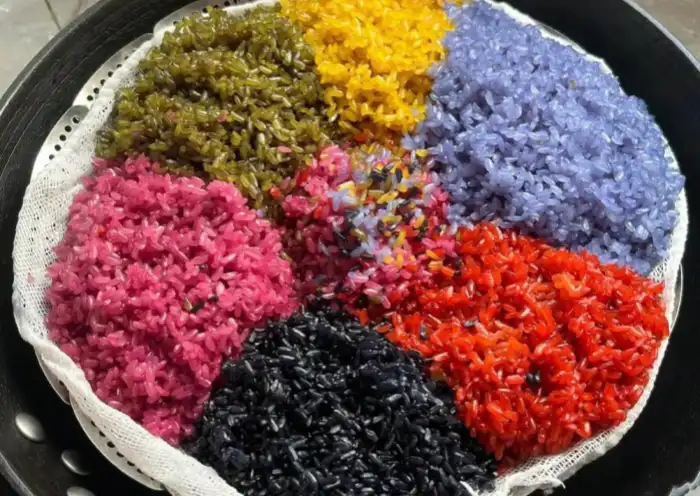
And indeed, traditional crafts with different matches of colors and patterns have long been vital expressions of identity for multiple groups.
And since there are so many ethnic groups living in Guangxi, it also celebrates way more festivals than other provinces. If you are interested in the diverse celebrations, plan your tour carefully and you’ll get the chance to join some of them (e.g. Miao New Year, Dong harvest celebrations, Zhuang Sanyuesan Festival). And now you may know that why Chinese people would call Guangxi as not only a scenic wonderland but also a living museum of China’s ethnic heritage.
Related Readings: Top Ancient Towns & Villages around Guilin
A Culinary Journey for the Adventurous
Regional Flavors
Guangxi has one of the most diverse food styles in the country. Its northern area, especially cities like Guilin and Liuzhou, is dominated by bold and spicy flavors, as dishes here are greatly influenced by neighboring Hunan province. In contrast, foods in the south are tasted slightly lighter, as people would prefer Cantonese-inspired dishes that made with an emphasis on freshness and balance. So don’t worry if you’re just traveling in one province, in Guangxi you can still enrich your journey with a wide range of taste.
The Famous and the Fearless
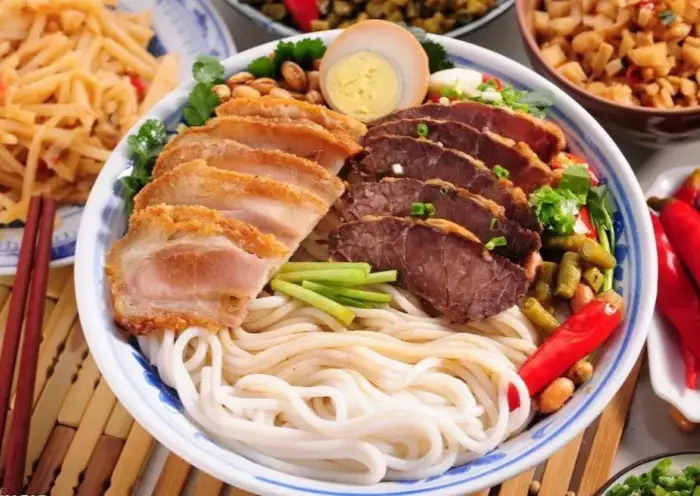
Guilin Rice Noodles are famous throughout the country, and it is said that everyone who travel here should have a bowl of this beloved local staple. Normally served with pickled vegetables, peanuts, and a rich broth, you’ll find it simple yet deeply satisfying.
For those who dare, Luosifen (snail rice noodles) from Liuzhou is a must—its strong, pungent aroma has earned it both a cult following and international fame. While in Nanning, Laoyou Rice Noodles have taken an unshakable status in people’s heart. Its tangy and peppery flavor is said to have the power of “curing homesickness.”
However, if rice noodles are not your first pick, you may also find a sense of fulfillment in other specialties. For example, you can try Yangshuo Beer Fish, which is a river delicacy cooked with beer and added with a savory kick. Or maybe the Yao people’s Oil Tea, made by frying tea leaves with garlic and puffed rice before brewing, you’ll find it a unique cultural experience. In general, Guangxi’s flavor is bold and exciting, one need to be fearless to really touch the soul of its food culture.
Recommended Tour: 5 Days Guilin Food and Sightseeing Tour
Guangxi’s Millennia of History is Waiting to Be Explored
Ancient Roots and Early Humans
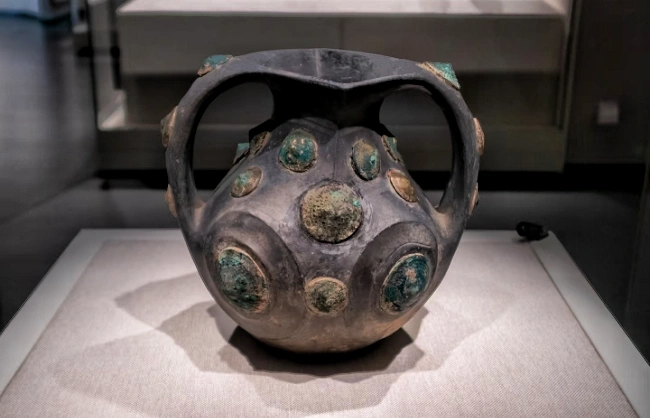
Guangxi’s history stretches back hundreds of thousands of years. Archaeological discoveries show that humans had showed up and lived in here as early as 800,000 years ago, making it one of the earliest inhabited regions in southern China. Ancient cave dwellings and stone tools all tell the stories of how early peoples made their living in Guangxi’s fertile valleys and limestone landscapes.
The Lingqu Canal: An Ancient Marvel
Lingqu Canal is recognized as one of Guangxi’s greatest historical legacies, which was built in 214 BCE under the Qin Dynasty. This project had managed to link the Xiang River (flowing north into the Yangtze) with the Li River (flowing south toward the Pearl River). This ingenious waterway then became a strategic corridor between northern and southern China, and it had later shaped regional trade and military routes for centuries
With all the efforts and intelligence spent on it, the Lingqu Canal is undoubtedly recognized as one of the world’s oldest and most remarkable canals. For all the time, it’s been telling people how brilliant and remarkable the ancient Chinese engineering is.
From Ancient Kingdoms to Autonomous Region
In ancient times, Guangxi was originally home to the Baiyue peoples, who share a rather distinctive culture and tradition. Later, this place became a part of the Nan-Yue Kingdom before being fully integrated into imperial China. And over the centuries, Guangxi had played a key role as both a frontier and a cultural crossroads mainly because of its unique geographic position. And during this period, it has never stopped absorbing influences from Central China and Southeast Asia.
In the modern era, its significance was even more recognized with the establishment of the Guangxi Zhuang Autonomous Region in 1958. This decision emphasizes the importance of Zhuang and many other ethnic groups’ history and culture to all the nation.
Recommended Tour: 3 Day Guilin Tour with Yangshuo and Xingping
Guangxi’s Strategic and Modern Face
China’s Gateway to ASEAN
Guangxi has a rather special geographic location. It not only borders Vietnam but also directly faces the Gulf of Tonkin, so that it has long been a vital link between China and Southeast Asia. In modern era, as the communication between regions is becoming more and more important and extensive, it then takes an even more prominent role as a hub for cross-border trade and regional cooperation. The capital city Nanning also hosts the annual China-ASEAN Expo, and this further highlights Guangxi’s position as a diplomatic and commercial bridge which can connect China with ASEAN countries.
Related reading: How to Plan a Trip to Nanning and Surroundings
Economic Powerhouses: From Sugar to Scenery
Guangxi is believed to be both culturally rich and also economically dynamic. In agricultural side, it produced most of China’s sugarcane and sugar, fulfilling the needs for both domestic consumption and exports. Beyond that, its development in the tourism is also unrivaled nationwide, since the region possesses some many natural gems including world-famous karst mountains, river landscapes, and diverse ethnic heritage. Indeed, Guangxi’s natural and cultural assets will help it to continue to attract travelers from around the globe.
Guangxi’s Scenic Coastline
Though Guangxi is often associated with images of mountains and rivers in people’s mind, it, in fact, possesses a coastline of about 1,500 kilometers (932 miles) along the Gulf of Tonkin. And along this line, there are seaside cities like Beihai, which is one of China’s most popular coastal destinations.
Just offshore lies Weizhou Island, a really famous tourist attraction. It’s a volcanic island with a dramatic scenery drawn by cliffs, coral reefs, and laid-back island life. As a result, many people are praising it as a favorite site for diving and having beach holidays. Further southwest, you’ll encounter with Fangchenggang, a city serves as both a deep-water port and a gateway to Vietnam. It’s silently standing there in the beautiful coastal scenery, seeing people go out and in for maritime trade. Together, these destinations tell a multi-faced Guangxi—one shaped not by limestone peaks, but by the sea.
Recommended Tour: 3 Days Beihai and Weizhou Island Beach Tour
The Origin of Guilin’s Name
In translation, the name Guilin (桂林) means “Forest of Sweet Osmanthus,” since Guilin city is steeped in the fragrance of osmanthus blossoms, and famed for the vision of endless groves of osmanthus trees from the past to the present. So that this seasonal blossom has then become a symbol of Guilin itself. As a result, it is more possible for visitors coming in September or October to find Guilin at its most enchanting.
What is the Difference Between Guangdong and Guangxi?
Historically, Guangdong and Guangxi were together known as the “Two Expanses area”—with dong (东) meaning “east” and xi (西) meaning “west.” While they share some cultural roots in history, their paths have diverged over time.
Guangdong, which has attained much more development in trade and manufacturing for it has a more convenient and broader coastalline, gradually becomes one of China’s richest coastal powerhouses. And it’s also the cradle of Shenzhen, a globally renowned city for its rapid and dramatic economic growth.
Guangxi, by contrast, is more mountainous which makes it less suitable for economic development. However, it get more celebration for the breathtaking landscapes, diverse ethnic cultures, and slower pace of life. In general, the most important difference for travelers to understand is clear: Guangdong offers a glimpse of modern China’s economic strength, while Guangxi provides an escape into nature and tradition.

Guangxi is Easily Reachable from Vietnam
People can see on a map that Guangxi actually shares a long long border with Vietnam, as a result, this province has also long served as one of the most convenient gateways between China and Southeast Asia. If you want to travel to Vietnam after a China tour, you can cross through major land ports such as Friendship Pass (Youyi Guan) near Pingxiang, or via Dongxing, the busiest border town opposite Mong Cai in Vietnam.
Recommended Tour: 7 Days Guangxi Tour of Detian Waterfall & Weizhou Island
FAQs about Guangxi
Does it snow in Guangxi?
Guangxi enjoys a subtropical climate, which means it would still be warm even in winter. So that snow would extremely rare to see in this region. However, higher mountain areas with lower temperatures like northern Guilin and Longsheng may occasionally see light snow or frost.
What are the symbols of Guangxi?
One of the most typical things would probably the osmanthus flower, and this can be seen in the name of Guilin. However, there are still many other significant symbols like the Zhuang culture, or the breathtaking scenery of karst peaks and the Li River.
What is the most spoken language in Guangxi?
The answer is definitely Mandarin. However, expect for this, many locals also speak Zhuang language (a Tai–Kadai language), as well as Cantonese, Pinghua, and various local dialects depending on the area.
Is Guangxi a good place to visit in the winter?
Yes. It has a rather mild weather in winter especially when compared with northern China, so that many people living in other regions would take it as an escape from winter’s harsh coldness. Popular spots like Guilin, Yangshuo, and Nanning remain accessible year-round, though it’s best to bring a light jacket for cool evenings.
What are the most popular ethnic minority festivals in Guangxi?
The Zhuang people’s “Song Festival” (San Yue San) in April is surely the most famous, and people will host a lot of events like singing contests, dancing, and colorful costumes. And this festival also gives Guangxi people a special regional holiday (2 days).
What are some of the major historical sites from Chinese dynasties in Guangxi?
Must visit historical sites include the Lingqu Canal from the Qin Dynasty, ancient city walls in Guilin, and the Friendship Pass (Youyi Guan) fortress near the Vietnam border.
What is the largest city in Guangxi, and what is it famous for?
Nanning is both the capital and largest city in Guangxi province, and it is also known as the “Green City” for its lush parks and other greening constructions. Besides, it’s the place where China-ASEAN Expo is held.
What are the most well-known rivers and cave systems besides those in Guilin?
Beyond the Li River, the Hongshui River and Xijiang River also flow through Guangxi, and both of them are important waterways for transport and regional communications.
Famous underground wonders include Silver Cave in Yangshuo and Tongling Grand Canyon in Baise. They can show the surreal beauty of a world that cannot be reached by sunlight.
Plan Your Guangxi Tour with China Xian Tour
Guangxi is a treasured place providing all types of travelers a sense of fulfillment. And to make the most of your days in Guangxi, it is recommended to join China Xian Tour for an exclusively customized journey. Our local travel experts are here waiting to help you get a carefully crafted itineraries which are just designed according your own interests, time and budget. Contact us to start planning your Guangxi tour, and prepare to fully immerse yourself in the exploration of this amazing land.