

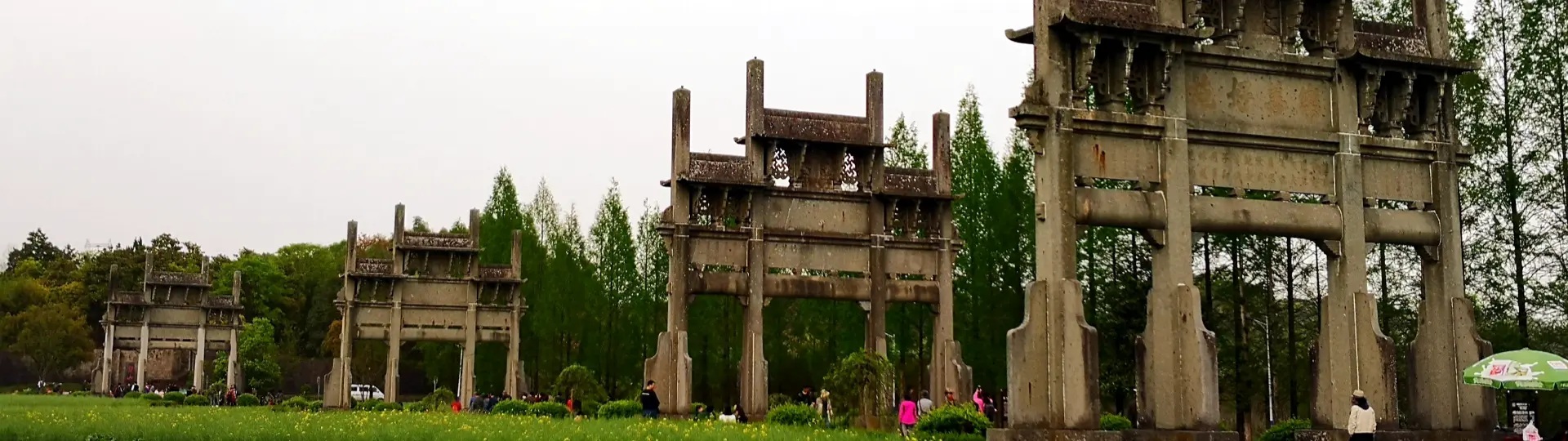
The Tangyue Memorial Archways are located on the eastern avenue of Tangyue Village, Zhengcun Town, She County, Anhui Province. It is a representative work of ancient Huizhou architectural art from the Ming and Qing Dynasties. The seven consecutive archways in Tangyue not only reflect the ethical concepts of Huizhou culture, such as loyalty, filial piety, chastity, and righteousness, but also encompass a rich “people-oriented” humanistic history.
Serving as an important testament to the Huizhou merchants’ dominance for over three hundred years, each of the Tangyue Memorial Archways has a touching story filled with emotional intricacies. Immersing yourself in the stories of Tangyue Memorial Archways, as it ensures a truly worthwhile Huangshan tour.
Tangyue Memorial Archways Facts
- Type: Archway, Historic Site
- Recommended Visiting Hours: 1-2hour
- Best Time to Visit: Spring
- OpeningHours: 07:30 – 17:30
- Tickets: 100 Yuan
- Address:Tangyue Village, Shexian County, Huangshan, Anhui Province
What to See in Shexian Tangyue Memorial Archways
Bao Can Filial Piety Archway (鲍灿孝子坊)
The Bao Can Filial Piety Archway of the Tangyue Memorial Archways is built in the 13th year of the Jiajing reign of the Ming Dynasty (1534). The archway features high relief carvings of lions playing with balls. The central column, lower beam, and dougong (bracket set) of the main archway are made of white marble in imitation of wood.
Cixiao Li Archway (慈孝里坊)
The Cixiao Li Archway is the oldest of Tangyue Memorial Archways in terms of its initial construction, dating back to the Song Dynasty. It was later damaged for various reasons and was reconstructed during the Ming and Qing dynasties. The archway is inscribed with the “Cixiao Poem” by Emperor Yongle of the Ming Dynasty. Emperor Qianlong was also moved to write a couplet on the archway and allocated funds for its renovation.
Bao Wenling’s Wife’s Chastity and Filial Piety Archway (鲍文龄妻节孝坊)
This Archway in the Tangyue Memorial Archways was built in the 34th year of the Qianlong reign of the Qing Dynasty (1769). According to county records, Wang, a native of Tangyue, became a widow at 25 and vowed to remain chaste. She raised her child to adulthood but died from overwork at 45, having kept her chastity for 20 years.
Bao Shufang and His Son’s Righteous Deeds Archway (鲍漱芳父子义行坊)
The Bao Shufang and His Son’s Righteous Deeds Archway is also known as the Philanthropy Archway of the Tangyue Memorial Archways. It features a soaring column design with four columns and three bays. The main beams and smaller beams are unadorned, except for the arches under the eaves, which are engraved with intricate patterns.
Bao Wenyuan’s Wife’s Chastity and Filial Piety Archway (鲍文渊妻节孝坊)
This archway is a typical ancient chastity archway built specifically for women, constructed in the 32nd year of the Qianlong reign of the Qing Dynasty (1768). Wu, at the age of 22, married into the Bao family. When her husband’s younger sister fell ill, Wu nursed her day and night. Wu’s actions moved local officials and the emperor so much that she got the rare honor of receiving this grand archway.
Bao Fengchang Filial Piety Archway (鲍逢昌孝子坊)
Built in the 2nd year of the Jiaqing reign of the Qing Dynasty (1797), this archway commemorates Bao Fengchang’s extraordinary filial piety. During the turmoil at the end of the Ming Dynasty, Bao Fengchang’s father went missing for many years. In 1646, Bao Fengchang traveled thousands of miles, begging all the way to find his father. His filial devotion was rewarded when he found his ailing father in the ancient Yanmen Temple in Gansu.
Bao Xiangxian Minister Archway (鲍象贤尚书坊)
Bao Xiangxian was a capable official who governed the Yunnan border effectively and was beloved by the people. He had maintained his integrity and loyalty all his life. After his death, he was posthumously honored as the Minister of Works.
The Art of Tangyue Memorial Archways
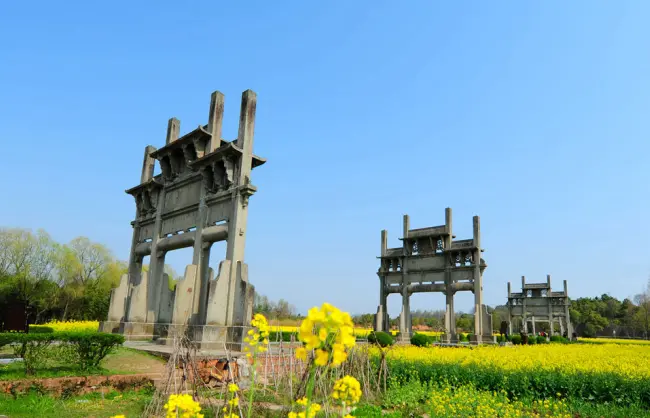
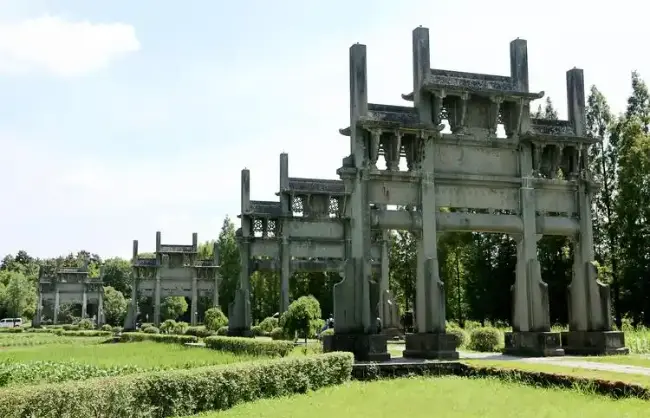
The Tangyue Memorial Archways are meticulously designed with strict axial symmetry, creating a sense of stability and visual focus. The archways are exquisitely carved, and the area around them is preserved with permanent farmland and no surrounding structures.
The continuous seven archways echo each other, recording the regional cultural characteristics of an era through their stone forms. They also reflect the comprehensive aspects of ancient Huizhou society, including clan systems, imperial examinations, commerce, and local customs, showcasing the profoundness of Huizhou culture. For a cultural experience during your Huangshan travel, don’t miss out the Tangyue Memorial Archways.
How to Get to Tangyue Memorial Archways
To get to the Tangyue Memorial Archways cluster in Huangshan City, tourist can take a passenger bus (every 20 minutes) from Tunxi District, to Zhengcun Intersection and transfer to bus No. 4 to reach the scenic area directly. Alternatively, you can also take bus No. 4 towards She County and reach the attration, or take bus No. 10 in She County.
Nearby Attractions
- Yellow Mountain: Anciently known as “the Capital of the Heavenly Emperor,” Yellow Mountain was considered the abode of deities due to its majestic beauty and mysterious allure.
- Tunxi Ancient Street:A pedestrian street in Tunxi District, with a history of over a thousand years.


