


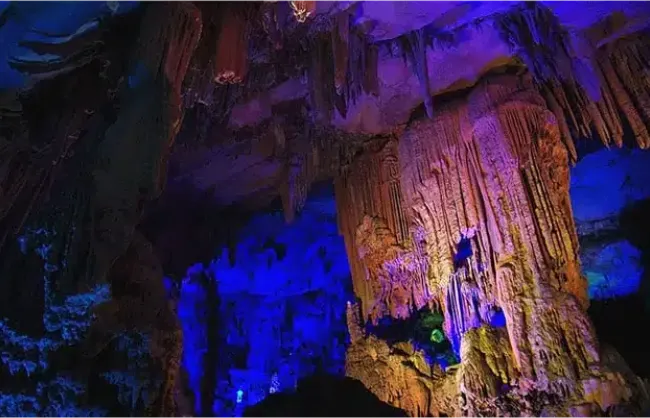
Reed Flute Cave is in Guilin’s northwest suburban area and 5 kilometers from the city center. It is a noted famous tourist scene because of its terrific stalactite cave and beautiful idyllic scenery. It is also recommended as one of “world tourism scenic spots” by World Tourism Organization.
The cave is 240 meters deep and 500 meters long with multiple colorful and exquisite shapes formed by stalactite, such as primeval forest, crystal palace, mountains of flower and fruit, inscriptions on the cave wall and others. So it is also known as the “Palace of Natural Arts”. After development in 1959, It has been equipped with a restaurant, teahouse, waterside pavilion, lake pool, bridge, and cruise boat with flowers and trees. Today, it has become a must-visit destination in a Guilin tour.
Content Preview
- Fast Facts about Reed Flute Cave
- Geological Wonders & History of the Reed Flute Cave
- What to See in Reed Flute Cave?
- Attractions outside Reed Flute Cave
- How to Get to the Reed Flute Cave
- Best Time to Visit
- Essential Tips
- Reed Flute Cave vs. Other Guilin Caves: How to Choose
- Nearby Attractions
- How to Plan a Guilin City Day Trip with Reed Flute Cave
- FAQs about Reed Flute Cave
- Let China Xian Tour Guide Your Way to Guilin’s Wonders
Fast Facts about Reed Flute Cave
- Location: The right bank of the Taohua River in the northwest of Guilin City
- Chinese name: 芦笛岩
- Opening hours: 9: 00 – 17: 00
- Entrance fee: 90 yuan
- Best time to visit: April to October
- Time needed: 1 – 5 hours
Geological Wonders & History of the Reed Flute Cave
How Was the Reed Flute Cave Formed
Reed Flute Cave is an ancient cave naturally formed over a long period. A million years ago, it was a lake lying underneath the earth. While on its journey through time and through the movements of the surface of the earth, the lake gradually took its shape of a cave. Later, groundwater formed by rainwater flows along many crushed zones in the mountain, dissolving the calcium carbonate in the rocks into a solution containing carbonate and calcium ions.
Once ground-water flowed into a crack of the rock and entered the cave, the water evaporated, leaving behind calcium carbonate. It is the precipitation crystallization of the Calcium ions that formed the stalactites after many years of accumulation.
When Was the Reed Flute Cave Discovered
The Reed Flute Cave had lain in obscurity for a thousand years as if lost in time. It was a pure coincidence when the lake was discovered. In the 1940’s a group of Japanese soldiers accidentally found the cave. Twenty years later, it was officially opened to the public. Nowadays, it becomes a popular destination when traveling Guilin. In fact, many distinguished guests have visited the cave, including former Chinese leader Deng Xiaoping, and former US presidents Nixon and Carter.

Types of Formations
- Stalactites are calcium carbonate deposits that grow downwards from the ceiling of the cave. When water rich in calcium carbonate drips from the ceiling, calcium carbonate deposits as the water evaporates. By time, it forms an inverted cone-shaped structure. The growth of the stalactite is extremely slow, only a few millimetres a year.
- Stalagmites are calcium carbonate deposits that grow upwards from a cave floor. When water drops onto a cave floor, calcium carbonate deposits and accumulates, and gradually forms conical shaped stalagmites.
- If stalactites and stalagmites continue to grow in an upward and downward motion and finally connect, they form stone columns, which are very common and spectacular features of caves, reaching several meters height in some cases.
- Stone curtains or dripstone are thin, shaped like a sheet or curtain. They are usually wavy or wrinkled, with beautiful shapes, resembling hanging curtains.
Legend of the Reed Flute Cave
When talking about the origin of the cave’s name, many people may refer to a local legend which says the tall reeds growing near the entrance were once used by villagers to carve simple flutes. And that’s why people started to call it Reed Flute Cave.
Another richer myth has built connections between the cave’s stalactites and formations with the classic Chinese tale of the Monkey King. One giant stalactite inside the cave is said to have been the magic spear which originally belongs to the Dragon King (a character in the tale), and later got wielded by Sun Wukong in his travels.
And there’s an even more poetical stories, which say that the cave’s glittering columns were once treasures turned to stone by immortals.
What to See in Reed Flute Cave?
Lion Rock and Sunrise (pinyin: Shilingzhaoxia 狮岭朝霞)
Lion Rock and Sunrise is such a grand view with so many stalactites – there are high peaks, thick forests, and ancient trees with thick shade. THere are also animals live in the Reed Flute Cave. Every sunrise, a bunch of lions would dance out joyfully facing the morning sun in the forest, making the entire forest filled with vitality. One of the lions is pretty “big” and looks at a little “lion” that is playing on the side of the mountain.
Crystal Palace (Pinyin: Shuijingong水晶宫)
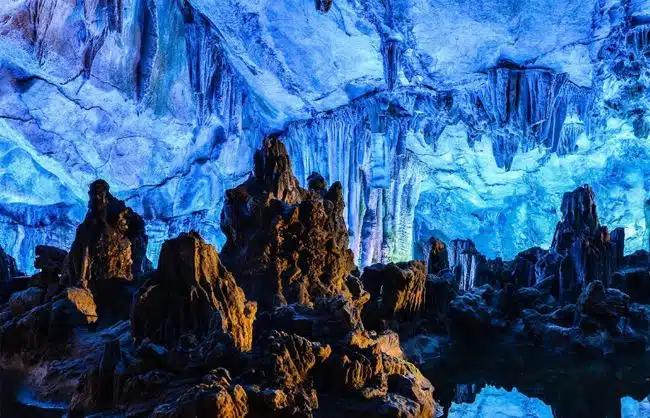
Crystal Palace is the widest part of the Reed Flute Cave. It is 93 meters wide and 18 meters tall. A huge palace lantern is hung on the upper left side of the hall, which casts a magical glow over the entire hall like the Crystal Palace of the Dragon King’s in the East Sea. Entering this hall, you can see it is very flat and spacious. The surface of the palace is smooth, and the top rock is relatively intact with few cracks.
Pines in the Snow (Pinyin: Tasongaoxue 塔松傲雪)
Pines in the Snow features two unique stalagmites. One looks like a big snowman, with its head and body, and the protruding parts are its arms. Due to the cold weather, it has tucked its hands into its pockets. The other looks like a tall, conical pine tree with a thick layer of ice and snow covering its branches and leaves, standing proudly in the snowy forest.
Sky-Scraping Twin (Pinyin: Shuangzhuqingtian 双柱擎天)
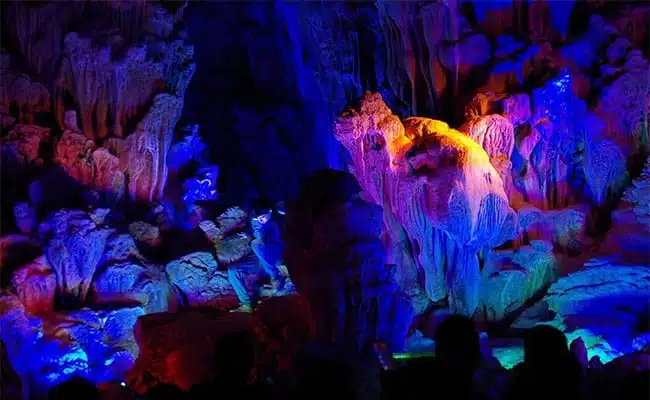
Here, there are thousands of years old green pines and tens of thousands of years old cypresses, densely packed and stretching as far as the eye can see. These numerous and tall stone pillars form the most spectacular stone forest in Reed Flute Cave. They are of the same height and thickness. A closer look reveals their differences: the one on the right seems not to be connected to the cave ceiling, but in fact, a few stone threads have already connected them. The “stone pillar” on the left appears to be connected, but in reality, it is not entirely connected, and it is that the top is concealed by a stone curtain of the same color.
Ancient Inscriptions (Pinyin: Bishuwenhua 壁书文化)
Reed Flute Cave and Big Cave are not only famous for their strange and beautiful scenery but also for the numerous inscriptions left by previous visitors. These ancient inscriptions are called “wall writings.” There are a total of 77 wall writings in Reed Flute Cave, including 5 from the Tang Dynasty, 11 from the Song Dynasty, 1 from the Yuan Dynasty, 4 from the Ming Dynasty, 4 from the made by scholars, monks, and tourists. You can appreciate ancient Chinese calligraphy from different periods.
Attractions outside Reed Flute Cave
Peach Blossom River (Pinyin: Taohua Jiang 桃花江)
On the way to Reed Flute Cave, most tourists will travel along the Peach Blossom River. The river is about 25 kilometers long. It is like a green ribbon, covering the Guilin Basin. The Peach Blossom River flows through a limestone area, and the water is very clear, flowing gently under the Feiluan Bridge.
The Peach Blossom River flows placidly on both sides. The hills and woodlands on the banks (which are varied, lush and substantive, dry and sparse) are reflected on the water surface. The bright red peach blossoms of spring are vibrant, fully showcasing the stunningly picturesque countryside. The peaks of Furong Mountain, Zhongyin Mountain, Lion Mountain, Qingxiu Mountain and Jia Mountain stand tall. The scenery is even more beautiful on a moonlit autumn night.
Flying Phoenix Bridge (Pinyin: Feiluan Qiao 飞鸾桥)
The first thing you will see after getting into the Reed Flute Scenic Area is a stately and simple stone bridge. This is the Flying Phoenix Bridge. The bridge is 62.4 meters (204.7 feet) long and 10.5 meters (34.4 feet) wide. According to the chronicles, it was built during the Song Dynasty (1228-1233 AD), and has been rebuilt many times. It is a pretty great place to take photos at sunset.
How to Get to the Reed Flute Cave
Bus: Guilin’s transportation network is actually very advanced. Visitors can take Bus No.3, 13 and 58, or a city sightseeing bus to get to the scenic spot (getting off at the Reed Flute Cave Station).
How to Get to the Reed Flute Cave from:
- Guilin Liangjiang International Airport (about 25 kilometers): Take a taxi in Zhongyin Road to reach the scenic area.
- Guilin South Railway Station (about 6 kilometers): Take Bus No. 3 from the South Station directly to the scenic area. The operation time of Bus No. 3 is from 6:30 to 21:50, with an interval of about ten minutes between each trip. The fare is 1 yuan per person.
- Guilin Railway Station (about 8 kilometers): Taking a taxi is the best way to reach the scenic area.
- City center: It is about 5 kilometers. You can take Bus No. 3 at Cross Street (Jiefang West Road) directly to the scenic area.
Best Time to Visit
Guilin has a very comfortable weather all year round. The Reed Flute Cave is a famous and fantastic scenic spot that is suitable to visit all year around. April to October is especially great for a Reed Flute Cave tour. But if you want to have a better experience, you’d better visit avoiding the official holiday in China.
Essential Tips
- You may take photos inside the cave, but make sure not to use flash.
- There will be dripping water and the ground will be wet in the cave so sports shoes are recommended.
- The cave is dark with some water on the ground, so be cautious going up and down the steps.
- There are vendors selling reed flute and other souvenirs outside the cave, and we recommend bargaining with the sellers.
- Key Photography Spots: If you want to take the best photos you can go to the Crystal Palace, Fish Tail Peak, and Dragon Tower, three most scenic areas inside the cave, where colorful lights and reflections together create stunning scenes.
- How to Book Tickets: There are many ways of buying tickets, on-site is fine and book in advance through Guilin’s official tourism website.
- Temperature Reminder: The cave stays cool year-round (around 18°C / 64°F), so bring a light jacket with you even in the hottest days of summer.
Reed Flute Cave vs. Other Guilin Caves: How to Choose
Cave Name |
Distance from Guilin City Center |
Highlights |
Best For |
Reed Flute Cave (芦笛岩) |
5 km |
Colorful lighting effects, intricate stalactites, and easy access |
First-time visitors, families |
Silver Cave (银子岩) |
85 km (Lipuxian) |
Largest karst cave in Guilin; silver-like reflections under light |
Adventure lovers, photographers |
Crown Cave (冠岩) |
29 km (on Li River route) |
Underground river cruises and rafting inside the cave |
Nature explorers, Li River cruisers |
Nearby Attractions
Seven Star Park: Located on the east bank of the Li River in the center of Guilin City, Guangxi. It is named after the seven peaks that are arranged like the Big Dipper in the sky. The park features the beautiful and mysterious Seven Star Mountain and Seven Star Cave.
Elephant Trunk Hill: Also known as Elephant Hill, it is located at the confluence of the Taohua River and the Li River in Guilin City, Guangxi, China. It is the city emblem of Guilin. Elephant Trunk Hill Park is one of the most famous parks in Guilin, with Elephant Trunk Hill as its theme.
How to Plan a Guilin City Day Trip with Reed Flute Cave
Itinerary A — Morning cave + afternoon city landmarks
You can start your day at around 9:00 a.m., and travel straightly to Reed Flute Cave (about 5 km northwest of the city centre). The illuminated chambers id the cave would take you approximately 1–2 hours to fully enjoy. After that, have your lunch in the city centre and spend the afternoon visiting some iconic Guilin city-spots such as Elephant Trunk Hill. This plan is best for those who want to experience both underground natural wonder and also the riverside city atmosphere without rushing.
Itinerary B — Late morning start + scenic side trips
However, if you prefer a slightly later start,leave your hotel around 10:30 a.m. is also fine. You may want to have some food before arrive at Reed Flute Cave by noon, and then explore the site through early afternoon. Your next stop can be a scenic break at the nearby Peach Blossom River or a visit to the historic Flying Phoenix Bridge. Finish your day with dinner back in the city or sunset at some viewpoints.
FAQs about Reed Flute Cave
Why does the Reed Flute Cave glow?
The colorful glow are, indeed, human made. It comes from the carefully designed LED lights that highlight the stalactites and stalagmites. And the lights can also create reflections on underground pools, so that you’ll feel like entering a dream-like world while wandering in the cave.
How long to spend at Reed Flute Cave?
Most travelers would spend 1–2 hours inside the cave. However, if you want to take more photos at each step, you may stay up to 3 hours in exploring its different chambers.
How deep is the Reed Flute Cave?
The cave stretches around 240 meters deep and 500 meters long. And the winding paths inside connect multiple chambers.
Is it possible to visit the Reed Flute Cave and other major attractions in one day?
Yes. Because the cave is really close to downtown Guilin (5km), so that you can easily combine it with visits to Elephant Trunk Hill, Seven Star Park, or even a short Li River cruise in just one day.
Are there places to buy food, water, or souvenirs near the cave entrance?
Yes. You can find a lost of small vendors and souvenir stalls near the entrance, and they all sell quite unique souvenirs. There are also restaurants and teahouses inside the scenic area.
Let China Xian Tour Guide Your Way to Guilin’s Wonders
Reed Flute Cave is definitely a rewarding destination, but it’s just one of Guilin’s many natural treasures. With China Xian Tour, you can continue your journey to even more wonders on Guilin’s treasured land. Our highly-experienced local guides will create a fully customized trip for you while also taking care everything along the way. And we’ll ensure you relaxing and enjoyable moments during all the days in Guilin.