


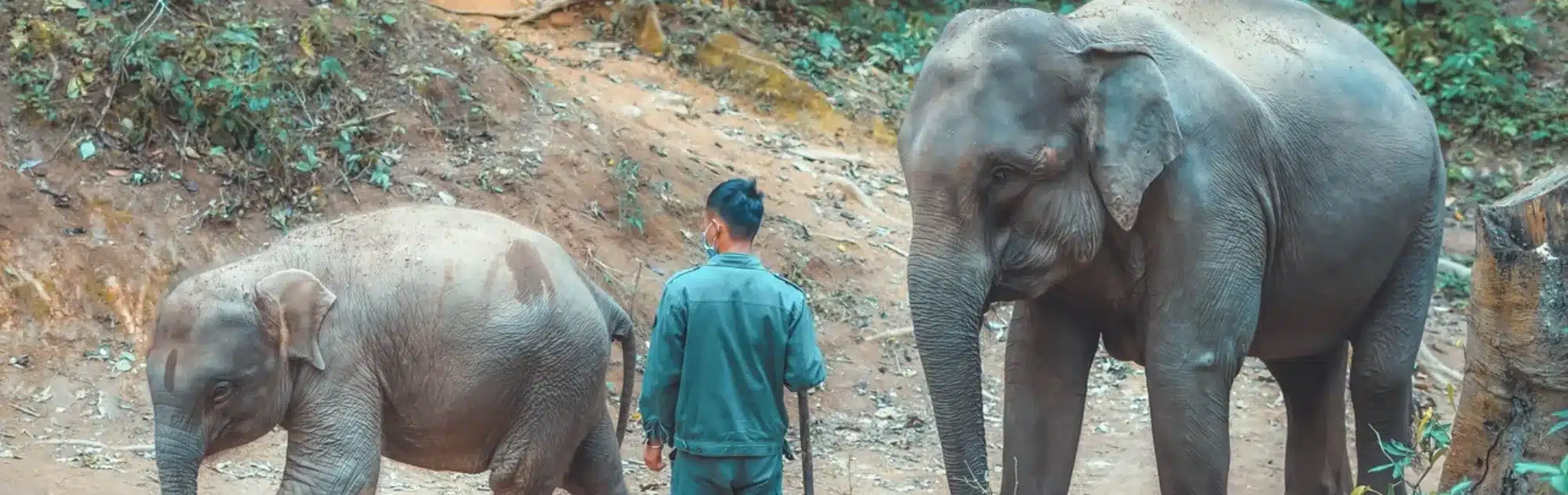
Located 22 kilometers from Jinghong, the capital city of Xishuangbanna, Wild Elephant Valley is a large nature reserve in Yunnan Province, China. Spanning an area of over 370 square kilometers, it is home to many Asian elephants. As China’s first national park themed around wildlife conservation and environmental protection, there are many rare and endangered wildlife, including wild buffalo, green peafowls, macaques, and other protected animals.
Aside from its rich biodiversity, the unique tropical rainforest scenery in Wild Elephant Valley also attracts an increasing number of visitors. Besides, the park offers performances rich in ethnic and cultural elements.
Content Preview
- Fast Facts of Wild Elephant Valley
- What to See and Do in Wild Elephant Valley
- Best Time to Visit the Wild Elephant Valley
- Getting to Wild Elephant Valley
- Getting around inside the park
- Practical Tips for Visitors
- Attractions Nearby Wild Elephant Valley
- FAQs about the Wild Elephant Valley
- Plan a Xishuangbanna Tour with China Xian Tour
Fast Facts of Wild Elephant Valley
- Location:213 National Road, Jinghong City, Xishuangbanna Dai Autonomous Prefecture, Yunnan Province
- Opening time: 8:00 – 18:00
- Ticket: CNY 60 per person
- Time needed: Half a day
- Best time to visit: The dry season of Xishuangbanna from October to April next year
- Suited to: Anyone, especially nature and wildlife lovers as well as families with kids
What to See and Do in Wild Elephant Valley
1. Close Interactions with Wild Elephants
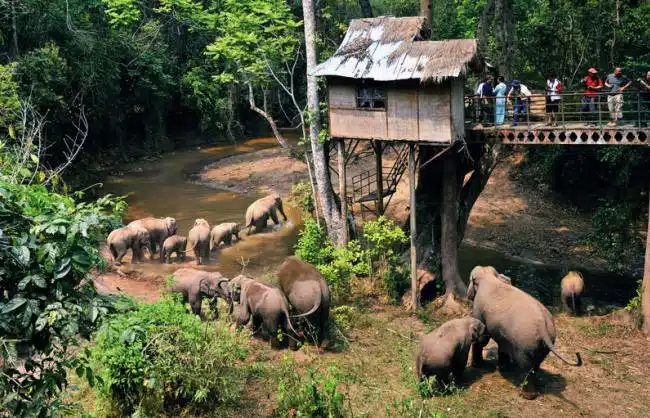
Reputed as a “bridge for communication between humans and Asian elephants,” Wild Elephant Valley in China allows visitors to observe Asian elephants and their natural habitat without disturbing them. There, you can visit China’s first elephant training school during your Yunnan Xishuangbanna tours to watch various wild elephants’ performances and explore the Asian Elephant Museum to learn more about these giants.
Details on the wild Asian elephants in the reserve
There are about 50 elephant herds and a total number of 300 – 350 elephants inside the reserve. The common small groups consist of 5 – 10 while the large herds can reach 20 – 30. According to the observation, about every 4.4 days, one herd will move around in the scenic area. To view them, the best places are the Skywalk Plank Road and the sightseeing cable car. During the tour, following these rules can ensure your safety: keep a distance of over 30 meters, do not feed or provoke, do not use flashlight and wear dark-colored clothing.
2. Explore the Tropical Rainforest
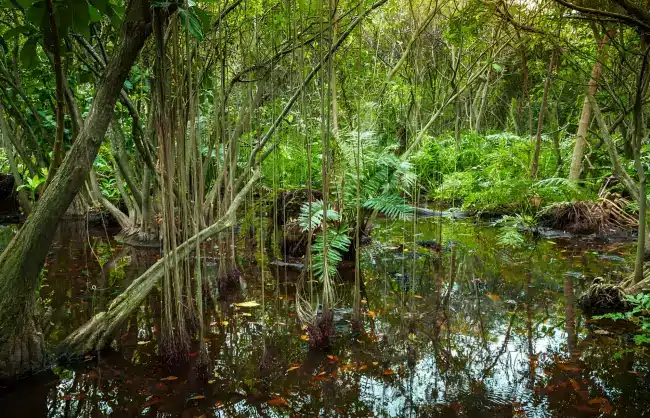
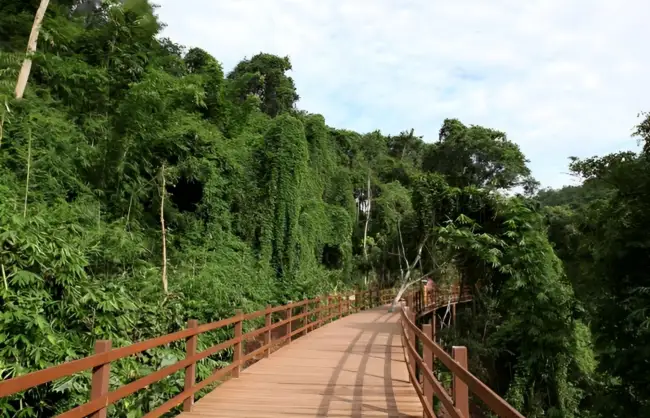
The Wild Elephant Valley Forest Park features diverse vegetation types, with tropical rainforests being the dominant one. Taking a ride on the 2,063-meter-long sightseeing cableway, the first of its kind in China, you can enjoy a bird’s-eye view of the tropical rainforest. What’s more, there is a vine-like elevated patrol and observation walkway for you to observe the lush vegetation.
3. Encounter Other Rare Animals
Being densely forested and teeming with wildlife, Wild Elephant Valley in Yunnan is also a paradise for wild animals. Apart from Asian elephants, It is home to various protected species, including Indian bison, slow lorises, macaques, white-cheeked gibbons, black bears, leopards, green peafowls, and so on. Moreover, there is a butterfly garden with a wide variety of butterflies fluttering year-round through the forests, riverbanks, and grasslands.
4. Discover the Hiking Trails
There are scenic hiking trails that wind through the Wild Elephant Valley. They pass through the rainforest, montane seasonal rainforest, and subtropical monsoon evergreen broadleaf forest. Along the way, you can enjoy views of the orchid garden and many rare plants in the tropical rainforest on your trip to Xishuangbanna in Yunnan.
5. Experience Ethnic Culture
Various songs and dance performances are held in the Wild Elephant Valley. For instance, the Rainforest Theater offers chances for visitors to enjoy traditional songs and dances of Yunnan’s ethnic minorities, including the Blang, Wa, and Dai ethnic groups. Besides, there are many ethnic villages near the valley. Visit there during your Yunnan tour to Xishuangbanna and interact with the locals, sample the delicious local food, and get some handicrafts as souvenirs.
Best Time to Visit the Wild Elephant Valley
Xishuangbanna experiences a tropical rainforest climate. Hence, the best time to visit Xishuangbanna Wild Elephant Valley in China is during the dry season from October to April when the weather is mild and the trails in this site are in good condition. What’s more, the dry season is also the best time to observe wild elephants, as they tend to congregate near the park’s water sources.
Besides, the best time to observe wild elephants will be at dawn or dusk. Visitors to Wild Elephant Valley can enjoy performances by trained elephants during the day and catch a glimpse of real wild elephants that emerge from the forest to forage in the area at night.
Getting to Wild Elephant Valley
By air: If you prefer to travel by flight, you can take a plane to Xishuangbanna Gasa International Airport (IATA: JHG) in Jinghong from Beijing, Shanghai, Xi’an, and other major cities in China. Afterward, take a taxi or a shuttle bus to reach Wild Elephant Valley.
By train: If you are in nearby cities like Kunming, you can take a train to Wild Elephant Valley Railway Station, which is about 20 kilometers from the Wild Elephant Valley Scenic Area, and a taxi can take you there.
By bus: If you find yourself in nearby cities and towns, you can take a bus to Jinghong Bus Station. From there, take a bus in the direction of Guanping and get off at the Wild Elephant Valley.
Getting around inside the park
Wild Elephant Valley covers a very large area, so the sightseeing electric car and the rainforest sightseeing cable car are put into use. The electric car is the most effortless way to cover the core areas inside the park. It is very suitable for the elders and kids. The cable car offers a bird-view of the rainforest and there are chances to see the wild elephants moving around in the forest. Skywalk Plank Road is the main trail system. The road is flat, thus basically accessible for baby strollers and wheelchairs. Along the road are clearly marked signboards and map, introducing the scenic spots and the areas the wild elephants may appear.
Practical Tips for Visitors
- Food & facilities: The Rainforest Elephant Restaurant inside the park offers unique elephant meals, which are divided into vegetarian meals and meat meals. Baked fish is the most popular dish. If you want to taste the authentic Dai food, there are also some agritainments at the entrance of the park. Besides, restrooms are available in all major areas and along the tour routes.
- Visitor etiquette:The most important rule is to keep a distance to the elephant of over 30 meters. To avoid disturbing them, keep quiet, do not try to feed, provoke or touch them and do not take photos with a flashlight. The valley itself is a precious nature reserve, please do not litter randomly.
- What to wear:Because a lot of walking is required, a pair of comfortable and anti-slippery shoes will be crucial. And thin, breathable and quick-drying long-sleeved shirts and pants will protect you from the mosquitoes and scratches. Considering the strong sunlight, sunscreen, sunhat and sunglasses are also necessary. Besides, bring a raincoat or an umbrella in case the weather changes suddenly.
- Accommodation:There is no hotel inside the park, but the nearby Mengyang Town provides various accommodation options.
Attractions Nearby Wild Elephant Valley
- Xishuangbanna Tropical Botanical Garden: It is the largest botanical garden in China in terms of area, species collection, and number of specialized zones, as the entire garden covers about 1,125 hectares, houses over 13,000 species of living plants, and features 38 specialized plant zones.
- Jinghong City: Located 33 kilometers from Wild Elephant Valley, this is the capital city of Xishuangbanna in Yunnan knownfor its Buddhist monasteries and traditional Dai architecture.
- Manting Park: It is a natural village-style park that was once the royal garden of the Dai kings and has a history of over 1,300 years. Visiting there, you’ll learn more about Dai royal culture, Buddhist culture, and Dai folk customs.
FAQs about the Wild Elephant Valley
What is the best time of day to see wild elephants?
The wild elephants are quite active during 06:00 – 08:00 and 16:00 – 18:00, so these two periods are the best time of day.
How long does it take to tour the Wild Elephant Valley scenic area?
Half a day is enough to have an in-depth experience.
How far is Wild Elephant Valley from Jinghong City center, and what are the best transportation options to get there?
It is about 22 km from the downtown area. To get there, tourists can take a direct bus at Poshui Square or Chaozhou West Twin Scenic Area.
Does the park still offer elephant shows or performances?Are there hiking trails available, and what is the difficulty level?
The Elephant School offers elephant shows and tourists can also feed the elephant here. As for hiking trails, the Skywalk Plank Road is the main trail. It is flat and well-maintained and the difficulty level is very low, elders and kids can also finish it easily.
Plan a Xishuangbanna Tour with China Xian Tour
Besides the Wild Elephant Valley, Xishuangbanna is also famous for its unique tropical forest and Dai customs, including the famous Water Sprinkling Festival in Mid- March and characteristic local food. Different from other areas in China, it is warm all year round. All the above appeal to many tourists every year. Do you want to enjoy the charm by yourself? China Xian Tour can customize a city tour based on your needs and cover all the major scenic spots. So do not hesitate to contact us and start your Xishuangbanna tour.