

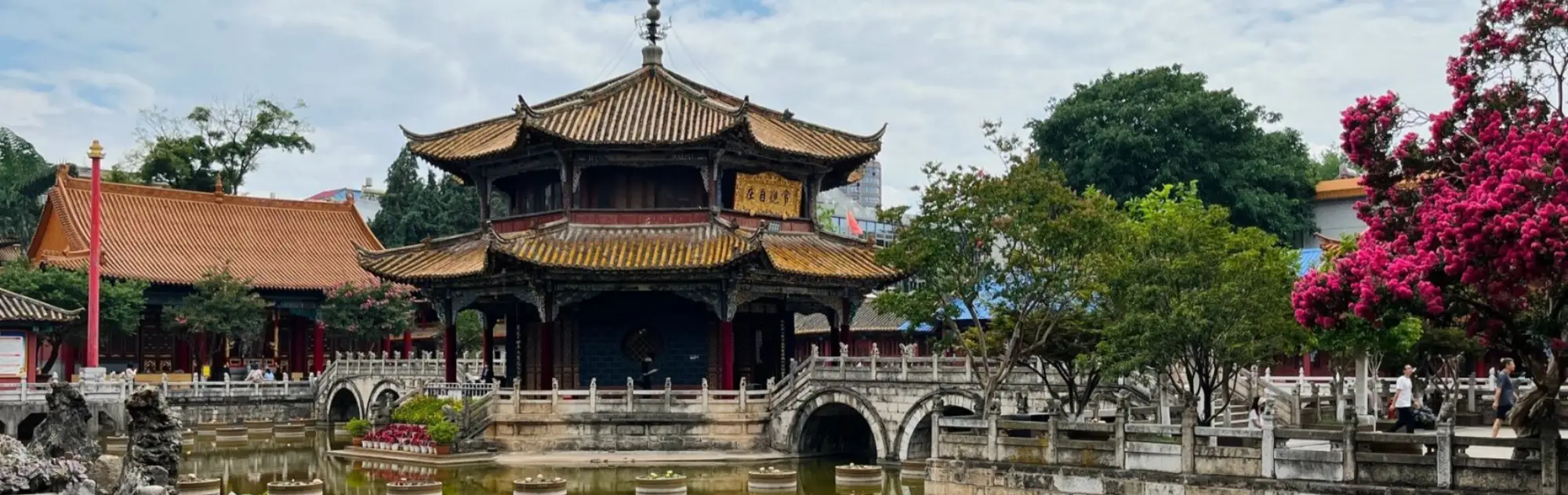
Yuantong Temple, located on Yuantong Street in the center of Kunming city, is the oldest Buddhist temple in Kunming with a history of over 1200 years. It is not only the largest temple in Kunming, but also a religious holy site that integrates the three major sects of Mahayana Buddhism, Theravada Buddhism, and Tibetan Buddhism (Lamaism), and enjoys great reputation in southwestern China and Southeast Asia.
Kunming Yuantong Temple is the earliest Guanyin (Avalokitesvara) Temple in China, more than 100 years earlier than the Guanyin Temple on Mount Putuo in Zhejiang. Boasting a long history, magnificent architecture, unique layout, convenient transportation, and beautiful scenery, Yuantong Temple is an important Buddhist cultural destination and famous tourist attraction in Kunming city. Start your Kunming tours to explore this unique ancient temple!
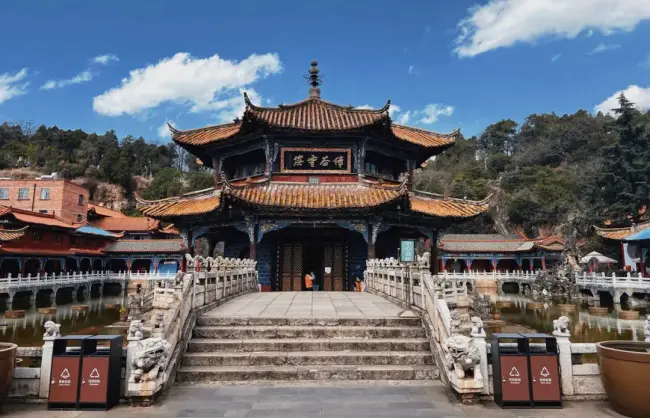
Facts About Yuantong Temple in Kunming
- Yuantong Temple Address: 30, Yuantong Street, Wuhua District, Kunming City, Yunnan Province
- Yuantong Temple Entrance Fee: RMB 6(free candles and incense sticks are provided)
- Yuantong Temple Opening Hours: 08:00-17:00
- Time Needed: About 2 hours
Yuantong Temple History
Yuantong Temple in Kunming, China is absolutely a lesser-known but worthwhile place to visit during your Yunnan tours. It is not only a famous Buddhist temple, but also a tranquil scenic area. Most of the existing temple buildings are from the Qing Dynasty.
The Yuantong Buddhist Temple in Kunming was first built during the Nanzhao period of the Tang Dynasty (around 766 AD), and was originally named Butara Temple, meaning Guanyin Temple. “Butara” is a Sanskrit transliteration, meaning “bright mountain with small white flowers”.
In the fifth year of the Dade reign of the Yuan Dynasty (1301 AD), the temple was renamed Yuantong Temple because “Yuantong” is one of the names of Guanyin Bodhisattva. The expansion project lasted for 18 years and was completed in 1319.
During the Ming Dynasty, Yuantong Temple was expanded and a new Jieyin Hall was built on the mountaintop.
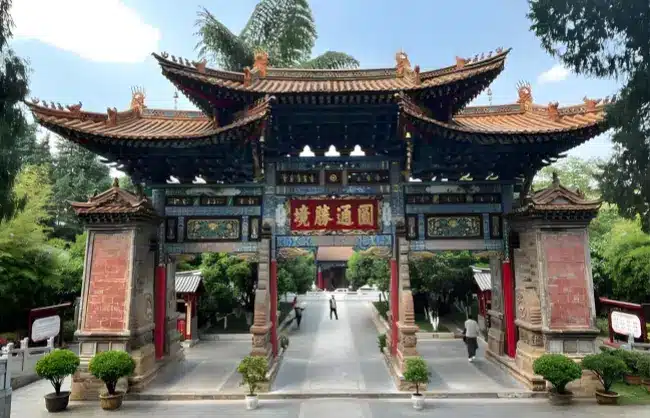
In the seventh year of Emperor Kangxi’s reign in the Qing Dynasty (1688 AD), Wu Sangui expanded the temple on a large scale, rebuilding the Octagonal Pavilion and the waterside winding corridor around it, building the memorial archway of “Yuantong Wonderland”, and moving the mountain gate out a hundred steps to the street, which became the scale of today.
Yuantong Temple Features
Among the existing Buddhist temples in the Dianchi area, the Yuantong Temple is the earliest built and has the longest history, which attracts many tourists to visit during their Kunming travel.
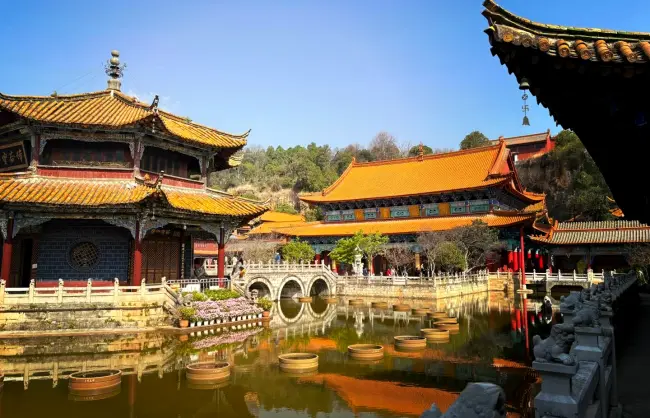
Yuantong Temple is spectacular with lush forests and has always been one of the eight scenic spots in Kunming, like a beautiful Jiangnan water-town garden. With unique pavilions, towering halls, rugged mountains, steep cliffs, and lush forests, Yuantong Temple in Kunming has attracted numerous praises from celebrities throughout Chinese history, and are known as the “Luofeng Embracing Greenery” (螺峰叠翠).
The Rare “Inverted Slope Temple”
The main entrance of Yuantong Temple is located on Yuantong Street. The further you enter the temple, the lower the terrain becomes. This is a relatively rare “inverted slope temple” in Chinese temple architecture. After entering the mountain gate, it is not an uphill slope, but a downhill slope along the central axis. The Yuantong Hall is located at the lowest point of the temple.
The Yuantong Hall is the central main hall of Yuantong Temple, which basically retains the original appearance of the Qing Dynasty. In the hall is enshrined the sitting statue of three Buddhas, which was carved in the Emperor Guangxu’s reign of the Qing Dynasty. In the middle of Yuantong Hall, each of two columns with a height of more than 10 meters is carved with a colored dragon, and on the four walls are carved five hundred Arhat, all of which can be called the best works of Chinese Buddhist temples.
The Rare “Temple Above Water”
From an architectural perspective, Yuantong Temple seeks tranquility amidst chaos, backed by the Luofeng Mountain (Yuantong Mountain), forming a unique water courtyard Buddhist temple with a distinctive style in Chinese garden art.
Facing south, Yuantong Temple architecture is magnificent. The entire temple is centered around the Yuantong Hall, with a Free Life Pond (no fish) in front. There are corridors on both sides that wrap around the pond and connect to the opposite hall, forming a unique style of water pavilion style temple and pond courtyard.
The Integration of Multiple Cultures
Yuantong Temple combines the three major Buddhist systems into one, which is a rare phenomenon in China. Inside the Yuantong Temple, there are also a unique Theravada Buddhist hall – the Bronze Buddha Hall, as well as a Thai-style building housing a Buddha statue gifted by Thailand.
And upon closer observation, traces of Taoism can be found too, such as the wood carved eight Taoism immortals and three stars of “happiness, wealth and longevity” on the memorial archway of “Yuantong Wonderland”, and the clay sculpture of Taoist immortal officials on the two walls of the Yuantong Hall, all of which reflect the coexistence of Buddhism and Taoism in Yunnan.
Local Kunming people often say that Yuantong Temple is a place full of legends. The unique karst topography, combined with over 1200 years of ancient temple history, has brought together countless spiritual energy within Yuantong Temple.
Getting to Yuantong Temple in Kunming
- Transportation in Kunming City
Take bus No. 85, 92, 95, 100, 101, 119, 187, 235 or z5, get off at Yuantong Street bus stop and walk about 20 meters to reach Yuantong Temple.
- How to get from Kunming Airport to Yuantong Temple
Take Subway Line 6 to Tangzixiang Station, then transfer to Subway Line 2, get off at Chuanxin Gulou Station, and walk westward about 1100 meters to reach Yuantong Temple. Or take a taxi, which needs about 35 minutes to cover a distance of 27 kilometers.
Attractions Nearby Yuantong Temple in Kunming
- Kunming Zoo: also known as YuantongMountain Zoo, is a park with the richest viewing content and the most visitors in urban Kunming.
- Green Lake Park: one of the most beautiful parks in Kunming, known as the “Jade in the City”. Every winter, it is a popular place to observe red billed gulls.
- Nanping Pedestrian Street: one of the busiest commercial streets in Kunming, with various Kunmingfamous snacks and special local products.


