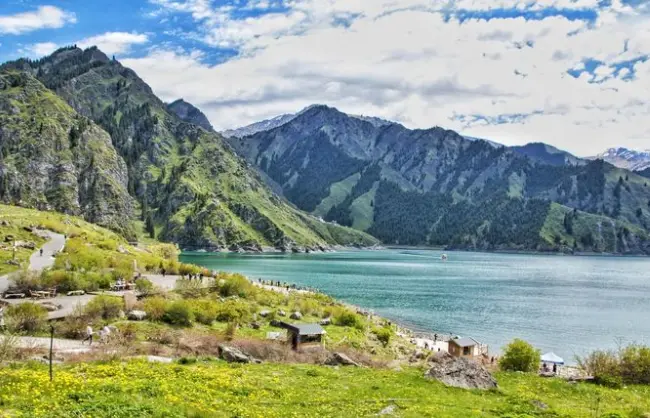





Located within the Altai Mountains of Xinjiang, Kanas Lake is one of the top attractions in Xinjiang, China, which means “beautiful and mysterious lake” in Mongolian. As the top highlight of Kanas Nature Reserve, the lake is known for its breathtaking alpine vistas and the legendary “lake monster” that is said to dwell in its depths. According to the local Tuwa folklore, the Kanas Lake monster can manipulate clouds and mist and often swallows livestock that wander close.
It is also a “color-changing lake”, showcasing different colors throughout the year, the seasons, and even the days. Surrounding the lake is a harmonious blend of snow-capped mountains, forests, and grasslands which change scenery with seasons.
Formed by glacial activity about 200,000 years ago, Kanas Lake boasts the deepest freshwater lake in China, with its depths reaching 188.5 meters. Whether you are seeking outdoor adventures or a peaceful escape, it will satisfy you with activities such as hiking, rafting, or exploring nearby ethnic villages.
Content Preview
- Fast Facts of Kanas Lake
- Why Visit Kanas Lake – The Beautiful Wilderness in Northern Xinjiang
- Legends about Kanas Lake Monster
- Highlights of Kanas Lake Nature Preserve
- Top Things to Do in Xinjiang Kanas Lake Scenic Area
- Weather and Best time to go
- How to Get to Lake Kanas
- How to Visit Kanas
- Attractions Nearby Kanas Lake
- FAQs about Kanas Lake
- Plan Your Xinjiang Kanas Tour with China Xian Tour

Fast Facts of Kanas Lake
- Location: In the Altai Mountains, Burqin County, Altay Prefecture, Xinjiang, China.
- Area: About 45.73 square kilometers.
- Altitude: 1,374 meters
- Opening hours: 8:00-20:00
- Ticket price: CNY160 per person
- Time Needed: About 1 day for the Kanas Lake; 3 days is recommended to fully explore the lake and its surrounding villages and attractions.
- Highlights: Spectacular lake views, unique Tuwa villages, diverse flora and fauna, and thrilling outdoor activities.
- Suited to: Nature enthusiasts, photographers, hikers, and those interested in local culture and traditions.
Why Visit Kanas Lake – The Beautiful Wilderness in Northern Xinjiang
Sheer Natural Beauty – a Paradise for Photography Enthusiasts
Kanas Lake is an unparalleled natural wonder in Xinjiang and even in China, featuring iconic places such as Fairy Bay, Moon Bay and Wolong Bay. Does Kanas Lake look like the Alps? Yes, but it is more primitive and wild.
Let’s uncover the mystery of this color-changing lake. This leads us to how Kanas Lake was formed and the influence of its natural environment. It is the deepest glacial moraine lake in China, presenting different colors throughout the seasons and weather conditions – from milky white and light green to deep blue and emerald green.
Beyond Kanas Lake, explore the whole Kanas Lake Scenic Area, which also includes Xinjiang Kanas National Geopark, Baihaba National Forest Park, Jayudeng National Forest Park, Hemu, etc. Therefore, mountains, forests, lakes, grasslands, plus light and shadow, interweave to make an oil painting that only God could create.
The original Tuwa (Tuvans) Villages & Their Unique Traditions
But, who are the Tuwa people? What’s special about them? They are classified as Mongolians in China, but in fact they have retained their distinct Tuwa characteristics in terms of culture and bloodline. The total population is only about 2,500, so they are even included in China’s 56 ethnic groups.
In the traditional villages of Kanas, Hemu, and Baihaba in the Altay region of Xinjiang, you can witness/experience the lifestyle of the Tuwa herders – living in their similar wooden houses, hunting, fishing, and engaging in small-scale agriculture. Moreover, you can learn about their language (Turkic) and religious beliefs.
>> Further reading: Top 10 Ethnic Groups in Xinjiang
Legends about Kanas Lake Monster
The tales of the Kanas Lake monster are as varied as they are intriguing. Some say the monster had appeared long ago. It ambushes herds devours livestock and can swallow a calf in one bite. Some believe the monster is a guardian of the lake’s sanctity who protects the spirit of Genghis Khan. They believe the remains of Genghis Khan rest in the depths of the lake.
There’s also a story of a Russian man in the Tuwa village who caught a massive redfish in the lake but failed to transport the fish even took over a dozen horses and spent three days and nights. It is said that the ancestors of local Tuwa people once attempted to capture the monster, but met with no success. All these legends contribute to the mystique of Kanas Lake.
Highlights of Kanas Lake Nature Preserve
Kanas Lake is nestled among majestic mountains and lush forests and is near several Mongolia Tuwa villages, endowing it with breathtaking natural landscapes and rich cultural experiences. Some of the top natural and cultural sites in this area include Camel Neck Bay, the Color-Changing Lake, Wolong Bay, Fish Viewing Pavilion, Hemu Village, Baihaba Village.

Guanyu Pavillion (Fishing-Viewing Platform)
You might be the next discoverer of the legendary lake monster when visiting Kanas Lake. Guanyu Pavilion is just the best spot for monster-watching and the Kanas Lake panorama. This is a two-story building atop a lakeside hill. Don’t miss it on your Kanas Lake tour to enjoy the expansive views of the lake and surroundings.
The best time to visit the pavilion is as dawn approaches when it offers a mesmerizing sunrise view. If you visit this area after a rain, you main fortunately encounter the sea of clouds and rising mists from the Guanyu Pavilion.
Kanas River
Kanas River is a tributary of the Burqin River which are originated from the majestic Kanas Lake. The river crept its way through valleys and forests, and formed several charming bays such as the Wolong Bay, Moon Bay, Fairy Bay. In winter, the river and the surrounding forests will become a wonderland of snow, mists, rime ice.
Wolong Bay
Wolong Bay is the drainage outlet of the Kanas Lake, about 10 kilometers from the lake. The long-term erosion of the Kanas River left a series of meandering river bends along the bay. The heart of the bay lies a vegetated sandbar that stretches 800 meters long and 450 meters wide and covers an area of about 36,000 square meters. To view the bay from the nearby platform of 1500 meters above sea level, the bend of the river is in a Ω-shape, resembling a dragon lying in the water, hence its name.
Wolong Bay is surrounded by dense forests, with a wooden bridge spanning east to west at the drainage outlet. Visitors can walk on the bridge to enjoy the mirror-like Wolong Bay on the north and the rushing Kanas River on the South.
Crossing the bridge, visitors will be led to a serene birch forest featuring vivid seasonal colors. These birch trees stand stall, with white bark glistening like marble, just like an elegant beauty, and thus are poetically referred to as the “Forest Maidens”. This has become a beloved spectacle around this region.
Fairy Bay
Fairy Bay is the widest sectoin among all the bays around Kanas Lake, and is known for its enchanting morning mist scenery. It is a shallow beach nestled in the mountain ravine. Since is often shrouded in clouds and fog, the bay alongside the backdroped mountains and forests create an ethereal wonderland, thus is called Fairy Bay.
Against the backlight, the lake surface of this section sparkles, scattering light as if countless pearls were scattered above the water, earning it another nickname “Pearl Beach”.
Moon Bay
Moon Bay is a landmark of Lake Kanas and a must-visit on a Northern Xinjiang tour, and the frequently seen photo – a blue “S”-shaped Kanas River is just caught here. About 1 kilometer north of Wolong Bay, Moon Bay is a crescent-shaped bay nestled in the canyon, with its appearance changing with the water levels of the lake.
The bay is a paradise for photography enthusiasts, showing various stunning visuals from spring to autumn and from dawn to dusk. Along the bay, peaks and lush forests of Siberian larch and poplar intertwine, creating a spectacular landscape.

Top Things to Do in Xinjiang Kanas Lake Scenic Area
Hike Kanas Lake National Geopark
Hiking is the best way to explore Kanas Lake for active travelers. Seasonally, the lush forests change colors, crafting a picturesque scene along with the gem-like water. The lakeside boardwalks and wild hiking trails winding along the lake and through the forests lead visitors to take in the lake views, the hidden nooks, and rich flora and fauna at their own pace.
When to hike Kanas Lake? From June to August each year is the officially recommended period for hiking. Some of the hiking routes, such as the Kanas Old Village – Black Lake, are only open in summer. During the autumn season (September-October), the lake shores will be more vibrant with fall foliage and migratory birds. Generally, all hiking and outdoor adventure activities are prohibited from November to the following May.
Recommended Kanas Lake Hiking Routes:
- Hiking in the Three Bays (Fairy Bay – Moon Bay – Wolong Bay): A 2-3 hour hike covering approximately 6 kilometers. Best for beginners.
- OneBay Hike (Double Lake Pier – Tulek Rock Art): 3-5 hours of hiking 5.5 kilometers (round trip) – relatively easy.
- Kanas Old Village – Black Lake Route: 12.5 kilometers (one way) takes 4-6 hours. The altitude is 2000 meters, so it’s a challenging routefor experienced hikers. A local guide is needed.
- Kanas Lake Ring Route: From Jiadengyu and end in Hemu Town, approximately 60 kilometers.Only for serious hikers.
Take a Cruise on Kanas Lake
The pier offers a dual-lake cruise service. The ticket price is CNY 120 yuan per person. The entire journey lasts approximately 45 minutes. The cruise ships include “Fish Watching Platform” and “Friendship Peak”, among others, which are all new energy-powered vessels. Each can accommodate 80 people and is equipped with KTV and other entertainment facilities.
The sailing route will pass through the iconic three bays and also offers a distant view of Yaze Lake (“The Eye of Kanas”). It is recommended to choose the departure time after 4 p.m., as the light is softer and it avoids the peak travel period.
Experience Tuwa People’s Life in Hemu Village
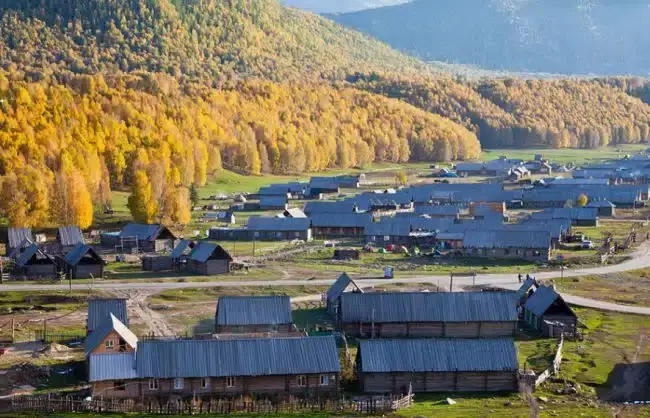
A hidden village nestled amid snow-capped mountains, lush forests, and verdant grasslands, Hemu Village is the place to experience the authentic life and traditions of the Tuwa people. Upon arriving, the first sight you see will be the quaint log cabins which are a hallmark of the Tuwa people. Locals still maintain their nomadic life and simplicity, and for generations, they build have their cabins half-buried in the earth to withstand the harsh cold in winter.
Away from hustle and bustle, you will enjoy a relaxing and peaceful time in front of the amazingness of rustic scenery. It’s recommended to hike around the mountain slopes around the village for some awesome panoramic views. If you can get up early, don’t miss the chance to catch amazing photos of sunrise view over Tuwa people’s houses, and babbling Hemu River.
Weather and Best time to go
Kanas is at the northernmost part of Xinjiang, seeing winter earlier than other regions of the country. This area may have been blanketed in heavy snow as early as November. May to October is the best time for hiking and exploring the grandeur of the lake landscapes when the lakes are green, the forests are vibrant, and the climate is pleasant.
The scenery is especially outstanding in September and October when the lake’s water supply diminishes and the surrounding forests bursts into a kaleidoscope of colors, just like a fairyland.
If you are keen on winter snowscapes, November to April of the following year is the ideal time when the scenic area transforms into a winter wonderland. But be prepared for limited access. Available activities may include enjoying frost and rime ice scenery and photography of winter landscapes (though many services are reduced or suspended).
How to Get to Lake Kanas
You can fly to Urumqi, the transportation hub in Xinjiang, from your city first. From Urumqi, you can either get to Kanas by train or plane.
There is no high-speed train from Urumqi to Kanas, visitors can take a normal train from Urumqi Railway Station to Altai Railway Station or Beitun City Railway Station, then take a bus to get to the scenic area.
By plane is convenient and time-saving. Visitors can fly from Urumqi to Kanas Airport directly, from the airport, you can take a tourist shuttle bus to get to the scenic area.
For a seamless experience and hassle-free transportation, you can also join one of our Xinjiang tours including Kanas Lake, we can customize the trip according to your preferences and interests.
How to Visit Kanas
Transport Within the Scenic Area
- After entering the Kanas Scenic Area, it is not allowed for private cars to entermost internal zones during peak seasons. Visitors must use scenic shuttle buses.
- The shuttle bus fare (round trip) between the entrance and the Kanas transfer center is about 70 yuan (valid within 48 hours).
- A second entry shuttle pass (i.e. if you exit and re-enter) costs about 110 yuan.
- There is also a shorter shuttle line to the Fish Viewing Platform (Guanyu Pavilion) priced at ~20 yuan one-way.
- The last shuttle bus from Kanas Lake back to the Three Bays area is typically scheduled around 8:30 pm, so plan your time accordingly.
Suggested Kanas Lake Tour Itinerary in 3 Days
Most travelers spend three days on a Kanas trip which includes Kanas Lake, Hemu, and Baihaba.
Day 1: Start your journey from Jiadengyu, where the scenic shuttle bus to Kanas Lake is available. Walk along the lakeside trails or take a short boat ride to closely appreciate the turquoise waters. Thereafter, come to the Wolong Bay, Moon Bay, and Fairy Bay. End of your first day heading to the Fish Viewing Pavilion to take photos of the sweeping lake.
Day 2: Head out for Hemu Village in the morning, walking into the traditional Tuwa log cabins and misty birch forests. Staying overnight here is highly recommended – when the sun rises over the village, you’ll see one of the most beautiful sights in Xinjiang.
Day 3: Extend your Kanas Lake trip to Baihaba Village, which is quite near the China-Kazakhstan border. Indulge in the quiet farmland scenery and unique borderland culture.
Essential Travel Tips
- Payment: In main scenic areas and guesthouses, mobile payment (Alipay, WeChat Pay) is common. But in remote spots (especially in Baihaba or rural paths), cash is safer.
- Clothing & Gear: Even is you’re traveling in summer days, you may still need layers as evenings and early mornings get chilly. Rain gear and windbreakers are must-packed.
- Altitude & Pace: Though elevationhere is not extremely high, walking long trails can still more or less tire you. Don’t overextend yourself on tight schedules, proper rest is important.
- Border & Permits: To visit Baihaba, a border pass (frontier permit) is required. Check this with your travel agency.
- Wildlife & Environment: Stay on designated paths.Do not feed or disturb wildlife. Carry out all trash.
Best Places to Stay: Inside Scenic Area, Jiadengyu, or Hemu Village?
Location |
Pros |
Cons |
Inside Scenic Area (near Kanas Lake) |
Closest to major attractions, ideal for sunrises/sunsets |
High cost, fewer lodging options |
Jiadengyu (Jiadengyu area / gateway town) |
More lodging choices, moderate pricing, good transport hub |
Some distance from inner areas |
Hemu Village |
Authentic Tuwa village life, beautiful surroundings, calm atmosphere |
Simple facilities, harder logistics |
Attractions Nearby Kanas Lake
- Hemu Village: Only a short distance from Kanas Lake, Hemu Village is a well-preserved Tuwa settlement, where visitors can experience the local way of life and enjoy the stunning natural surroundings.
- Baihaba Village: Famous for its picturesque wooden houses and idyllic setting, Baihaba Village is a must-visit for photographers and nature lovers alike.
- Altai Mountains: Hailed as one of the most beautiful destinations in China, featuring breathtaking landscapes and unique environment.
FAQs about Kanas Lake
Which are the best vantage points for the lake?
- Fish Viewing Platform (Guanyu / Guanyu Pavilion): for panoramic views
- Moon Bay / Wolong Bay / Fairy Bay: different angles of curves, reflections, misty moods
- Boardwalks and forest trails near the lake edge
Do Hemu and Baihaba charge entry fees?
Yes. Hemu generally charges ~ 60 yuan, and Baihaba ~ 50 yuan.
Plan Your Xinjiang Kanas Tour with China Xian Tour
Kanas Lake has attracted countless people with its tranquil and breathtaking beauty. And plus other cultural and natural highlights nearby, it’s definitely worth to put it on your itinerary. To have a smooth and satisfactory journey, consider joining a customized Xinjiang tour with China Xian Tour. Our local travel experts will take care of everything along the way, and you can thus expect all the best moments during your days on this land.