
Mount Mengding is the birthplace of world tea culture and the starting point of Sichuan-Tibet Tea-Horse Ancient Road. Together with Mount Emei and Mount Qingcheng, it is hailed as the three major historical and cultural mountains in Sichuan. The ancient Linqiong Road and the Southern Silk Road connect Mount Mengding and Bifeng Gorge with Gongga Mountain, Hailuogou National Park and Paoma Mountain, to form a popular tourist route.
Content Preview
- Mount Mengding Facts
- Landscape Features of Mengding Mountain
- Tea Culture of Mount Mengding
- What to See in Mount Mengding
- History of Mengding Mountain
- How to Get to Mount Mengding
- Attractions nearby Mount Mengding
- Recommended Visiting Route
- Contact China Xian Tour to Craft a Chengdu Tour with Mengding Mountain
Mount Mengding Facts
- Location: Sanmeng Road, Mingshan District, Ya’an City, Sichuan Province
- Ticket Price: 52 yuan/person
- Opening Time: 8:30-17:30 (no entry at 17:00) from April 1st to October 31st; 9:00-17:00 (no entry at 16:30) from November 1st to March 31st.
- Suggested Visiting Time: 5-6 hours
Landscape Features of Mengding Mountain
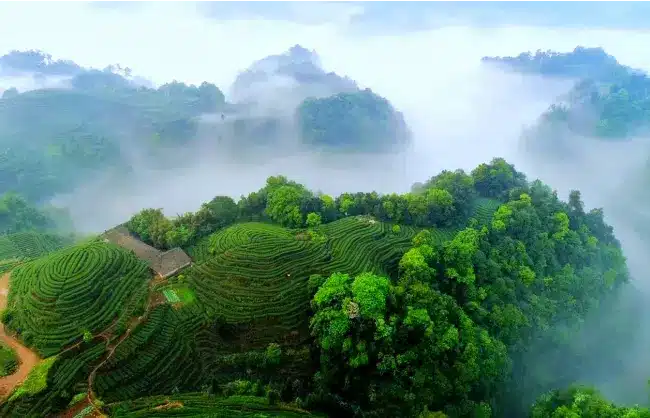
Located in Ya’an, western Sichuan, Mengding Mountain is also known for its five main peaks that curve around a central basin, resembling a lotus blossom (an auspicious symbol in Chinese culture). At its center lies the Imperial Tea Garden, and this had once used to grow tribute tea for emperors.
With elevations between 800 and 1,400 meters, the mountain is often shrouded in mist and light rain, and this has created an exactly ideal microclimate for tea’s growth. Other factors like the fertile red soil, gentle slopes, and lush vegetation also support ancient ginkgo and rhododendron trees to live longer, and some have already stayed there for over a thousand years.
Tea Culture of Mount Mengding
According to written records and historical evidence, Mount Mengding is the earliest place in the world to grow tea artificially. In 51 BC, Wu Lizhen domesticated and planted seven wild tea trees between the five peaks of Mount Mengding, thus beginning the history of artificial tea cultivation.
In 724 Tang Dynasty, Mount Mengding tea was listed as the royal tribute, and became a special tea for worshiping heaven and ancestors during the Tang, Song, Yuan, Ming and Qing dynasties. In the history of over 1,000 years, there are more than 2,000 poems and articles praising Mount Mengding tea.
The cloudy, rainy and foggy climate of Mount Mengding creates suitable humidity and temperature, providing a great weather condition for tea. 30° north latitude is the golden area for tea growing, and 800 – 1200 meters above sea level is recognized as the world’s best altitude for tea planting. Coupled with acidic and fertile soil, these factors provide an excellent ecological environment for tea growth. The traditional tea-making technique of “stir-frying and kneading” contributes to the unparalleled taste and high quality of Mount Mengding tea.
Picking and Processing of Mengshan Tea
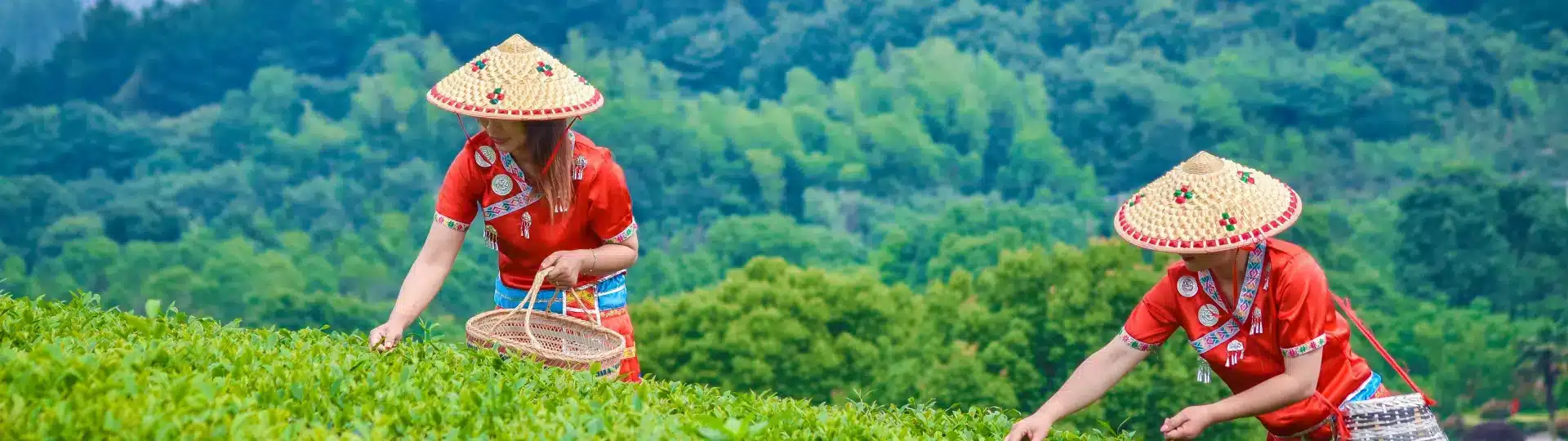
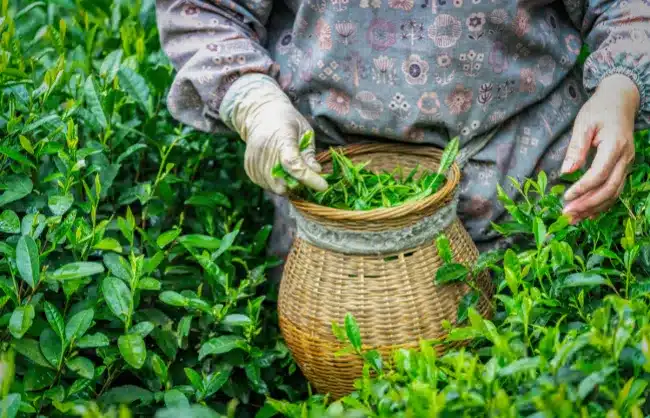
The tea-picking season begins in early spring when the first tender buds appear in the air. Today, local farmers are still following ancient methods passed down through generations:
- Picking: Only the top bud and one or two tender leaves are selected, usually by hand, during the morning hours when dew is still on the leaves.
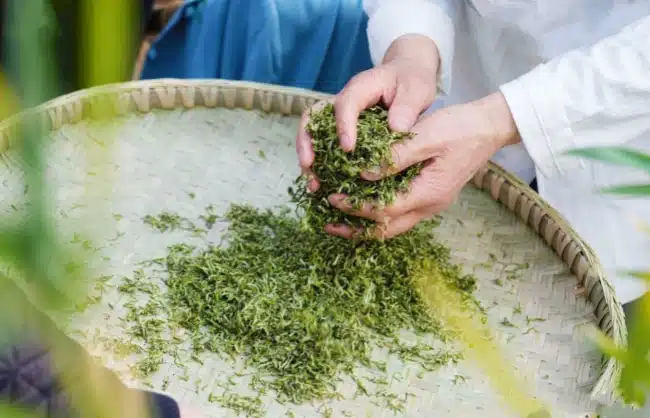
- Withering: The leaves are left to rest briefly so that the moisture content can be reduced.
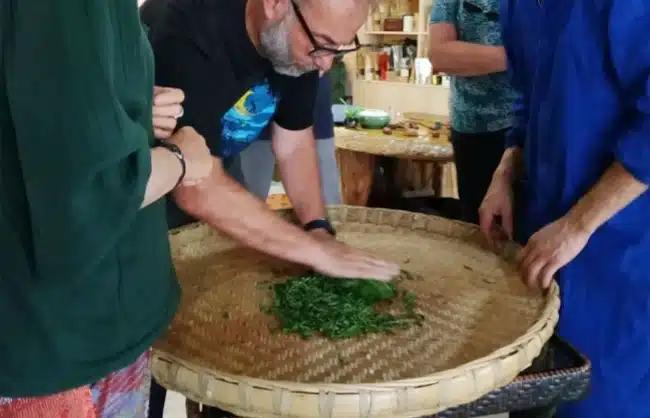
- Stir-Frying: This step requires precise control of temperature and timing. Skilled artisans will stir-fry the leaves in large woks to halt oxidation.
- Rolling and Shaping: Then the leaves are goin to be hand-rolled and kneaded, which is mean to give them a curled or flat shape. And this actually affects their aroma and taste.
- Drying: Final drying ensures the leaves can keep their fragrance, color, and quality.
This careful process, combined with the positive influence brought by Mengding’s natural environment, gives the tea a refreshing aroma, smooth texture, and lingering sweetness. One of the most famous varieties of Mengding tea would be Mengding Ganlu (Sweet Dew), a green tea known for its delicate fragrance and soft green hue. Take a sip of it, and you’ll also get a glimpse of China’s thousands years of tea culture.
What to See in Mount Mengding
Tiangai Temple
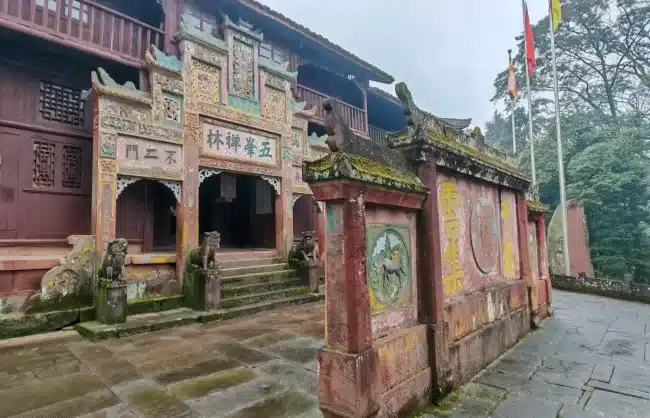
Located on the top of Mount Mengding, Tiangai Temple covers an area of 8,000 square meters and is surrounded by 12 thousand-year-old ginkgo trees. In the middle of the temple is a stone hall of Ming Dynasty architecture, which has a full-body statue of Master Wu Lizhen, the founder of Mount Mengding tea. It is the only temple in China that is dedicated to people instead of Bodhisattvas.
Imperial Tea Garden
The Imperial Tea Garden is located among the five small peaks on Mount Mengding. The surrounding peaks are shaped like lotus petals, and the Imperial Tea Garden is in the lotus heart. From the Tang Dynasty, workers have picked tea leaves here to present to the royal family. In 1186 this tea garden was officially named “Imperial Tea Garden”.
Tea Museum
The museum is located at the beginning of the walkway. It displays documents, specimens and tea sets about Mengdingshan tea. Here you can see all kinds of famous teas in China and learn about the history and culture of Mount Mengding tea.
Yongxing Temple
It is situated on the west side of Mount Mengding, covering an area of 5000 square meters. The whole building is made of stone and carved with various patterns such as dragon and kylin. There are more than ten stone engravings of Qing Dynasty poetry tablets and couplets around the temple. And there are rare flowers such as camellia and magnolia in the temple, including a red rhododendron planted in the Ming Dynasty (1368-1644). In late spring and early summer, it will be full of lush flowers.
Ganlu Stone House (甘露石室)
A historic stone house on Ganlu Peak was built in the Ming Dynasty. Here, stone pillars, stone beams and stone roofs are integrated. Legend has it that Wu Lizhen, the pioneer of tea ceremony, once rested here, and its existence also shows a unique and simple architectural style in the tea garden.
Mengquan Well (蒙泉井)
Mengquanjing (also known as Ganlujing) is located next to the Royal Tea Garden. What’s very special is that the stone railing by the well is carved with the pattern of “two dragons playing a pearl”. It is said that Master Wu Lizhen also took the water from planting tea from here. The well water is clear, and after brewing, it adds a unique aroma to the tea.
Panlong Pavilion (盘龙亭)
Panlong Pavilion is a hexagonal wooden pavilion on the eastern ridge of Mengding. A 36.7-meter-long dragon is carved in the pavilion, and there are 218 different dragon-shaped carvings. Looking out from here, the scenery is very beautiful, making it a good place to rest. And its design also shows the rich connotation of Chinese culture.
Celestial Ladder (天梯古道)
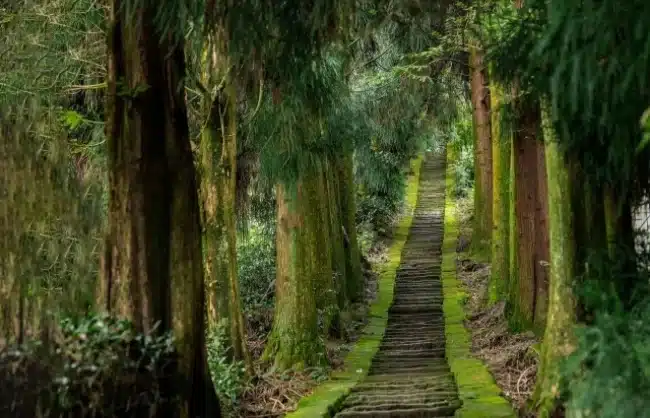
The ancient ladder road is a steep stone step, extending up from the Yu Palace to the Tiangai Temple, with more than 1,400 steps and a slope of 30°-50°. As a tourist, you will feel the excitement of climbing to the sky with every step up.
Recommended tours:
One Day Mengding Mountain Tea Culture Tour from Chengdu
2 Days Chengdu Private Tour with Mt. Mengding Tea Culture Experience
History of Mengding Mountain
Mengding Mountain has a history deeply intertwined with the origins of Chinese tea culture. As early as 51 BC, during the Western Han Dynasty, Wu Lizhen, a Taoist master, was the first person to cultivate wild tea trees on the mountain. This marked the beginning of artificial tea planting in the world. His efforts transformed Mengding from a wild, mountainous area into a revered birthplace of tea farming.
Over the centuries, Mengding tea had gained much wider national recognition. In around 742 AD, during the Tang Dynasty, it was designated as an imperial tribute tea, which would be served to emperors and also used in ceremonial offerings to heaven and ancestors. This special status had been maintained through the later Song, Yuan, Ming, and Qing dynasties, and it had thus become a cornerstone of royal and religious rituals for over a thousand years.
How to Get to Mount Mengding
By self-driving: From Chengdu city, you can drive along Chengya Highway to Mount Mengding scenic area.
By bus: There is a direct sightseeing bus from Ya’an Railway Station to Meng Ding Mountain, with around a 2-hour journey.
Attractions nearby Mount Mengding
- Bifengxia Panda Base: A scenic area with lovely giant pandas in their natural habitat, offering a delightful experience of observing pandas and joining the panda volunteer program.
- Shangli Ancient Town: Explore its ancient buildings and savor local delicacies in this historic town, which is an important node on the Tea-Horse Road and SouthernSilk Road.
- Leshan Giant Buddha: As a famous UNESCO World Heritage Site featuring the world’s largest stone-carved Buddha statue, visitors can admire the giant Buddha, explore nearby Buddhist caves, and enjoy a boat ride on the river.
Recommended Visiting Route
Start your visit at the Visitor Center, then walk to the Tea Museum to understand Mengding’s tea heritage. Continue uphill to the Imperial Tea Garden, followed by Mengquan Well and Ganlu Stone House. After a short hike along the Celestial Ladder, reach Panlong Pavilion for views. End at Tiangai Temple, the spiritual and cultural highlight of the mountain.
Contact China Xian Tour to Craft a Chengdu Tour with Mengding Mountain
Mengding Mountain is one of the most rewarding destination when traveling to Sichuan, especially if you’re a tea-lover. And a trip to Mengding is often included in a classic Chengdu Tour. A combined itinerary allows you to not only learn Mengding’s charming culture but also Chengdu’s various highlights, such as meeting pandas or tasting the best Sichuan flavors. To have the best experience, contact China Xian Tour to craft a private journey for you. And except for the fulfilling itineraries, we’ll also be there for you 24/7 to take care of everything along the way. As a result, all you need to along the way are just making unforgettable memories and enjoy yourself.