



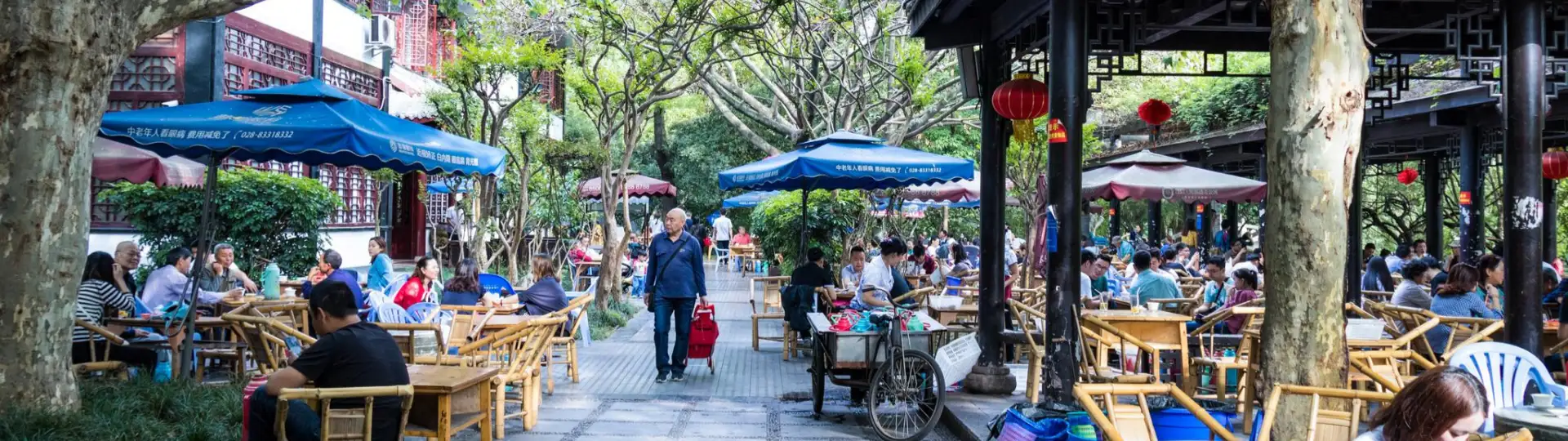
Chengdu is always so charming for many tourists. Just because of the adorable black-and-white pandas? Of course not. The city holds so many more charms for you to explore. The spicy hot pot, flavorful food found along ancient streets and alleys, traditional tea houses, mesmerizing face-changing of Sichuan Opera, clacking of mahjong tiles, and unique laid-back lifestyle ingrained in locals’ hearts together make the city a delight.
If you want a real touch of Chengdu’s local life? This guide is a must-read. Follow it to truly understand its life soul and find the best places to experience its lazy, cozy atmosphere. More than Jinli and Kuanzhai Alley, we also mentioned some authentic streets and markets only locals’ know.
Content Preview
- The Heart of Local Life in Chengdu: Embracing Slow Living
- Taste Local Cuisine in Chengdu – Food You Can’t Miss
- Chengdu Tea Culture: Beloved Teahouses
- Popular Local Activities in Chengdu beyond Food and Tea
- Experience Local Chengdu Life at Night
- Where to Experience Local Chengdu Life
- Local Chengdu Crafts & Souvenirs to Buy
- Transportation in Chengdu: How to Travel around
- Join a Local Chengdu Tour with Us
The Heart of Local Life in Chengdu: Embracing Slow Living
You will be overwhelmed with a slow-paced life immediately when you get to Chengdu. Slow living in Chengdu is not a sloth but wisdom of loving life. As a combination of rapid development and slow life, Chengdu gets a better understanding of how to enjoy life while forging ahead.
1. Slow Life and Social Contact in Parks
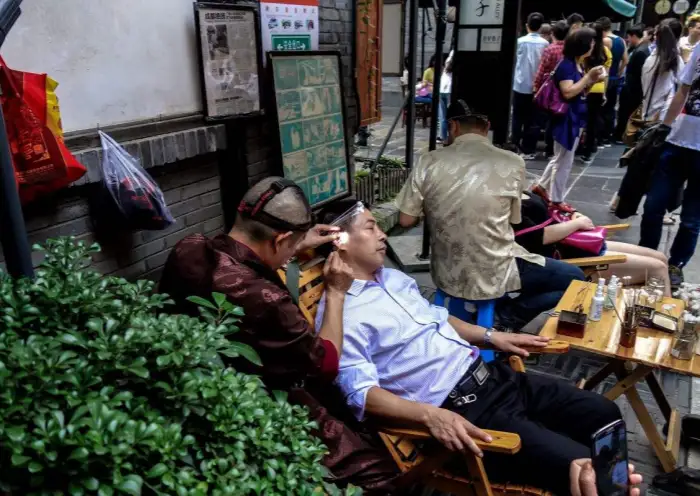
If you don’t have any ideas about your Chengdu tour, you can firstly go to local parks in Chengdu. You will find many pleasures hidden in parks, such as mahjong, tea drinking, ear cleaning, traditional treats, face changing, storytelling and so on. They are one of the best places to look into slow and leisure life in Chengdu, ideal for either people-watching or cultural experience. >> Learn more free activities to do in Chengdu to look into authentic local life.

2. Mahjong Culture: More Than a Game
You may hear the joke that people have heard the sound of playing mahjong when they are on the plane. This joke has proven the popularity of mahjong in Chengdu. Mahjong clubs can be found all over the city. Chengdu boasts more than 8,000 cafes, but the number of Mahjong clubs is twice as many as cafes.
Due to humid weather, local people prefer an indoor group activity. Mahjong naturally becomes the best choice. Moreover, people will have a chat to relieve their stress and make new friends while playing mahjong. This is another reason that local people like mahjong.
You must simply try playing mahjong during your travel to Chengdu. It is not only a game but also a Chinese wisdom.
Places to experience Mahjong:
- Taiping Old Street in Xinjin is firstly recommended. You can play mahjong with local residents and have a cup of tea in the tile-roofed houses built in the late Qing dynasty. Many foreign tourists often come here.
- If you chase after fashion, young styles and spacious spaces provided by CLUBPAP will be a nice choice. You can play mahjong while taking pictures.
- If you are a green hand of mahjong, Miao Zhong Cha Fu (众妙茶府) is recommended. It is open all hours and you can study basic rules of mahjong at any time.
3. The Chengdu Local Dialect: A Sound of the City
Chengdu dialect is the art of navigating life that people have a gentle fist but unbending spine. In case of any disputes, Chengdu dialects sound like a pettishly charming manner due to the contrast of tone.
Also, Chengdu dialect is an aesthetic sign of local life. Here are several examples. 巴适 (bā shì) means you feel mentally and physically pleasant. 耙耳朵(pá ěr duo) is a banter of henpecked husband. 鬼火冒 (guǐ huǒ mào) means rage. 惊风火扯 (jīng fēng huǒ chě) means panic. 铲铲 (chǎn chan) is a straightforward refusal. 毛线 (máo xiàn) means a euphemistic ways of speaking. These dialects are as drastic as explosives to express emotions.
If you have a seat in a tea house or enjoy street foods, you will be fully exposed to Chengdu dialects.
Taste Local Cuisine in Chengdu – Food You Can’t Miss
Sichuan cuisine features a numbing-spicy fresh-savory profile. It is believed to be the ultimate harmonization of contradictions because it offers various flavors and cooking skills. Chengdu is, without doubt, the best place to taste authentic Sichuan cuisine. A food trip in Chengdu is thus a can’t-miss when traveling in Chengdu.
Local Chengdu Famous Food: What to Try First
Speaking of Sichuan cuisine, there are several must-try dishes in Chengdu.
Nanqiao Pig’s feet is a soup stewed with Chinese yam and Chinese angelica. It has a taste of melt-soft resilience. Spicy dipping sauce will give a delightful taste.
Chengdu Dan Dan Noodles is traditional snack. It boasts special sauce and minced peanut without soup. Each noodle is covered with strong sauce. It will give you the addictive quartet of numbing, burning, freshness and fragrance.
Mapo tofu is celebrated for its spicy flavor and unique numbing effect. The essential ingredient is Sichuan peppercorn that not only enhances fragrance and flavor but also numbs your tongue. The thick broad-bean sauce and minced beef will release a fiery bloom with savory waves.

Must-Try Local Hotpot in Chengdu
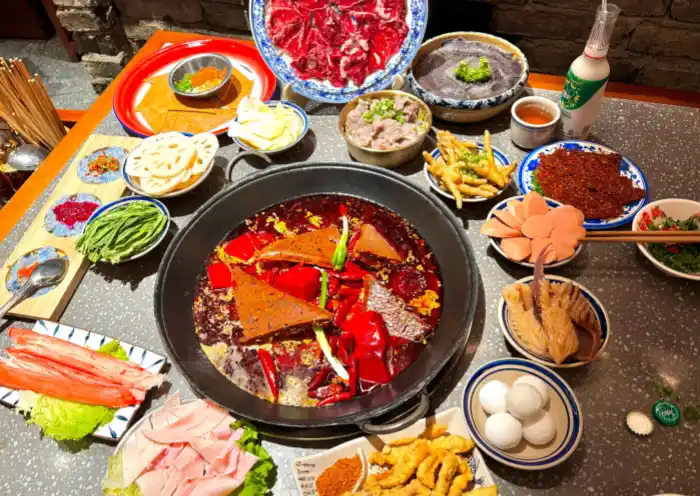
Hotpot is a calling card of Chengdu. It is not only a gustatory feast but also a cultural experience. You cannot say you have ever been to Chengdu if you don’t have a taste of hotpot. Here are recommendations for you.
If you cannot feel happy without spicy flavor, you must select Nan Huo Guo (楠火锅) that is hailed as the spiciest hotpot in Chengdu. You remember to order a portion of ice dessert that can rapidly cool the burn.
You can go to Ba Shu Da Zhai Men (巴蜀大宅门). This is an old store with the history of 30 years. The broth of chrysanthemum and beef tallow will provide a full-bodied flavor. Remember to taste its specialty dish, deep-fried meat and ice powder.
If you focus on the surrounding while eating, you can choose Hou Tang Lao Huo Guo (吼堂老火锅). It has the decoration in the style of the Republic of China. You can admire the way to make hotpot condiment. The must-try dish is hand-made shrimp balls.
Before entering a hot pot restaurant, getting some tips on how to eat hot pot in Chengdu like a local is essential for your experience.
Chengdu Local Street Foods and Night Markets
In Chengdu, local street foods have another name, fly restaurants. It means good taste and affordable price. It is warmly popular among local people. Below are some recommendations from locals:
- Ming Ting Xiao Guan (明婷小馆) is a household name. Almost all local people have eaten its specialty, Naohua Toufu. Smooth toufu and spicy flavor will have a compulsive appetite.
- Yu Tian Fan Dian (雨田饭店) is among the best fly restaurants in Chengdu. Its specialty, the braised pork in brown sauce, tastes unctuous without cloying.
In the deep of night, you can saunter in local markets to find local flavors.
- Fu Qin Ye Shi (抚琴夜市) is in full swing at night. The grilled eel and the pickled pepper carp will bring a hot and spicy flavor.
- Jian She Lu Ye Shi (建设路夜市) features affordable desserts. The hand-laminated pastry only costs 9.9 yuan. You can buy some pot-stewed meats and drink beers at night to experience local Chengdu night life.
Related reading: Top Reasons to Visit Chengdu
Chengdu Tea Culture: Beloved Teahouses
Sichuan, the birthplace of global tea culture, has followed an original custom of chewing bitter tea in the Han dynasty. In the Tang dynasty, the daughter of Sichuan military commissioner Cui Ning firstly developed Gaiwan tea. It later becomes the sign of Chengdu tea culture.


Chengdu Tea Culture
Chengdu Giawan tea is characterized by three-piece se, namely teacup lid, teacup saucer and tea bowl. This is a unique way of drinking tea by means of tea set and ceremony. People can observe the shape of tea, smell the fragrance of tea, and taste the flavor of tea at the same time.
On the tea table, the differences of social identity are naturally eliminated. Everyone can equally have communication. It reflects the philosophy of slow life in Chengdu.
Renowned Tea House
You are strongly advised to have a cup of tea in Chengdu Crane’s Hoot Tea House (鹤鸣茶馆). This is a cultural landmark over one hundred years. The plaque of Crane’s Hoot inscribed by Wang Jiazhen hangs in the hall. At the entrance places a wash basin in the style of copper teapot.
You can have a seat and take a cup of tea nearby the lake in the leafy shade of an age-old ginkgo tree. The server will take a brass long-spouted teapot to add water from height.
Popular Local Activities in Chengdu beyond Food and Tea
Local features of Chengdu are more than food and tea. You can enjoy face changing of Sichuan opera, historic alleys & ancient streets, intangible cultural heritages, and pandas.
Face Changing of Sichuan Opera
Face changing is a salient feature of Sichuan opera. It mainly depends on three techniques, namely mask tearing, face wiping and powder blowing. That means performers can change face by tearing off pre-threaded masks, wiping greasepaint across cheeks, and blowing colored powder from concealed box.
Different colors of facial makeup have their own meanings and classical roles. Crimson means loyal, brace and resolute. Its classical roles are Guan Yu and Zhao Zilong. Pure white indicates insidious and cunning. Its representative figures are Cao Cao and Yan Song. Black means upright and frosty, such as Zhang Fei and Bao Zheng. Golden/silvery indicates deities and demons, like the God Erlang.
You are advised to personally watch face changing in local theatres, such as the Pear Garden Academy. It is particularly suitable for family tour because it can help you know traditional culture and have an interesting interaction.


Daily Life in the People’s Park
Stepping into the People’s Park in Chengdu, what firstly leaps to your eyes must be sheets in rows in the matchmaking corner. On the sheets is personal information in an effort to seek for life mate. Here you can learn Sichuan style humors based on the way that local people pursue love.
Also, you can enjoy the ear cleaning service after drinking a cup of tea. The stick of goose feather will give you off-the-beaten experience.
Besides, you can go boating on the lake as if you were walking in an ink and wash painting. Visit here in autumn if you can. You will have a chance to admire remaining lotus and listen to the rain under the eaves.
Wandering Historic Alleys & Ancient Streets
The ancient Ming and Qing dynasty streets in Chengdu are where you can look into the authentic heart of Chengdu:
- Citang Street embraces the most complete existing architectural complex of the Ming and Qing in Chengdu. Here you can visit 14 historical sites of Sichuan Governor General’s Office built in the Qing dynasty.
- Junping Street receives its name from the Taoist scholar Yan Junping. You can find official mansions left from the Qing dynasty and official residences of senior military and political officials during the Republic of China.
- Jiaozi Alley has a good name for the world’s earliest paper money “Jiao Zi” during the northern Song dynasty. It witnesses glorious history of financial industry in Chengdu.
Chengdu Panda Base
Chengdu Panda Base, with total covering area of 2.38 square kilometers, is the world’s largest artificial breeding base of giant panda.
You cannot miss delivery room because panda cubs drink milk and sport here. You can climb to the top of Panda Tower to overlook the whole base and get the best photo backdrop.
Tourists are required to book tickets online ahead of seven days. The ticket price for adults and students is 55 yuan and 27 yuan. Children are free of charge. You can see pandas during the slack season from November to February so that you can avoid overcrowding.
Intangible Cultural Heritage
Sichuan embroidery is well-known for 122 stitches and lifelike work. The double-sided embroidery with different patterns and colors on each side is particularly popular. If you want to have custom embroidery, the price is about 8,000 yuan per square meter.
Lacquerware making is renowned for tin engraving, carved lacquer, silver engraving, dragging-knife and needle-point engraving. It is a traditional utensil incorporating functionality and artistry. It features luster, corrosion and moisture resistance.
Shadow puppet is a folk art integrating carving, painting and drama. Hide or cardboard is carved into various roles to do a show in the lamplight. You can admire sophisticated technique and vivid performance.
You can participate in experience class to make embroidery, lacquerware and shadow puppet. Buying souvenirs home is also a nice option.


Experience Local Chengdu Life at Night
The night life in Chengdu is a spirited hubbub starting from at 10 o’clock.
The food haven must be your first station. You can stay with friends to have late-night snacks, such as spicy rabbit’s head, stinky tofu and cold noodles in sauce, etc. Then, you can find a bar in Jiuyanqiao to enjoy ballad and wine. Strolling down the street in Taikoo Li to go shopping is also a nice choice. If you are interested in local culture, you can find a tea house to watch the performance of face changing in Kuanzhai Alley or go sightseeing by boat.
Chengdu has a handy public transportation to offer. You can still take subway even if you stay out at night. Its operation time will be even postponed when major events are conducted. There will be an affordable price if you hail taxi in the night.
Where to Experience Local Chengdu Life
To experience authentic Chengdu life, you cannot miss local landmarks and traditional treats.
Jinli Old Street & Kuanzhai Alley (宽窄巷子)
Jinli Old Street, with a long history over 2,500 years, extends 550 meters and covers 30,000 square meters. It is adjacent to the Memorial Temple of Zhuge Liang and centers on the culture of the Three Kingdoms.
Kuanzhai Alley is an architectural complex built in the late Qing dynasty. It incorporates alleyways of north China and folk houses of western Sichuan. It boasts the cultural wall that encompasses 40,000 ancient bricks and extends 400 meters in length.
Wenshu Monastery Area – Zen & Local Life Blend
Wenshu Monastery is a wooden architectural complex built in the Qing dynasty. It is open to the public for free.
Wenshu Monastery boasts the Buddha’s skull relic, but it is not open to visitors. Besides, you can find the plaque that was personally inscribed by the Emperor Kangxi in the Qing dynasty, thus demonstrating the historical status of Wenshu Monastery.
Whenever the Laba Festival arrives, it has free porridge to offer. This folk custom has been kept alive over three hundred years.


Hidden Neighborhoods and Riverside Walks
When you travel to Chengdu, you cannot but focus on its long-standing history. You are recommended to stroll along Dianjiangtai Street. You can admire the incorporation of historical ruins and modern art.
If you want to explore the secrets of Chengdu in old times, you cannot miss Caojia Lane. There is a fairy tale world that was reconstructed from red brick house built in the 1950s as if you were brought back to the industrial age.
If you are willing to get close to nature, you can go to the Northwest Bridge Riverside Park. When you walk along the riverside boardwalk of 1.5 kilometers in length, you can observe egret, divert yourself in fishing, or watch dancing recitals.
Markets Only Locals Know
Here are some unassuming markets that only locals know.
If you want to have a taste of seafood in an inland city, you remember to roam about Qingshiqiao seafood market. You can find all kinds of fresh aquatic and marine products here. You can directly find a restaurant nearby and pay for cooking, then waiting for a meal.
If you favor Chinese antique, Songxianqiao Antique Center must be your priority. This is the oldest antique market in Chengdu. It pools all kinds of porcelains, calligraphy and paintings, jades, sculptures, figures of the Buddha. You will be spoiled for choice here.
Local Chengdu Crafts & Souvenirs to Buy
You may not bring Chengdu home after your trip, but you can buy some local crafts and souvenirs as a keepsake.
- If you focus on the cost performance, you can buy key rings, panda dolls and refrigerator magnets in shops around sightseeing spots.
- If you prefer something distinctive, you can choose Lohas panda dolls. The design is inspired by the real panda named Menglan.
- Sichuan embroidery that is well-known for its three-dimensional effect is worth buying. The circular fan of double-faced embroidery is strongly recommended.
- Daoming bamboo weaving is an environment-friendly and useful utensil. Bamboo is split into several strips and woven into baskets or others.
- If you are pleased with the spicy flavor of Chengdu, you are strongly advised to buy hotpot condiment. It enables you to glut yourself with Chengdu local-flavor cuisine wherever you are.
- If you have a sweet tooth, you can take some peach cookies in Wenshu Monastery. Legend has it that this dessert originates from the imperial recipe of the Qing Dynasty.


Transportation in Chengdu: How to Travel around
Chengdu embraces a well-developed transportation network. 15 metro lines and 1,496 bus routes can take you to any sightseeing spots in Chengdu.
If you want to have a handy service, you can hail a taxi. The starting price in daytime is about 8-9 yuan for two kilometers. Beyond the first two kilometers, you will be charged 1.9 yuan per kilometer. Price will rise about 2 yuan from 23:00 to 6:00 at night.
Scenic Spot |
Bus Route |
Subway Route |
Panda Base |
Take the Panda Shuttle Bus No. 1 (start from Chunxi Road)
Take the Panda Shuttle Bus No. 3 (start from Kuanzhai Alley) Take the Panda Shuttle Bus No. 5 (start from The Memorial Temple of Zhuge Liang) Take Bus No. 408 Take Bus No. 409 Panda tourism special double-decker bus (start from Chunxi Road) |
Take Metro Line No. 3
|
The People’s Park |
Take Bus No. 5/62/64/78 |
Take Metro Line No. 2 |
Jinli Old Street |
Chengdu Night Tour Double-decker Bus No. 1
Take the Panda Shuttle Bus No. 5 (start from The Memorial Temple of Zhuge Liang/Jinli Old Street) |
Take Metro Line No. 3/5 |
Kuanzhai Alley |
Take the Panda Shuttle Bus No. 3
Take the Shuttle Bus of the Panda Base |
Take Metro Line No. 4 |
The Memorial Temple of Zhuge Liang |
Take the Panda Shuttle Bus No. 5
Chengdu Night Tour Double-decker Bus No. 1 |
Take Metro Line No. 3/5 |
Wenshu Monastery |
Take the Shuttle Bus of the Panda Base
lTake the Panda Shuttle Bus No. 5 |
Take Metro Line No. 1 |
Join a Local Chengdu Tour with Us
Contact us now to embark on a local Chengdu tour with fewer efforts and troubles. Just tell me your preferences. We are able to get transportation, tour guide, accommodation and schedule ready for you. What you need is just to indulge yourself with a wonderful local Chengdu tour.
Why Choose a Local Chengdu Guide?
Chengdu is like a hidden gem. If you find a local Chengdu guide, you will gain more in-depth experiences and insights into local life and highlights.
The unique cultural experience enables you to get access to private events, such as having a morning class in Taoist temple, producing a facial makeup of Sichuan opera, satiating yourself with special dishes, and pampering yourself with characteristic inns.
The immersive festival experience will design a tourist route exclusive to you to avoid overcrowding and enjoy original folk customs of Sichuan style, such as the Peach Blossom Festival in Longquanyi in March, and the Water-Sprinkling Festival in Huanglong Brook in July.
If you are a foodie, you will get a custom map of local-flavor cuisine. You will be satiated with the culinary adventure in Chengdu ranging from those time-honored snacks to must-eat food list of the Michelin Guide.


