

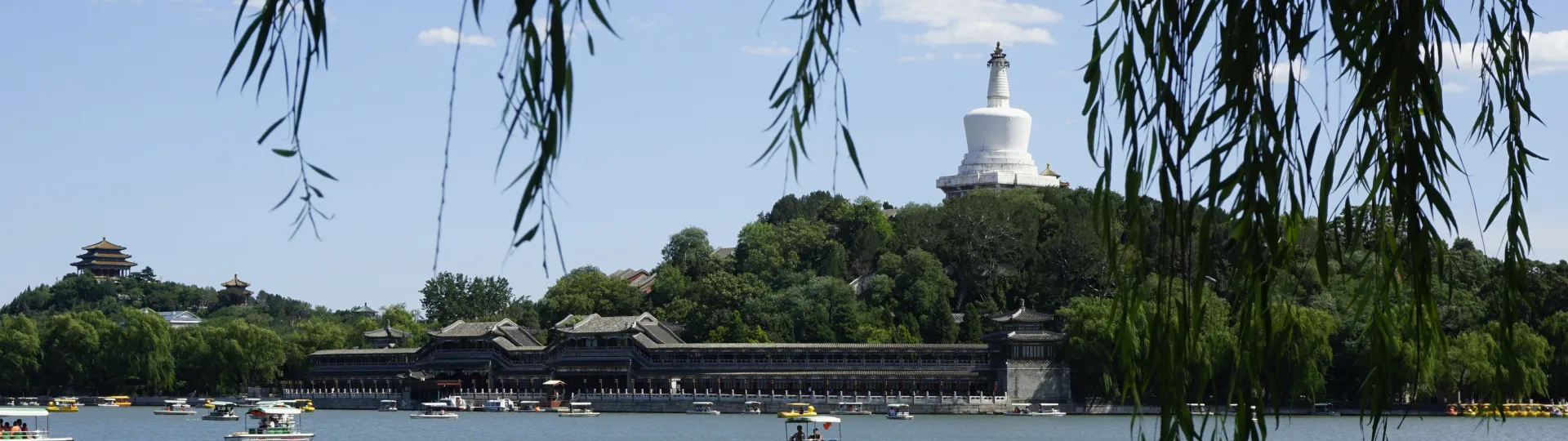
Located in the center of Beijing, Beihai Park (or Beihai Gongyuan) is adjacent to the famous Forbidden City and Jingshan Park. Constructed in 1166 AD during the Jin Dynasty, the park has witnessed the rise and fall of the Jin, Yuan, Ming, and Qing Dynasties and boasts the oldest and most well-preserved classical royal gardens in China. It was once a place for emperors and royal family members to handle state affairs and conduct ceremonies, with a wealth of cultural heritage preserved.
Centered around the Beihai Lake, the park is especially known for its “One Lake and Three Mountains” layout. Among the total area of 68.2 hectares, about 38.9 hectares are water area. The waterscape harmoniously blends with surrounding landscapes and ancient pagodas, pavilions, and age-old pines, creating a dreamlike atmosphere.
Compared to the popular Summer Palace, Beihai Gongyuan is less frequented by tourists. Thus, if you want a tranquil escape from the crowds, add Beihai Park to your Beijing tour.
Content Preview
- Basic Facts about the Beihai Park in Beijing
- History of Beijing Beihai Park
- Main Attractions in Beihai Park
- Boating Services and Fees in Beihai Park
- When is the Best Time to Visit Beihai Park?
- How to get to the Beihai Park?
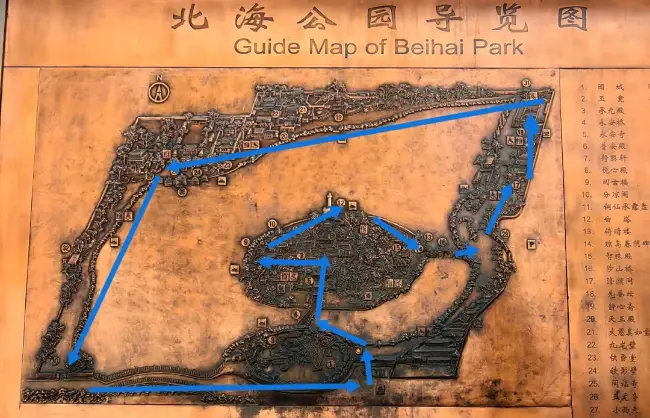
- Recommended Routes to Tour the Beihai Park
- Beihai Park Travel Tips
- Nearby Attractions and Places
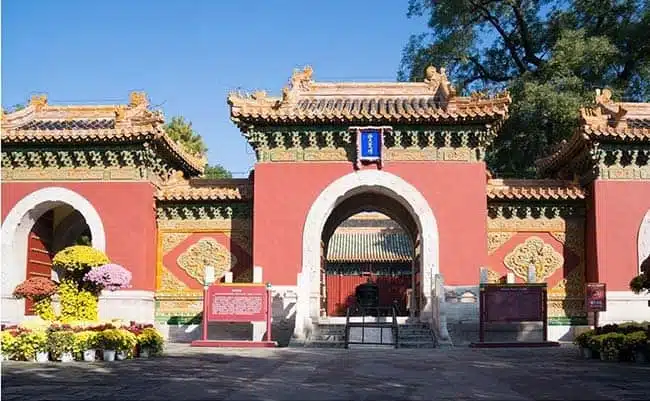
Basic Facts about the Beihai Park in Beijing
- Chinese name: 北海公园
- Location: 1 Wenjin St., Xicheng District, Beijing, China
- Area: 68.2 hectares
- Opening hours: 6:30–21:00in peak season (Apr. – Oct.); 6:30–20:00 in off season (Nov. – Mar.) Opening hours for gardens inside: 9:00–18:00 in peak season, 9:00–17:00 in off season.
- Visiting time needed: About 2-5 hours
- Entrance fee:CNY 10 per person in peak season, CNY 5 per person in off-season
- Combo tickets (include Yong’an Temple, White Dagoba, Yilan Hall, and Tuancheng (Circular City):CNY 20 per person in peak season, CNY 15 per person in off-season
- Best time to visit:April to October
- Why visit: The oldest and most well-preserved classical royal garden in China; showcases garden art of different dynasties; distinct beautiful scenery in each season; various cultural and artistic activities; easy accessibility
History of Beijing Beihai Park
Beihai Park in Beijing served various imperial purposes in different dynasties. It was used by emperors and the royal family to hold some sacrificial ceremonies, or as a royal garden for relaxation.
Its history can be traced back to the Liao Dynasty when it was originally a lake called “Jinhai”, with a small island called “Yaoyu”. In the Jin and Yuan Dynasties, Qionghua Island and its surrounding lakes were expanded several times, and renamed Taiye Pond, forming the “One Pool, Three Hills” layout. And centered around the island, palaces were constructed on both the eastern and western shores of the lake, developing Beihai into a grand imperial garden.
In the following Ming and Qing Dynasties, the island and lake were expanded several times. Palaces from previous dynasties were restored and new places and pavilions were constructed. The iconic White Dagoba was built on the site of the former Guanghan Hall during the Qing Dynasty.

Main Attractions in Beihai Park
Centered around the serene waters of Beihai Lake, Beihai Park features a wealth of ancient architecture and landscape areas, which can be generally divided into four areas: the North Shore, East Shore, Qionghua Island, and Tuan Cheng (Circular City). Below are the top attractions in Beihai Park.
Jinxin Studio (静心斋)
Originally called “Jingqing Zhai,” Jingxin Studio was constructed when expanding the “Western Heaven Buddhist Kingdom” during the Qing Dynasty. Now, it is the most intricate garden within Beihai Park, featuring an array of pavilions, corridors, studios, stone bridges, pools, rockeries, and terraces.
Minor Western Heaven (小西天)
Xiaoxitian (Small Western Heaven) was built by Emperor Qianlong to celebrate and pray for the longevity and blessings of his mother. Its main building boasts the largest square pavilion-style palace building in China, covering an area of 1,200 square meters, with finely carved patterns on its nanmu wood doors and windows.
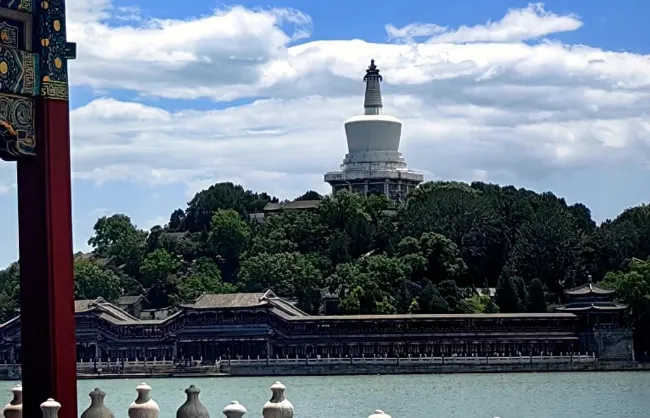
White Dagoba (白塔)
Standing at over 30 meters on Qinghua Island, the White Dagoba is a symbol of both Beihai Park and Beijing City. Due to its harmonious design and striking presence within the surrounding landscape, the dagoba has become a popular spot for visitors to take photos. For most visitors, climbing to the top of the dagoba is a can’t-miss activity to enjoy the panoramic views of the park.
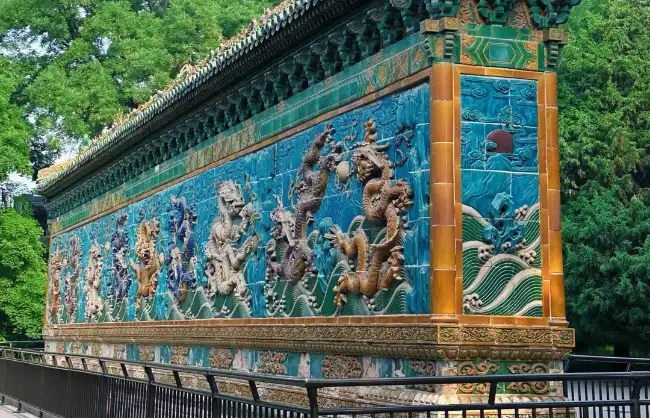
The Nine-Dragon Screen (九龙壁)
Built during the Ming Dynasty, the Nine-Dragon Wall in Beihai Park is the only double-sided one among the three existing ancient Nine-Dragon Walls in China. Both sides of the wall are adorned with nine vivid dragons playfully chasing pearls. The wall stands 5.96 meters high, 1.60 meters thick, and 25.52 meters long.
Five-Dragon Pavilions (五龙亭)
The Five-Dragon Pavilions was constructed in 1602 during the Ming Dynasty, serving as the place for emperors and their close attendants to fish and admire the moon. Now, it is an ideal point to enjoy the scenic views of the White Pagoda and the picturesque natural landscapes of the park.
Circular City (团城)
Circular City (Tuan Cheng) is a brick-built circular small ancient fortress located in the southern part of the park, recognized as the best spot to enjoy the panorama of Beihai Park. There are wall gates on both the east and west sides, from which, visitors can enter and ascend to the top platform. The buildings on the platform are symmetrically arranged and incorporate garden design elements. This kind of architecture style is said to be rare to see across the country.
Boating Services and Fees in Beihai Park
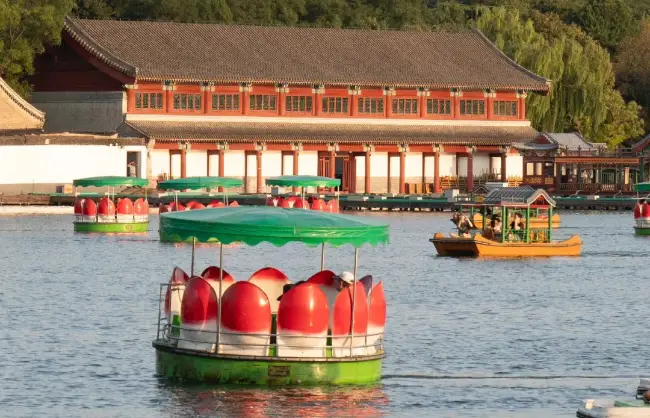
The water of Taiye Pond in the park comes from Yuquan Mountain. It is clean and pristine, making it an ideal spot for boating and cooling off. There are various kinds of boats availabe for visitors to rent, including ferry, rowing boat, sculling boat, etc. Below are prices for each boat:
Ferry |
CNY 10 per person (Single Trip); CNY 15 per person ( Round Trip) |
Water Bumper Boat |
CNY 30 for 15 minutes (Max 2 people ) |
Rowing Boat |
CNY 180/ h with power assisting device ( Max 4 people ); CNY 100/ h without power assisting device ( Max 4 people ) |
Pedalo |
CNY 60/ h ( Max 4 people ); CNY 120/ h ( Max 6 people ) |
Yellow Duck Pedalo |
CNY 100/ h ( Max 4 people) |
Sculling Boat |
CNY 30 per person for half an hour; CNY 50 per person for an hour |
Battery-driven Boats |
CNY 100/ h ( Max 4 people ); CNY 160/ h ( Max 6 people ) |
Lotus Boat |
CNY 120/ h ( Max 4 people ); CNY 180/ h( Max 6 people ); CNY 220/ h ( Max 8 people ) |
When is the Best Time to Visit Beihai Park?
The best time for tourists to visit is from the middle of July to the late August. During these days, tourists can enjoy the charming scenery and fragrance of the great number of lotuses.
Spring (March to May) and autumn (September to November) are also great times when the weather is pleasant, which also coincides with the best time to travel to Beijing.
Tips: Visitors had better avoid the official holidays in China, because many Chinese citizens choose to travel on official holidays. As a result, most Chinese tourist attractions are overcrowded and traffic jams are quite common.
Official Holidays in China
Chinese New Year |
Around January or February |
Winter vacation |
January-February |
Labor Day |
May1st -3rd |
Summer vacation(for students) |
July-August31st |
Around mid-September |
|
National Day |
October 1st-7th |
How to get to the Beihai Park?
Bus
- If visitors want to enter from the North Gate, Bus No.13, No.42, No.90, No.107, No.111, No.118, No.609, No.612, No.623, No.701are available. Please get off at the Beihai Park North Gate Station.
- Visitors can take Bus No.5 or No.609 and get off at Xiban Qiao Station, and enter from the East Gate.
- To get to the South Gate or Southwest Gate, visitors can take Bus No.5, No.101, No.103, No.109, No.124, No.619, Special line 1 and line 2 and get off at the Beihai Station.
Subway
Visitors can take subway line 6 and get off at Beihai Bei(North) Station from the Exit B, and then can walk to the North Gate.
Recommended Routes to Tour the Beihai Park
There are two tour routes of the Beihai Park basically.
The tour route for 2 hours (visit area: Round City and Jade Islet)
Round City → South Gate of Beihai → Eternal Peace (Yong’an) Bridge → Temple of Eternal Peace (Yong’an) → White Dagoba → go along the east side → Stele of the Jade Islet in Spring Shade → the Long Corridor → Yilan Hall → Yuegulou → back to Eternal Peace (Yong’an) Bridge and exit from the South Gate
The tour route for 4 hours (visit area: the whole park)
Round City → Jade Islet → take the boat from Yilan Hall to the north bank → Five-dragon Pavilion → Minor Western Heaven → Chanfu Temple → Kuaixue Hall → nine-dragon screen → Western Heaven Temple → Zhishan Bridge
Beihai Park Travel Tips
- Except the Circular City, other courtyards within the park are closed on Mondays (except for public holidays), so avoid visiting on Monday.
- The main attractions are concentrated around the North Gate and South Gate. Attractions around the North Gate are all included in the regular tickets. While around the South Gate, Circular City and White Dagoba need an extra ticket. Or, you can buy a combo ticket with these attraction all included.
- The park close late at night, making it a good place for an evening walk.
- There is a skating rink in the park, usually open two days before the New Year’s Day.
- Bring some snacks with you, as dining options are few in the park.
Nearby Attractions and Places
- Forbidden City: The imperial palace of the Ming and Qing dynasties, about 1.3 km from the park.
- Jingshan Park: The imperial gardens of Yuan, Ming and Qing dynasties, about 500 meters from the park.
- Houhai Lake: A well-known place for old Beijing locals to entertain themselves, about 1.6 meters away.
- Nanluoguxiang: A famous hutong in Beijing, starting from Drum tower East Street (Gulou Dong Dajie) in the north and extent to Ping’an Street in the south; about 1.3 km from the park.