


The history of Harbin (an important city in Northeast China) is closely related to the Northeast Frontier development, ethnic integration, and modernization process. Located in the southwest of Heilongjiang, this provincial capital city has a long history and has never had a city wall. It is also the birthplace of the Bohai Kingdom, Jin and Qing Dynasties. Harbin not only records the glory and vicissitudes of various ancient dynasties, but also has gone through more than a hundred years of immigration, turbulence, and development in modern history, gradually forming its unique European style under Russian influence. All these attract numerous people to travel to Harbin.
Read on to learn more about the legendary Harbin history and culture, which reflects the transformation trajectory of China from a traditional dynasty to a modern country.
Content Preview
- Harbin History Timeline
- The History of the Harbin Ice and Snow Festival
- Russian Influence on Harbin’s History and Culture
- Harbin Jewish History
- Harbin Key Historical Sites, Museums and Fun Facts
- FAQs About Harbin History
- Explore Harbin with China Xian Tour
Harbin History Timeline
Ancient Harbin History at a Glance
- As early as 22,000 years ago, during the late Paleolithic period, there were already human activities in Harbin. About 5,000 years ago, the Harbin area entered the Neolithic Age.
- About 3,000 years ago in the late Shang Dynasty, Harbin entered the Bronze Age and belonged to the earliest ancient civilized country in Heilongjiang – the Baijinbao culture.
- From the 23rd century BC to the 5th century: During the Xia, Shang, and Zhou dynasties, the Harbin area was the homeland of the Sushen tribe. Sushenwas renamed Yilou in the Han Dynasty, then renamed Wuji during the Northern Wei Dynasty.
- From the 6th to the 10th century: During the Tang Dynasty, it was renamed Mohe and the Bohai Kingdom was established here. After the Bohai Kingdom was conquered by the Khitan in 916, the Jurchen tribe rose to power.
Rising as the Jin Dynasty Capital
In 1115, Wanyan Aguda successfully unified all the Jurchen tribes and established the Jin Dynasty, making its capital at Shangjing (now the Acheng District, Harbin). Harbin became the political and military center of the Jin Dynasty, and the rudimentary form of the city began to emerge.
The establishment of the Jin Dynasty not only brought unprecedented prosperity to Harbin, but also infused it with a strong Jin Source culture. Jin Dynasty famous general Wanyan Zongbi (Jin Wuzhu) and other figures have become shining stars in Harbin history.
Harbin in Yuan, Ming, and Qing Dynasties
During the Yuan and Ming dynasties (13-17th century), Harbin became the territory of the Wojin family, the third brother of Genghis Khan, and the jurisdiction of the Nurgan Dusi, respectively.
In the early 17th century, the Manchu Qing ethnic people rose in Northeast China and entered Shanhaiguan, replacing the Ming Dynasty. In the early Qing Dynasty, Northeast China was regarded as the “birthplace of the imperial dragon” and was prohibited from settlement, resulting in sparse population in the Harbin area.
Until the mid-19th century, the Qing government relaxed the ban on land reclamation, and a large number of people from Shandong, Hebei, Shanxi, Henan provinces flooded into Northeast China, triggering a wave of migration. This way, the territory south of the Heilongjiang River was defended. The name “Harbin” roughly appeared after the Jiaqing and Daoguang periods.
Harbin’s Modernization and Chinese Eastern Railway
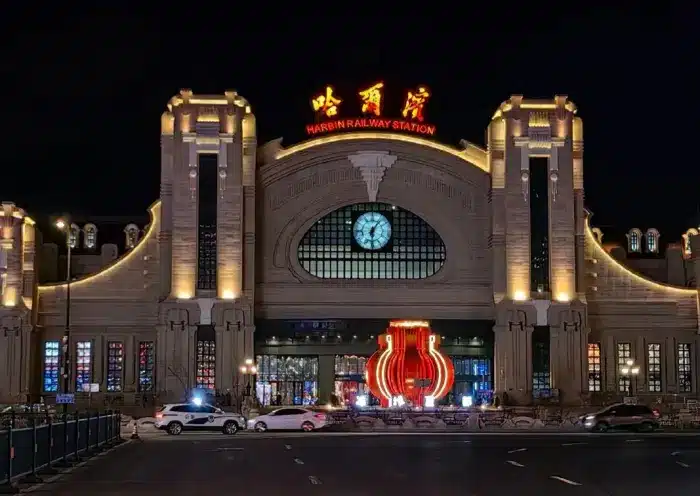
The late 19th century to the early 20th century was one of the most glorious periods in Harbin history. Many famous Harbin attractions were born during this era. But it also experienced many upheavals, successively under control by Tsarist Russia (1898-1917), Beiyang Warlords, Soviet Union, and puppet Manchukuo (1932-1945).
From 1896 to 1903, with the construction of the Chinese Eastern Railway, industry, commerce, and population began to gather in the Harbin area, and Harbin gradually formed the embryonic form of a modern city.
At the beginning of the 20th century, Harbin had already developed into an international commercial port. Over 160,000 immigrants from 33 countries gathered here, and 19 countries set up consulates here, making Harbin the economic center and international metropolis of North Manchuria at that time. Russian architecture, Jewish communities, and the immigrants culture converged here, laying the diverse foundation for the Harbin city.
In 1932, Harbin fell under Japanese puppet rule. The Unit 731 of Japanese army conducted inhumane experiments on bacteria in Harbin. In 1945, Harbin was liberated from Japanese cruel rule. On April 28, 1946, Harbin officially established the People’s Government and became the earliest major city to achieve liberation across China.

Modern and Contemporary Development (Since 1949)
After the founding of the People’s Republic of China, Harbin rapidly resumed development. During the “First Five-Year Plan” period (1953-1957), Harbin was a National Key Construction City, with 13 key projects supported by the former Soviet Union, forming its basic industrial landscape. During this period, Harbin rapidly transformed from a consumer city into an new industrial city, becoming an important electromechanical industry base for China.
Since the reform and opening up (1978), Harbin opened a new chapter in its development. It established China’s first inland port and has continuously held multiple China-Russia Expos, International Ice and Snow Festivals, Harbin Summer Music Festivals, and more.
The History of the Harbin Ice and Snow Festival
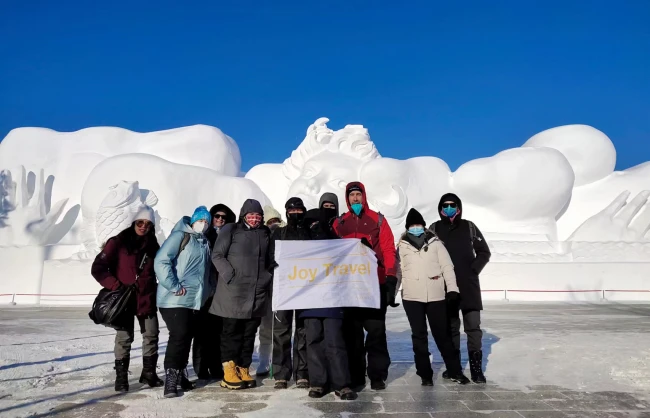
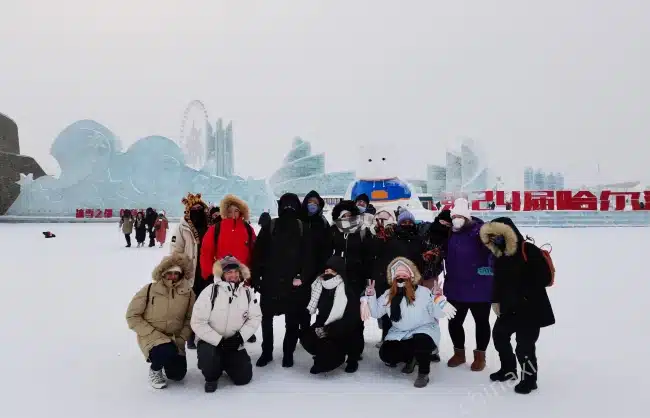
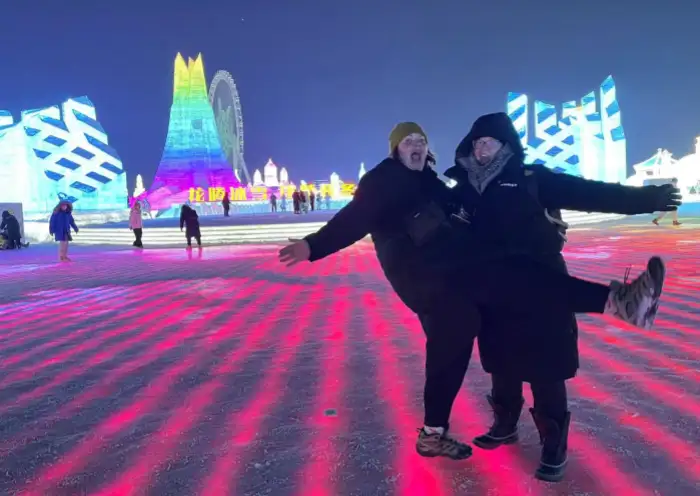
The Harbin International Ice and Snow Festival was founded on January 5, 1985, and in 1999, it became one of the world’s four major ice and snow festivals. In 1989, Harbin Sun Island held the first Snow Sculpture Art Expo. Since then, the one-month-long Harbin Ice and Snow Festival every winter has become a global ice and snow event that integrates various fields such as culture, sports, tourism, economic trade and technology.
Note: Through local legislation, January 5th has become a grand festival for the Harbin people.
The Harbin International Ice and Snow Festival is the first international festival in China’s history that features ice and snow activities. But in fact, the tradition of Harbin people enjoying ice and snow can be traced back to 1963. At that time, people carved ice lanterns and simple ice sculptures to dispel the loneliness of winter and kill time. The first Harbin Ice Lantern Garden Party held in 1963 marked the official beginning of Harbin’s ice and snow culture.
Russian Influence on Harbin’s History and Culture
Harbin Russian History and Architecture
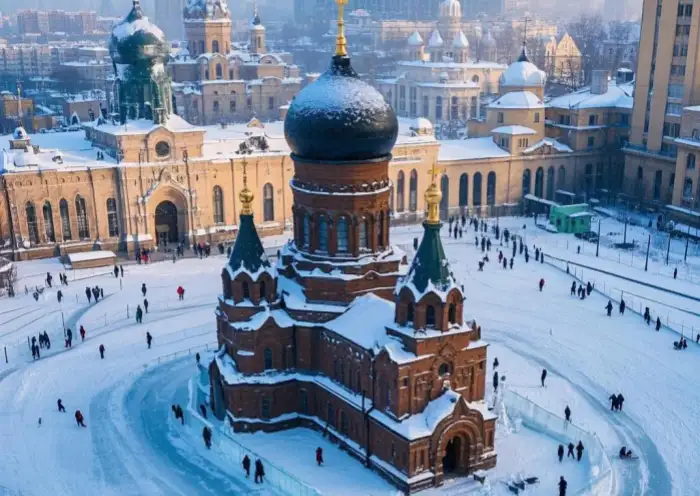
Harbin has a nickname: “Eastern Moscow”. Russia holds a significant position in Harbin history timeline. In the late 19th and early 20th centuries, the construction of the Chinese Eastern Railway marked the beginning of Harbin’s cultural connection with Russia. A large number of Russians flooded into Harbin. They not only brought population and technology, but also participated in the urban planning and construction of Harbin.
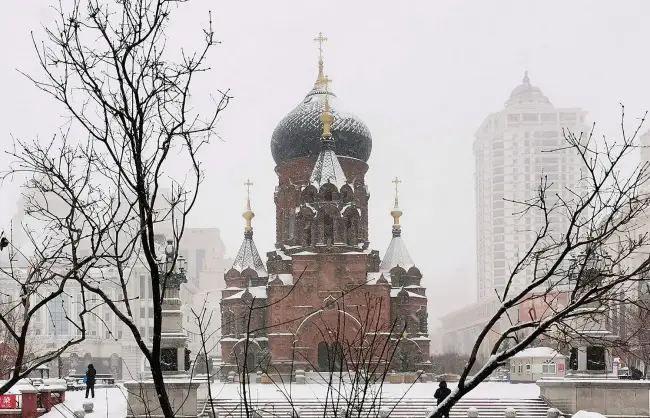
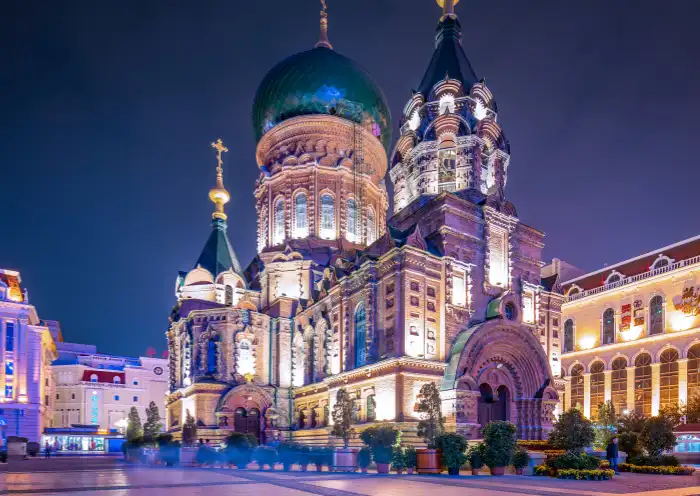
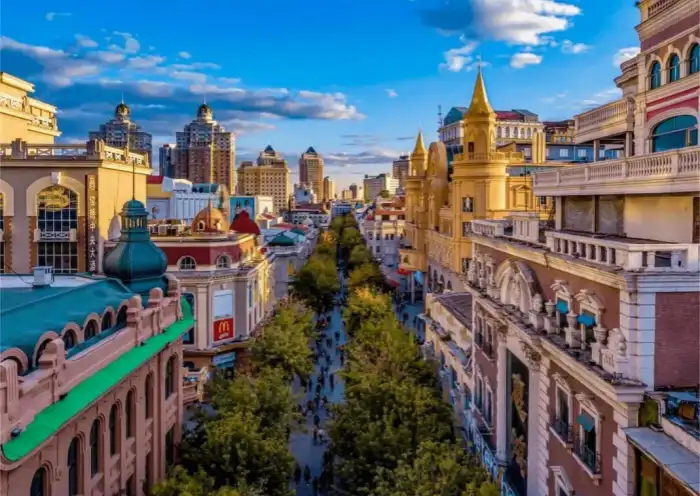
Central Street is a typical representative of this period. It was originally designed and built by Russian engineers, and the buildings on both sides blend various architectural styles such as Renaissance and Baroque. St. Sophia Cathedral is also an outstanding example of the Russian architectural style in Harbin. This Byzantine-style Orthodox church has a magnificent exterior, a huge green dome, exquisite murals and sculptures. In addition, Harbin also has many Russian-style residences, schools, and public buildings.
Suggested Harbin tour: 3-Day Classic Harbin City Tour with Ice and Snow World
Russian Influence on Harbin Food and Lifestyle
At the beginning of the 20th century, the influx of Russians into Harbin also brought their lifestyles and cultural traditions. Russian food culture, as well as music, dance, painting, literature and other artistic forms, were widely spread and loved in Harbin. There are many Russian-style Western restaurants in Harbin, which serve authentic Russian cuisines such as Borscht, kvass, and dalieba. Besides, there are many Harbin foods that blend Chinese and Russian flavors, such as Russian barbecue with Northeastern pickles. Harbin also preserves traditional Russian festivals such as Easter and folk crafts such as matryoshka making.
Harbin Jewish History
In the late 19th and early 20th centuries, over 20,000 Jews migrated from Russia or Eastern Europe to Harbin to escape persecution. They freely engage in various activities here and have also had a profound impact on this city, leaving behind a large number of precious Jewish legacies. After the end of World War II, most of the Jews in Harbin returned to Israel or countries such as Europe and America. Until 1985, the last Jewish resident in Harbin passed away.
There are a total of 14 Jewish activity old sites in Harbin, including the Jewish Synagogues, the Jewish National Bank, the former residence of Jewish businessman Soskine, the Jewish Cemetery, etc. More than 600 Jewish people are buried in the Harbin Jewish Cemetery, including the grandparents of former Israeli Prime Minister Olmert.
Harbin Key Historical Sites, Museums and Fun Facts
Famous Historical Sites in Harbin
As a famous historical and cultural city in China, Harbin gathers together diverse cultures, preserving numerous historical sites and landmarks:
- Imperial Tombs and Capital City: Jin Shangjing History Museum, Ruins of Five Nations City (during Liao and Jin peiods)
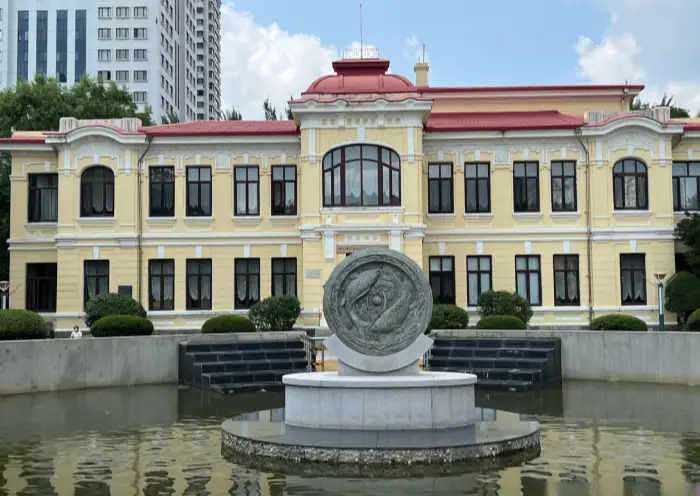
- Religious and Russian Architecture: St. Sophia Cathedral, Central Street architectural complex, Harbin Confucian Temple, European-style building at No.1 Yiyuan Street, Volga Manor
- War Sites and Patriotic Education Bases: Former Site of the Japanese Invaders Unit 731 (Exhibition Hall), Northeast China Martyrs Memorial Hall
What’s more, the Harbin Museum and Heilongjiang Provincial Museum can provide you with a deeper understanding of Harbin history timeline, culture, art, nature, etc. If interested, you can also visit on your Harbin tours.
Interesting Harbin History Facts
- Harbin has 45 ethnic minorities, and is the only city in China where Buddhism, Taoism, Christianity, Catholicism, Islam, and Eastern Orthodoxy coexist.
- Harbin has a total area of 53,100 square kilometers, making it the largest provincial capital city in China, equivalent to the area of 8 Shanghai
- Harbin is the earliest Chinese city to inherit modern music art, and has been awarded the only “World Music City” in Asia by the United Nations.
- Harbin is the birthplace of China’s beer industry. In 1900, Russian businessman Ulubulevsky established China’s first brewery(predecessor of Harbin Beer) in Harbin.
- Harbin was one of the earliest cities in China to experience coffee.

FAQs About Harbin History
Why Is Harbin Russian History So Significant?
In 1896, Russia was allowed to build the Chinese Eastern Railway (i.e. the Manchuria Railway). From then on, Harbin became a leased territory under Russian colonial rule. When the Railway was completed in 1903, the trains departing from Harbin could reach Vladivostok in the east and Chita in the west. Russian and other European immigrants began to migrate in large numbers, and Harbin became the largest water and land transportation hub and commercial port in Northeast China at that time.
How Did Harbin’s Population Change Throughout Its History?
The Songhua River Basin where Harbin is located has been a settlement area for the Northeastern ethnic minority Jurchen (Manchu) people since ancient times. After the Jin Dynasty established its capital here in 1115, Harbin population was approximately 400,000. In early Qing Dynasty, Harbin and other Northeastern areas were very desolate. In the mid to late 19th century, the “Braving the Journey to the Northeast” wave led many Han Chinese to migrate to Harbin. At the end of the 19th century, there were approximately 30,000 residents in Harbin. Then, the construction of Chinese Eastern Railway has driven rapid population growth in Harbin. According to statistics, in 1912, the population of Harbin exceeded 60,000, of which over 40,000 were Russians.
During World War II, Harbin served as a stronghold for Japanese colonization in Northeast China, with a population of hundreds of thousands. By the time of its liberation in 1945, Harbin population had reached over 700,000. After the founding of New China, Harbin as a national key industrial city attracted a large population. Nowadays, the population of Harbin is around 10 million, but gradually decreasing year by year.
What Role Did Harbin Play During World War II?
In 1932, Harbin was occupied by Japan and went through a brutal 14-year rule thereafter. But the people of Northeast China engaged in arduous fight, and there emerged many national heroes and revolutionary martyrs such as Zhao Shangzhi, Yang Jingyu, Li Zhaolin, and Zhao Yiman. Until 1945, with the Soviet Red Army entering Harbin, the Japanese army surrendered. During World War II, Harbin was the source and main battlefield of the Northeast China Anti-Japanese War. The heroic Harbin people, unyielding and tenacious in their resistance, made outstanding contributions to the victory of the War.
How Did the Chinese Eastern Railway Affect Harbin’s Growth?
In 1898, the Russian Empire built the Chinese Eastern Railway and chose Harbin as the hub, marking the beginning of Harbin construction as a city. After the Railway was completed, Harbin quickly rose to become an international commercial port, attracting capital from Russia, Japan, Europe, and America, forming the “Oriental Moscow” features. It can be said that Harbin was a city born from the Railway, and has become a unique example of Chinese city modernization.
Explore Harbin with China Xian Tour
I believe that after reading this article, you have gained a general understanding of Harbin history timeline. From a Northeast frontier hub, cultural melting pot to world-renowned Ice City, Harbin is always worth your visiting. Join our China Xian Tour group, follow our local professional guide and explore Harbin history and culture, cuisine, and scenery in all aspects, experiencing the diverse charm of this city.