

Religions and the devout belief of local people derived from them makes Tibet a hot destination for travelers from home and aboard, attracting endless tourists to explore the mysterious plateau and to feel its unique culture and religion. Yes, it’s a holy land to worship Buddhism. It is quite common for you traveling to Tibet for blessing.However, do you know where should you go to satisfy your dream? Which monasteries are must-visited?
Here is a roundup of the detailed information for 8 most famous monasteries in Tibet for travelers’ reference. Please keep reading if you’re interested in a Tibet Culture tour or a Religion Tour.
Jokhang Monastery
Jokhang Monastery, located in the center of old city town of Lhasa, started its construction in 647 A.D. under the order of the Tibetan emperor Songtsen Gampo. One of the most famous monasteries in Tibet, it contributes to the great fame as “Holy Land” of Lhasa of Tibet in some degree. Standing in Lhasa over than 1300 years, Jokhang Monastery has occupied a supreme position in Tibetan Buddhism. It is the most magnificent architecture of Tibetan Regime Period which gets to be preserved best today.
As the earliest wooden structure architecture in Tibet, Jokhang Monastery created a new pattern for Tibetan monastery building. There are various treasures stored, 108 Buddhist halls, 5 golden domes in the temple which covers about 25,100km2. Buddhist images worshipped in this temple covers all the five great sects in Tibet Buddhism, thus it is prosperous throughout all the years and receives endless pilgrims every day.
Drepung Monastery
It had only a small temple hall of a dozen square meters and 7 monks when the Drepung Monastery had been built at the first time. In the early 17th century, the 5th Dalai Lama rebuilt and expanded this temple which owns tens of thousands of monks in its most prosperous time. The most important building Tsochin Hall is about 20000km2, supported by 183 large wooden columns.
Gandan Monastery
Gandan Monastery keeps the top position in the “six greatest temples of Gelugpa sect”and one of the most famous Tibetan monasteries in Tibet. It shares the fame as “Three Great Monasteries” with Deprung Monastery and Sera Monastery, have keeping almost 4000 monks in its glorious time. This monastery built in 1409 A.D. situates in Dazi County, at 40km of east of Lhasa city, earning its name on not only religion, politics and architecture but also for the rare treasures given by the central Chinese government in that time which supplies material to study cultural communication and relationship between inland China and Tibet.
Recommended Tibet tours to the Must-See Tibetan Monasteries in Tibet:
- 8 Days Lhasa to Everest Base Tour
- 7 Days Best Scenic Tour from Lhasa to Nyingchi
- 10 Days In-depth Tibet Adventure Tour
Sera Monastery
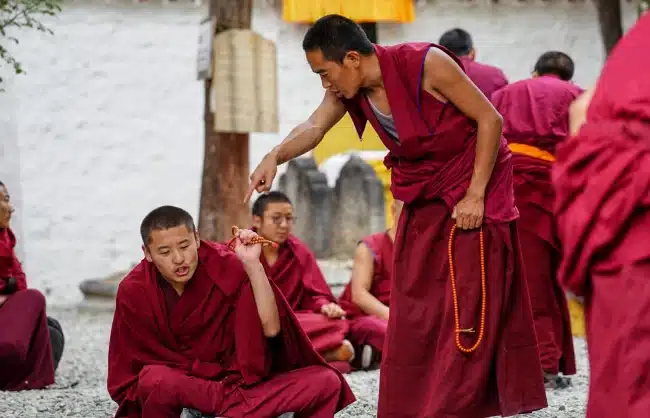
Two legends regarding the origin of the monastery’s name are popular among Tibetan people: one is that there was a heavy hailstone which bears the same meaning with “Sera” in Tibetan language when built this monastery; another one is that the monastery was built in a place with wild rose popping out all over while “Sera” also means wild rose in Tibetan language.
The debate about Buddhism is the most well-known thing in Sera Monastery. There are monks activate themselves to debate with each other on the debating ground. It’s a traditional Buddhist activity in Tibet, special and interesting, worthy of a visit.
Drak Yerpa Monastery
In 8th century, Trisong Destsen invited the famous Padma Sambhava from India to promote Buddhism and arranged him to live in Dark Yerpa Monastery. Padma Sambhava built the famous “108 mahasiddhas practice cave” which has become the practice place for Vajrayana. In the later ages, this temple had been rebuilt and expanded for times, having some famous halls or ashrams, especially for the Vajrayana.
Tsurphu Monastery
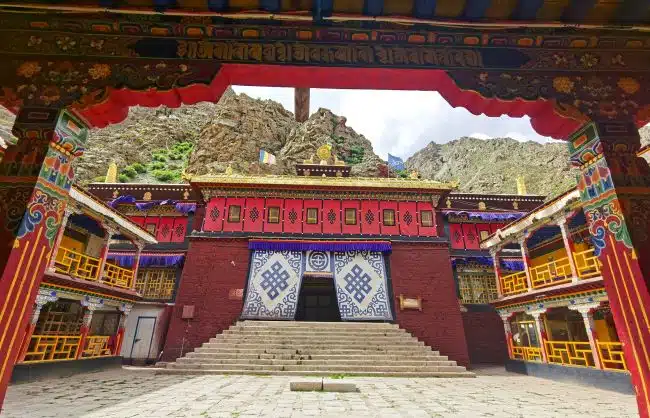
Tsurphu Monastery is over the sea level about 4300m, located at the upstream of Tsurphu river, about 70km from west of Lhasa. It is the main temple of Karma Kagyu sect, firstly creating the Living Buddha reincarnation system in Tibetan Buddhism and applied by other sects later.
Tsurphu Monastery owns lots of rare treasures, including the “Kong Zhu Fo”—the literal meaning in Chinese is that a Buddha lives in the air, which is the top one in all the property of this temple. The legend regarding the “Kong Zhu Fo” is that it was made by the 8th Karmapa for his master and it was said the image could fly in the air for 7 days when it was done, hence the name.
Reting Monastery
Another must-see Tibetan monastery in Tibet, Reting Monastery has been the first temple of Kadam sect in Tibet, built by its founder Dromtön in 1057, over 900 years till today. It locates at Tangguo Town, Linzhou County, about 240km from north of Lhasa. As a legend saying, this place had been a bald mountain, later Srongtsen Gampo visited here and sprinkled water he used to wash hair there and prayed for it, thus there were 25,000 cypresses growing here. “Reting” means that eradicating all troubles until people come to paradise and relief.
Drigung Monastery
Drgung Monastery in Tibet has been regarded as the ivory tower for dying people to get rid of the flesh to reach paradise with soul. That is because it has one of three most famous celestial burial sites in the world. The three ones include an Indian site built by a master of Esoteric Buddhism, two sites in Tibet—one in Drigung Monastery and one in Qing Pu practice land, Shannan area.
Sakya Monastery
Known as the “Second Dunhuang” for its trove of Buddhist scriptures and murals, Sakya Monastery is the seat of the Sakya sect. Its gray-stone walls and towering kora path all express a sense of solemnity. Don’t miss the Thangkas (scroll paintings) and the monastery’s role in Tibet’s political history during the Yuan Dynasty.
Pelkor Chode Monastery
Located two hours from Tashilhunpo Monastery, this 15th-century Shigatse marvel fuses Han and Tibetan architecture, centered around a three-tiered stupa housing 100,000 Buddhist statues. Its rare cultural blend offers photographers an excellent chance to catch the intricate carvings and spiritual energy with their camera. Arrive at dawn for golden-lit walls and chanting rituals. Guides will reveal hidden details for you—like symbolic figures—while its quieter vibe (vs. Lhasa) captures authentic Tibet.
Best Time to Visit Tibetan Monasteries
April–May (Spring Blossoms):
- Weather: Daytime temperatures range from 10°C to 20°C (50°F–68°F). Remember to bring thermal wear, as you’ll probably experience coldness duringnights (around 5°C/41°F). In daytime, clear skies dominate, ideal for photography and outdoor activities.
- Highlights:
Go see Lhasa’s parks bloom with wildflowers, and the Lhasa River, which will thaw for scenic boat rides.
Festivals: Losar (Tibetan New Year, Feb/Mar) features masked dances, prayer ceremonies, and traditional lion dances. Though technically speaking, it happens in late winter, its cultural impact spills into early spring.
Hiking: During this season, trails around monasteries like Ganden and Tsurphu will be accessible for tourists. You can see Rhododendrons blooming in high elevation area.
September–October (Golden Autumn):
- Weather:Warm days (15°C–25°C/59°F–77°F) and cool nights (5°C–10°C/41°F–50°F) dominate during this time. Minimal rain, crisp air, and stunning fall foliage will greatly add beauty to monastic landscapes.
- Highlights:
Saga Dawa Festival (Apr/May in Tibetan calendar, May/Jun Gregorian): Pilgrims center on sacred peaks like Mount Kailash, this scene will create an immersive spiritual atmosphere.
In harvest season, if you go to rural areas near monasteries (e.g., Reting Monastery), you’ll probably get chances to experience local festivals and homestays.
Wildlife: Snow leopards and Himalayan vultures will be more visible in mountainous regions like Drigung Monastery in this season.
Avoid
- July–August (Monsoon Season):
Frequent rainstorms (especially in southeastern Tibet) can disrupt travel plans, cause landslides, and make high-altitude trails muddy and slippery.
Increased humility makes stone-carved monastery interiors damp and less comfortable.
- December–February (Winter Harshness):
Daytime temperatures hover near 0°C–5°C/32°F–41°F, with nights plunging to -10°C/+14°F in remote areas.
Limited road for access due to heavy snow on routes like the Lhasa–Shigatse Highway. Some monasteries will reduce visitor volume during this period.
Dos & Don’ts When Visiting Tibetan Monasteries
Do:
- Walk Clockwise Around Kora Paths and Stupas
When you’re walking around sacred circles (kora) and stupas, remeber to walk in a clockwise direction, which symbolizes the Buddhist cycle of rebirth.
- Remove Shoes/HatsBefore Entering Prayer Halls
Some Monasteries need visitors to take off your shoes and hats at the entrance of temples or halls with religious artifacts.
- Dress Modestly
- Your shoulders and knees should be covered. The most appropriate option would be some loose, non-revealing clothing like long pants, long-sleeved shirts, or dresses. Do not enter if you’re wearing tight jeans or crop tops, especially near prayer areas.
- Ask Permission Before Photography
Always seek consent before photographing monks, nuns, or rituals. Some monasteries ban photography entirely; others charge fees for picture-taking in sacred zones.
- Carry Cash for Donations
Many monasteries’ running relies on donations. Small bills (10–50 RMB) are appreciated for incense, butter lamps, or general contributions.
- Join Prostration Ceremonies Respectfully
If you’re invited to participate in prostrations (commonly happen during festivals), you can mimic nearby locals’ practices: fold hands, bow deeply, and repeat mantras if guided.
Don’ts:
- Touch Sacred Objects or Murals
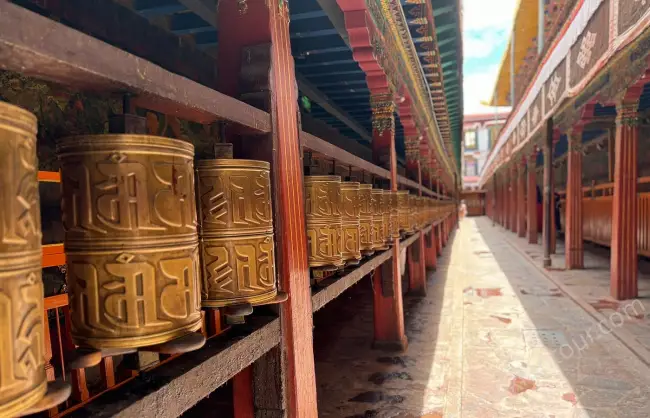
Statues, prayer wheels, and thangkas (scroll paintings) are all considered holy. Oils from skin or accidental contact can damage centuries-old artworks.
- Point Feet at Altars or Statues
Feet are seen as impure in Tibetan culture. Avoid stepping over prayer mats, and never direct your feet toward Buddhas, altars, or monks.
- Wear Hats or Smoke in Prayer Halls
Hats are removed as a sign of respect. Smoking is banned in most temples, as tobacco is considered spiritually polluting.
- Interrupt Rituals or Ceremonies
Avoid loud conversations, pointing, or flash photography during prayers, mantra chanting, or offerings. Stand quietly at the periphery if observing.
- Step on Thresholds of Prayer Halls
Thresholds are believed to separate the secular from the sacred. Step over them carefully, never dragging luggage or feet.
- Disrespect Monks’Personal Space
Do not touch monks’ robes or ask intrusive personal questions. Offer greetings with palms pressed together (Tashi Delek) instead of handshakes.


