



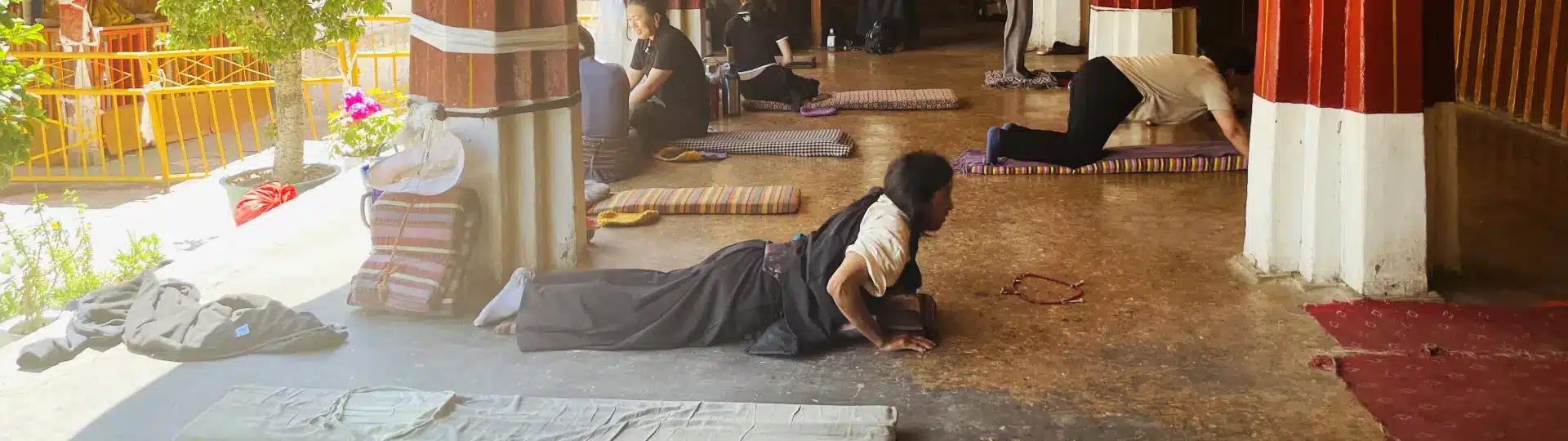
On a tour of Tibet you will see many religious locals and monks. Two of the main ways Tibetan Buddhists gain religious merit is by making pilgrimages and by performing prostrations.” This can look quite strange to those who are not familiar with the practice. When prostrating the Buddhist goes down on his knees, places his elbows and forehead on the ground and often even lies down completely on the ground. Tibetan Buddhist pilgrims often travel to religious sites like Mt. Kailash and make a circumambulation of the site to wash away the sins of a lifetime.
“Circumambulation” is a fancy way of saying they circle around the site on foot. Some devout pilgrims even incorporate prostrations into the circumambulation by kneeling then lying down on the ground, rising, moving slightly forward to where their outstretched hands had been on the ground and then repeating the process. These pilgrims go up and down progressing slowly until they have made the entire circular route. To help their bodies cope with this strenuous ritual they wear protective leather aprons, protection on their hands and wooden clogs with rubber tips on their feet. Pilgrimages can take months and even years in an effort to gain spiritual enlightenment and religious merit.
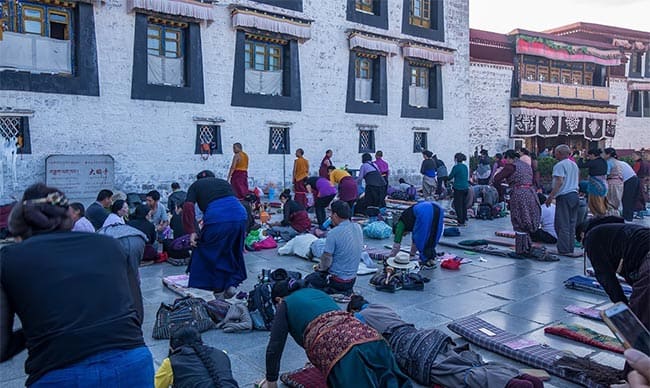
Tibetan Buddhist Prostration
To make a prostration Tibetan Buddhists stand with their hands in the lotus position (as Christians hold their hands when praying) and lift their hands to the crown of their head. This movement honors the second Buddha (Guru Rinpoche) and purifies the body helping the person to get closer to realization (nirmanakaya) also known as the physical form of Buddha.
Keeping their hands in the prayer position the hands are moved to the throat; a symbolic mark of respect for the words of Guru Rinpoche and helping the person to get closer to realizing the state of sambogakaya or body of enjoyment. This is the physical form of Buddha which the person prostrating should visualize.
The hands in the pray position are then brought down to in front of the heart in respect of the enlightened mind of Guru Rinpoche. This helps the person to rid his mind of distractions and get closer to realizing the state of dharmakaya, the spiritual form of Buddha.
Then the worshiper places all four limbs and their forehead on the ground and stretches out his arms straight in front of him bringing his hands in the prayer position to his forehead. This acknowledges the blessing of Guru Rinpoche. This completes the prostration and the worshiper brings him or herself upright and takes three small steps forward before repeating the prostration.
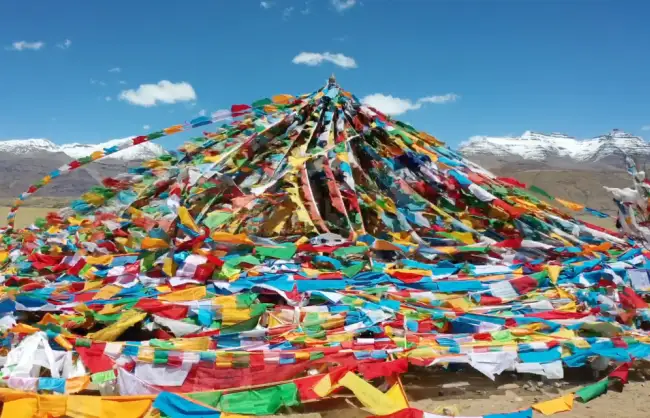
Tibetan Buddhist Pilgrimage
Today pilgrimages are sometimes made by vehicle or on horseback but many devout Tibetan Buddhists still make the pilgrimages in the traditional way, on foot. Making the journey on foot is considered more spiritual and meritorious. Taking that one step further pilgrims can complete the pilgrimage not only on foot but by prostrating themselves all the way. This gains the pilgrim the highest form of spiritual merit.
Tibetan Buddhist pilgrims have many pilgrimage sites which are held sacred to them. There are natural sites that are considered sacred like lakes and mountains. Spiritual deities are believed to reside in natural forms. Some man-made places like monasteries are also considered pilgrimage sites because of their association with famous Buddhist teachers or scholars.
Making a pilgrimage is not easy or simple; it demands great physical effort, time and self-denial. Pilgrims stick to a strict schedule and to keep it they may have to spend an entire day in prostration. After the brutal toll on the body pilgrims can be recognized by the mark on their forehead as unlike the hands, knees and feet the forehead has no protection from its contact with the ground during prostrations.
Famous Temples in Tibet:
Tibetan Buddhist Circumambulation
The pilgrimage itself is the act of reaching a sacred location but once there the experience is not over. The pilgrim then has to complete a circumambulation of the site to really achieve spiritual enlightenment, wash himself of sins and gain religious merit. While performing the circumambulation pilgrims chant a Buddhist mantra. In Tibet you may see Buddhist pilgrims performing a circumambulation at Mt. Kailash (one of the most beautiful mountains in China); at Amnye Machen in Amdo Prefecture and in Lhasa around the Jokhang Temple.
Related reading: Best Time to Visit Mount Kailash


