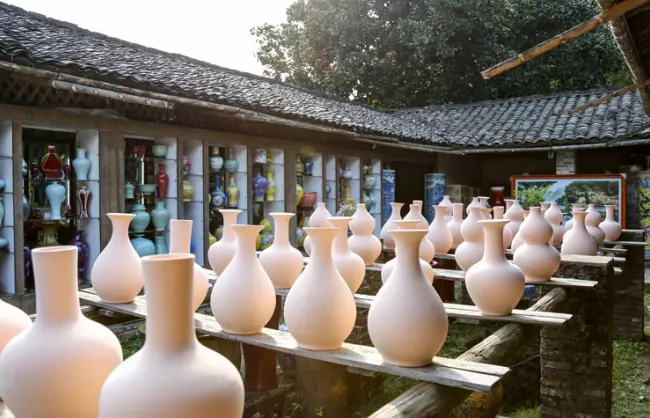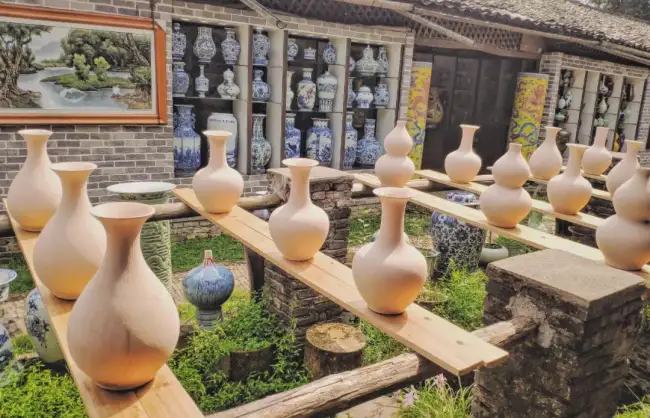



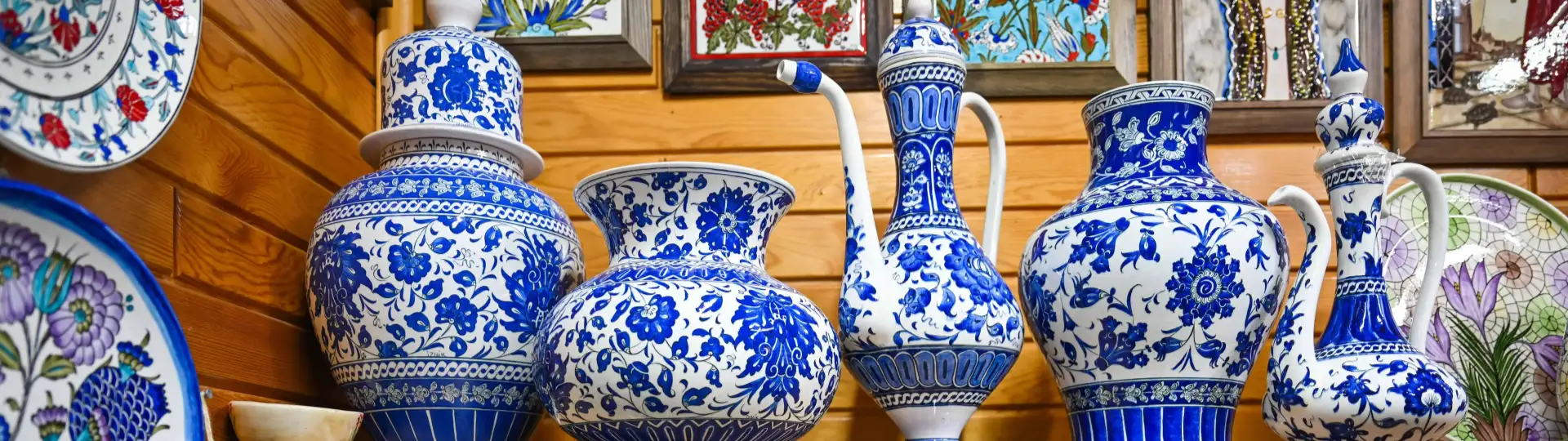
The amazing Chinese blue and white pottery, with several dynasty marks, can allow you to feel the unique Eastern poetry.
Blue and white porcelain, also known as white-ground blue-patterns porcelain or Qinghua (青花), is a precious mainstream variety of Chinese porcelain and belongs to underglaze porcelain. It has a wide influence worldwide, symbolizing the pinnacle of Chinese ceramic art and the cultural heritage of ancient China.
This article will introduce the origin, characteristics, craftsmanship, identification, as well as the historical and cultural value of blue and white pottery – one of the most popular and valuable collectibles in China.
Content Preview
- What Is Chinese Blue and White Porcelain?
- History of Chinese Blue and White Porcelain
- How Is Chinese Blue and White Porcelain Made?
- Types and Styles of Chinese Blue and White Pottery
- Common Blue and White Porcelain Patterns and Their Meanings
- How to Identify Authentic Chinese Blue and White Porcelain
- Visiting Porcelain Sites in China
- Fun Facts and Cultural Significance
- FAQs About Blue and White Porcelain
- Plan a China Tour with Us
What Is Chinese Blue and White Porcelain?
As a traditional famous porcelain of China, blue and white porcelain has held the dominant position in Chinese pottery since the 14th century.
Defining Blue and White Pottery
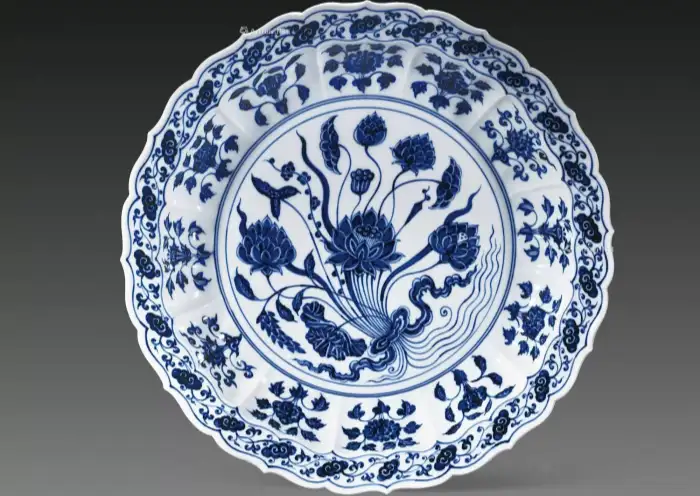
What is Chinese blue and white porcelain? It refers to a type of underglaze colored porcelain. Use natural cobalt oxide as a pigment to draw patterns on the porcelain body, then apply a layer of transparent glaze, finally fire at a high temperature of around 1300 ℃ in one go.
After the cobalt material is fired, it turns blue, and together with the white porcelain body, forms the appearance of white background with blue patterns. Thus, it is called blue and white pottery.
So, authentic blue-and-white porcelain must meet three basic conditions: 1. cobalt pigment; 2. Underglaze color; 3. One-time high temperature firing.
Advantages of Chinese Blue and White Pottery
As the most Chinese-style porcelain, blue and white pottery features strong coloring ability, bright vivid colors, high firing rate, and stable color presentation. The patterns on it never fade. The raw material is a natural mineral containing cobalt, which is relatively abundant. White ground with blue patterns gives a clear and elegant feeling, and has the effect of traditional Chinese ink painting. Just as sung by Jay Chou in Blue and White Porcelain, “The deep blue and pearl white glow like porcelain… The sky is crying blue as I wait for you…”
Why Did Blue and White Become Iconic in Chinese Ceramics?
Blue and white porcelain is the most splendid variety in the history of Chinese ceramics. Its charm lies in the pure white body, vibrant blue color, various patterns and decorations, and exquisite craftsmanship. Those that have been passed down through generations also reflects the social cultures of different eras. Not only has Blue and White become a treasure of traditional Chinese culture, but also occupies an important position in world art history.
History of Chinese Blue and White Porcelain
Blue and white pottery originated in the Tang and Song dynasties, matured in the Yuan dynasty, and reached its peak in the Ming and Qing dynasties. Its emergence and development were attributed to the advancements in porcelain-making technology, the prosperity of overseas trade, and frequent cultural exchanges.
Early Origins in the Tang and Song Dynasties
The most ancient Chinese blue and white porcelain appeared in the Tang Dynasty and was produced in Gongxian Kiln, Henan Province. The main types were small pieces, and the craftsmanship was not yet mature, mainly for export. The Tang blue and white porcelain plate found on the “Heishi” sinking ship is the earliest complete one discovered so far.
This porcelain’s development in Song Dynasty was slow and did not become the aesthetic mainstream. And it had no direct continuation relationship with Tang porcelain.
Mature in the Yuan Dynasty
The truly mature blue and white pottery was born in the Hutian kiln in Jingdezhen during the Yuan Dynasty. Yuan Dynasty Qinghua porcelain uses imported Sumali Cobalt from Persia, with a large shape, heavy body, full decorative composition, multiple layers without disorder, rich themes, and a rare number of surviving pieces (only 300 pieces, mostly in museums). After the Yuan Dynasty, large-scale production began and was exported overseas.
Its representative work is the Scrolling Peony Pattern Plum Vase.
Golden Age in the Ming Dynasty
The Ming Dynasty was a prosperous period for blue and white porcelain, with Jingdezhen as the main kiln site. There is a large quantity of porcelain produced, with superior quality and elegant style, meeting both the domestic and international needs. Among them, the porcelain from the Yongle and Xuande reigns had fine porcelain bodies and smooth glazes, and were exquisitely crafted, recognized as the pinnacle of Chinese blue and white porcelain.
Falling From Pinnacle in the Qing Dynasty
During the Qing Dynasty, the porcelain industry in Jingdezhen reached a new historical level. During the Kangxi Reign, Zhuming material was used, and the “multi-toned blue” technique brought this porcelain to its peak. After the Qianlong Reign, due to the development of family-rose porcelain and other reasons, blue and white porcelain gradually declined.
Global Influence and Export to Europe
In Chinese history, blue and white pottery was once exported overseas and became an important carrier of cultural exchange between China and foreign countries. Its export began in the Yuan Dynasty (14th century). During the Ming Dynasty, it was exported in large quantities via the Maritime Silk Road, leading an aesthetic trend through Asia and Europe. After the 16th century, Portugal and other countries became its main distributors in Europe by opening up new sea routes. By the 18th century, this porcelain had been collected and inherited in various continents including Europe, Asia, Africa, and America.
How Is Chinese Blue and White Porcelain Made?
The Production Process
- Material preparing: Carefully select, screen, and purify kaolin clay to make the porcelain body delicate and highly ceramicized.
- Molding: Use hand-building techniques to make the clay into a desired shape.
- Drawing: Use cobalt oxide ore to carefully draw various patterns and decorations on the body.
- Glazing: Use unique methods to evenly apply the glaze paste to the body surface, adding its luster and texture.
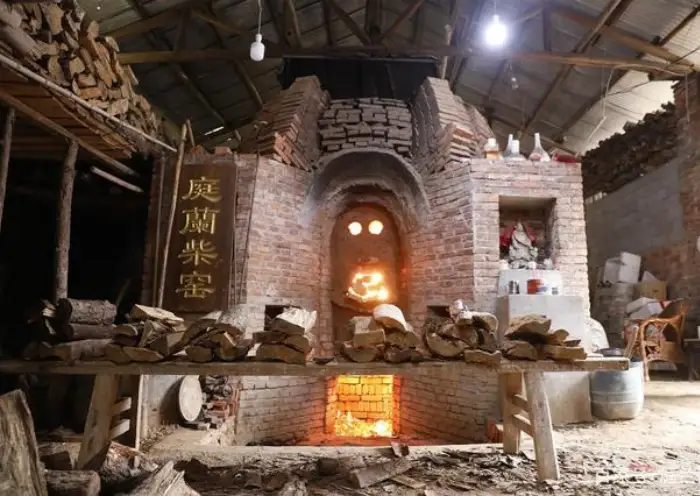
- Kiln firing: Place the glazed body into a wood kiln and fire it at a high temperature of 1250-1350 ℃ once, forming the final blue and white porcelain.
Traditional vs. Modern Techniques
With modern technology, the raw materials for blue and white pottery have become more abundant, the molding process has become mechanized, and the decorative techniques have become more diverse and refined. The firing process is also more advanced, using modern equipment such as electric kilns and gas kilns. In short, traditional craftsmanship emphasizes “handmade temperature”, while modern craftsmanship has the advantage of “efficiency and standardization”.

Types and Styles of Chinese Blue and White Pottery
There are many types of Chinese blue and white porcelain, such as:
Household Porcelain
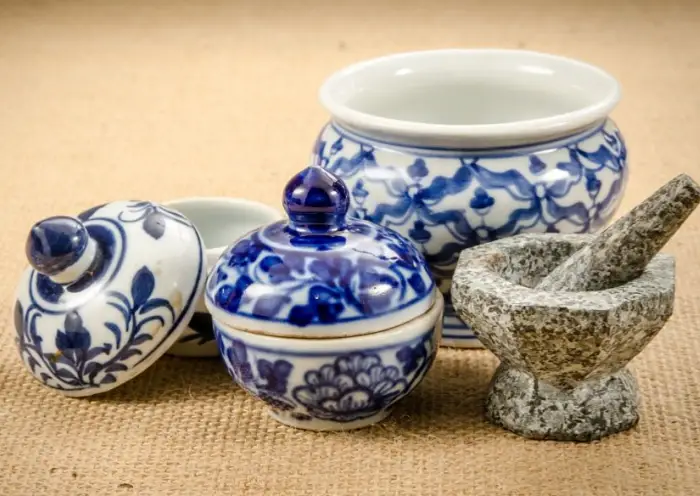
This category covers daily necessities such as bowls, plates, cups, tea pots, etc. Bowls focus on practical functionality and simple designs. Plates are praised for their elegant forms and exquisite graphics. Cups attracts attention with their small size, delicacy, and fine paintings.
Ornamental Porcelain
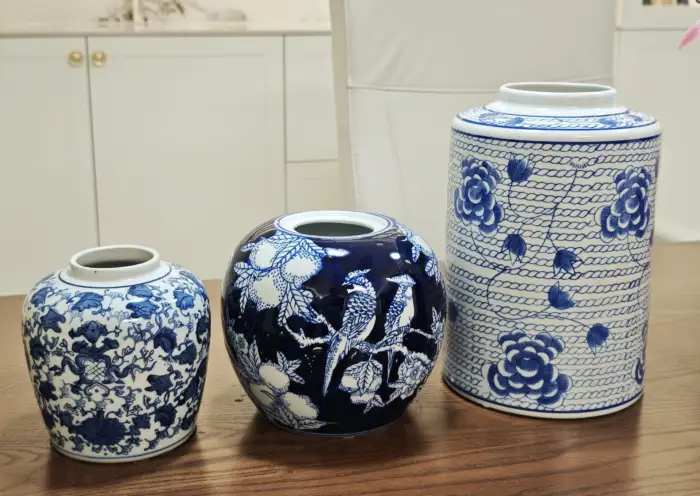
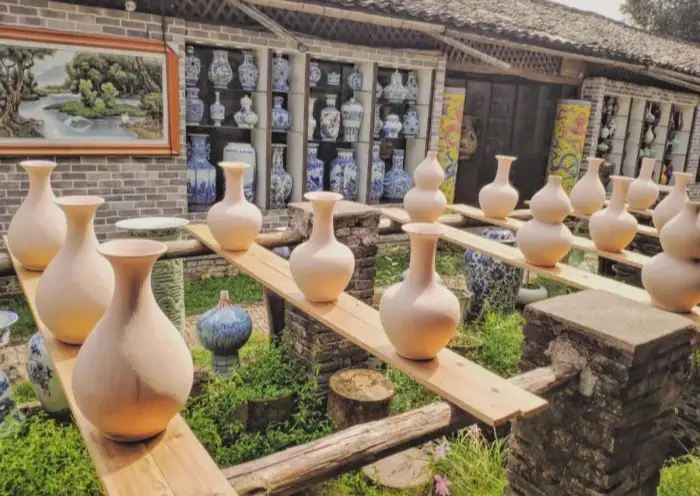
The decorating porcelain mainly features large-sized objects such as vases, jars, zuns, often used for home decoration. Blue and white pottery vases are known for their grand posture and rich patterns. Jars are characterized by their full form and diverse themes.
Artistic Porcelain
It excels in unique skills and exquisite painting techniques, such as hollowed-out porcelain, porcelain plate painting, figurines.
Modern Collection and Design
In modern society, blue and white porcelain has become a highly collectible artwork. It’s also widely used in modern design, becoming an important element in home furnishings, dinnerware, and gift designs.
Common Blue and White Porcelain Patterns and Their Meanings
The decorative patterns of ancient blue and white pottery have a wide range of themes, mainly including:
Animal Patterns
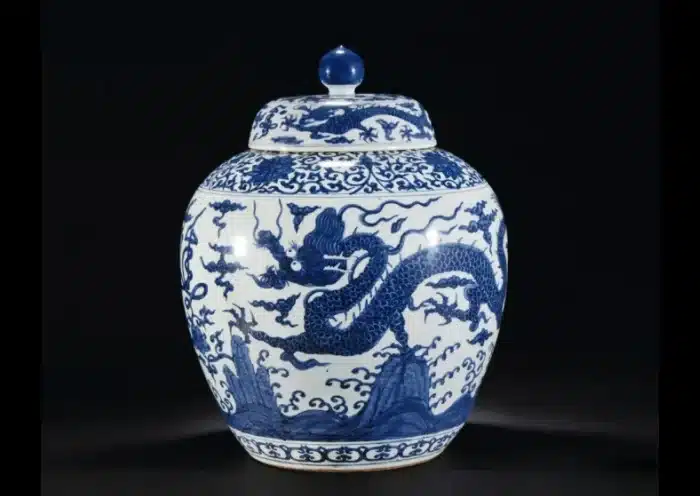
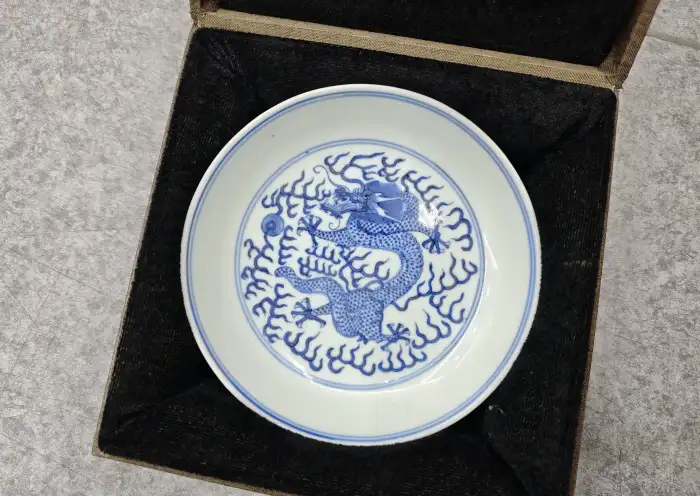
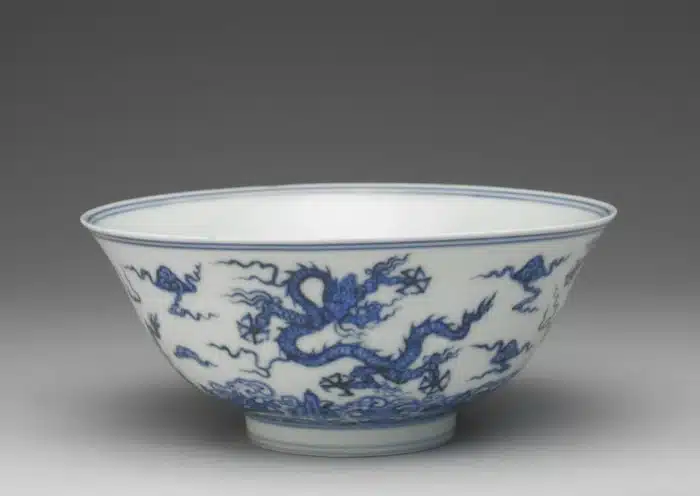
The most common ones are dragons, qilins, phoenixes, and lions, symbolizing auspiciousness and prestige. There are also seahorses, peacocks, cranes, deer, monkeys, fish, turtles, snails, bats, and so on.
Plant Patterns
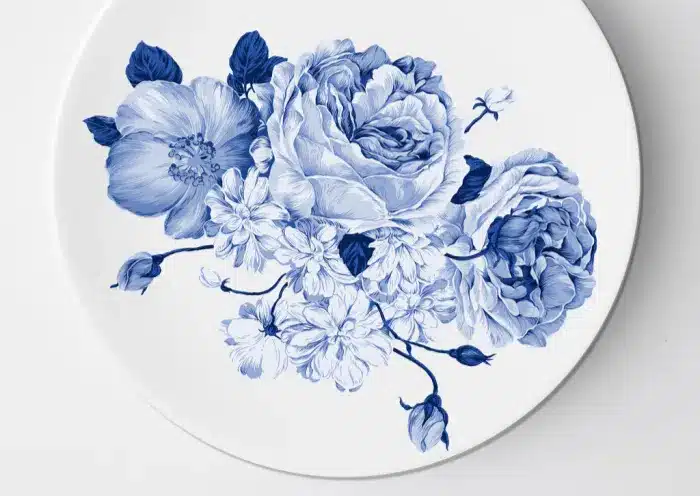
Floral patterns include lotus, chrysanthemum, peony, plum, lotus, lily, etc. Official kilns often have scrolling and broken branch motifs. Melons and fruits include lychee, pomegranate, peach, grape, etc. There are paintings combining several types of plants, such as pine, bamboo, plum, etc; or combining flowers and bird animal, such as the twin peony and lion.

Character Patterns
The human figures often appear in the form of scenes, including character images from mythological tales, novels and operas, children play, high scholars, and female figures.
There are also landscape patterns, Arabic and other text patterns, geometric patterns, auspicious patterns such as fret and cloud, etc.
How to Identify Authentic Chinese Blue and White Porcelain
Essential points for choosing high-quality blue and white porcelain on China tours:
Key Features
Its color is mainly white background + cobalt blue, fresh and elegant. The patterns and decorations are diverse, with lifelike depictions and clever compositions. Its design is mainly characterized by simplicity and elegance, rich shapes, coordinated proportions, smooth lines, and strong practicality and artistry.
Ming vs. Qing Styles
There are many Ming and Qing Dynasty blue and white porcelain pieces in existence.
The Qinghua porcelain of the Ming Dynasty had a relatively coarse body, with thick and moist glaze. The design favored a simple and rustic style, featuring gentle and rounded lines. The decorative patterns were bold and vivid in brushwork, with a wide range of themes. The marks (inscriptions) were placed rather casually.
The Qinghua porcelain of the Qing Dynasty has a light and delicate body, with thin and fine glaze. The design were upright and dignified, and the craftsmanship for large pieces was increasingly sophisticated. The decorative brushstrokes were delicate, the patterns were regular, and the themes were often antique. Generally, there were marks on the bottom.
Tips for Distinguishing Genuine Antiques From Modern Reproductions
Genuine Antiques: The body material is not coarse or fine. The glaze surface is soft, warm, and heavy but lacks flatness; the glaze bubbles are of different sizes and transparent. The shape is beautiful, the decoration is vivid, there is no strong contrast in color intensity, and the bottom is smooth. When tapped with your hand, it produces a clear and pleasant sound with a long-lasting reverberation.
Modern Reproductions: The body material is too fine. The glaze surface is light and dazzling, overly smooth and flat, with fine and opaque glaze bubbles. The lines are stiff and unnatural, and the surface feels rough when touched. When tapped with the hand, its sound is dull and strong.
Factors Influencing Value
In the field of antiques collecting, Chinese blue and white porcelain has always held a significant position. Scarcity is the core element of its collectible value. Especially the masterpieces from peak periods such as the Yuan Dynasty, Ming Yongle and Xuande reigns, Qing Kangxi reign are extremely rare.
- Decorative itemsare more valuable than functional ones, with values ranked from high to low as vase, jar, plate, bowl.
- Character paintings are more valuable than plants, especially those that tell historical stories. The most valuable animal pattern is the dragon.
- Peak period works have higher value than origin period works.
- The complete pieces with reign marks are more valuable.
Visiting Porcelain Sites in China
There are many production areas for Chinese blue and white porcelain, among which Jingdezhen in Jiangxi, Yixing in Jiangsu, and Chaozhou in Guangdong are particularly well-known.
Jingdezhen (Porcelain Capital)
The popularity of Yuan Dynasty blue and white porcelain led to Qinghua becoming the symbol of Chinese porcelain. During the Ming and Qing dynasties, the imperial kiln factory gathered the top porcelain craftsmen, which further established Jingdezhen’s position as the “porcelain capital in the world”.
Best China Tours Including Jingdezhen:
Museum Collections (Beijing, Shanghai)
- Beijing Palace Museum: It mainly features imperial porcelain, with meticulous craftsmanship. The peak was during the Yongle and Xuande reigns of the Ming Dynasty. The most valuable treasure is the Ming Yongle Reign Blue and White Scrolling Lotus Patterns Palmed Cup.
- Shanghai Museum: It houses various exquisite blue and white pottery from the Yuan, Ming, and Qing dynasties, with a focus on export and cross-cultural integration.
These two museums each hold 16 Yuan Dynasty Qinghua treasures, which are must-visit when you travel to China.
Recommended China Museum Tours:
- 2 Days Beijing Stopover Tour: Great Wall+Forbidden City
- 8 Days Beijing – Xian – Shanghai Highlights Tour
Fun Facts and Cultural Significance
The Pop Culture Power of Qinghua Ci
The reason why blue and white porcelain can become a treasure of Eastern art is not only because of its exquisite craftsmanship, but also the cultural connotations it contains. At the same time, it was also an important carrier of China’s ancient foreign exchanges, and was loved by people all over the world.
As a symbol of China’s elegance and craftsmanship, the blue and white porcelain has been revitalized through various media in the country. Jay Chou’s 2008 hit song “Qing Hua Ci” is one of the most notable example. Beyond that, its motifs and patterns are also used in clothing and accessories design.
It Inspired a European Craze
With the deepening of cultural exchanges between China and foreign countries, Chinese blue and white porcelain was once highly sought after by European royalty and nobility, with considerable values. Historical figures such as Elizabeth I and Louis XIV have had a special fondness for this porcelain.
At the end of the 17th century (during the late Ming and early Qing dynasties), millions of pieces of Chinese porcelain were sold to Europe every year, especially “blue and white porcelain” which became a symbolic display in the palace rooms of the upper class in Europe, symbolizing wealth and grade. It even promoted the birth of porcelain factories such as Mason in Europe.
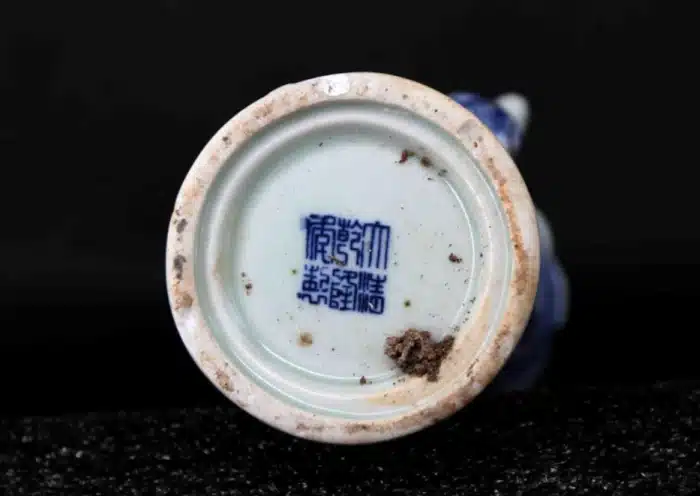
A Hidden “Mark” at the Bottom
The inscriptions on the bottom of blue and white pottery come in various types:
- Reign Marks: Use writing, engraving, and printing methods to indicate the era of porcelain firing.
- Auspicious Words, Hall Name, Praise, and Decorative Pattern Marks: These are distinctive inscriptions of folk Qinghua
FAQs About Blue and White Porcelain
How Can You Tell If Blue and White China Is Valuable?
- Looking at cobalt materials: Porcelain made from imported cobalt is mostly created by senior craftsmen and has higher artistic value.
- Looking at the color: The underglaze color is bright, and porcelain with five color tones is particularly precious.
- Judgingby artistic level: Porcelain with elegant shapes, three-dimensional compositions, and clear characters and scenery has higher collection value.
- Judging by marks: By mastering the basic characteristics of historical inscriptions, you can accurately determine the era and kiln of ancient porcelain.
Generally speaking, limited edition art ceramics, molded and painted by hand and fired in wood kilns, are more worth collecting!
What Are the Most Valuable Chinese Pottery Marks?
The most valuable marks on Chinese blue and white pottery mainly include:
- Official kiln inscriptions, which are rare in existence and serve as the core proof of dating and identity;
- Classic decorations, created by top craftsmen, possessing unparalleled cultural and artistic value;
- Special craftsmanship, such as the iron rust spots of Sumali Blue, which are the epitome of era technology and crucial for determining authenticity and value.
Where Was Most Blue and White Porcelain Made?
The core production area of most blue and white porcelain is Jingdezhen, Jiangxi. Since the Yuan, Ming, and Qing dynasties, Jingdezhen has become an unparalleled porcelain capital of China due to its high-quality kaolin, “binary formula” body-making technology, top-notch porcelain craftsmen, and mature use of cobalt materials. Until now, Jingdezhen continues to produce the world’s most mainstream Qinghua porcelain by combining traditional craftsmanship with modern techniques. It is the cultural and production center of this porcelain.
What Are Some of the Most Famous and Valuable Pieces of Blue and White Porcelain?
According to statistics, six out of the top ten most expensive porcelain pieces in China are blue and white pottery.
- The Ming DynastyNine-Dragon Vat, which sold for RMB 897 million in 2012, became the record holder for the highest auction price of porcelain worldwide.
- The representative of the Yuan Dynastyblue and white porcelain, “Xiao He Chasing Han Xin Under the Moon” Plum Vase was sold for RMB 712 million in 2011.
- The Yuan Dynasty“Guiguzi Descending the Mountain” Painting Jar was sold for about RMB 230 million at the 2005 London auction, setting the highest record for Chinese art works at that time.
- In 2013, the world’s only pair of Zhizheng-styleYuan Dynasty Inscriptive Cloud Dragon Pattern Elephant Ear Vases were sold for RMB 398 million.
How Does Chinese Blue and White Porcelain Differ from Japanese or European Imitations?
Chinese blue and white porcelain features a stable color tone achieved through natural cobalt pigments (such as Sumali Blue), and uses the unique technique to blend and create layers of depth. It inherently possesses an understated cultural connotation. However, Japanese imitations (such as Imari Porcelain) mostly use local cobalt pigments, resulting in a more vibrant color tone and elaborate patterns. European imitations (such as Mason Porcelain) are difficult to replicate Chinese art conception and cultural depth.
Plan a China Tour with Us
“Prefer to keep a single piece of blue and white porcelain rather than a whole chest of gold.” Welcome to join our China tour package and enjoy this unique and charming Eastern aesthetics! You can also contact us to customize your perfect Chinese porcelain discovery tour.