
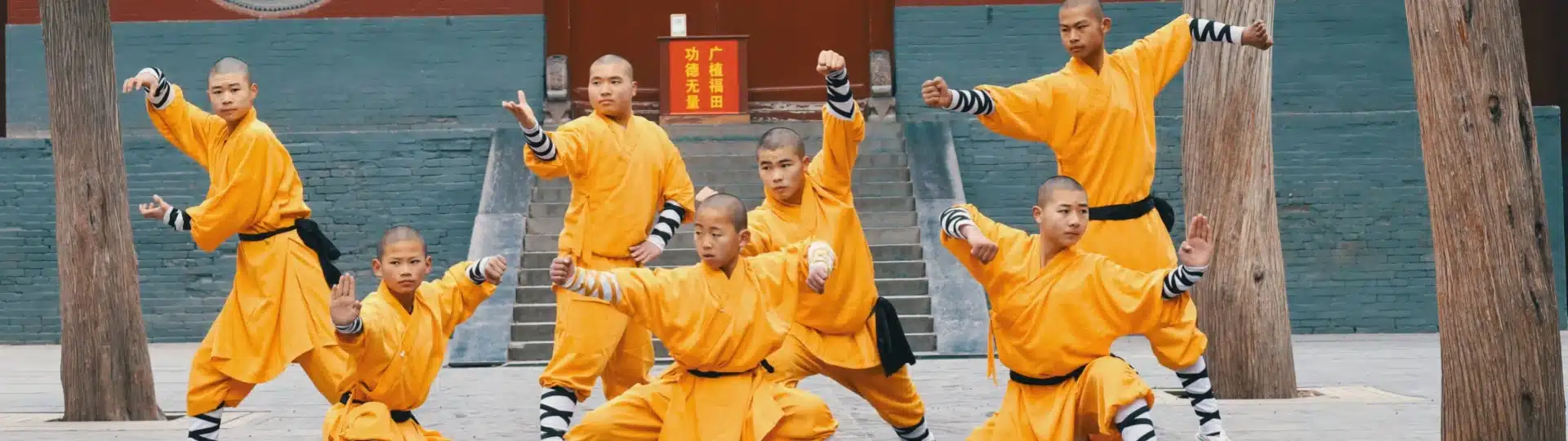
Chinese Kung Fu/Martial Arts is much more than marvels of climbing walls and leaping roofs, or the skill of defeating rivals in a few moves in the arena. It is a profound philosophy of the body and a cultural gene flowing through the Chinese veins.
This guide will offer you in-depth knowledge about Chinese Martial Arts– its definition, its different styles and schools, some excellent places for experiencing and learning Chinese Kung Fu, and influential Chinese Martial Arts movies and masters. Let us push open the door to the mysterious Kung Fu world and take a close look at what is behind every mighty and skilful move.


What Are Chinese Martial Arts?
The meaning of “Kung Fu” and “Martial Arts”
“Kung Fu” literally means acquiring skills through long-term effort and practice. It stresses perseverance and gradual improvement in defensive moves. Traditional Chinese Kung Fu encompasses various styles and types, each featuring distinct techniques, forms, and training methods.
“Martial Arts” refers to a modern sport developed in the 20th century that standardizes traditional Chinese Kung Fu. It absorbs classic elements of Kung Fu while concentrating on aesthetics and patterns of moves.
Nowadays, “Martial Arts” has become an umbrella term that includes techniques, principles, and philosophies of traditional Chinese Kung Fu. And the two terms, “Kung Fu” and “Martial Arts,” have been interchangeable on most occasions (as in this guide).
When Was Kung Fu Invented?
Chinese Kung Fu/ Martial Arts has a winding history. There are some key stages:
The Origin of Chinese Kung Fu can be traced back to the primeval period when human beings frequently fought against wild beasts. In the process, moves like pushing, kicking and splitting gradually evolved.
Following the development of Bronze, weapons like spears, axes, swords and knives were integrated into Kung Fu. And competitions of Martial Arts began to appear.
During the Qin, Han, and Three Kingdoms Periods, the prosperous economy, politics, and culture drove Kung Fu to a new direction of “performance”.
Later in the Southern and Northern Dynasties Periods, due to the widespread obsession with alchemy and immortality, people hoped the moves of Kung Fu could contribute to health preservation.
In the Song and Yuan Dynasties, folk Martial Arts groups emerged. These groups rely on Martial Arts training and performances as a means of livelihood. Martial Arts performances become more diverse and popular.
Finally, Chinese Martial Arts reached its Peak in the Ming and Qing Dynasties—various Kung Fu schools and numerous Kung Fu masters were known to the world. For example, the Grand Master Wong Fei-Hung and the founder of Baguazhang, Dong Haichuan.


Classification of Chinese Martial Arts
Chinese Martial Arts can be classified in multiple ways. First, there are numerous schools. The most famous ones among them may be Shaolin and Wudang.
Second, according to the History of Chinese Sport by Guo Fenxi, the major reason for the formation of schools is the difference between the south and the north.
People from the north are typically tall and robust, contributing to their mighty, vigorous, and wild moves. And some of the moves focus on legs. People from the south tend to grow petite and slender. Their moves show the same refinement and softness. As a widespread saying concludes: “Fists South, Legs North”.
The other common way of classifying Kung Fu is by the training focus. Some of the schools concentrate on exercises that enhance the internal “power”, such as vital energy, blood, and thought. The others aim to improve speed and strength by exercising external power from muscles and bones.
Most Popular Chinese Martial Arts Styles / Types
Shaolin Kung Fu: The Heart of Chinese Boxing
Shaolin Kung Fu is a traditional cultural system formed in the specific Buddhist environment of the Shaolin Temple. It is one of the most ancient, well-structured, and highly skilled Martial Arts schools.
For example, there are seventy-two unique techniques, as well as rich disciplines such as capture and control, combat, bone removal, point manipulation, and qigong. The focus is on “external power”. All the techniques can only be passed on by masters to their apprentices.
The majority which practices Shaolin Kung Fu are the Buddhist Monks. That is why they can blend Zen into their moves and express a unique state of relaxation, freedom, and divinity.
Recommended tour

Train in authentic Shaolin Kung Fu at the legendary Shaolin Temple in Henan, the birthplace of Chinese martial arts and Chan Buddhism.
Wing Chun: Efficiency and Close-Combat
Although the identity of the founder of Wing Chun has been controversial, Wing Chun’s origin is not a puzzle: it took root in Guangdong and Hong Kong since the mid to late Qing dynasty, and was passed down by folk training schools and Cantonese opera troupes.
Wing Chun largely absorbs the tenacious and pragmatic nature of Cantonese culture. Every move is based on the needs of practical combat rather than fancy techniques. One can achieve the greatest effect while consuming only the least energy. Everything starts with patient and regular practice of the basic stances.
By the 20th century, Yip Man had become a central figure for the development of Wing Chun. Yip tried to combine the strengths of different Wing Chun schools and broke down the barriers between them. By teaching Wing Chun in his own training school, he made Wing Chun more accessible to the public.
Recommended tour
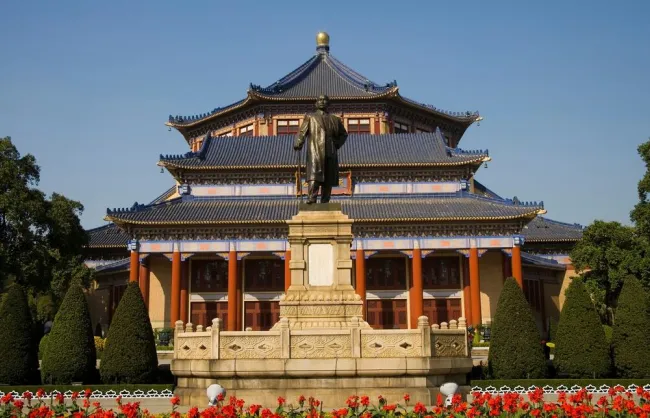
Discover Guangzhou's Lingnan heritage at Chen Clan Ancestral Hall and Shamian Island, then experience Foshan's lion dance, martial arts, pottery making and paper cutting.
Tai Chi: The Soft Overcoming the Hard
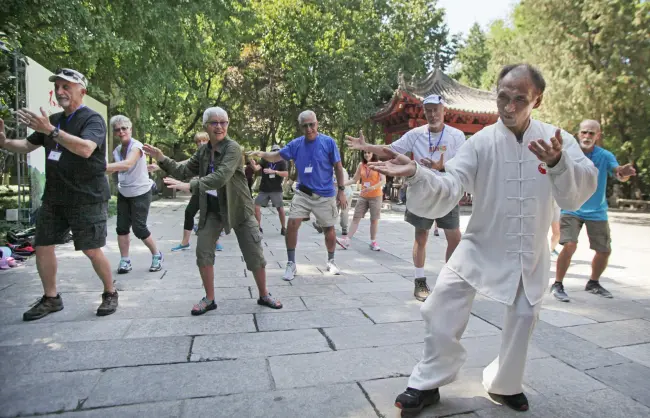
Tai Chi Chuan was invented by Chen Wangting in the early Qing period. Its basic form is derived from Qi Jiguang’s Thirty-Two Rules of Boxing. Its integration of the ancient breathing exercises from Traditional Chinese Medicine provides an internal theoretical rationale for the external moves.
Tai Chi Chuan is based on the philosophical ideas of Yin-Yang, Five Elements, Bagua, Taoism, and so on. It incorporates rich traditional Chinese culture.
Tai Chi emphasizes the cultivation of mental energy and breathing adjustment. With core moves such as five steps and eight patterns, people can achieve physical fitness and mould their temperaments through practising the moves at different speeds and balancing the tension and relaxation. Now Tai Chi has become a popular modern sport and a precious intangible cultural heritage.
Recommended tour
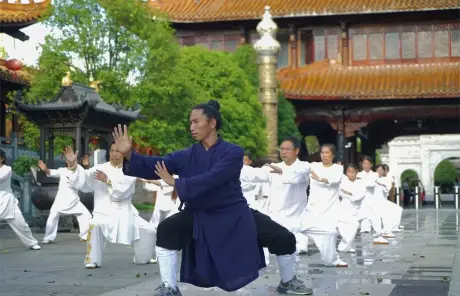
As an intangible cultural heritage of China, Tai Chi is one of the Chinese martial arts based on the principle of Yin Yang (the two opposing principles in nature, the former feminine and negative, ...
Baguazhang
Baguazhang or Zhuanzhang is a traditional Chinese Martial Arts created by Dong Haichuan in Hebei Province and later thriving in Beijing. He combined various Kung Fu styles and Yin-Yang and integrated palm techniques with circular steps and turning moves.
Replacing fists with palms and walking in a circular pattern are two key characteristics of Baguazhang. The main content includes moves like Eight Old Hands and training methods such as “turning hands in static stance”. It also features weighty weapon techniques like “rotating swords and knives”. It is another well-known intangible cultural heritage.
Xing Yi Quan
Xing Yi Quan was created by Ji Jike in Puzhou, Shanxi Province, and is now a living ICH. It has a unique characteristic of symbolic meaning. Specifically, it imitates the movements of various animals in nature and integrates traditional Chinese cultural elements, such as the Five Elements, Bagua, and Chinese Zodiac Signs.
It pursues the harmony of body and mind, and the collaborative improvement of both inner and external power. Its basic training methods include “three-body stance exercises”, “five-element fists”, and “twelve-form fists”.
Drunken Fist (Zui Quan)
Drunken Fist or Zui Quan, as the name indicates, blends drunken posture and demeanor into martial arts techniques. It is a type of pictographic martial arts from the Ming and Qing dynasties. With the coordination of eyes, hands, body, legs, and steps, it conceals “lethal” attacks within every “sloppy” move.
Drunken Fist is divided into northern and southern schools and has evolved into a modern sport and competition, retaining its status as a prominent cultural heritage.
Southern Fist (Nan Quan)
Again, as its name implies, Southern Fist is more popular in southern China (e.g., Guangdong, Fujian, etc.). Its origin can be traced back to the Tang and Song dynasties, and then it matured in the Ming and Qing. The development of Southern Fist is closely related to the geographic environment and military conflicts, as well as people’s need for self-defence.
Due to the intertwined waterways and mountain ranges, the combat space in the south is limited. As a result, Southern Fist tried to compensate for this disadvantage with flexible fist patterns, stable steps, and close-combat training.


Lesser-Known Martial Arts Styles
Name |
Origin |
Features |
Kongtong |
Kongtong Mountain, Gansu Province |
It integrates the thoughts of Taoism, Buddhism, and Confucianism. Its flexible body movements and step transitions contrast with the straight-line attack style of the mainstream Chinese Martial Arts. |
Kunlun |
controversial |
It is a branch of Taoist Martial Arts. It focuses on internal energy and the use of weapons. Its distinct techniques and theories are mostly transmitted directly from masters to their apprentices. |
Emei |
Mount Emei, Sichuan Province |
Certain branches of the Emei School, such as the Monk’s Fist, integrate techniques of borrowing force to strike force. It results in a style that balances fierce power with subtle dexterity. |
Where to Experience Chinese Kung Fu
Beijing–Watch a Kung Fu Show
The Legend of Shaolin Kung Fu was the first and only Broadway-mode stage production from 2009 to 2014 at the Red Theater in Beijing, China. It integrates various elements of traditional Chinese Martial Arts, dance, music, and acrobatics for a comprehensive artistic effect.
In the one-hour performance, the audience can witness Kung Fu styles such as Baduanjin and Tai Chi, along with skilful wielding of weapons like the nine-section whip and crescent-shaped shovel.
Although it is now a memory, you can still keep an eye on the latest notifications on the official website for similar productions.
Mount Song, Henan– Shaolin Temple
Zen Shaolin: The Musical Spectacle is Henan’s first mountain-based Buddhist Martial Arts performance. It blends Zen martial culture with natural landscapes through the authentic skills of 600 martial monks.
The performance features a wide variety of content, which includes Shaolin Kung Fu techniques, weapon-wielding, and qigong. There are highlights of children’s Kung Fu, One-Finger Zen, and thrilling Silver Spear Throat-Stabbing.
- Time: 20:00-21:15, February 24th– December 31st
- Ticket Prices: 269-1000 CNY (varies in different seating areas)
Wudang Mountain- Holy Land for Tai Chi Chuan
As the birthplace of Tai Chi Chuan and Wudang School, Wudang Mountain hosts grand Martial Arts competitions and performance events throughout the year. They would provide Kung Fu feasts for the tourists.
For example, on the 2023 Wudang Kung Fu Elite Exchange Tournament, enthusiasts of Tai Chi and Chinese Martial Arts assembled to present different forms of Tai Chi and other Fist moves, weapon-wielding such as Tai Chi Sword, fitness sports and Qigong, and other specialized Kung Fu.
Mount Emei– Sichuan Style Kung Fu
Just like Wudang Mountain, Mount Emei, where the Emei School was born, witnesses diverse Martial Arts events every year, like the recent Emei Martial Arts Heritage Conference (August) and the World Traditional Martial Arts Tournament (October).
At the Heritage Conference, for example, the representative inheritor of Emei Martial Arts led the Emei Women’s Kung Fu Troupe in their performance “Chinese Spear”. It blends traditional spear techniques with modern choreography to convey the martial arts philosophy of “combining hardness and softness, harmony and coexistence”.


Best Chinese Martial Arts Schools in China for Travelers
- Dengfeng
Dengfeng City, Henan Province, is where the Mount Song Shaolin Temple is located. Influenced by the profound Shaolin Martial Arts culture, it has a vast range of Shaolin Kung Fu schools for travelers who can learn authentic Shaolin Kung Fu in an immersive atmosphere.
For instance, the Mount Song Shaolin Martial Arts training school is one of the oldest professional Martial Arts training schools built in the 80s. Travelers can enrol as transfer students anytime in the year to study in this state-standard institution.
- Chenjiagou
It was in Chenjiagou that Chen Wangting invented Tai Chi Chuan. It is the literal “cradle of Tai Chi”, with a long history of the evolution of Chinese Martial Arts.
Chenjiagou Martial Arts Training School, for example, offers personalized lessons that cater to students aged 6-50. Travelers can enjoy quality Martial Arts study in its rich Tai Chi heritage and professional training system.
- Foshan
The influence of Wing Chun centers in Foshan, Guangdong Province, extends across the Pearl River Delta and radiates throughout China and other 176 countries and regions. By December 2024, this “City of Martial Arts” has owned 122 registered training schools and over 200 unregistered ones, with more than 3000 practitioners. Some of them are established by international Kung Fu enthusiasts.


Kungfu Movies
Chinese Kung Fu movie is an outstanding genre in the global cinema market. These movies present not only astonishing physical prowess and the aesthetics of Martial Arts, but also the chivalrous ideals, patriotic sentiments, and philosophical thought. Through the transformation of combat into narrative language, the audience can see the fluid action sequences woven with characters’ fates and dilemmas.
The movie series Wong Fei-Hung in the 90s successfully portrayed Hung Gar Kung Fu as graceful and effortless movements and established the image of a national hero who navigated the turbulent late Qing era and the clash between East and West.
Another example is Crouching Tiger, Hidden Dragon in 2000. It elevated Martial Arts to a world-class artistic level. The action design, such as the lightness and poetic grace of a bamboo forest fight, embodied the expressive beauty of Chinese Kung Fu.
Famous Chinese Kung Fu Actors and Masters
Bruce Lee
Bruce Lee is Hollywood’s first Chinese leading actor and the first global promoter of Chinese Kung Fu. This Kung Fu star, whose ancestral home is in Foshan, the “City of Martial Arts”, studied under the Wing Chun master Yip Man.
In 1973, Lee’s Hollywood movie Enter the Dragon achieved massive success and ignited a Kung Fu craze in the United States, and propelled Chinese Kung Fu onto the global stage.
Jackie Chan
Jackie Chan is another crucial figure who endeavors to promote Chinese Kung Fu to the world. Jackie Chan’s daring stunts, humorous style, and appealing acting have won him worldwide acclaim in the film industry, especially for Kung Fu movies.
With the knowledge and experiences of various martial arts, including Northern and Southern Fists, Karate, and Aikido, Chan transforms Kung Fu into a cultural language that transcends national borders and cultural barriers through fusion, inclusivity, and innovation.
Jet Li
In 1982, the movie Shaolin Temple, starring Jet Li, achieved a box office phenomenon of 160 million yuan with a ticket price of one fen. The movie not only cemented Li’s fame as an actor but also associated him with Chinese Kung Fu movies.
Li has also made efforts to bring Chinese Kung Fu to a wider audience by staging numerous international Kung Fu performance tours and founding Martial Arts schools.
Donnie Yen
Donnie Yen is an artist who combines Chinese Martial Arts with modern cinema. To prepare for the role of Yip Man in the movie series, Yen spent nine months learning Wing Chun. Yen not only created an impressive character but also showed the global audience the charm of Chinese Kung Fu.
Explore the Essence of Chinese Culture with China Xian Tour
Chinese Martial Arts/ Kung Fu is an art of physical power, as well as an invaluable cultural treasure and heritage. It does more than simply build strength and keep fit, but cultivates peace in mind and soul.
Whether you are keen to experience a Chinese Kung Fu event on Wudang or Emei Mountain, or interested in getting a few months’ professional Martial Arts training, don’t hesitate to have an immersive Kung Fu tour with China Xian Tour!
Our friendly and professional consultation and guide teams are waiting to offer you a wonderful personalized tour, with more stories about the history, important figures, and meaningful places of Chinese Kung Fu. Join us today to walk the paths trodden by Chinese Kung Fu masters and feel the essence of Chinese culture.