

The story of Hanfu is a history of Chinese clothing culture spanning over five thousand years. Its evolution carries spiritual core and technical aesthetics of Chinese civilization. It can be broadly classified into the stage of establishment in the Pre-Qin dynasty, customization in the Han dynasty, integration in the Sui and Tang dynasties, keypoint in the Yuan and Ming dynasties, and the revitalization in modern times.
If you’re a fan of Chinese culture and are especially curious about traditional Chinese clothing, this article will be your ultimate guide. Follow our complete guide to Chinese Hanfu, and you’ll discover all things about this traditional Chinese attire, including its history and development, main Hanfu types in different dynasties, popular Hanfu patterns, accessories, and frequently asked questions about the clothing.
Content Preview
- What is Hanfu?
- Types of Hanfu by Dynasty
- Styles and Components of Hanfu
- Hanfu Aesthetics: Design, Patterns, and Accessories
- Where to Buy Hanfu
- Hanfu vs Qipao
- FAQs about Hanfu
- Enjoy a Hanfu Experience Tour with Us
What is Hanfu?
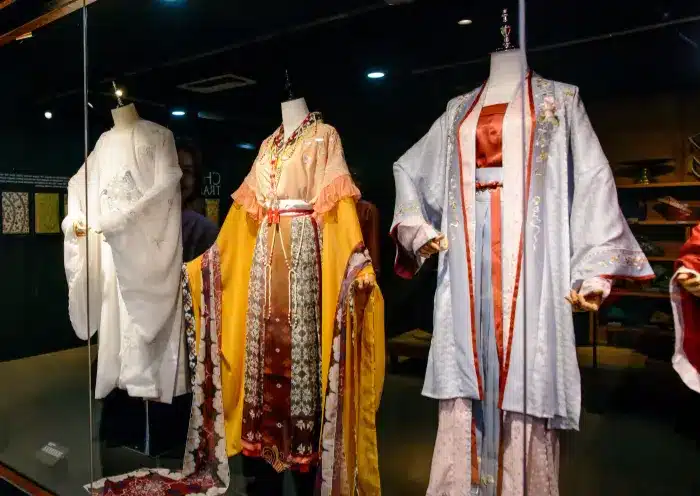
Chinese Hanfu refers to the traditional apparel of Han ethnic group. It is a symbol of Chinese culture, playing a big role in traditional Chinese clothing and sartorial history. As a carrier of Chinese aesthetics, it acts as the inheritor of more than 30 intangible cultural heritages industrial arts.
Originating over four thousand years ago, Hanfu was once a daily essential in ancient times and evolved through various dynasties in Chinese history. The defining feature of Hanfu is its “Jiaoling Youren” (交领右衽), a ‘Y’-shaped collar where the left lapel crosses over the right, secured with long ties rather than buttons. A complete Hanfu ensemble is usually adorned with specific headwear, shoes, hairstyles, auspicious embroidery, and more.
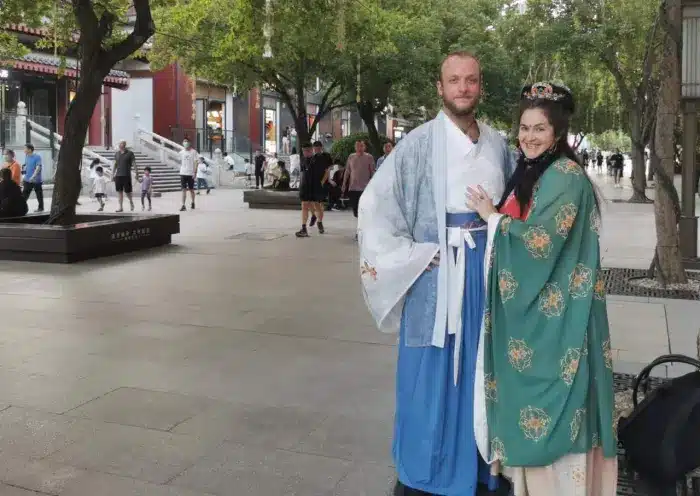
With the wider international influence, such countries as Japan, the North Korea and Vietnam learn extraordinary elements from Hanfu. Driven by social media, Hanfu dress now has become one of marks of Chinese traditional culture.
History of Hanfu through Chinese Dynasties
Chinese Hanfu clothing can stretch back to the reign of Yellow Emperor and extend to the Ming and Qing dynasties. After thousands of years of evolution and development, it has developed into a distinctive clothing system.
In the Han dynasty, Chinese Hanfu centers on Shenyi and establishes the firstly hierarchy of official uniform of China.
With a massive influx of ethnic minorities and foreigners from western regions and the Central Asia, Hanfu clothing of the Tang dynasty is deeply affected and known for novel styles, gorgeous embroidery and bright colors. Hanfu clothing integrates Han-nomadic culture and considers practicality and artistry.
Later, Hanfu puts emphasis on elegant style and low-saturated ink color in the Song dynasty. It paves the way for the transition of Chinese clothing from complication to simplicity.
In the Yuan dynasty, Chinese Hanfu is profoundly affected by the Mongol ethnic minority. The Ming and Qing dynasties make further efforts to improve styles and colors. However, it has been largely replaced by the clothing of Man ethnic group in the Qing dynasty.
When Was the Hanfu Worn Historically?
The archaeological results discover that Hanfu can be dated back to the Xia, Shang and Zhou dynasties. During that time, the upper garment and lower skirt system was basically established. What we wear today is the outcomes produced by the development of several dynasties.
Features of Hanfu
Chinese Hanfu, the intangible cultural matrix of living inheritance, is distinguished by structural principles, semiotic system and aesthetic DNA.
Hanfu is characterized by its distinctive form and rich cultural meanings. Iconic features of traditional Hanfu include an intersecting collar with a right lapel overlapping the left, wide sleeves, ties instead of buttons, and central seams.
Unlike Western clothing, the tailoring of Hanfu prioritizes flat cutting. Instead of an emphasis on conforming to the body’s curves, Hanfu’s design typically creates a loose and natural wearing effect achieved through ingenious cutting techniques and structural design.
The clothing is also typically worn in layers, often consisting of three main parts, which are Neiyi (innermost layer), Zhongyi (a middle layer), and Waiyi (the outermost garment).
Characteristic |
Description |
Why It’s Special |
Jiaoling Youren (交领右衽) |
The collar crosses to form a “Y” shape, with the left lapel overlapping the right (right-folding). |
Embodies the traditional etiquette of “revering the right” |
Ties, No Buttons (系带无扣) |
Garments are fastened with fabric ties (like gift wrapping ribbons) instead of buttons. |
Creates flowing lines, allowing ribbons to sway elegantly with movement, enhancing its graceful appearance. |
Loose, Wide Sleeves (宽袖洒脱) |
Sleeves are broad and expansive |
Symbolizes inclusivity and freedom; hands moving within them evoke the graceful unfurling of clouds. |
In layers |
Neiyi (亵衣): The innermost layer, functioning as an undergarment. Zhongyi (中衣): A middle layer, similar to an inner robe. Waiyi (外衣): The outermost garment. |
Allows for adaptation to various climates and adherence to specific etiquette requirements. |
Types of Hanfu by Dynasty
The evolution of Hanfu types has witnessed the cultural core of dynasties. There is a brief table displaying innovation patterns and cultural symbols in the corresponding dynasties.
Dynasty |
Innovative Pattern |
Cultural Symbol |
Qin and Han |
Shenyi |
Seek for immortality by the pattern of flowing clouds |
Tang |
Flat collar and half-arm shawl |
Show social openness by the low-cut dress with exposed neckline |
Song |
Vertical cutting |
Low-saturated ink color |
Ming |
Buttons and stand-up collar |
Highlight the social grade via the visual design |
Origin of Hanfu – in Xia and Shang Periods, Zhou Dynasty
Chinese Hanfu originates from the reform of textile technology in the Neolithic Age. After the development of Xia and Shang Periods, the complete system centering on etiquette in the Zhou Dynasty takes shape. Hanfu is therefore developed into philosophical and ethical values of Chinese civilization.
Hanfu in Qin and Han Dynasties (221 BC-AD 220)
The Qin and Han dynasties have various Hanfu clothes to offer, but it mainly consists of Shenyi (ceremonial deep robe, 深衣) and Paofu (robed garment, 袍服).
The Shenyi, also known as the one-piece robe with crossed collar, emphasizes the beauty of simplicity. It is characterized by geometric cut, wide sleeve and large lower hem. Colors are deliberately limited, such as red for nobility, black for scholars. The Paofu highlights elegance in the style of spiral-wrapped design.
Tang Dynasty Hanfu (618-907)
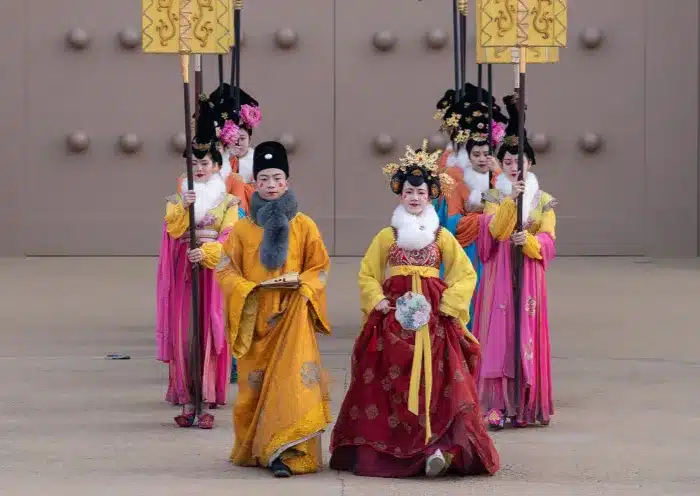
Against the background of multicultural integration, Hanfu of the Tang dynasty features inclusiveness, openness and boldness. The basic combination of high-waisted skirt and short jacket is highly popular among women. With the cultural infiltration of nomadic people, the color scheme prefers pink, gold, blue, and red and other bright colors. Women from the royal family favor the low-necked design to show their neck and breasts. This is a mark of social openness.
Song Dynasty Hanfu (960-1279)
Influenced by the neo-confucianism, Chinese Hanfu dress in the Song dynasty highly praises simple and practical design. The typical form is Beizi (long outer coat, 褙子), tube top and skirt. Different from previous dynasties, lightweight linen amasses popularity among the common people.
Ming Dynasty Hanfu (1368-1644)
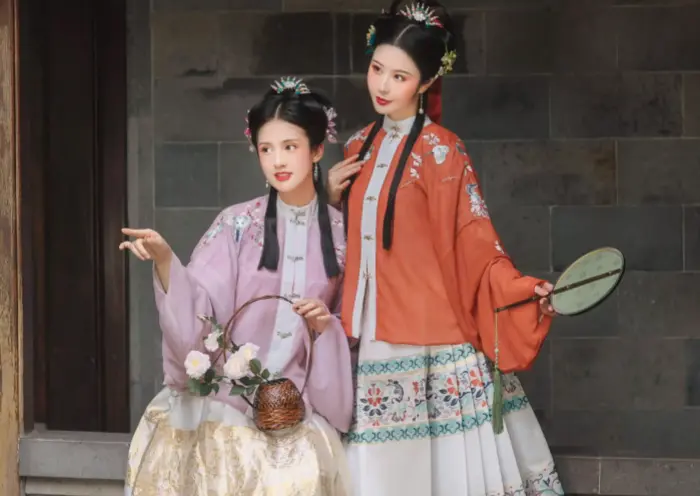
In the Ming dynasty, Chinese Hanfu dress inherited the styles of the Tang and Song dynasty and developed its own features. Women’s Hanfu consists largely of Aoqun (wrap-front jacket and pleated wrap skirt, 袄裙), (double-breasted waistcoat, 比甲) and Xiapei (mbroidered vest, 霞帔). It should be noted that the weaving skills at that time was extraordinary, like the Kingfisher feather art.
Hanfu in the Qing Dynasty (1616-1644)
When the Qing dynasty was in power, Hanfu was gradually influenced by the aesthetic idea of Man ethnic group. The traditional elements of Hanfu of males disappeared, including crossed collars, girdle and knot. Women’s Hanfu absorbed the features of Man ethnic group’ clothes, such as cloud shoulder. Hanfu dress in the Qing dynasty is the only one integrating designs of minor ethnic group. When don’t you have a try?
Modern Hanfu – Hanfu in Modern Times (Since 1917)
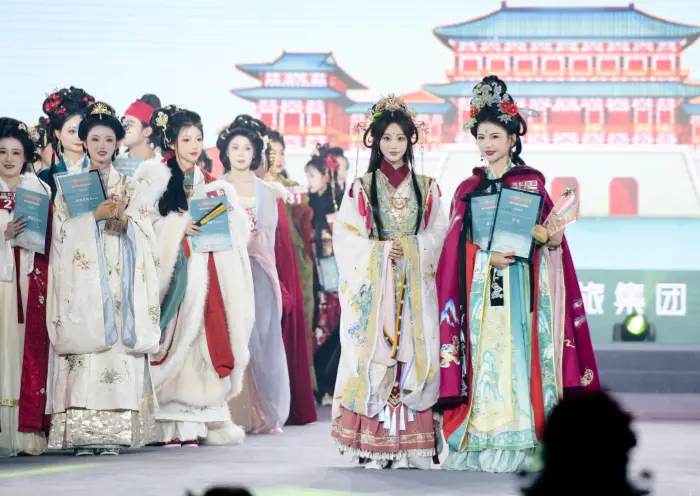
Modern Hanfu refers to a creative clothing system that integrates design aesthetics and life needs on the basis of traditional Chinese clothing. It, as the aesthetics of new Chinese life, acts as not only casual clothes but also wedding Hanfu.
Modern Hanfu amasses much popularity among Chinese people who are devoted to Chinese traditions and foreign people who are interested in Chinese traditional culture and history. If you like, you can wear Hanfu dress in daily life, festival celebrations and cultural tourism.
Styles and Components of Hanfu
Hanfu dress originates from tradition, but it is also provided with similar components of modern apparel, including shoes, hairstyle, female dress, pattern, robe, skirt, necklace, hair accessories, pants, hat, jacket, boots and earrings.
In ancient China, styles and components of Han are important marks to show identify, social status, privilege and official post. With the social development, these features now have become distinctive decorations of Hanfu.
Women’s Hanfu
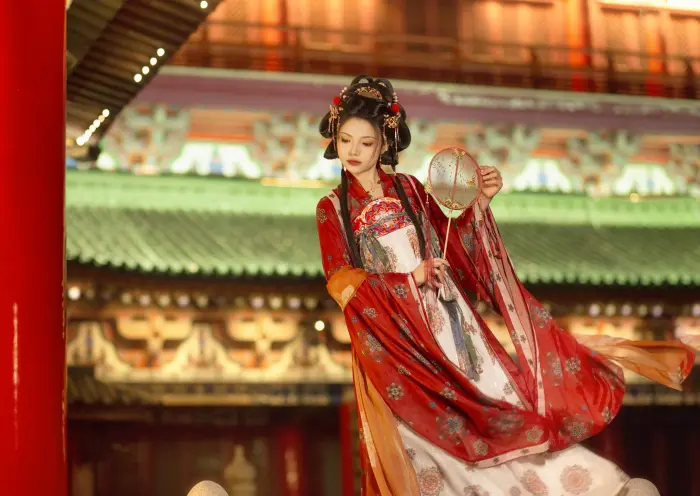
Women’s Hanfu mainly contains Shenyi, Pofu and Ruqun (cross-collar jacket with attached skirt, 襦裙). It places a particular emphasis embroidery designs, like cranes, phoenix, bamboo and others. Today we can see the traditional white Chinese Hanfu with black bamboo embroidery design and crane embroidery design. In addition to that, the color scheme tends to show social status. Ruqun is the most popular because of numerous styles and colors.
Different from modern apparel, Hanfu is adept at discovering the beauty of all body figures. If you have a plump figure, don’t miss the traditional clothes of Tang dynasty. Or, you can get up as a historical figure or game character, like Nuwa Hanfu.
Men’s Hanfu
The popularity of Hanfu dress is not limited to women. It also strongly appeals to many men, such as Feiyu robe (Mandarin Square with winged fish pattern). If you have read Chinese novels of martial arts, you may have a dream of hero. Hanfu is absolutely the best option. In addition to that, here are many options for you.
Hanfu for males mainly encompasses Shenyi and Ruqun. Shenyi spotlights cosmic harmony by means of the upper robe and the lower skirt. Ruqun accounted for 73% of daily wear in Tang dynasty. The salient features of men’s Hanfu are plain color, plain patterns, belts and Daxiushan (大袖衫, broad-sleeved robe).

Hanfu Aesthetics: Design, Patterns, and Accessories
The essence of Hanfu aesthetics rests with design, patterns and accessories. Abiding by the oriental philosophy, Hanfu turns out to be a miniature of the structure that heaven and man are united. It transforms epic civilization into diversified patterns. Accessories are additionally used as cultural symbols.
Popular Hanfu Patterns and Symbolic Meanings
There is a wide range of popular Hanfu patterns in Chinese history, such as traditional embroidery, crane and bamboo, etc. It can be mainly divided into three categories and have different symbolic meanings.
- Plants and flowers: The pattern of flowing clouds in Qin and Han dynasties originates from the Taoism and implies immortality. The pattern of composite flowers in the Sui and Tang dynasty is based on peony/lotus and Buddhist art, and symbolizes wealth and completeness. The pattern of entangled branches in the Song and Ming dynasties features vines and stands for the continuity of life and the prosperity of family.
- Lucky birds and auspicious beasts: Examples include traditional white Chinese Hanfu with yellow phoenix embroidery design. The pattern of phoenix that was admired through the ages symbolizes the harmony of Yin and Yang. The pattern of loong and phoenix that is exclusive to the royal family spotlights the reign and the divine order. The pattern of concentric pearl roundels in the Tang dynasty mirrors the Silk Road civilization.
- Geometric shapes: The pattern of twelve universal signs is specially used for the imperial robe and represents the emperor. The pattern of interlocked double-rhombus in the Song and Ming dynasties symbolizes the concerted efforts to expel evils and get fortune.
Accessories That Complete the Look
Hanfu is definitely a leading role, but the cherry top is well-designed accessories. You will have an authentic Hanfu design when you can wear hair accessories, shoes, necklace, hat, earrings and boots of Hanfu accordingly.
Hanfu Hairstyles and Makeup
Beyond the garment itself, Hanfu makeup and hairstyle will enhance your overall appearance. Especially if you are having a Hanfu photoshoot experience, it is highly recommended to devote some time to these elements.
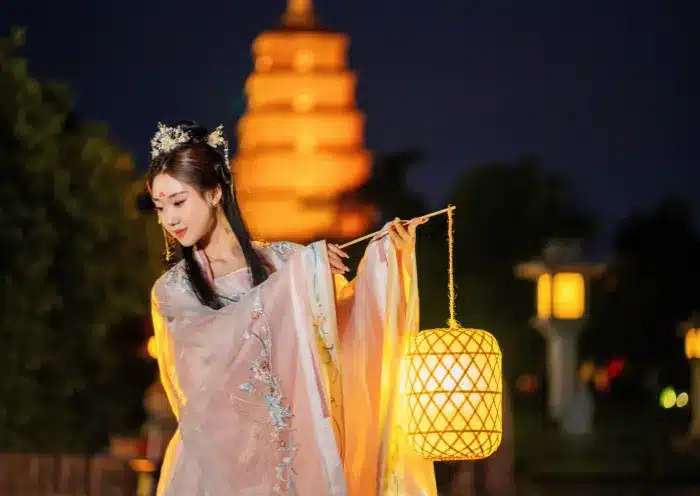
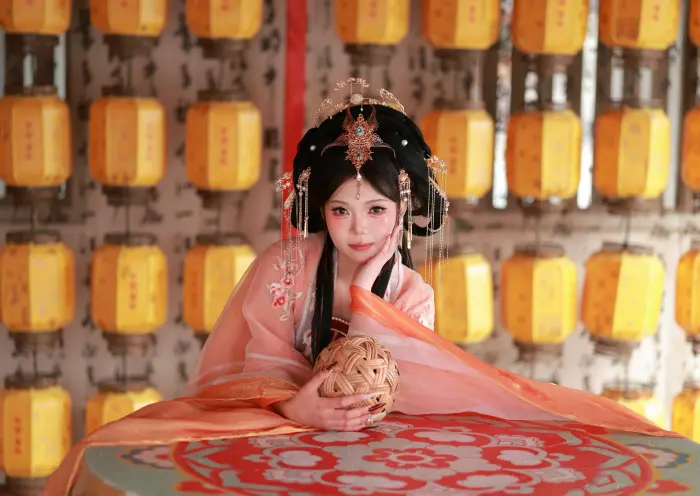
If you are new to Hanfu or visiting China for the first time, selecting a studio will offer you a one-stop service, including Hanfu rental, makeup application, intricate hairstyling, and photography. You can easily find such studios in most ancient cities in China, like Xi’an, Luoyang, Hangzhou, etc.
Where to Buy Hanfu
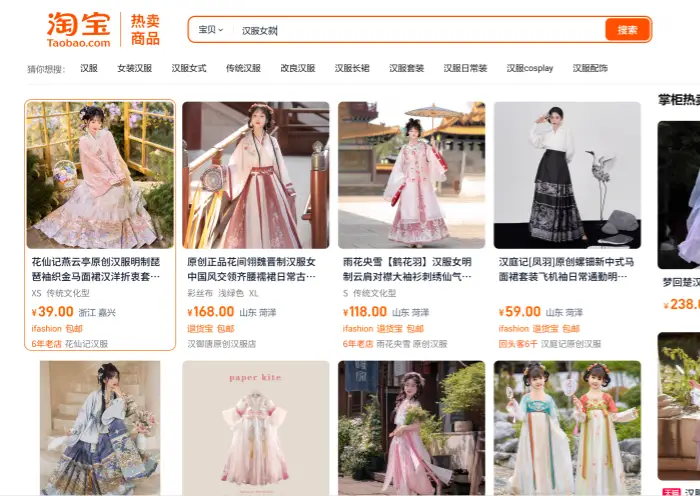
If you are travelling to China, online e-commerce platform is the first choice. You can browse almost all types of traditional Chinese Hanfu and get your parcel in hotels. Or, you can visit physical stores, especially in scenic spots. You can wear Hanfu dress and take pictures. Of course, if you have a stricter requirement, the high-end customization is also available.
If you don’t plan a China tour, you can buy Chinese Hanfu on cross-border e-commerce platforms. You are also likely to find Chinese Hanfu clothing in Chinese cultural exhibitions abroad or shops around well-known museums that sell derivatives.
Hanfu vs Qipao
Hanfu and Qipao (cheongsam, 旗袍) are two popular systems of Chinese dress culture, but they are essentially different in attribute, historical origin, social sign and philosophical foundation. The comparison is as follows:
Hanfu |
Qipao |
|
Attribute |
Runs from the Pre-Qin dynasty to the Ming dynasty. |
The improved version of fashionable dress in the Republic of China (1912-1949) |
Historical Origin |
Date back to the Yellow Emperor |
Integration of Qizhuang (Man ethnic group’s robe with side slits, 满族旗装) and the western dress design in the 1920s-1930s |
Social Sign |
The identity symbol in the Ming and Qing dynasties |
The spirit of independence of new women in the 20th century. |
Philosophical Foundation |
The unity of heaven and man |
The ideological trend of women’s liberation |
FAQs about Hanfu
Can I Wear Hanfu Casually?
There is no doubt that Chinese Hanfu clothing is suitable for daily dressing. But, you need to follow the critical dress code. In modern society, wearing the traditional Chinese Hanfu reflects cultural revitalization. It is exactly the way of cultural heritage by upholding traditional spirit and accommodating modern scenarios. You are advised to follow basic specifications to show your respect for Chinese traditions.
What is the Best Hanfu for Summer or Winter?
Although the traditional Chinese clothing provides more than one options, here are recommendations to safeguard your comfort and beauty.
In summer, Hanfu styles of the Song dynasty are strongly recommended because of lightness and breathability. Beizi and Baidie skirt (parallel-folded skirt with continuous pleats, 百迭裙) are designed in the style of straight-collar center-front opening and the gusseted side slit. The design of Feijixiu Banbi (half-sleeved Hanfu jacket with winged sleeves, 飞机袖半臂) can release your arms from high temperature environment. Also, the imperial U-collar jacket of the Tang dynasty is a nice choice. The U-shaped collar will give you a strong feeling of cool.
When winter is coming, Chinese Hanfu of the Ming dynasty is recommended because of warm keeping and windproof design. Aoqun and Mamianqun (horse-face pleated skirt,马面裙) can keep you beautiful and warm at the same time. The round-neck robe developed from the Tang dynasty is a nice choice. It is suitable for women and men. You can add more clothes as needed.
Where are the Best Photo Backdrops of Hanfu Dress?
To find the best photo backdrop of Hanfu dress throughout China, you can make a choice based on personal preference.
If you are interested in Chinese history, you can visit the ancient capitals Xian, Luoyang, and Hangzhou. The traditional Chinese clothing together with the rich historical architecture and heritage in these cities seems to transport you back through several dynasties.
If you take a fancy to natural scenery, you will have more options.
In spring, the cherry blossom whirling the whole sky in the West Lake of Hangzhou city will be a nice photo spot.
In summer, the patches of shaded greenery in Qinglong Gorge of Beijing will bring you to the world of martial arts.
In autumn, Chongzhou of Chengdu city will offer courtyards in the Ming and Qing dynasties that steal the styles of A Dream of Red Mansions.
In winter, snow mounds and deserts in Dunhuang city of Gansu province will be a better background for your Chinese Hanfu portrait.
Enjoy a Hanfu Experience Tour with Us
With over 15 years of experience in tailoring China tours, we have assisted numerous visitors who are drawn to Chinese traditional culture and clothing. We know exactly how to align your interests with rich and in-depth travel experiences and are always dedicated to crafting memorable journeys. If you are ready to explore, get some inspiration from the following tours: