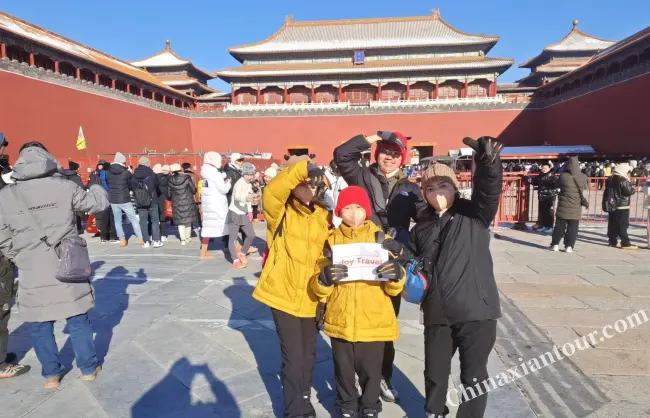
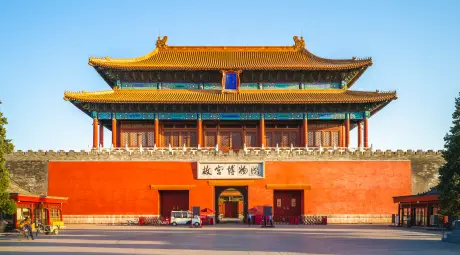

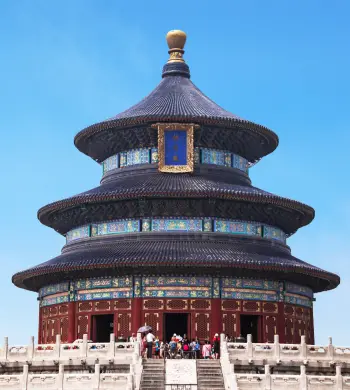

As the most beloved color in China, red symbolizes happiness, celebration, and good fortune in Chinese culture. It is ubiquitous in many important celebrations, occasions, and venues, like the red wall of the Forbidden City, the red decorations during Chinese New Year, weddings. That’s why people instinctively associate it with China Red when think or the vibrant red color.
In ancient China, red was often linked to fire and the sun. Because the fiery glow of a campfire could ward off wild beasts, and the rising red sun could sweep away shadows, people believed red, more than just a color, could attract good fortune and serve as a powerful symbol.
If you take a China tour, you can clearly feel the significant influence of red. Read this article for a more in-depth understanding of red in Chinese culture and traditions, and its symbolism and use in daily life.
Content Preview
- The Meaning of Red in Chinese Culture
- Red in Chinese Festivals and Celebrations
- Where You Can See “China Red” in Real Life
- China Cultural Tour with Us
The Meaning of Red in Chinese Culture
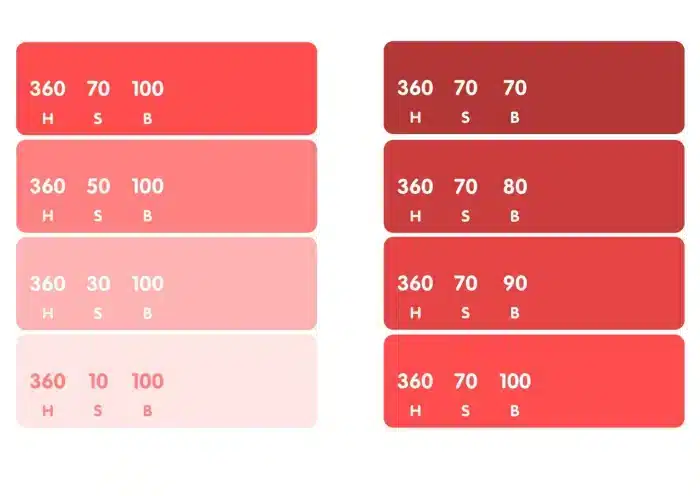
In ancient China, red was not a single color but a joint name. Distinguished by tone and depth, there are variations of red, including jiàng (绛), chì (赤), zhū (朱), dān (丹), and hóng (红).
The dominated status of Red in Chinese civilization has spanned millennia. Its root can be traced back to ancient times when people usually connect it with life, survival and fire.
Then during the Warring States period, red was widely used as the official color, symbolizing legitimacy and imperial power. It continued the imperial status in the subsequent Han, Tang, Song, and Ming dynasties.
In folk traditions, people assign red rich cultural meanings. Served as the color of joy and celebrations, it is the dominate hue for traditional festivals and weddings. Furthermore, the similar Chinese characters of red, such as chì (赤), and dān (丹), are often seen in phrases used to describe unwavering loyalty and sincerity.
When it comes to the modern China, red also serves as a symbol of revolution.

Historical Roots of “China Red”
Due to the independence on fire and the sun, Chinese people worship red. Fire can keep out the cold and cook food. The sunrise and sunset take on a red look. Red thus becomes the visual symbol of warmth and vitality. This is none other than the historical root of China red.
Red as a Symbol of Luck and Prosperity
Chinese culture shows that red refers to luck and prosperity. The five elements theory has red correspond to fire, indicating the energy of the sun and the impetus growing all things.
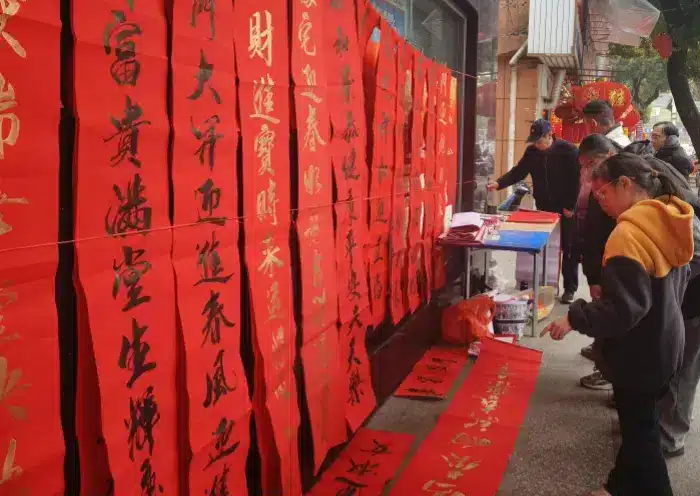
This is why Chinese people often use red in daily life, such as putting up Spring Festival couplets, hanging red lanterns, applying cinnabar to door header, making red envelopes and so on. They are eager to infuse new energy into life via red.
Red vs. White in Chinese Culture
In accordance with the five elements theory, red represents fire and summer. It symbolizes vitality and brightness, and drives out evil spirits. On the contrary, white represents metal and autumn. It stands for grief, purity and loneliness. Red and white are culturally contradictory because the relationship of fire and metal is restriction.
Red is typically the sign of festivals and celebrations. Chinese people will have red to pray for luck and happiness, such as lanterns and envelopes.
White is often seen during the Hungry Ghost Festival on the 15th day of the seventh lunar month, like white lanterns and white mourning dress. It is to express condolences to the deceased.
Red in Chinese Festivals and Celebrations
The Spring Festival is grand ceremony of red. Legend has it that the monster Nian will make an attack on villagers on the Chinese New Year’s eve. So, people will put up red couplets, hand red lanterns and set off firecrackers to drive off it. In addition to that, people will distribute red envelopes, paste red paper-cut for window decoration, wear red clothes to pray for good luck.
Red is also an indispensable element of celebrations, especially Chinese weeding. Red wedding dress, red veil and red candle are attached to auspicious meaning. The wedding room will be decorated with red festoons so as to create a joyous atmosphere.
Chinese New Year Red: Decorations
Couplets, lanterns, window decorations and firecrackers are common decorations of China red.
Spring Festival couplets and Fu character can avoid disasters. Red lanterns resemble artificial sun, which can bring positive life-energy in winter. Hanging red lanterns is in pairs to strike a balance of yin and yang. Red window decorations can create a propitious atmosphere. Firecrackers can expel devils.

Chinese Red Envelope
Red envelope has an auspicious role to play in many occasions.
In the weeding party, guests will give red envelopes to the newly married couple to express blessings. When parents give a dinner to celebrate the completion of their baby’s first month of life, guests will send red envelopes to show wishes. To celebrate the birthday of seniors, the younger generation will give red envelopes.
Nowadays many enterprises will distribute welfare to employees during legal holidays in the form of red envelopes.
Red in Chinese Weddings: Joy and Tradition
Chinese ancients believe that red is the zenith of yang energy. It can frighten devils and protect the newly married couple from bad luck. This is why red is widely used in Chinese weddings.
Red wedding dress is dominated by fire element to maintain harmonious relationship between husband and wife. Red veil and candles can ward off evils. Red (红, hóng) phonetically sounds like great (鸿, hóng) and means good fortune. The flaming red also symbolizes a prosperous life.
The Role of Red Lanterns in Festivities
Red lanterns have a big role to play in festivities.
It looks like the sun when they light up at night. On the Chinese New Year’s Eve, hanging red lanterns at the door can drive out devils. The circular structure of red lanterns symbolizes the harmony of yin and yang. They are strung out on the door during the Lantern Festival to pray for blessings. Red lanterns of Loong and phoenix on the wedding night mark the continuity of family bloodline.

Where You Can See “China Red” in Real Life
China red has become beautiful scenery in real life. Wherever you travel to China, the eye-catching red will always surprise you.
Streetlights will have red lanterns fly in commercial blocks and national flags are strung out along the streets during the festivals, especially the National Day.
Many landmark buildings are decorated with red, such as China Art Museum in Shanghai. Its façade is painted with red of seven types to explain China red.
Traditional buildings, like the Imperial Palace, are case in point of China red.
If you are invited to participate in Chinese wedding or the Spring Festival, you will find more decorations of China red.
Chinese National Flag
The national flag of China is the five-starred red flag. Red directly indicates the new democratic revolution led by the Community Party of China. It implies the sacrifice of numerous revolutionary martyrs who bled for China.
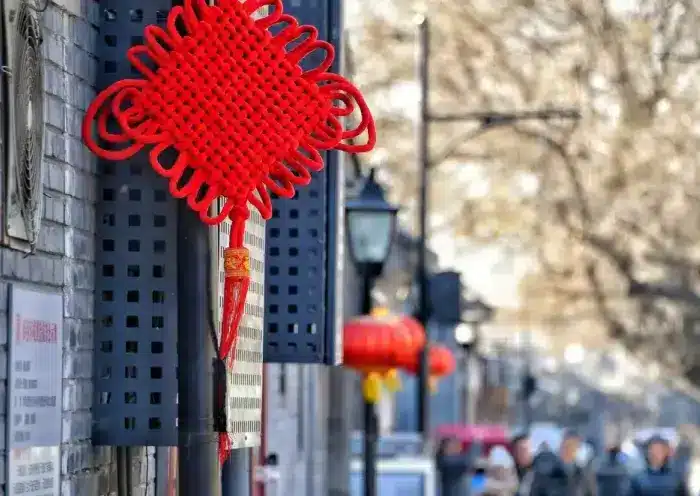
Red Chinese Knot
Chinese knot is an ornament woven from red silk thread. This is a closed structure that is completed with a single thread. It means family reunion and intimacy. Chinese knots in pairs are often used for Chinese weddings because it indicates eternal love.
Besides, knot (结, jié) and auspiciousness (吉, jí) share the similar pronunciation, so it means good lucky and happiness. People often hang it on the door header to pray for safety.
Red Walls of the Forbidden City and Tiananmen
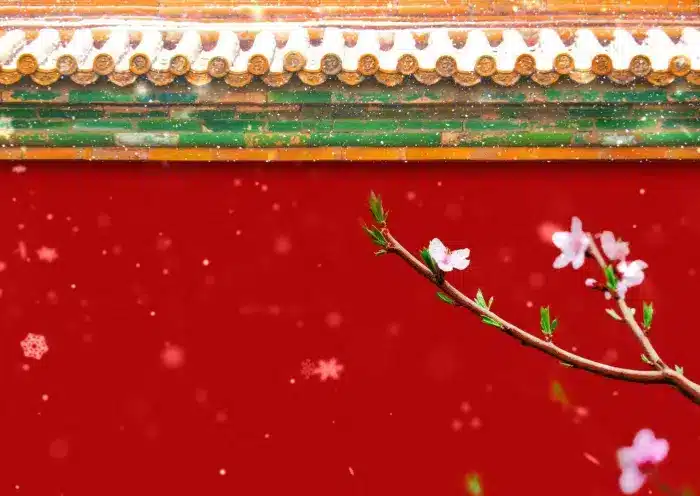
Red has long been the symbol of auspiciousness, solemnity and vitality since ancient times. The royal palaces have been painted with red since the Zhou dynasty. This tradition was kept alive until the Forbidden City in the Qing dynasty to show royal dignity and prestige.
The five elements theory shows that fire (red) generates earth (yellow). The red walls of Forbidden City in Beijing are believed to safeguard the foundation of imperial power. The red walls of Tiananmen turn out to be the national symbol and keep the revolutionary spirit going.
In terms of aesthetics and function, red paint can protect wooden buildings against erosion.
Chinese Temples, Red Gates & Lanterns
Red is a visual expression of “wisdom flame” in Tibetan Buddhism. It means a pious spirit and perseverance of followers. Besides, red walls and yellow tiles comply with the five elements theory. It is convinced that Buddhism can keep imperial power stable for good. This is why Chinese temples are mostly painted with red to highlight dignity and privilege.
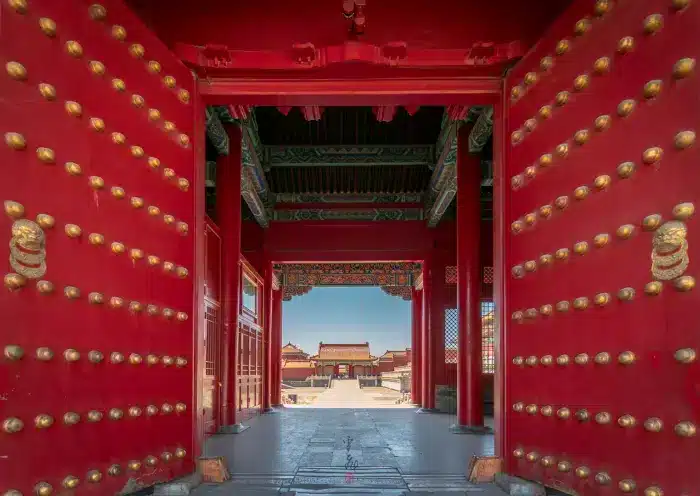
Red gate was a courteous reception rewarded by the emperor in the Han dynasty. It later became the emblem of power. For instance, the Imperial Palace has red gate to emphasize supreme imperial power. The Potala Palace has red gate to show the authority of religion.
Red lanterns are developed into various types, such as palace lantern, the revolving heron lamp and the spindle-shaped lamp. It is welcomed by merchants because it can bring good lucky and pool wealth.
Chinese Red Lacquerware and Handicrafts
Chinese red lacquerware is an incredible art. In The Forbidden City, lacquerware is based on cinnabar and inked with black paint to show the aesthetic judgment of scholars. Yi ethnic minority favors the color scheme of red, yellow and black for their traditional lacquerwares. Red is passion. Yellow is a bumper harvest. Black is the origin of all things. Zang ethnic minority prefers red lacquerwares with gilding, which is a perfect match of Thangka.
Red paper-cut, an intangible cultural heritage, amasses much popularity and is widely used for weddings and festivals. In north China, paper-cut tends to be concise and unconstrained. If you travel to south China, you will find sophisticated and vivid styles.
Red Clothing
Red clothing is particularly popular in Chinese weddings. To express blessings, red wedding dress is often embroidered with gold thread and patterns of Loong, phoenix and peony, etc. If you have not yet held a wedding ceremony, red Hanfu wedding dress is worth a try.
What should be noted is red clothing of Miao ethnic group. It mainly consists of red and black. They respectively mean enthusiasm and origin. Although it is not used for wedding dress, it is a unique aesthetics of ethnic group.
China Cultural Tour with Us
If you are looking for a China tour with in-depth experience of profound Chinese culture, traveling with a reliable travel agency, like China Xian Tour, will be a nice choice for most international visitors. More than sightseeing, a guided tour will bring local culture and history to life through knowledgeable guides’ engaging storytelling and insightful explanations. All the logistics, such as accommodation, ticket booking, and transportation, will all be well arranged. You just need to prepare your curious questions and enjoy a truly informative experience.