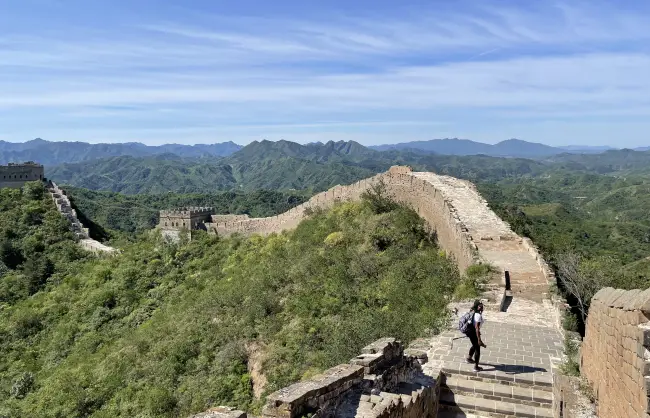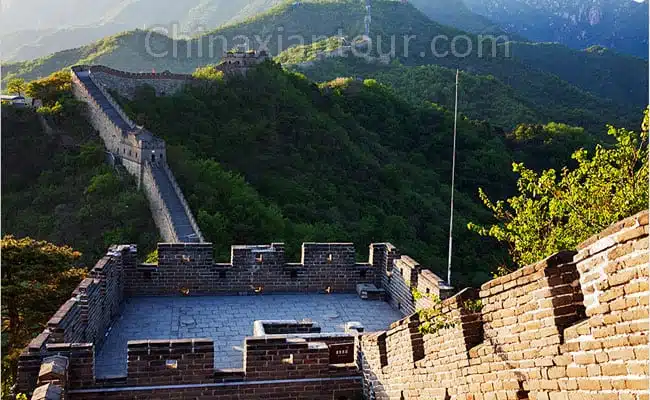


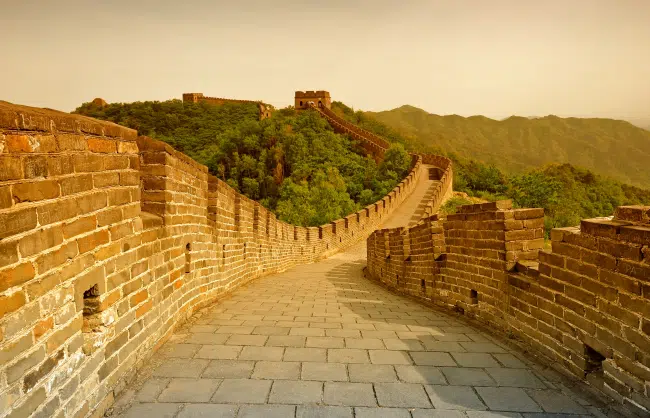
The Great Wall of China is a world-famous icon that attracts millions of visitors to travel to Beijing every year. With a total length of 13,000 miles, it was first constructed over 2,000 years ago. Its construction continued up till Ming Dynasty, when the most significant parts of the Great Wall we know today were built.
The primary purpose of the Great Wall of China was to defend the civilization against nomadic invasions from the north. It served as a protective barrier and provided strategic advantages for defense. So how was the Great Wall of China built? This article will explore the construction materials of the Great Wall of China, methods, and the workers involved in the building of this architectural wonder.
Content Preview
- Materials of the Great Wall of China
- Construction Methods Used for Building the Great Wall
- Technological and Engineering Detail
- Who were the Workers that Built the Great Wall?
- Challenges Faced When Building the Great Wall
- FAQs about the Construction of the Great Wall
- Plan Your Great Wall Tour with China Xian Tour
Materials of the Great Wall of China
Rammed Earth and Wood
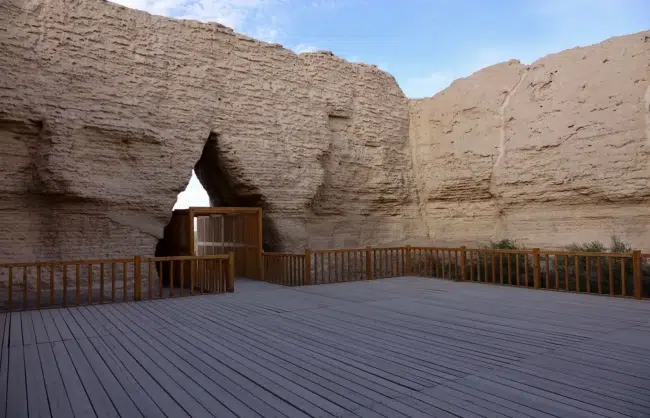
Because of a lack of technology, before Sui Dynasty (581-618), the main building material of the Great Wall of China was rammed earth. It’s a a technique where a mixture of soil, clay, sand, and gravel is compacted. It was cheap and sturdy, especially in areas with limited resources of bricks or stones. However, rammed earth wasn’t always strong enough against rain and wind.
Wood was also a commonly used material of the Great Wall of China. It was mainly used for building the supporting structures, gates, and watchtowers. Different techniques were involved in the constructions in different regions. For example, in the dry climate of Gansu, the section of Jiayuguan Pass was covered in yellow clay for protection.
Bricks and Stone
As technology advanced in Tang and Song Dynasties, brickmaking became much easier. However, bricks were still quite expensive to produce and distribute at the time. It was not until Ming Dynasty when bricks became the primary materials of the Great Wall of China.
Bricks were much more durable and easier to work with than rammed earth. Their rectangular shape was easy for stacking and interlocking, making the structure of the wall much steadier. In Ming Dynasty, the structures of the Great Wall of China become more elaborate with patterns and doorways. The size and weight of bricks made constructions faster.
Bricks and stones were often constructed with other materials to make even stronger. Other Great Wall of China materials include lime mortar, tiles, and even sticky rice. You can see on a Beijing tour that part of the Badaling Great Wall is made of huge stones with lime mortar and sticky rice in its crevices to reinforce the wall.
√ Recommended Great Wall of China tours from Beijing:
- Mutianyu Great Wall Day Tour in Beijing
- 4 Days Beijing Small Group Tour with Jinshanling Great Wall
- 2 Days Beijing Stopover Tour: Great Wall+Forbidden City
- 2 Days Wild Great Wall Trekking & Camping Adventure
Construction Methods Used for Building the Great Wall
Foundation Construction
Before building the wall itself, the first thing to do was to establish a strong foundation. Workers dug trenches, lay foundations made of stones and bricks, which would provide stability for the taller structures.
Transportation of Materials
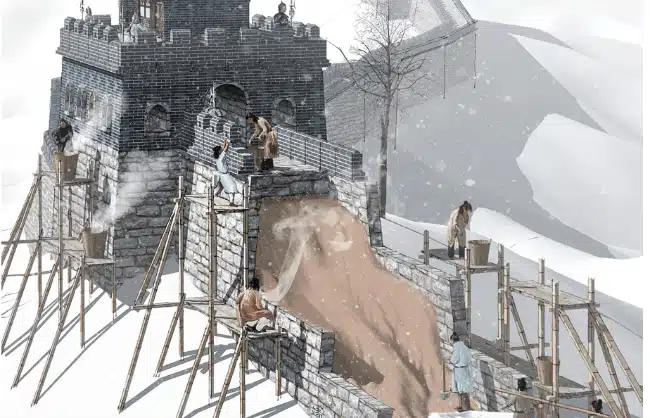
To save costs and manpower, each section of the Great Wall used locally produced materials. There were a number of ways to transport these materials, by manpower, animals, or with simple tools at the time. Workers carried the bricks and stones in baskets and shouldered them. In the winter, they used ice on ground, so it was easier to push or slide the bricks.
Animals that delivered materials included mostly goats and donkeys. Depending on the terrain, people used different types of tools, like wheelbarrows when the construction sites were relatively flat. There were rolling logs and crowbars to transport stones up into the mountains.
Wall Construction
If you go on a Great Wall of China tour today, you will notice that most of the walls are established along the top of mountains. That’s because the natural terrain of the mountains rendered better defensive effects. Layer by layer, bricks or stones were carefully laid on the foundations. Watchtowers and fortresses were built to be vantage points for surveillance or communication.
Technological and Engineering Detail
Mortar and Binding Agents
Many people is curious about why the Great Wall stands firm for thousands of years. The sticky rice mortar is one of the core secrets. It is a super binding agent made of slaked lime, sticky rice flour and sandstone. Compared with traditional lime mortar, the amylopectin inside the sticky rice flour is an inhibitor, which can control the growth of calcium carbonate microcrystals and make it form a dense and uniform structure. This structure offers higher compressive strength and resilience. After curing, the sticky rice mortar has excellent waterproof performance, so it can prevent rain from eroding and infiltrating effectively.
Drainage and Water Management
Besides the sticky rice mortar used between the bricks, the lime is applied on the top of the Great Wall as a waterproof layer. And on the parapets outside the wall, there is a brick designed as double-slope surface with a bulge in the middle, which can quickly drain the water on the top to both sides. Finally, the water will be discharged through the water nozzles. Most of the nozzles are inside the wall, which face to the south and the water can evaporate more quickly. For large water flow, the sluice is designed specially. This is an arched passage with a gate built at the intersection of the Great Wall and the river course. Its function is to adjust the water volume by lifting or closing the sluice. It can ensure smooth drainage but also avoid floods.
The Beacon System
The Beacon System is a precious communication network. The beacon towers are usually in higher places and about 3 km away from each other. Each tower has a dedicated person to guard, and they are responsible for monitoring the enemy and conveying signals promptly. Usually, they use the smoke signals during the day and fire signals at night combined with cannons to convey the message. Below is the specific meaning of the number of smoke and fires in Ming Dynasty.
Threat Level |
Enemy Troop Size |
Daytime Signal |
Nighttime Signal |
Signal Meaning |
Level 1 |
1-100 people |
1 beacon (smoke column) + 1 cannon |
1 torch fire + 1 cannon |
Small-scale enemy harassment |
Level 2 |
100-500 people |
2 beacons + 2 cannons |
2 torch fires + 2 cannons |
Medium-scale enemy attack |
Level 3 |
500-2000 people |
3 beacons + 3 cannons |
3 torch fires + 3 cannons |
Large-scale enemy invasion |
Level 4 |
2000-5000 people |
4 beacons + 4 cannons |
4 torch fires + 4 cannons |
Major enemy assault |
Level 5 |
Over 5000 people |
5 beacons + 5 cannons |
5 torch fires + 5 cannons |
Large enemy invasion, critical situation |
Who were the Workers that Built the Great Wall?
The building of the Great Wall of China is an immense project that lasted for over 2,500 years. There’s no accurate answer for how many people worked on its construction. The workers involved were mainly three groups of people, soldiers in the army, civilian workers, and criminals.
According to historical records, in Qin Dynasty, Emperor Qin Shi Huang sent about 20% of the country’s population, nearly 1 million people to work on the wall. The wall of Sui Dynasty in Inner Mongolia also took about 1 million people. It’s difficult to make estimations about the rest of the constructions.
Army Soldiers
The main source of manpower for building the Great Wall of China came from the army. It was considered an important duty for soldiers who defended the border. 300,000 soldiers were dispatched in Qin Dynasty, and the project took more than 9 years. Armies were sent to build the wall in Ming Dynasty as well.
Civilian Workers
During every dynasty, whenever the Great Wall was under construction, the court recruited a large number of common people. The number of civilian construction workers was usually in the hundreds of thousands. Emperor Qin Shi Huang recruited more than 500,000 civilian workers. Sui Dynasty even forced the widows to work because so many of the male workers have died in the construction process.
Criminals and Prisoners
Throughout the dynasties, criminals and prisoners were sent to patrol and construct the wall. In Qin Dynasty, they were required to work for 4 years at the wall. The conditions were incredibly harsh, and many lost their lives during the construction.
Challenges Faced When Building the Great Wall
Terrain and Weather
One of the biggest challenges of building the Great Wall of China was the various terrain the massive construction had to take place upon. Workers had to do strenuous labor on tops of mountains, in the deserts, and in extreme weather conditions. They had to adapt construction methods, which required thoughtful planning and engineering expertise.
Logistics and Manpower
For an ambitious project like the Great Wall, the logistics alone posed a lot of challenges. The construction required a large number of materials like rammed earth, bricks, and stones, which were all difficult to transport. In regions where resources were scarce, materials had to be transported from other locations.
The building also required lots of manpower. It was hard to recruit workers because the work was so strenuous and dangerous.
Unexpected Attacks
The primary purpose of the Great Wall of China was to defend the country against invasions from the north, so as constructions took place, workers had to be on guard for sudden attacks from the enemy. They had to protect themselves and their resources as they worked on the wall. There were soldiers constantly on the lookout for potential threats.
FAQs about the Construction of the Great Wall
How did the material used for the Great Wall differ between the dry climates of the west (like Gansu) and the eastern sections (like Beijing)?
The main material of the Great Wall in Gansu Province is rammed earth. Some sections also use layers of rose willow and sandstone. While in the sections in Beijing, stones and bricks are the major materials.
What specific ingredient was sometimes mixed with lime mortar to reinforce the Ming Dynasty brick sections of the Great Wall?
On the one hand, they use the magnesium lime, which is featured by high density, low porosity, high strength and good toughness. Besides, the sticky rice flour is added to enhance the features.
What methods did workers use to transport heavy bricks and stones up the steep mountain slopes during construction?
The most basic way is to rely on workers carrying on their backs or shoulders and using baskets or poles. For giant stones, move by using rollers and crowbars. It is said that animals are used to transport some light materials, such as goats and donkeys.
Which specific material was the primary building element for the Great Wall before the Sui Dynasty?
Before the Sui Dynasty, rammed earth is the most common material. In mountain areas rich in stones, stones are also used to build city walls.
Plan Your Great Wall Tour with China Xian Tour
After learning about these abundant knowledge about the Great Wall, how about start a Great Wall tour to observe the details with your own eyes? If you do not know which section to choose, ask our travel consultant for help, she can introduce the main experience to you in detail and customize a trip based on your needs, such as a one-day Great Wall tour or a Beijing essence tour. So contact China Xian Tour now!
Read More about the Great Wall of China