


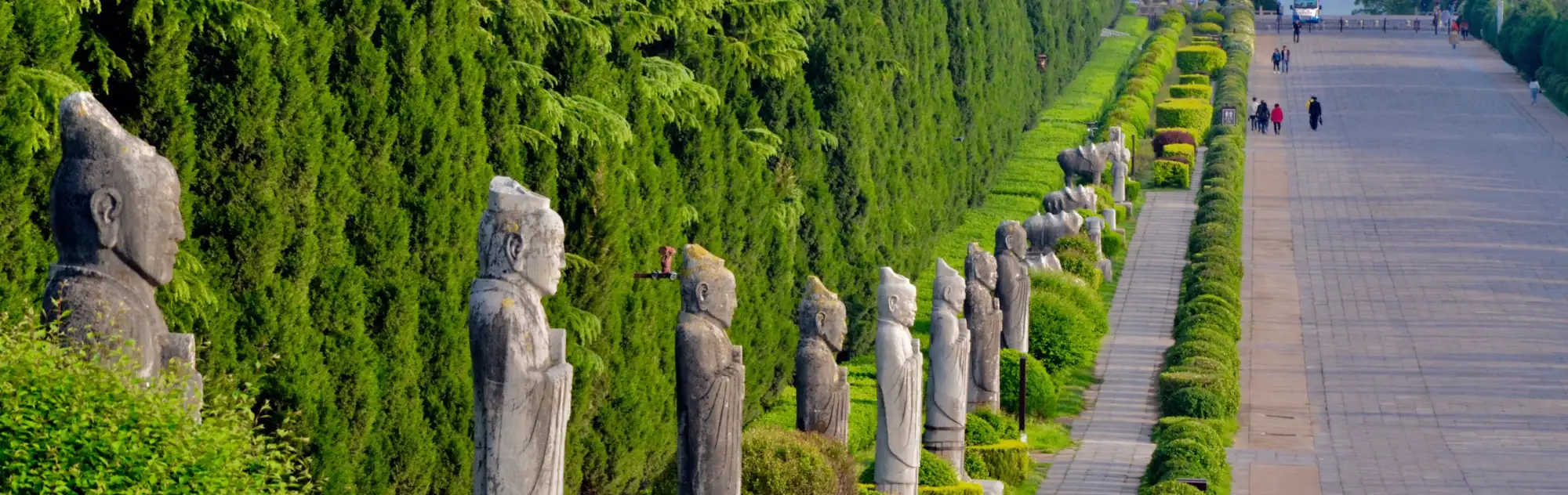
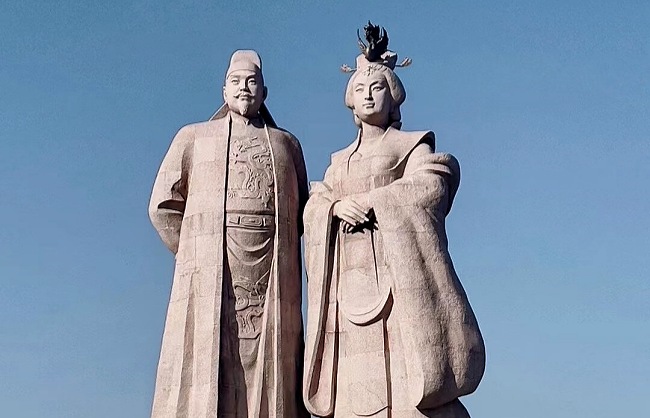
Qianling Mausoleum is the joint burial site of Tang Emperor Gaozong and Empress Wu Zetian.
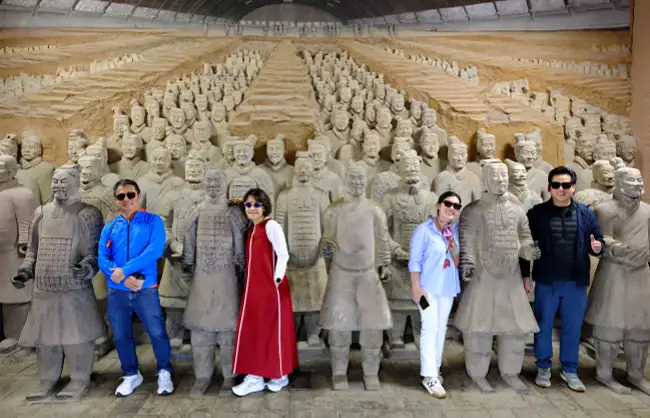
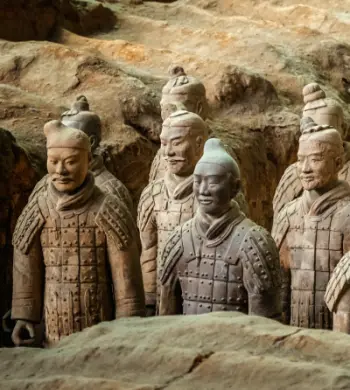
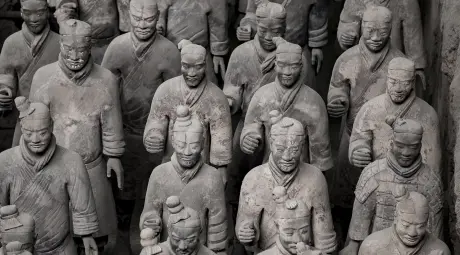
Unlike the Terracotta Warriors, where the main draw is the large excavation pits and thousands of terracotta figures, Qianling Mausoleum attracts visitors to focus more on the tomb complex itself. Major highlights include the Spirit Way and its stone sculptures, the Wordless Stele, the 61 statues of foreign envoys, and several excavated satellite tombs.
If you’re into history and archaeology, especially Wu Zetian and the Tang Dynasty, Qianling Mausoleum is worth adding to your Xi’an trip. If you only have one or two days in Xi’an, see the major attractions such as the Terracotta Warriors first, then consider Qianling Mausoleum if you have extra time.
Fast Facts about Qianling Mausoleum
- Address: Mount Liangshan (about 6 km north of Qianxian County), Chengguan Subdistrict, Qianxian County, Xianyang, Shaanxi Province
- Distance from Xi’an: About 80 km (usually a 1.5-hour drive, depending on your starting point and the traffic)
- Ticket Price: CNY 100 (US$15) March–November; CNY 80 (US$12) December–February.
- Opening Hours: 8:00–18:00 (March–November); 8:30–17:30 (December–February)
- Recommended Visit Duration: 3–4 hours
Content Preview
- Is Qianling Mausoleum Worth Visiting?
- Why Is It Important?
- What to See
- How to Visit
- How to Get from Xi’an to Qianling Mausoleum
- How to Plan a Day Trip
- Practical Tips
- Explore Qianling Mausoleum with China Xian Tour
Is Qianling Mausoleum Worth Visiting?
Yes. It’ll be a real highlight for those who are interested in ancient tombs and stone sculptures. And if you want to look into Wu Zetian’s story, this site tells a lot about her life. Much of the appeal comes from seeing the scale and layout of a Tang imperial tomb complex through its surviving above-ground remains.
Qianling Mausoleum may not be for you if you:
- Are visiting Xi’an for the first time and only have a tight schedule.
- Prefer museums or large indoor exhibitions.
- Want to enter an imperial tomb chamber.
- Don’t enjoy walking outdoors or exploring historical sites.
Since many people would compare it with the Terracotta Warriors, you can understand their difference in this way: the Terracotta Warriors stand out for the scale of the archaeological discovery, while Qianling is more about the tomb’s layout, the stories behind it, and Tang Dynasty history.

Why Is Qianling Mausoleum Important?
Qianling Mausoleum is the resting place of Emperor Gaozong and Wu Zetian. What makes it especially distinctive is that Wu Zetian was not just the wife of an emperor; she later ruled China as emperor in her own name. And this connection is part of what makes Qianling so unusual in Chinese history.
Qianling Mausoleum is also part of the “Silk Roads: the Routes Network of Chang’an-Tianshan Corridor,” which was inscribed on the UNESCO World Heritage List in 2014.

What to See at Qianling Mausoleum
1. The Spirit Way and Large Stone Sculptures
The Spirit Way is one of the first major sights you come across at Qianling Mausoleum. It’s an avenue leading toward the main mausoleum, with stone statues lined on both sides.
Those large stone sculptures are in the shape of lions, winged horses, ceremonial columns, and guardians. Together, they form the ceremonial approach to the Tang imperial tomb.
If you’ve mostly been visiting museums during your Xi’an tour, Qianling gives you a chance to walk through the history in an imperial tomb complex rather than simply viewing artifacts behind glass.
2. The 61 Statues of Foreign Envoys
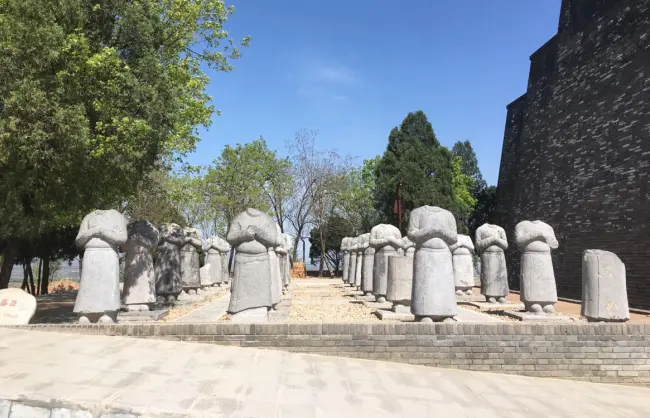
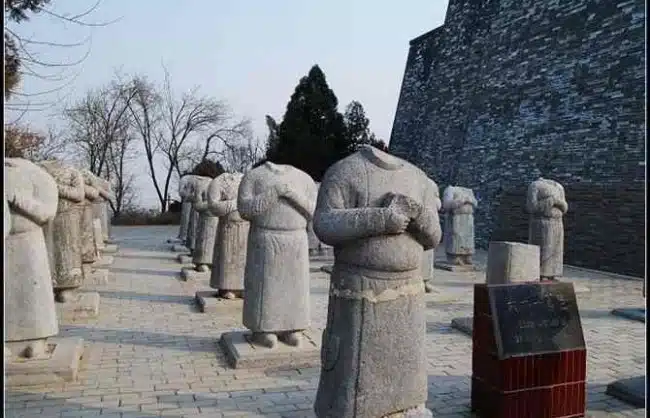
The 61 statues are one of the most distinctive sights of Qianling Mausoleum.
They stand outside the Zhuque Gate and are generally thought to represent the Tang Dynasty’s diplomatic ties, tribute system, and cultural exchanges with other regions.
You’ll find that most of them are now headless, but the exact reason remains unclear. Their different clothing and regional features offer a glimpse into the Tang Dynasty’s international connections.
3. The Wordless Stele: Why Is Wu Zetian’s Stele Blank?
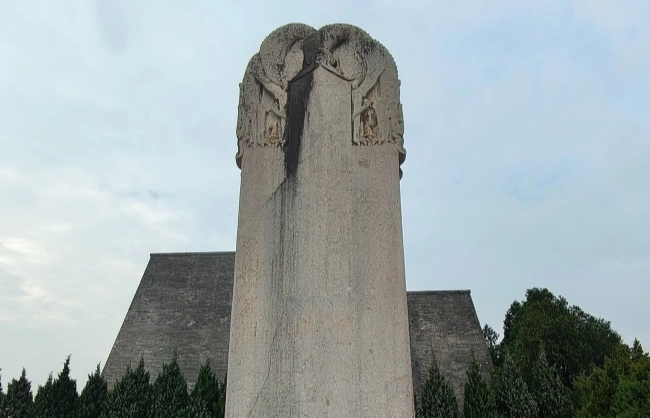
The Wordless Stele is one of the best-known sights at Qianling Mausoleum. It stands opposite the Shushengji Stele in front of the main mausoleum.
When it was first erected, the Wordless Stele had no inscription. Why Wu Zetian chose to leave it without an inscription remains unclear.
Over the centuries, inscriptions were added to the stele by others, so the Wordless Stele you see today is not entirely blank.
4. Tombs of Royal Family Members
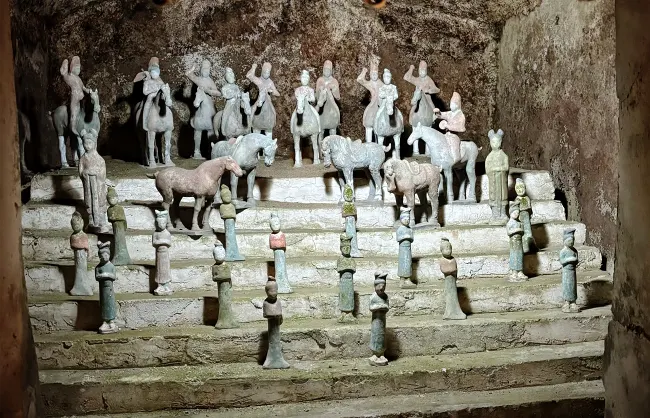
Qianling Mausoleum includes several important satellite tombs, such as the tombs of Princess Yongtai, Prince Yide, and Prince Zhanghuai. The Qianling Museum is also located within the scenic area.
If you have the time, add some of the satellite tombs to your route, especially if you’re interested in Tang Dynasty tombs, murals, and artifacts.

Visit the Qianling Mausoleum of Wu Zetian, China's only female emperor, and explore Xianyang Museum's Three Thousand Painted Warriors of the Western Han Dynasty.
Can You Enter Wu Zetian’s Tomb?
No. The underground chamber of the main mausoleum is not open to visitors.
But if you’re interested in the layout of an imperial tomb and Tang Dynasty history, the above-ground site still gives you a good look at the layout of the imperial tomb and its surrounding features.
How to Visit Qianling Mausoleum
For a first visit, you can follow the route below:
Visitor Center → Yongtai Princess Tomb & Qianling Museum → Yide Prince Tomb → Spirit Way → 61 Statues of Foreign Envoys → Wordless Stele and Shushengji Stele → Main mausoleum → Zhanghuai Prince Tomb / Summit of Mount Liangshan (Optional)
Choose your route based on how much time you have.
2-Hour Visit
Focus on the main sights: the Spirit Way, the 61 Statues of Foreign Envoys, the Wordless Stele, and the main mausoleum.
3–4-Hour Visit (Recommended)
With more time, add Yongtai Princess Tomb, Qianling Museum, and some of the other satellite tombs.
Full Visit (5–6 Hours)
You’ll have time to hike to the top of Mount Liangshan after visiting the main mausoleum and several satellite tombs.
Note: These estimates cover time inside the scenic area only. If you’re coming from Xi’an, allow extra time for transportation.
Do You Need to Take the Shuttle Bus?
You can walk to most areas of Qianling Mausoleum, but some are quite far apart. If you only plan to visit the Spirit Way and the main mausoleum, you can get around on foot. If you want to visit the satellite tombs, though, the shuttle bus saves quite a bit of walking. The fare is CNY 20 (about US$3) per person.
Tip: The shuttle bus mainly operates between the main mausoleum and the satellite tombs, and it doesn’t go to the top of Mount Liangshan. So, you’ll still need to hike to reach the summit.

How to Get from Xi’an to Qianling Mausoleum
Option 1: High-Speed Train + Taxi
If you’re traveling independently, the high-speed train is a straightforward option to get to Qianling Mausoleum.
A high-speed train from Xi’an North Railway Station to Qianxian Railway Station takes around 30 minutes. From there, a taxi to the Qianling Mausoleum Visitor Center takes about 15–20 minutes.
The downside is that you’ll need to arrange your own ride between Qianxian Railway Station and Qianling Mausoleum.

Option 2: Private Car or Chartered Vehicle
A private car or chartered vehicle is often more convenient, especially for families, older travelers, or larger groups. It allows you to skip unnecessary transfers, and you won’t need to arrange another ride after arriving in Qianxian.
If you need a private car service, feel free to contact our travel consultants.
How to Plan a Day Trip to Qianling Mausoleum from Xi’an
Both Qianling Mausoleum and Famen Temple are west of Xi’an, so many visitors would visit them as a day trip from Xi’an. They offer distinct historical and cultural highlights:
- Qianling Mausoleum: Tang imperial history, Wu Zetian, and ancient royal tombs
- Famen Temple: Buddhism, the Buddha’s relic, and Tang Dynasty religious culture
Public transportation between the two sites involves transfers and adds travel time. A private car makes the day more straightforward. If you need this service, contact China Xian Tour, and we’ll handle everything for you along the way.

Journey into Tang Dynasty history at Qianling Mausoleum, the resting place of China's only female emperor Wu Zetian, and visit Famen Temple to see the sacred finger bone relic of Shakyamuni Buddha.
Practical Tips
Qianling Mausoleum is an outdoor attraction.
The summer sun can be very intense, so prepare water, sunscreen, and a hat.
Wear comfortable shoes.
You’ll need quite a bit of walking if you plan to visit both the satellite tombs and the main mausoleum.
Plan your way back.
If you’re traveling independently by high-speed train and bus, plan your return trip in advance.
Consider taking the shuttle bus if you’re traveling with older family members or children.
Qianling Mausoleum covers a large area, and the main sights are spread out. Taking the shuttle bus can save you quite a bit of walking.
Explore Qianling Mausoleum with China Xian Tour
Qianling Mausoleum is a great place to learn about Empress Wu Zetian, Tang imperial tombs, and the culture of the Tang Dynasty at its peak. It also pairs well with other attractions west of Xi’an, such as Famen Temple.
China Xian Tour can help plan a private itinerary around your schedule and interests and arrange private transfers, so you’ll have more time to explore the historical sites that are truly worth seeing.