





🏜️ Taklamakan Desert Expedition At a Glance
The Taklamakan Desert (塔克拉玛干沙漠) spans an immense 330,000 square kilometers across Xinjiang, equal to 20% of Xinjiang’s total land area or 50 cities the size of Shanghai. Stretching 1,000 kilometers from east to west and 400 kilometers from north to south, it features massive pyramid-shaped sand dunes rising up to 300 meters high.
As the world’s tenth-largest desert and the second-largest shifting sand dune desert after the Rub’ al Khali on the Arabian Peninsula, the Taklamakan is historically nicknamed the “Sea of Death.” The name “Taklamakan” stems from local Turkic/Uyghur traditions, often interpreted as “you can go in, but you can’t get out” or “land of ruins.” In this challenging environment, ancient civilisations developed the ingenuity of the karez irrigation system to sustain life along the Silk Road.
Content Preview
- Where is the Taklamakan Desert? (Location & Map)
- What to See in the Taklamakan Desert
- How Do Most Travelers Visit the Taklamakan Desert?
- History of the Taklamakan Desert
- Physiography & Dune Types
- Taklamakan Desert Climate & Weather
- Best Time to Visit the Desert
- Key Desert Highway Stops & Supply Towns
- Flora & Fauna of the Taklamakan
- The Taklamakan Desert and the Ancient Silk Road
- How to Get to the Taklamakan Desert
- Packing & Clothing Tips for Travelers
- Frequently Asked Questions (FAQs)
- Plan Your Xinjiang Silk Road Tour
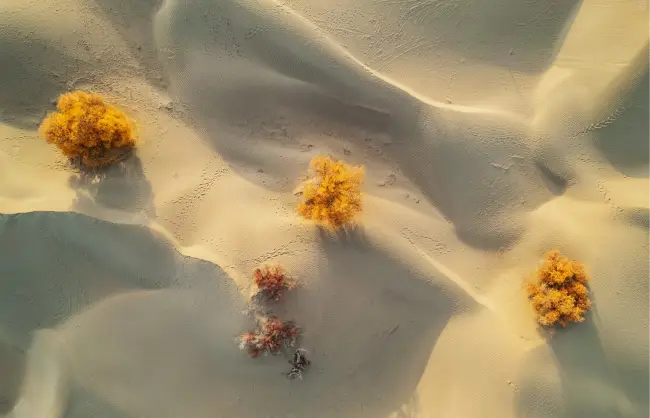
Rolling Sand Dunes and Autumn Populus Euphratica Trees in the Taklamakan Desert
Where is the Taklamakan Desert? (Location & Map)
The Taklamakan Desert occupies the central Tarim Basin in Xinjiang, northwestern China. It extends from Korla in the east (where it meets the Gobi Desert) all the way west toward Kashgar near the Pamir Plateau.
Looking at a Taklamakan Desert map, the southern perimeter is bordered by the Kunlun Mountains, while the northern edge faces the Tian Shan Mountains across Aksu and Kuqa. This vast natural basin creates one of the most distinct desert geography landscapes on Earth.
Related Reading: Top 6 Deserts in China
What to See in the Taklamakan Desert
Paved cross-desert highways (including G216 and G217) now allow travelers to safely drive across the heart of the Taklamakan Desert, transforming a once formidable expedition into an accessible road trip.
1. Luntai–Minfeng Desert Highway (G216)
Spanning 522 kilometers (about a 9-hour drive), this historic route crosses central shifting dunes and ancient Populus Euphratica forests near Luntai. Minfeng County at the southern end features the Niya Ruins Museum, displaying artifacts from ancient Silk Road kingdoms.
2. Aral–Hotan Desert Highway (G217)
Covering 424 kilometers (approximately 6 hours of driving), this highway cuts straight through the western wilderness. It offers expansive views of untouched sand waves with minimal human settlement along the way.
How Do Most Travelers Visit the Taklamakan Desert?
Modern highways and rail loops around the Tarim Basin make visiting the desert straightforward. Depending on your travel schedule, most visitors choose between a quick gateway excursion or a multi-day highway crossing:
Option A: Half-Day to 1-Day Desert Gateway Experience
Travelers with limited time can experience 4WD dune bashing, camel rides, sunset photography, and stargazing at desert gateway areas near Korla (Rob People Village), Luntai, Hotan, or Kashgar.
Option B: Multi-Day Cross-Desert Road Trip (2–3 Days)
Popular cross-desert routes include:
- Luntai to Minfeng Route (522 km): Supplies and hotels available midway at Tazhong Town; passes the Luntai Golden Poplar Park.
- Aral to Hotan Route (424 km): Ideal for dramatic sand dune photography and visiting Hotan jade markets.
- Yuli to Qiemo Route (334 km): A shorter crossing connecting Luobu Village and Qiemo County.
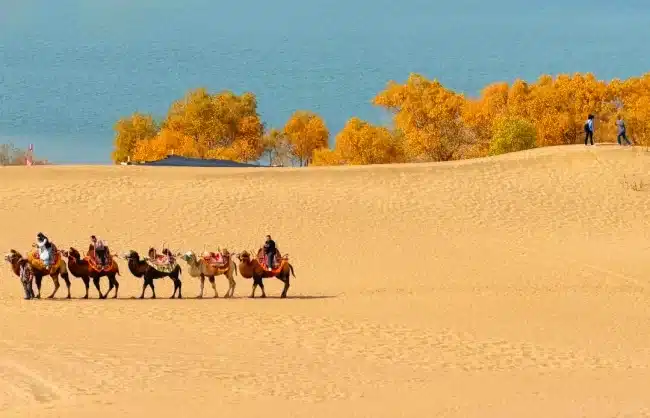
A twelve-day adventure through Southern Xinjiang from Urumqi to Kashgar via Turpan, Korla, Kuqa, and Hotan, featuring Jiaohe Ruins, Taklamakan Desert, and Karakuri Lake.
History of the Taklamakan Desert
Geologically, the Taklamakan Desert was created by tectonic collisions between the Indian subcontinent and the Eurasian Plate. This collision uplifted the Himalayas, Kunlun, and Tian Shan ranges, creating an enclosed inland basin. Over millions of years, wind erosion turned deep continental sediments into boundless sand dunes.
Linguistically, “Takla” in Uyghur implies “beneath” or “place of origin,” while “Makan” means “dwelling,” referring to the ancient ruined cities buried beneath the shifting sands along historical Silk Road routes.
Physiography & Dune Types
The Taklamakan features diverse desert landforms, including isolated Cenozoic sandstone ridges like the Mazartag Mountains and four major dune formations:
- Transversal Dunes: Crescent-shaped Barchan chains running perpendicular to prevailing winds.
- Longitudinal Dunes: Parallel sand ridges running across the southeastern desert.
- Star Dunes (Pyramid Dunes): Located in the central core, where converging winds build pyramid sand peaks up to 300 meters tall.
- Dome & Honeycomb Dunes: Circular sand formations created by complex wind patterns.
Taklamakan Desert Climate & Weather
The Taklamakan experiences an extreme continental desert climate. Annual rainfall ranges from just 10 mm in the east to 38 mm in the west, while annual evaporation rates reach 2,500 to 3,400 mm.
Summer surface temperatures can exceed 67°C (152°F), with daily temperature swings over 40°C. In winter, temperatures drop below -20°C (-4°F). Spring is subject to strong winds and sandstorms, while winter occasionally brings rare snowfall across the dunes.
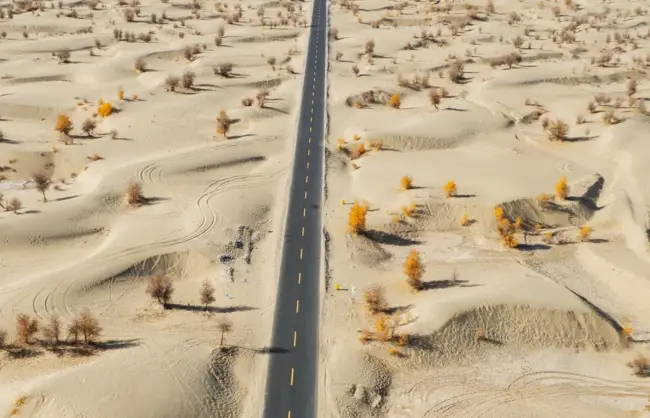
Paved Desert Highway Cutting Through the Taklamakan Sand Dunes
Best Time to Visit the Taklamakan Desert
The optimal time to visit is **autumn (late September to mid-November)**. During this window, sandstorms subside, daytime temperatures are comfortable, and the Populus Euphratica (desert poplar) forests along the Tarim River turn brilliant gold.
Season |
Weather Conditions |
Travel Recommendation |
|---|---|---|
Autumn (Sep – Nov) |
Mild temperatures, low wind, golden poplars |
Best Time to Visit (Highly Recommended) |
Summer (Jun – Aug) |
Extreme heat (>40°C air, >60°C ground) |
Not recommended for deep dune excursions |
Spring (Mar – May) |
Frequent sandstorms and strong winds |
Requires dust protection & weather monitoring |
Winter (Dec – Feb) |
Freezing temperatures (<-15°C), occasional snow |
Suitable for winter photography (proper thermals needed) |
🛡️ Safety & Travel Logistics Note: Because southern Xinjiang covers vast distances, traversing the Desert Highways and visiting ancient Silk Road ruins requires verified transport and route planning. Let our local travel specialists handle your logistics, 4×4 vehicles, and permits seamlessly.
Key Desert Highway Stops & Supply Towns
Highway Route |
Start & End Points |
Distance |
Key Highlights & Service Stops |
|---|---|---|---|
Luntai – Minfeng (G216) |
Luntai → Minfeng |
566 km |
Tarim Poplar Forest, Tazhong Town (Service Stop), Yatongguzi Village, Niya Ruins Museum |
Hotan – Aral (G217) |
Hotan → Aral |
440 km |
Daliyabuyi Village, Hongbaishan Service Area, Tarim River scenery |
Qiemo – Yuli (G335) |
Qiemo → Yuli |
334 km |
Luobu (Lop) People Village, Tarim River Grand Bridge |
Qiemo – Aral |
Qiemo → Aral |
525 km |
Tazhong Oilfield Center, vast central dunes |
Flora & Fauna of the Taklamakan Desert
While the open sand dunes are mostly barren, river valleys, oases, and depression troughs with shallow groundwater support tough desert species:
- Plants: Desert Poplar (Populus Euphratica), Tamarisk (Saltbush), Reeds, Camel Thorn, and Russian Olive trees. Green wall shelterbelts have also been planted along the desert highways to stabilize shifting sands.
- Wildlife: Wild Bactrian camels, gazelles, wild boars, desert hares, long-eared hedgehogs, and endemic birds such as the Tarim Jay and Desert Lark.
The Taklamakan Desert and the Ancient Silk Road
The Taklamakan Desert was central to the ancient Silk Road. To avoid the impassable interior sands, historic merchant caravans skirted its borders along two main branches:
- Northern Silk Road Route: Traveled along the northern edge through Turpan, Korla, Kuqa, and Aksu to Kashgar.
- Southern Silk Road Route: Traveled along the southern edge through Dunhuang, Miran, Qiemo, Niya, Hotan, and Yarkand to Kashgar.
Today, ruins such as the Niya Site, Subashi Ancient City, and Loulan Kingdom relics remain along these historic oasis routes, making a China Silk Road Tour through Xinjiang a memorable travel experience.
How to Get to the Taklamakan Desert
1. Accessing via Rob People Village (Near Korla)
- Fly (1 hr) or take a high-speed train (4–5.5 hrs) from Urumqi to Korla.
- Drive from Korla city center to Rob People Village (80 km, approx. 1.5–2 hours).
2. Crossing the Desert Highway (G217 / G216)
- Fly from Urumqi to Kuqa (1 hr), Aksu (1.5 hrs), or Hotan (2 hrs).
- Drive across the cross-desert highway from Kuqa/Luntai down to Hotan or Minfeng, staying overnight in Aral or Tazhong Town.
Packing & Clothing Tips for Travelers
- Clothing: Lightweight, breathable long-sleeved shirts and pants to protect against sun and sand. Pack a wide-brimmed hat, UV sunglasses, and a dustproof neck gaiter/scarf. For autumn/winter visits, bring insulated jackets and windproof outer layers for cold nights.
- Footwear: High-top hiking boots or desert gaiters to keep hot sand out of your shoes.
- Essential Gear: SPF 50+ sunscreen, lip balm, high-capacity water bottle, dustproof camera covers, and power banks.
- Camping Gear: If participating in overnight desert camping, bring a 4-season windproof tent, sleeping bag, and solar chargers.
Frequently Asked Questions (FAQs)
How big is the Taklamakan Desert?
The Taklamakan Desert covers about 330,000 square kilometers (127,400 square miles), making it China’s largest desert and the world’s second-largest shifting sand desert.
How much rainfall does the Taklamakan Desert receive annually?
Annual rainfall is extremely low, averaging between 10 and 38 millimeters per year, while annual evaporation rates exceed 2,500 mm.
Can tourists visit the Taklamakan Desert?
Yes. Tourists can travel across the desert via paved desert highways (such as G217 and G216) or visit desert gateway parks near Korla, Luntai, Kuqa, Hotan, and Kashgar.
What is the connection between the Taklamakan Desert and the Silk Road?
The ancient Silk Road was divided into Northern and Southern routes that skirted the edges of the Taklamakan Desert, connecting China with Central Asia, Persia, and Europe through key oasis cities.
Are special permits required to visit the Taklamakan Desert?
Standard tourist routes and highways are open. However, entering restricted border zones or deep off-road core areas requires travel permits arranged in advance through a licensed travel agency.
Embark on a Xinjiang Expedition with China Xian Tour
Planning a travel itinerary across Southern Xinjiang? Let our experienced local specialists arrange your private transport, desert highways, English-speaking guides, and Silk Road accommodations.