
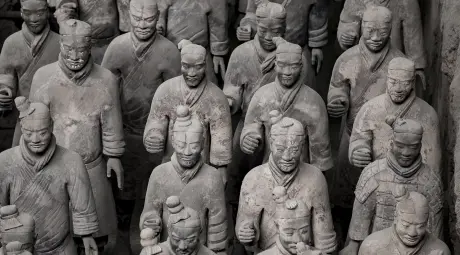


The Silk Road was an extensive network of trading routes which had promoted the exchange of goods, ideas and cultures between the East and the West for more than 2,000 years. Today, the name of “Silk Road” has become a popular term among travelers, which means a wealth of captivating attractions, from historical sites to stunning natural landscapes.
In this article, we will take you on a journey through the top 12 destinations along China Silk Road to unveil the unraveled views along this ancient trading route.
Content Preview
- 1. Luoyang: Explore the Ancient Capital of China
- 2. Xi’an: The Starting Point of the Silk Road
- 3. Dunhuang: The Vital Gateway on the Silk Road
- 4. Ningxia: An Oasis in Desert along the Silk Road
- 5. Wuwei: Discover the Han Dynasty’s Westernmost Outpost
- 6. Zhangye: Marvel at the Rainbow Mountains
- 7. Jiayuguan: Explore the Western End of the Great Wall
- 8. Gannan: Experience Tibetan Culture in China
- 9. Qinghai: Explore the Heart of China’s Tibetan Plateau
- 10. Turpan: A Melting Pot of Multiple Cultures
- 11. Kashgar: The Gateway to Enter the Central China
- 12. Urumqi: Discover the Capital of Xinjiang Province
- 13. Hotan – Explore the More Ancient Jade Route
- 14. Kuqa (Kucha) – Experience the Culture of the Ancient Qiuci Kingdom
- 15. Ili (Yining) – Indulge in The Jiangnan of the Frontier
- FAQs about Silk Road
- Explore Silk Road with China Xian Tour
1. Luoyang: Explore the Ancient Capital of China
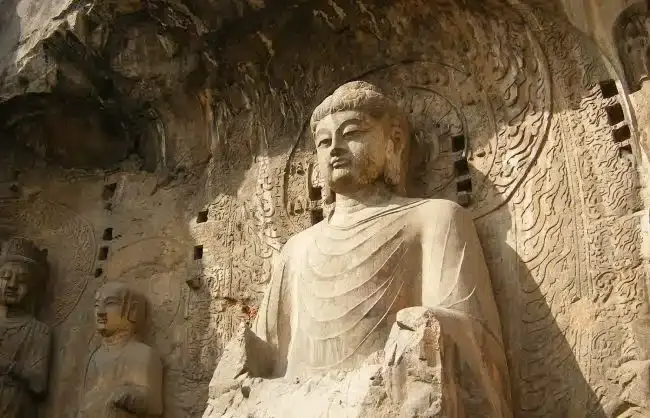
The Silk Road first reached Europe during Eastern Han Dynasty (25-220). As the capital at the time, Luoyang became a metropolis welcoming a steady stream of merchants and visitors from the West. Today, Luoyang is a celebrated historic city in China, where 13 dynasties established their capital successively, leaving countless historical sites for tourists to explore.
Best Time to Visit: April – May, September – November
Highlights:
- Longmen Grottoes– As one of the four greatest grottoes in China, it is a treasure trove of ancient stone-carving arts, enshrining more than 110,000 Buddha statues in all sized from 2 centimeters to 17.14 meters.
- White Horse Temple– It is the first Buddhist temple in China, founded in 68AD after Buddhism was introduced to China, and now becomes an international monastery with Buddha halls integrating architectural features of China, India, Cambodia, and Thailand.
How long to stay: 2 – 3 days
Travel Tips:
Luoyang is nicknamed as “the city of peonies”. These graceful flowers are in their full bloom during April ~ May and there will be grand peony fairs held at major gardens in the city, such as China National Flower Garden and Wangcheng Park, for visitors to enjoy the wonderful scenes.
2. Xi’an: The Starting Point of the Silk Road
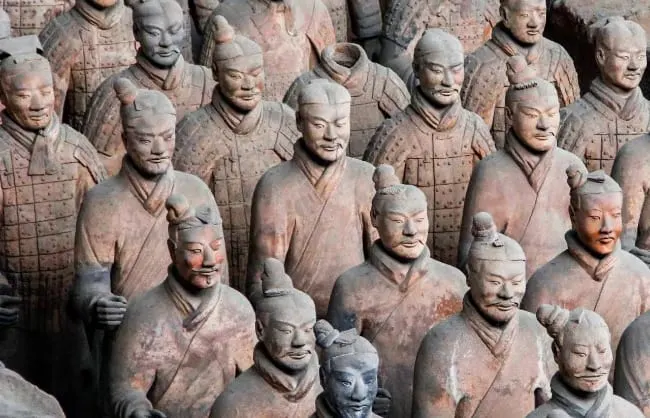
Xi’an is widely known as the starting point of the Silk Road. This ancient trading route has witnessed the prosperity of Xi’an (formerly called Chang’an) as the world’s most powerful capital in Tang Dynasty (618-907). Today, a sightseeing tour around the Big Wild Goose Pagoda and nearby antique blocks will take you back to over 1,000 years ago to experience its grandeur.
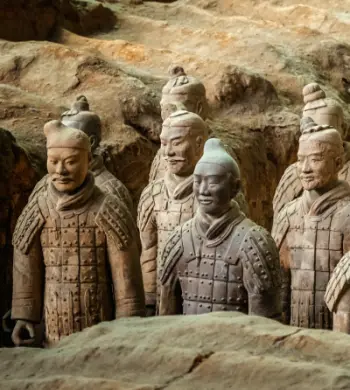
Moreover, around 7,000 years of civilization has endowed Xi’an with an impressive array of historical relics, including the world-famous Terracotta Warriors and Horses, the iconic Bell and Drum Towers, and the might City Wall.
Best Time to Visit: March – May, September – November
Highlights:
- Terracotta Warriors and Horses– The “grand army” made up of more than 8,000 life-sized pottery soldiers and horses will definitely astonish you. The troops have guarded Emperor Qin Shi Huang for more than 2,200 years after his death.
- Ancient City Wall– It is one of the most complete city walls in China, with a history of over 600 years. A walking or cycling tour on the ramparts enables you to take in the panoramic view of the city.
- Big Wild Goose Pagoda– Standing in the heart of Da Ci’en Temple, the tower is a symbolic landmark of Xi’an City, and is surrounded by wide squares and quaint pedestrian streets, including the prosperous Great Tang All Day Mall.
How long to stay: 3 – 4 days
3. Dunhuang: The Vital Gateway on the Silk Road
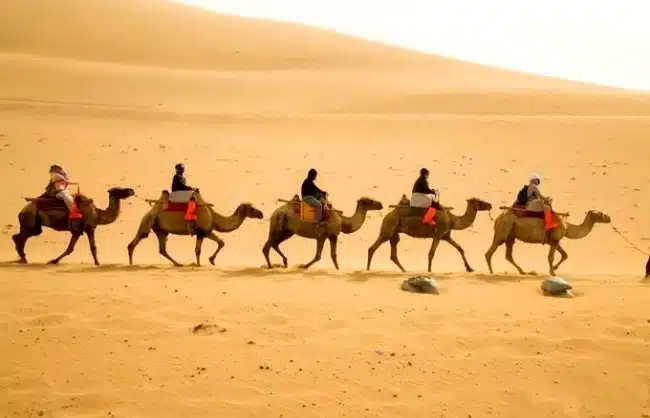
Dunhuang is a city located in the northwest region of China, and used to be a major stop and trading center along the ancient Silk Road. The vital location of Dunhuang attracted numerous merchants and visitors coming from Central and Western Asia, as well as India, making Dunhuang a melting pot of multiple cultures and religions. Mogao Grottoes is the best proof of cultural integration with diverse artistic elements reflected on statues and frescos.
Besides, visitors will also find Dunhuang a city filled with wonderful desert scenery. Here, limpid spring can go along nicely with sands, and the vast desert gives a full show of the incredible Yardang landform.
Best Time to Visit: May – October
Highlights:
- Mogao Grottoes– It is the world’s largest site of Buddhist arts with the richest contents, including 735 caves, 2,415 Buddha statues, and 45,000 square meters of frescos portraying religious stories, images of flying Apsaras, natural views, ancient agricultural life…
- Singing Sand Dunes & Crescent Lake– The tranquil Crescent Lake is embedded in the yellow sands and is embraced by the Singing Sang Dunes, presenting a totally different desert view.
- Dunhuang Yardang National Geopark– Here, you will admire the largest and most splendid Yardang landform on the earth. Thousands of years of wind erosion have cultivated rammed earth in the region into various shapes, such as castles, ramparts, pillars, lions, fleet…
How long to stay: 2 – 3 days
4. Ningxia: An Oasis in Desert along the Silk Road

Bordering Inner Mongolia to the north and Shaanxi Province to the east, Ningxia has been a vital stop along the Silk Road for centuries. Visitors can set out an exploration to historical sites, such as Western Xia Tombs, Ruins of Guyuan Ancient City and Xumishan Grottoes, to trace the past of the city. Nature lovers will see Ningxia as a unique tourist destination along the ancient Silk Road, where various landscapes such as deserts, lakes, wetlands and mountains all exist harmoniously. Also, tourists can experience wine tasting in some of the best wineries in Ningxia.
Best Time to Visit: May – October
Highlights:
- Xumishan Grottoes– The grottoes were founded 1,400 years ago with 162 caves and over 500 stone statues preserved today.
- Sand Lake– It is a perfect combination of desert scenery and a vast stretch of lake. Visitors can enjoy a leisure boat ride and also experience thrilling desert activities, like camel riding, sand gliding, and dune surfing.
- Western Xia Imperial Tombs– Ningxia was the location of Western Xia Dynasty (1038-1227). This mausoleum is the resting place for 9 kings and over 200 regal members. The structure of the tombs is rare in China, reflecting features of Buddhist architecture.
How long to stay: 2 – 3 days
5. Wuwei: Discover the Han Dynasty’s Westernmost Outpost
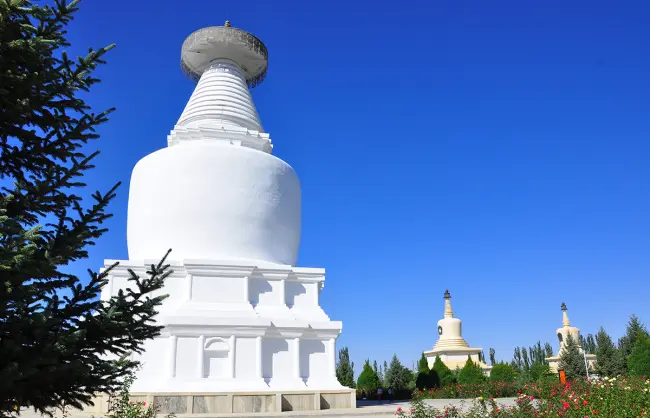
Standing at the eastern end of Hexi Corridor, Wuwei used to be a city of great strategic location along the Silk Road, just after Xi’an and Luoyang. The discovery of Bronze Galloping Horse in Leitai Tombs of Han Dynasty (202BC-220AD) made Wuwei a famous tourist destination in northwestern China to experience the fusion of diverse cultures exchanged along the Silk Road.
Best Time to Visit: July – November
Highlights:
- Tiantishan Grottoes– It is the earliest grotto excavated in China with a history of more than 1,600 years, and it is praised as the “origin of Chinese grotto arts”.
- Confucious Temple– It is the largest and best-preserved Confucious Temple in northwestern China. You will find 44 plaques with various scripts hanging outside a grand hall, which is considered the most captivating view of the site.
How long to stay: 1 – 2 days
6. Zhangye: Marvel at the Rainbow Mountains
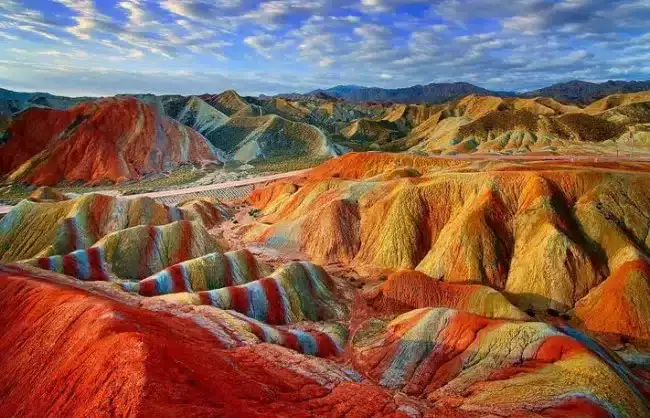
Zhangye has been an important transport hub in the middle section of Hexi Corridor. 4,000 years of history and multiple ethnic cultures have left Zhangye with rich cultural heritages, such as Giant Buddha Temple and Wooden Pagoda Temple. Besides, Zhangye is also the paradise for nature lovers and photographers. Admiring rainbow mountains at Zhangye Danxia Geopark will be a once-in-a-lifetime experience that will highlight the Silk Road tours.
Best Time to Visit: May – October
Highlights:
- Zhangye Danxia National Geopark– Here, visitors will take in the most beautiful Danxia landform in the world. Viewed from the distance, rolling mountains seem to be adorned with colorful ribbons in red, white, green and yellow, just like a rainbow falling down on the earth.
- Giant Buddha Temple– Built around 1,000 years ago, it was the imperial temple of Western Xia Dynasty, enshrining Asia’s largest reclining Buddha of 34.5 meters long and 33 meters high.
How long to stay: 1 – 2 days
7. Jiayuguan: Explore the Western End of the Great Wall

Jiayuguan was a vital transport port along the Silk Road, seated at the border of ancient China. Speaking of Jiayuguan City, a lot of visitors will think about the magnificent Jiayuguan Pass immediately. This mighty fortress marks the western end of China’s Great Wall and thus possessed a great strategic meaning in old times.
In addition to the well-preserved pass city, there are still Great Wall sections revealing a totally different view, such as the ruins of First Fire Tower, and Overhanging Great Wall which was built against cliffs stretching almost vertically.
Best Time to Visit: May – October
How long to stay: 1 day
8. Gannan: Experience Tibetan Culture in China
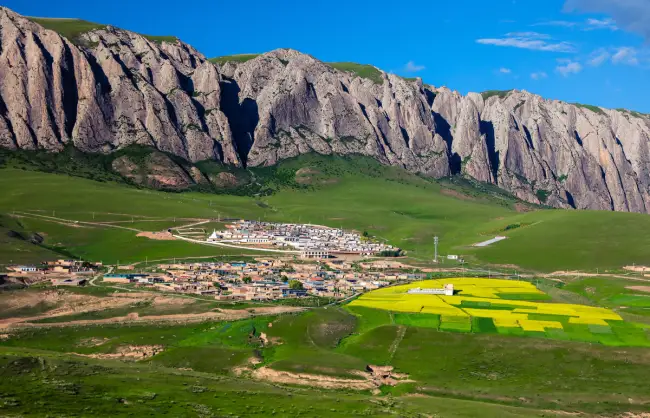
Gannan stands at the crossroads between Gansu, Qinghai and Sichuan provinces and was an essential passageway from the Central Plains to Tibetan area. It is a renowned tourist destination along the ancient Silk Road, famous for stunning natural landscapes, including snow-capped mountains, deep valleys, and vast grasslands, as well as rich Tibetan culture and heritage.
A visit to Labrang Monastery or Langmu Monastery offers a great chance to have an in-depth exploration into Tibetan Buddhism. You might feel moved in the strong religious ambience with magnificent Buddhist architectures around, which is really a special experience when traveling along the Silk Road.
Best Time to Visit: May – October
Highlights:
- Labrang Monastery– Known as the world’s greatest academy of Tibetan Buddhism, the monastery houses China’s most complete religious institutes. Here, visitors can admire magnificent halls with countless Buddha statues, frescos and religious artifacts enshrined inside, and also join the believers to march along the long prayer wheels corridor for blessings.
- Sangke Grassland– It is a vast area of alpine pasture seated in the arm of rolling mountains. The grassland always presents a peaceful scenery with flocks and herds grazing around under the bright blue sky.
How long to stay: 3 – 5 days
9. Qinghai: Explore the Heart of China’s Tibetan Plateau
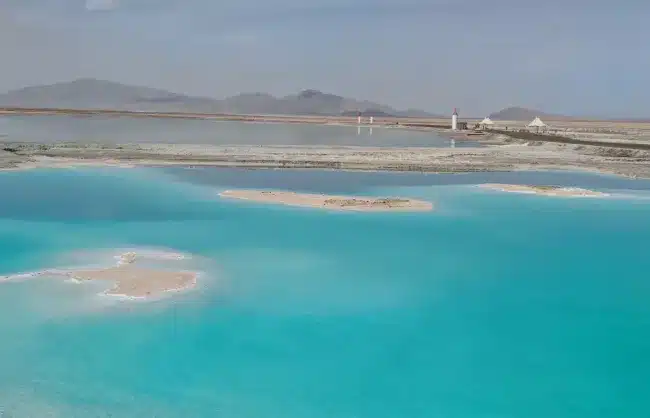
Just like Gannan, Qinghai was also a must pass on a vital branch connecting central China and Tibetan regions, and now one of the most top destinations on the Silk Road. Located at Tibetan Plateau, Qinghai is the paradise for nature lovers and photographers, boasting unraveled alpine landscapes from endless grassland to serene saltwater lakes. Qinghai is also the settlement for Tibetan people, housing many Buddhist temples and monasteries, such as Ta’er Monastery and Dongguan Mosque.
Best Time to Visit: May – August
Highlights:
- Qinghai Lake– It is the largest inland lake in China. The azure lake seems boundless. At the lakeside, you will find the lake stretching to a distant horizon and finally melting into the sky. The picturesque scenery wins it the reputation of “sapphire on the highland”.
- Chaka Salt Lake– Praised as “the Mirror of the Sky”, the tranquil lake is in pure white, reflecting the clear blue sky on the surface. The surreal scenery will make you feel like rambling in the sea of clouds.
- Ta’er Monastery– Founded in 1370, it served as the center of Buddhism in northwestern China. Today, there are still a lot of monks studying sutras. Walking around, visitors are very likely to encounter monks debating or preaching.
How long to stay: 3 – 5 days
10. Turpan: A Melting Pot of Multiple Cultures
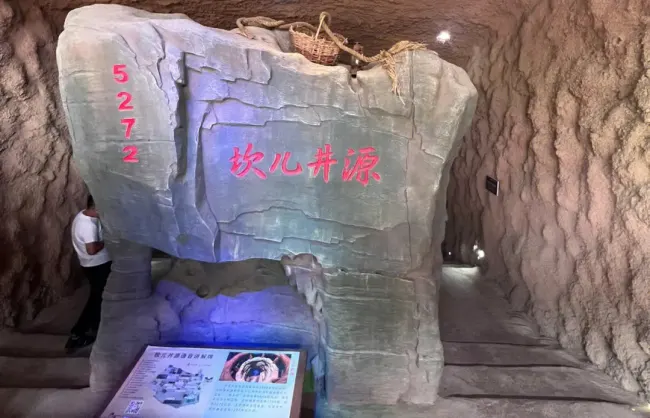
The Silk Road was divided into three branches after reaching Xijiang. The northern route with the longest history traveled through the city of Turpan, making it one of the most important business hubs along the Silk Road. Merchants coming from different parts of the world would take a break and do business in Turpan, turning the city into a melting pot where multiple cultures and civilizations met and integrated with each other.
Best Time to Visit: May – October
Highlights:
- Ancient City of Jiaohe– Jiaohe served as the political and economic center of Turpan for more than 1,000 years. Visitors can still find ruins of residences, warehouses, government buildings, temples and mausoleums well-arranged
- Karez System– Rated as one of the “three greatest projects in ancient China” along with Great Wall and Grand Canal, it is an underground water system that supplied the city with water from the nearby mountains to cope with the harsh desert environment.
How long to stay: 1 – 2 days
11. Kashgar: The Gateway to Enter the Central China
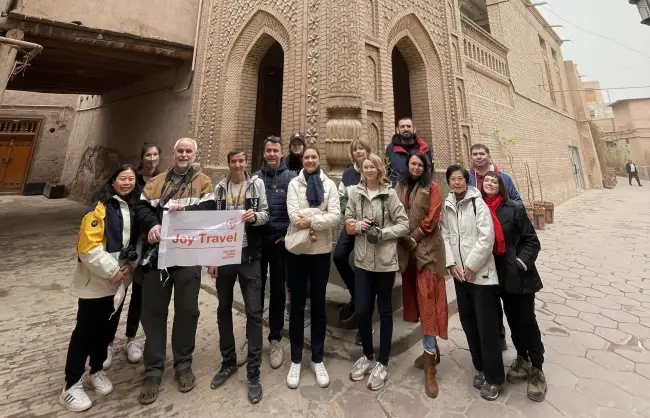
Located in the westernmost part of China, Kashgar was considered the gateway to enter the central China from the Western world. Today, you can still feel the prosperity of Kashgar as a vital commercial center along the Silk Road by strolling around bustling bazaars. And ancient buildings in the old city are also signs of culture exchanges, showcasing an infusion of diverse architectural styles.
Best Time to Visit: May – October
Highlights:
- Kashgar Old City– Traditional mud-brick residences are well preserved along the quaint alleys. Take a leisure walk around and you will immerse in the ethnic ambience mixed with cultural symbols of Han, Uyghur, Mongol…
- Sunday Bazaar– Exchanging goods at the grand bazaar in Kashgar has been a tradition for Asian merchants for thousands of years. Today, the bazaar is still filled with diverse products, from spices and textiles to livestock, offering visitors a chance to blend into the lively life.
- Id Kah Mosque –It is the largest mosque throughout the whole Xinjiang region, presenting typical features of Uyghur architecture and rich religious atmosphere.
How long to stay: 2 – 3 days
12. Urumqi: Discover the Capital of Xinjiang Province
Urumqi is the capital of Xinjiang Province and played a vital role in the cultural and economic exchanges in the past. As one of the major cities along the Silk Road, Urumqi is home to a wealth of cultural and historical attractions. Besides, nature lovers will also think Urumqi a great destination during their trip along the Silk Rad. The breathtaking alpine scenery around the Tianshan Mountains could definitely be a visual feast and provides a leisure visiting experience.
Best Time to Visit: May – October
Highlights:
- International Grand Bazaar –It is the busiest and largest bazaar in China, full of booths selling Xinjiang cuisines and special handicrafts. The Silk Road Sightseeing Tower in the center offers a panoramic view of the surroundings and houses exhibitions displaying distinctive ethnic culture.
- Grand Canyon at Tianshan Mountains– In local people’s eyes, the Grand Canyon is an optimal summer retreat featuring captivating natural landscapes consisting of snow mountains, lush forests, alpine lakes and wide pasture.
How long to stay: 1 – 2 days
13. Hotan – Explore the More Ancient Jade Route
Hotan is an oasis city on the southern edge of the Taklimakan Desert. It has a history of more than 2,000 years. Before the Silk Road, a Jade Road already existed in Hotan to transport the local fine jade to the Central Plains. Now, tourists can also visit the White Jade River to try picking up jade material on the riverbank and experience the joy of “jade hunting”. After the flourishment of the Silk Road, it became a convergence point of diverse civilizations. The Buddhist relics, Hotan Museum and Yotkan Ancient City are all direct proofs.
Best Time to Visit: April – June, September – October
How long to stay: 3- 5 days
Highlights:
- Hotan Museum: To learn about the history of Hotan, Hotan Museum is the first stop. The exhibitions cover the relics from prehistoric times to modern times, from which you will have a systematic understanding of the development process of Hotan as an ancient important town in the Western Regions and a key point on the Silk Road.
- Yotkan Ancient City: Through antique buildings, folklore street, and high-quality large-scale live performances, this scenic area vividly reproduces the prosperous scene of Ancient Khotan Kingdom and the integration of diverse cultures.
14. Kuqa (Kucha) – Experience the Culture of the Ancient Qiuci Kingdom
Named Qiuci in ancient times, Kuqa was the convergence hub of the central and northern routes of the Silk Road. It carries a thousand-year memory of the Silk Road. Cultural lovers will be amazed during the tour, because abundant world cultural heritages stand here, including Kizil Caves, Subashi Temple and Kizilgaha Beacon Tower. You can even experience the living Qiuci culture in Kuqa Palace, the former residence of the last Qiuci King. What’s more, in Kuqa, the natural wonders will also feast your eyes. The Tianshan Grand Canyon offers you a visual shock of Danxia landform and the Duku Highway is renowned as the most beautiful highway.
Best Time to Visit: April – May, September – October
How long to stay: 2 – 3days
Highlights:
- Kizil Grottoes:It is China’s earliest grottoes and the birthplace of Qiuci grotto art. The murals here obviously integrate the style of India, Persia and Greece and the content is not themed by Buddhist culture only, it also depicts the social life, music and dance, and the ethnic customs of the ancient Qiuci Kingdom.
- Tianshan Grand Canyon:The most stunning of the canyon is its red mountain, which is formed about 140 million years ago. With a length of 5 km, it resembles a giant dragon meandering through the mountain. When the sun is shining directly at noon, the wonderful effect of light and shadow makes it the golden moment for photography.
15. Ili (Yining) – Indulge in The Jiangnan of the Frontier
Ili is an important town on the northern route of the Silk Road. It is renowned as “The Jiangnan of the Frontier” because of its splendid natural scenery. The Ili River Valley and Nalati Grassland create poetic landscapes in this remote area. It also boasts a long history and diverse cultures. In Qing Dynasty, a general’s office was set in Ili and nine cities were built. At that time, it was the political, economic center and military stronghold in the north and south of the Tianshan Mountains. Now, Ili is regarded as a living museum. In the Kazanqi Folklore Tourist Area, Accordion Museum and Han Princess Memorial Hall, you can explore diverse cultures and the historic stories of promoting ethnic integration.
Best Time to Visit: June- early October
How long to stay: 3 – 5 days
Highlights:
- Nalati Grassland: It is one of the world’s four major river valley grasslands, where you can also see snow mountains, forests, meadows and streams. Tourists can also experience the nomadic life by riding a horse and herding sheep.
- Kazanqi Folklore Tourist Area: It is actually a multi-ethnic settlement area mainly inhabited by Uyghur people. The residences with blue gates and windows, the carriages on the streets and the traditional workshops will make you feel like stepping into the authentic local life.
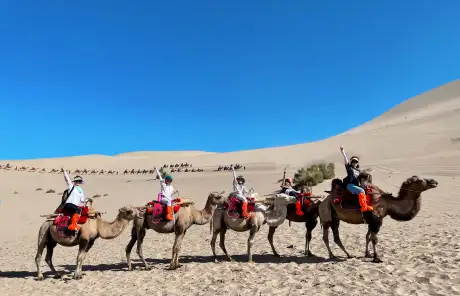
Discover the Hexi Corridor's treasures from Dunhuang's Mogao Caves to Zhangye's rainbow-colored Danxia mountains and Jiayuguan's Great Wall fortress on a seven-day group Silk Road tour.
FAQs about Silk Road
Why was the Silk Road historically important in the development of these cities?
Because it promotes economic prosperity and cultural integration directly.
Which cities offer the best experience of Uighur, Tibetan, and Hui culture?
Kashgar, cities along the ancient Tea Horse Road and Lanzhou offer the best experiences, respectively.
What are the differences between the northern and southern Silk Road routes?
The northern route is the main trading route and passes deserts and oases, and the southern route is the main channel for the spread of Buddhism and passes high plateau and snow mountains. >> See more key routes along the ancient Silk Road.
What is the best time of year to travel the Silk Road to avoid extreme heat or cold?
It should be April – May and September – October.
What is the recommended mode of transportation between major Silk Road cities (e.g., train, internal flight, bus)?
For the transfer between nearby cities, trains are recommended, and for a long-distance travel, flights are faster.
Explore Silk Road with China Xian Tour
When talking about Chinese culture, the Silk Road is always a hot topic. Due to its long history, it witnesses the ups and downs of several dynasties and the communication of diverse civilizations. To explore its charm, a reasonable itinerary will be very important, because there are many cities along the road. China Xian Tour will not let you down. We have focused on the Silk Road tour since we started inbound tourism. So we know how to tailor a Silk Road tour to cover the core attractions along the way and enrich your travel experience. So do not hesitate to contact us.