

Concealed deep in the Xinjiang interior, Jiaohe ruins lures tourists with its stunning earthen architecture and its abundance of historical context. Far from being a simple ancient town, it was a clever solution to the unusual set of challenges facing Turpan Depression’s inhabitants, which just so happens to be the world’s second-lowest point.
Scorching temperatures and evaporation are no joke. Traditional irrigation plans are out of the question. In this case, a clever irrigation system was devised that brought mountain runoff into the plains.
Entering Jiaohe Ancient City means entering history again. Each relic speaks words about the past, and each cobblestone lane tells stories about ancient times. When tourists stride along the original city walls, streets, and temples, they feel that they have walked in from the future to visit in the past for a glimpse at the magnificence of Western Regions.
For history enthusiasts and adventure-seeking tourists alike, Jiaohe ruins offers an unparalleled glimpse into the past, and therefore are a sight not to be overlooked on any trip to Xinjiang or Turpan.
Content Preview
- Jiaohe Ruins Facts
- Why Visit Jiaohe Ruins
- History of Jiaohe Ruins
- How Jiaohe Ruins Was Built
- Layout of Jiaohe Ancient City
- How Jiaohe Ancient City Defend Invaders?
- What to See and Do in Jiaohe Ruins
- Best time to visit
- Practical Tips for Visitors
- Attractions Near Jiaohe Ruins
- How to Get to Jiaohe Ruins
- FAQs about Jiaohe Ruins
- Explore the Jiaohe Ruins and Other Turpan Highlights with China Xian Tour
Jiaohe Ruins Facts
- Location: Situated in the Yarnaz Valley, 10 kilometers west of Turpan City, in Xinjiang’s autonomous region, northwestern China.
- History: Over 1,300 years.
- Ticket Price: CNY 70
- Area:Spanning 30,000 square meters, comprising several ancient buildings and structures.
- Opening Hours:
- High season (Apr 21 – Oct 20): 8:00 am – 9:00 pm.
- Low season (Oct 21 – Apr 20): 10:00 am – 6:30 pm.
- Time Needed: Half-day to full day.
- Highlights: Concubine Palace of the Front, Temple of Fire, Great Mosque, houses of residence.
- Recommended for: History buffs, people who love culture, architecture buffs.
Why Visit Jiaohe Ruins
- Incomparable historic status: Jiaohe Ruins is a world cultural heritage site and an important town on the ancient Silk Road. It witnesses a long history of China.
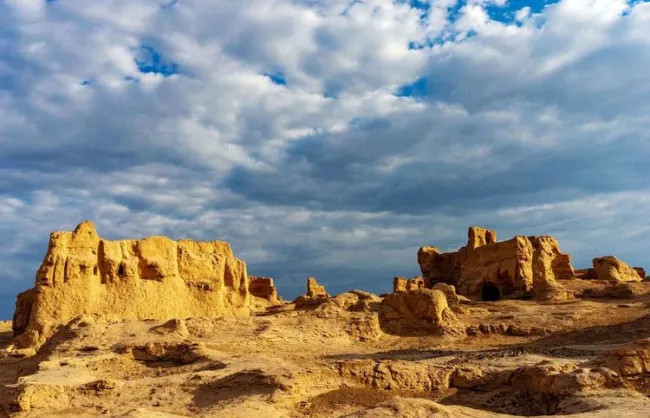
- Rarely seen architectural wonder: The Jiaohe Ancient Town is a city carved by using the “cutting earth to leave walls” And it has the most well-preserved earth buildings.
- An immersive experience of time travel: The layout of the Jiaohe Ancient Town is very clear. When wandering along the streets and lanes, it seems that you can imagine the daily life in ancient times.
- A striking visual feast: At dawn, the golden sunlight is cast on the broken walls, making it the world’s most beautiful ruins.
History of Jiaohe Ruins
Jiaohe ruins, found in the western suburbs of today’s Turpan City in Xinjiang Uygur Autonomous Region, china silk road travel spot has a history dating back to ancient times.
Jiaohe ruins in around 300 BC, the discovery of Caucasian remains in nearby graves surprised researchers, showing close links between the early inhabitants of the Jiaohe ancient city and the Caucasians, especially those residing in the town of Chishi.
At some point in 100 BC, the Han Dynasty began trading relations with Western states for the purpose of dominating the Silk Road and securing oneself against foes. Around 60 BC, Jiaohe ruins saw Chishi become part of the Han Empire, in which approximately a thousand troops were stationed there to ensure peace.
With the weakening of the Han Dynasty around 200 AD, as the empire collapsed, so did Jiaohe ancient city experience numerous royal transitions before falling to a general of the Tang Dynasty in 640 AD and being incorporated into Tang land. Most of the structures that still stand today date back to the Tang dynasty.
Historical accounts have it that Jiaohe ruins had a population of 7,000 in the 8th century, and this provides proof of the prosperous civilization of ancient city of Jiaohe.
Why It was Abandoned
In brief, it is a tragic result of changes in the natural environment and human factors. Water is very crucial to Jiaohe Ancient Town. But in the mid-Tang Dynasty, the climate changed to cold and the water of the surrounding rivers became less and less. Meanwhile, the population increased. So the water can not meet the needs of local agriculture and handicraft, and the passing caravans.
And due to its important location on the Silk Road, it became a place that every country wanted to obtain. So there were continuous wars from the 9th – 14th century, resulting in severe damage to the city. Besides, in Song Dynasty, a new passage was developed and the Silk Road did not pass through the Jiaohe Ancient Town. With time went by, it became today’s Jiaohe Ruins.
How Jiaohe Ruins Was Built
Jiaohe ruins, which occupy an island-shaped terrace 13 kilometers to the west of Turpan City, is a fascinating flashback to the past. Jiaohe ruins was so named because it has a river encircling the settlement. Bird’s eye perspectives reveal that Jiaohe ruins resembles a level boat resting in nature’s crease. Jiaohe ancient city, nestled between cliffs, has three city gates intricately carved into the eastern, western, and southern cliff faces.
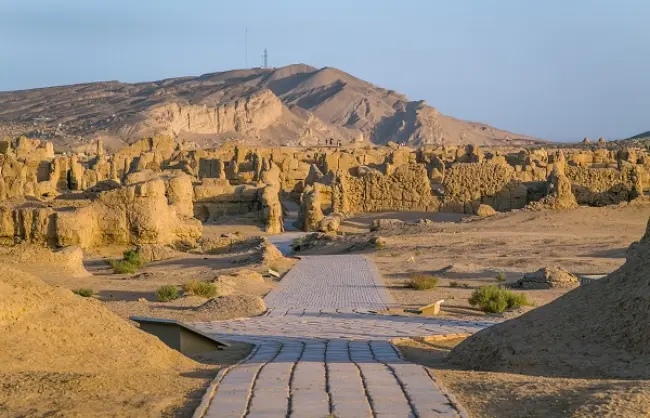
Missing are the traditional city walls, and outstanding is the fact that most of the buildings, large and small, are professionally cut out from the surface of the towering terrace using the “cutting earth to leave walls” method. Temples, governmental buildings, city gates, and houses are all made largely of adobe walls. The streets, which are deep and narrow, look like serpentine trenches, enhancing the beauty of this old settlement.
In essence, Jiaohe ruins is a colossal ancient sculpture, a must-visit for those embarking on china silk road travel. For those in Turpan, a visit to Jiaohe ruins turpan promises an unforgettable experience steeped in history.
√Related reading: The Silk Road Stories
Layout of Jiaohe Ancient City
There are mainly three functional zones inside the city. And the main road connecting these zones is called Central Avenue, a central axis stretching from south to north. In the middle part of the east district of the avenue is the government office zone. This zone covers a larger scale and it is suspected to be the location of the Anxi Protectorate of Tang Dynasty. To the north of the avenue is the temple zone, the religious center at that time. This area is centered by the large temple and has splendid pagoda forests. In the west district and the southern part of the east district are the workshops and residential quarter. The military defense facilities are distributed all over the ancient city.
How Jiaohe Ancient City Defend Invaders?
It is mainly reflected in four aspects. The first is its natural barrier. It is located on a terrace which is 30 meters above the land. On the four sides are cliffs and under the cliffs are two rivers. This terrain makes it easy to guard and hard to attack.
The second aspect is the architectural layout. The whole town is carved into earth, so the main streets are embedded underground and the houses do not have windows facing the streets. It is difficult for enemies to observe and invade. Besides, there are also barbicans, allowing them to fight against the enemies for a second time.
The third one is the facilities to ensure living needs. Inside the city, there are over 300 ancient wells and a dedicated warehousing area so that the water and materials can be supplied when being besieged.
The final aspect is its layout. The most important government office zone is in the protected place, the city center.
What to See and Do in Jiaohe Ruins
Jiaohe ruins offer a unique blend of history, culture, and architecture that make it a must-visit destination. Here are some must-see attractions:
Uncovering Jiaohe Ruins——The Front Palace
Amidst the Jiaohe ruins is the Former Concubine Palace, familiarly known as the Former Palace. This Former Concubine Palace is a product of the Tang Dynasty (618-907 AD) and exemplifies the refinement and majesty of the aristocracy during those times. Visit the Jiaohe ruins to discover this well-preserved palace.
Appreciating Art at Jiaohe Ruins——The Flame Temple
Inside the Jiaohe ruins lies the Flame Temple, a Tang Dynasty Buddhist complex known for its stunning murals and sculptures. The artworks are significant in highlighting the Buddhist art and culture of the Tang Dynasty.
Taking a stroll——The Grand Mosque
The Grand Mosque, one of the Yuan Dynasty (1271-1368) gems of the Jiaohe ruins, is an exemplar of Islamic architecture. Its ornamentation gives proof of Islam’s prosperity during that era.
Uncovering Residential Life
Travel back in time to the lives of ancient people by walking along the preserved houses of Jiaohe ruins. These structures reveal the residential life, house designs, and construction techniques of Jiaohe ancient ruins dwellers.
Revealing Ancient Engineering——The Ancient Well
In the Jiaohe ruins silk road location, you can find old well systems important for accessing water. Notice the deep grooves excavated at the well’s mouth, a quiet witness to the ingenuity and perseverance of old inhabitants.
Best time to visit
April to October is the best time for turpan travel to Jiaohe ruins of Xinjiang. The local climate is warm at this point, avoiding both heat and cold extremes, making it a pleasant experience.
For people who wish to have memorable experiences, a visit to the Jiaohe ruins in the evening is particularly suggested. At dusk, the ancient walls glimmer with mystical colors of yellow and red, contrasting against the desert background, making it a stunning sight.
In order to take this lovely vista of Xinjiang tours, it is best to arrive on the bus at 5 PM to avoid the intense midday sun and have time to photograph the ruins in a soft, golden light. The Jiaohe ruins silk road brings another historical experience to the backdrop of turpan tours.
Practical Tips for Visitors
- The biggest challenge during a tour in Jiaohe Ruins is the extreme heat and lack of shade in the Turpan Depression. At daytime, the temperature there can reach 40 ℃easily and the surface temperature can even reach over 50℃. Besides, there are almost no natural shades inside the scenic area. It is no exaggeration to say that High-spf sunscreen (SPF50+), wide hats, sunglasses, sunscreen face towels, ice sleeves and sun umbrellas can save your life.
- Other necessary packing items are 1.5 – 2 L of water, some high-energy snacks and a soft cloth bag or plastic bag to protect your phone and camera from the sand. Besides, do not forget to wear a pair of comfortable shoes.
- The scenic area offers professional interpreters, who can speak several languages. You can also rent an official audio guide, it also provides Chinese and English explanations.
- Jiaohe Ruins is a very fragile and precious world cultural heritage, so please walk on the designated plank road, and do not climb, touch or step on the relics.
Attractions Near Jiaohe Ruins
- Karez Well System:Just off the Jiaohe ruins, this system amazes with its ancient construction, bringing mountain water to parched plains. Don’t pass up the chance on the Xinjiang travel
- Turpan Museum: In the heart of Turpan City, this museum houses a treasure trove of artifacts and paintings, proving the history and culture of Turpan, with details regarding the Jiaohe ancient ruins.
How to Get to Jiaohe Ruins
- By Bus:People can take bus No. 1 or No. 101 to Turpan’s Xincheng Road stop.
- By Taxi:Jiaohe ruins is just 10 kilometers (6.2 miles) from Turpan City. It will only take 15 minutes by taxi and it will cost just 20 yuan.
FAQs about Jiaohe Ruins
What is the historical significance of Jiaohe Ancient City in relation to the Silk Road?
It is an important site along the Silk Road and the place where the Anxi Protectorate is located.
What does the name “Jiaohe” (交河) mean, and how does it relate to the city’s location?
Jiaohe means the river splits and flows around the city. Its name vividly depicts the geographic feature of the ancient city.
Which ancient kingdom was Jiaohe City the capital of?
It used to be the capital of the Former Kingdom of Cheshi.
What is unique about Jiaohe’s construction method (the “cutting earth to leave walls” technique)?
Jiaohe Ancient Town is not built with materials upward on the land, but is “carved” downward from the original earthen platform. So the main body of the house is located underground.
What are the major remaining architectural highlights to see, such as the Grand Central Pagoda or the Grand Mosque?
The major highlights are the Grand Central Pagoda, the Grand Mosque, the pagoda forests and the large and magnificent government office zone.
Are there on-site facilities like restrooms, water, or food vendors?
Yes, there are restrooms and a few stalls selling water and dried fruits.
Explore the Jiaohe Ruins and Other Turpan Highlights with China Xian Tour
If you want to choose a reliable travel agency to plan your Turpan tour, China Xian Tour is definitely the top choice, because in the first years we established, our main focus was on cities along the Silk Road. We are very familiar with the cities and scenic spots. And we have been devoted to tailor-made trips for many years. So we can plan a perfect Turpan tour with Jiaohe Ruins for you. Do not hesitate to contact us.