
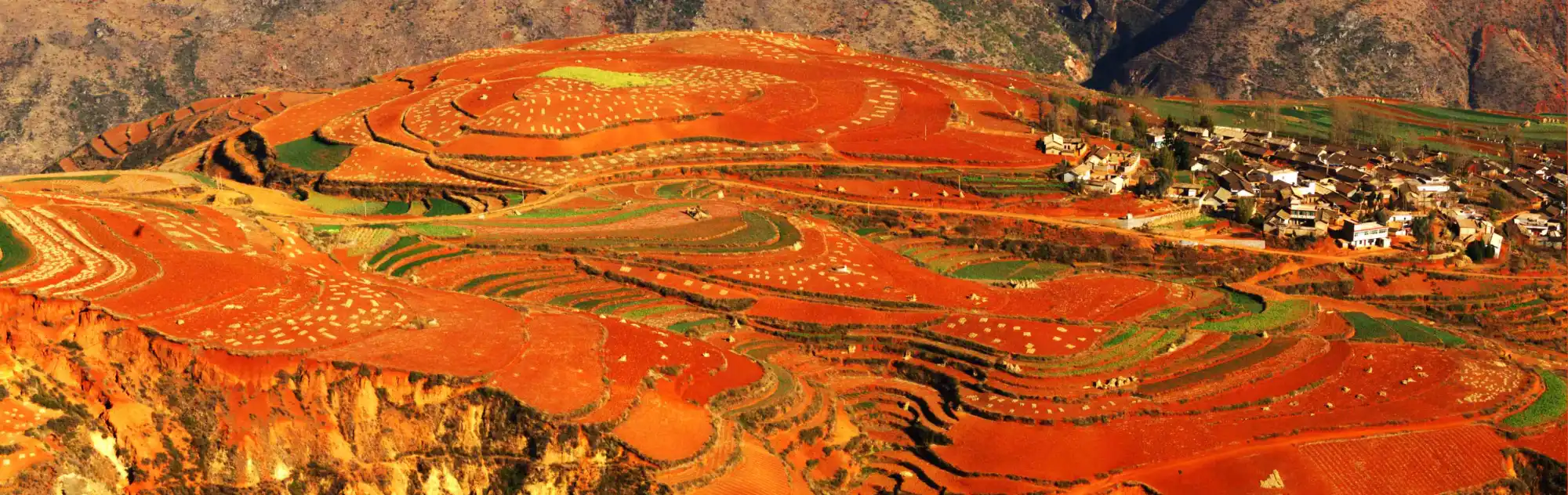
Yunnan is a treasured land which has bred countless natural wonders. And if you go 250 kilometers northeast of Kunming city, you’ll find yourself suddenly entering a world which should only exist in fairy tale: Dongchuan red land, a masterpiece of time. It’s so beautiful and surreal that people would like to describe it as “earth’s unfinished painting,” where seasonal continuously shifts and rewrites the scenery. To better discover the magic of nature, this article will tell you everything about this incredibly stunning site.
Content Preview
- Facts About Dongchuan Red Land
- What Makes Dongchuan Red Land a Photographer’s Paradise?
- Why the Soil Is So Red
- Top Attractions and Photography Spots
- Best Time to Visit Dongchuan Red Land
- What to Eat in Dongchuan Red Land
- How to Get To & Travel Around Dongchuan Red Land
- Useful Tips for Visitors
- FAQs about Dongchuan Red Land
- Discover Dongchuan Red Land with China Xian Tour
Facts About Dongchuan Red Land
- Location: Dongchuan District, Kunming, Yunnan Province, China
- Distance from Kunming: around 250 km (about 5-5 hours by car)
- Best Time to Visit: May-June, September-November
- Recommended Visit Duration: 1-2 days
- Entrance Fee: Free (some viewpoints may charge a small fee)
- Highlights: Stunning natural colors, terraced fields, rural charm
What Makes Dongchuan Red Land a Photographer’s Paradise?
The magic lies in the balance between nature and human life. Local people have been lived here and guarded these slopes from generation to generation. The rotations of crop show the process of their labor blending with nature, and together, they create a living art that never fades away. Since the altitudes can reach around 2,600 meters, the thin air can further amplify the iconic chromatic contrasts.
What distinguishes Dongchuan from other more or less commercialized destinations is its unvarnished authenticity. Visitors can really see the centuries-old traditional farming methods being practiced in front of them. While days and nights can both change the tone of the land, photographers can catch the perfect picture in every moment throughout the day.
Why the Soil Is So Red
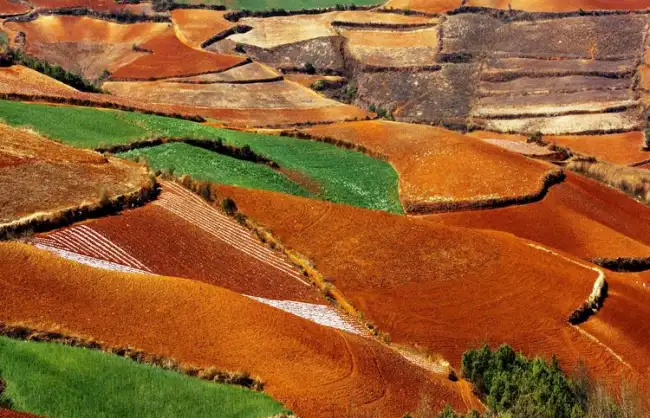
The striking crimson hue of Dongchuan’s landscape comes from its unique soil composition and climate. Rich in iron and aluminum oxides, the earth oxidizes over time under Yunnan’s warm and humid conditions, creating the deep red-brown tones that cover the hills. At altitudes between 1,800 and 2,600 meters, sunlight, moisture, and seasonal crop rotations further intensify the color contrasts, giving the terrain a naturally vivid look. Experts describe Dongchuan as “the most concentrated and characteristic red land of the Yunnan plateau” — a living masterpiece shaped by minerals, climate, and generations of farming.
Top Attractions and Photography Spots
Luoxiagou (Sunset Valley)
This canyon comes alive when the sun begins its descent. Terraced red fields transform into molten lava flows under oblique sunlight, the rays etching the land’s contours into bronze-like reliefs of light and shadow. Photographers should arrive by mid-afternoon to find the best spots along the valley’s edge before the golden hour begins around 4:30 pm.
Jinxiu Garden (Embroidery Garden)
This vast area is a living work of art, with fields carefully arranged to form patterns that resemble traditional embroidery. The alternating strips of red soil, green wheat, and yellow rapeseed flowers create a vibrant tapestry. In the mid-afternoon light, the full range of colors is revealed, while the soft shadows add depth. The garden’s neat geometric shapes contrast beautifully with the rugged landscape surrounding it.
Damakan (Sunrise Village)
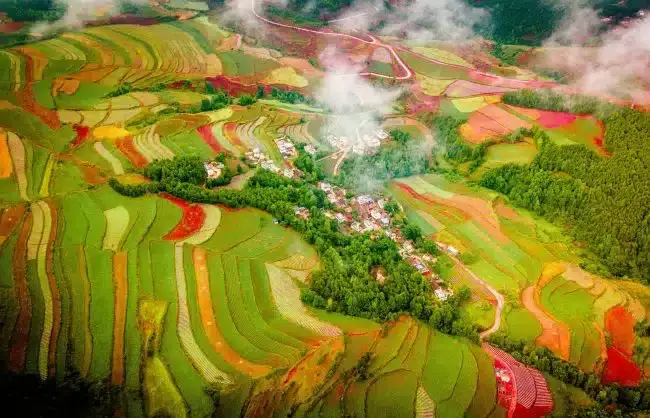
This site is perching on a high ridge northwest of Huashitou, and it offers unparalleled sunrise views over the awakening countryside. Morning mists often linger in the valleys, and many visitors can see the ethereal scenes of farmhouses emerging from the haze. The first rays of sunlight hits the red earth with remarkable intensity. Mornings here can be chilly and windy, so it’s best to dress warmly and bring a stable tripod for clear sunrise shots.
Qicaipo (Seven-Color Slope)
This dynamic landscape undergoes dramatic seasonal transformations that justify its colorful name. In spring, purple potato flowers create soft pastel tones, while autumn brings vibrant golden buckwheat fields. The slope’s undulating contours catch sunlight in interesting ways throughout the day, though late afternoon provides the most balanced illumination. Photographers should explore multiple vantage points to capture the changing interplay of colors and textures.
Yuepuao (Music Hollow)
The rhythmic patterns of terraced fields in this secluded valley inspired its musical name. The curved lines of cultivation resemble notes on a staff, particularly when local farmers work the fields. Late afternoon light accentuates these natural rhythms while casting warm tones across the landscape. As one of the less crowded locations, Yuepuao offers peaceful shooting conditions and authentic glimpses of rural life.
Photography Tips:
The most efficient route connects these locations in a Y-shaped pattern radiating from Huashitou Village. Each site has optimal shooting windows – typically early morning for east-facing locations and late afternoon for west-facing vistas. When photographing local residents, always request permission and consider offering a small gratuity. The ever-changing conditions ensure that repeat visits yield completely different images of this living landscape.
Local Culture and People
Similar to other regions in Yunnan, Dongchuan Red Land area is also home to several ethnic minority groups, and among all, Yi people are the most notable as well as the Miao and other smaller communities. For centuries, these groups have also sowed their life in the steep red-soil slopes, and their ingenious culture has grown as prosperous as their crops through their agricultural practices on the challenging terrain. They make the most of the land’s limited resources while preserving its striking beauty.
Their villages still retain authentic layouts, with traditional wooden or earthen houses built along the contours of the hills. No matter how rapidly the outside world is going, life here still revolves around farming and seasonal rhythms rather than tourism, and indeed, time is much gentler to this place. Visitors coming here can expect to witness genuine rural life rather than staged scenes. The harmony between the people, their land, and the changing seasons is always the key to the land’s beautiful stories.
Best Time to Visit Dongchuan Red Land
Generally, May-June is the best time to marvel at lush green wheat fields under blue skies. September-November is the peak season to see red soil contrasting with golden buckwheat and white rapeseed flowers. Winter (Dec-Feb) is when te region less crowded, but some fields are fallow.
Avoid the rainy season (July-August), as muddy roads may make travel difficult.
Seasonal Highlights of Dongchuan Red Land
Spring (March-April): There shall be some residual snow left in fields. While young green crops also bring the sense of life back to the red soil, these three striking colors will present an unforgettable painting to visitors.
Late April-June (May-June): During this season, wheat can be ripening and the red soil will also be newly ploughed. And the enchantment of color can be further powered with potato flowers blooming across the land.
July-August: This is the rainy season in Yunnan. While the weather may not be at its best condition, there will be far fewer crowds here, which allows you to enjoy the scenery in a quieter sense.
September-November: This is the peak travel time to Dongchuan Red land, as the golden buckwheat, rapeseed white flowers, rich reds of soil can together create the most striking and unforgettable views.
Winter (Dec-Feb): Few crowds with simpler fares, however, expect that some fields may fallow. The tranquility can cover the land with a quite different charm.
What to Eat in Dongchuan Red Land
Dongchuan Noodles – A regional specialty breakfast. These noodles are made from high-quality wheat and mountain spring water which are all attained from this precious land. And this type of noodle is known for having an incredibly smooth and springy texture.
Dongchuan Mutton – Sheep here all graze at a rather high altitude, and this habit has made their meat tender and mild in flavour. It’s commonly stewed or braised.
Potatoes & Buckwheat Products – Red-soil terrain is most suitable for the growth of potatoes and buckwheat, and that’s why these two have become local staples. Items like fried “gold potatoes” and buckwheat cakes or noodles are popular both to eat and to take home.
Other Local Snacks & Souvenirs – Fresh plateau apples, chestnuts, yak-derived products (hotpot, dried beef) and simple rural snacks are widely available in the area.
How to Get To & Travel Around Dongchuan Red Land
From Kunming:
- By Bus:Take a bus from Kunming North Bus Station to Dongchuan (3-4 hours), then hire a local van/taxi to the Red Land (1 hour).
- By Car: Rent a car or book a private tour (~4-5 hours drive).
Getting Around:
- Local Taxis/Vans: The best way to explore, as public transport is limited.
- Walking/Hiking: Some viewpoints are within walking distance of villages.
Useful Tips for Visitors
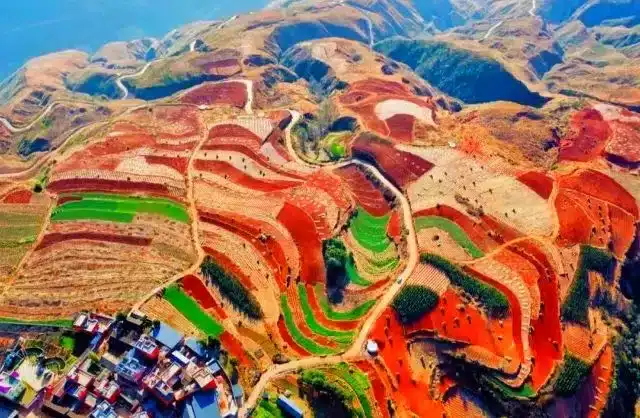
- Bring a good camera & drone – The landscape is incredibly photogenic.
- Wear comfortable shoes – Some viewpoints require short hikes.
- Respect local farmers – Do not step on crops for photos.
- Pack warm layers – Mornings and evenings can be chilly.
- Stay overnight – Sunrise and sunset are magical; guesthouses are available in villages like Huashitou.
FAQs about Dongchuan Red Land
Is it possible to visit Dongchuan Red Land on a day-trip from Kunming?
Yes, you can make a day trip from Kunming. Visitors would often take a morning bus trip to Dongchuan District and return in the evening.
What is the absolute best month to visit Dongchuan Red Land for photography?
May to June and September to November are the top windows with the boldest colors come back to the land. Late September to mid-November provides the richest reds and golds, which can bring a sharp contrast for your pictures.
Are there good accommodation options (hotels or guesthouses) near the Red Land viewpoints?
Yes, in villages like Huashitou Village (Flower Stone Village) you’ll find guesthouses and small hotels catering to all types pf travelers.
Is it necessary to hire a local guide or driver to explore the Red Land?
Yes, and that’s something many visitors will do. Hiring a local driver/van allows you to explore more scattered vantage points with flexibility. And usually the guides can tell you more details of the local culture and history.
Do I need to carry cash, or are credit cards/mobile payment widely accepted?
Nowadays, you can use WeChat/Alipay in basically everywhere, and these apps now have versions that specifically designed for foreigners (foreign credit cards may not be acceptable in these places). However, when traveling in some remote areas, it would be wise and useful to bring some cash.
Discover Dongchuan Red Land with China Xian Tour
Dongchuan Red Land’s is certainly a masterpiece painted by nature, and it’s always rewarding to explore deeper into its beauty. However, since it’s located in a rather remote area, joining China Xian Tour will be the best choice to have a stress-free and fulfilling tour. Our travel experts will customize an itinerary that suits your preference and can also include trip to other Yunnan highlights if you expect it. With us taking care of the details, you won’t need to worry about any other things except for preparing yourself for the unforgettable moments along the journey.