








Written by Natalia |
Influenced by the distorted aesthetic concepts of ancient society, in addition to the corset-wearing in Europe, there was also the historical practice of foot binding in China. In ancient Chinese culture, small feet were regarded as a symbol of female beauty and delicateness, thus giving rise to this peculiar tradition, which was popular for nearly a thousand years. The folk saying “a pair of small feet, a bucket of tears” directly reflects the physical torture and mental oppression that women are forced to endure.
This article will answer common questions about Chinese foot binding, explore how this “beautiful” tragedy occurred and evolved, what profound impacts it brought, and how it was eventually abolished.
Content Preview
- 1. What Is Chinese Foot Binding?
- 2. When and Where Did Foot Binding Originate?
- 3. Why Was the Foot Binding Practiced?
- 4. How Foot Binding Was Done?
- 5. How Long Did This Painful Process Take?
- 6. What Were the Foot Binding Practices in Different Dynasties?
- 7.What Did Bound Feet Look Like?
- 8. Could Women Walk with Bound Feet?
- 9. What Are the Health Problems Associated with Foot Binding?
- 10. When Was Foot Binding Banned and Why?
- 11. Is Foot Binding Still Practiced Today?
- 12. Where to Learn More About Foot Binding in China?
- Plan Your China Tour with China Xian Tour
1. What Is Chinese Foot Binding?
Foot binding is an ancient Chinese practice that wraps and restrains a woman’s feet with cloth to achieve a beautiful appearance. This small, arched “lotus foot” was once an important criterion for the aesthetic standards of ancient Chinese women, essentially a physical discipline imposed by male-dominated society on women.
What Were “Lotus Feet”?
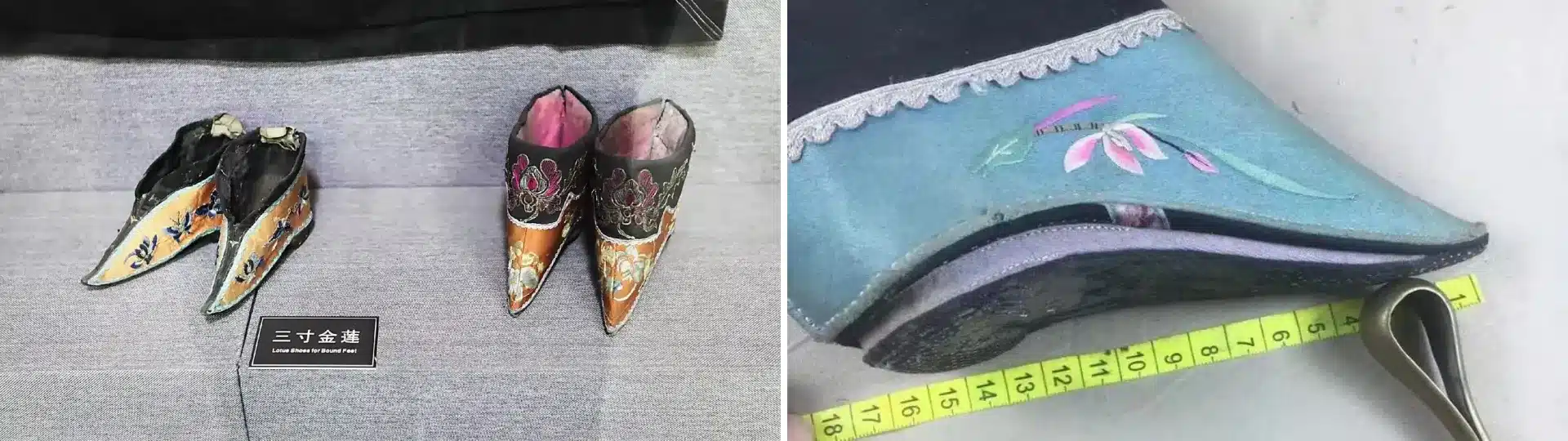
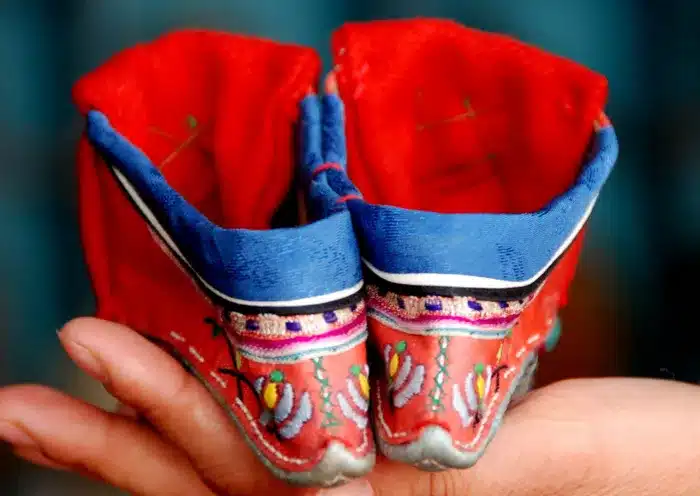
In traditional Chinese society, it was considered beautiful for women’s feet to be bound small enough and capable of walking. So, when women reached a certain age, their feet would be bound tightly with cloth straps, ultimately forming a pointed, thin, and conical shape resembling water caltrop. After binding the feet, put on embroidered pointed shoes (bow shoes) made of silk or cloth, which was called “Lotus Feet”. Such small feet were generally between three and four inches (10-13.2 centimeters) long, also known as “Three-Inch Golden Lotus”.

2. When and Where Did Foot Binding Originate?
When did this practice begin? Different sources offer varying opinions. The most widely-circulated one is that Chinese foot binding originated during the Five Dynasties and Ten Kingdoms period in the 10th century.
The last emperor of the Southern Tang Dynasty, Li Yu, had a concubine named Yao Niang who was delicate and skilled in dancing. She wrapped her feet with cloth to make them slender and curved like crescent moons, and danced on the Golden Lotus Platform, which was imitated by everyone.
Later, foot binding gradually spread to the public, and reached its peak during the Ming and Qing dynasties.
3. Why Was the Foot Binding Practiced?
The phenomenon of women changing their physical appearance to achieve “beauty” has existed in many cultures around the world. In ancient history of China, women practiced foot binding,which might be related to the Chinese people’s aesthetic preference for delicacy. The literati class of the Song Dynasty regarded “small feet” as a symbol of exquisite femininity, gradually forming a social trend of “smallness as beauty”.
Another reason is that ancient Chinese men emphasized that wives were “insiders” and should not go far away. So, foot binding was used to restrict women’s freedom of movement and maintain chastity. Since the Yuan and Ming dynasties, regardless of social class, the concept of difficult marriage with big feet was prevalent. This practice was also one of the important manifestations of sexual oppression imposed on women. In short, it was a complex cultural phenomenon influenced by multiple factors such as aesthetics, society, morality, and economy.
4. How Foot Binding Was Done?
The foot binding process during the Ming and Qing dynasties was cruel. Usually, starting from the age of 4-6 for girls, the natural growth of their feet was restricted and altered by wearing pointed shoes and using foot-binding cloth. Curled the four little toes under the big toe, and then wrapped them tightly with a strap in a series of loops. By bending and pressing, the foot length was greatly shortened. Continuing to restrain in this way, it would form a pointed-shaped foot, with the instep arching high, which is called the “three–inch golden lotus”. Then, a pair of matching shoes – lotus shoes – was needed. They were finely crafted, with soft soles and surfaces, lightweight and elegant, presenting a unique beauty.
5. How Long Did This Painful Process Take?
The painful process of Chinese foot binding usually lasts for about 7-10 years, depending on individual development and binding intensity. Women undergo foot re-shaping from childhood (5-8 years old) and reach a basic form by adolescence (12-15 years old), and then maintain it for life. At the cost of decades of physical torture, it forcibly conforms to male-dominated distorted aesthetics.
6. What Were the Foot Binding Practices in Different Dynasties?
Dynasty |
Age |
Shape & Size |
Popularity |
Song (960-1279) |
Usually starts from 5-8 years old and lasts until 12-15 years old when feet bones are basically formed. |
The main feature is “slender and straight”, without forming extreme deformities. |
Mainly popular in the upper classes, such as the court, nobles, officials, and literati families, and not widespread among the common people. |
Yuan (1271-1368) |
Starts from 4-7 years old, and completes in 4-6 years. |
The aesthetic is still based on “slender and straight”, with three-inch gradually becoming an ideal standard. |
Began to spread to the general public, and lower-class working women still have less foot binding. |
Ming (1368-1644) |
Strictly starts from the age of 5 and continues until the age of 12. |
Not only requiring small feet, but also emphasizing the bow shape of the feet, forming the “three-inch golden lotus”. |
Became widely popular among the people as a common social trend. |
Qing (1636-1912) |
Starts earlier (3-6 years old), and lasts until around 15 years old. |
Strictly requiring feet to be no more than three inches long, with severely deformed toes and a high instep. Forming the formula of “Three-Inch Golden Lotus”: thin, small, pointed, curved, fragrant, soft, and upright. |
Almost popular in all regions of China, whether urban or rural, upper class or general public, the vast majority of Han women must have their feet bound. |
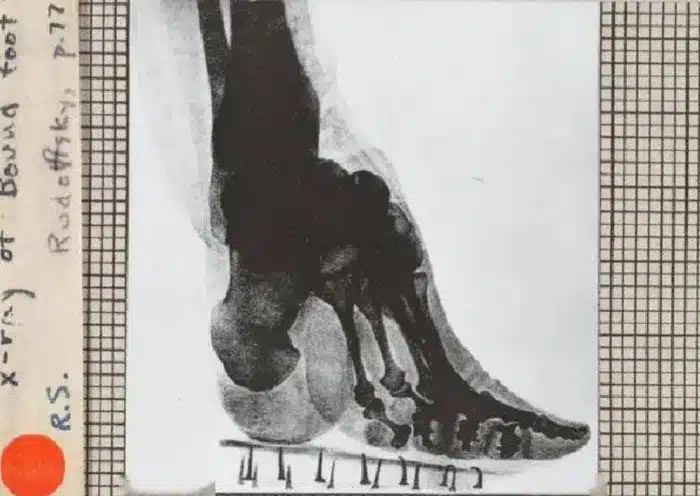

7. What Did Bound Feet Look Like?
The X-ray views of bound feet show a distinct triangular deformity in the foot bones. A typical example is the “three-inch golden lotus”, with its foot length shortened to about 10 centimeters and volume reduced to about half of a normal foot. When viewed from the front, the bound foot looks like it has suffered a fire injury. There is only one raised toe, and the nails on it can be vaguely discerned. From a side view, the toes are forcibly bent towards, curled up, and pressed against the sole. The heel becomes bloated, the sole disappears, and the arch protrudes, completely losing their natural physiological structure. And the skin on food back often shows dense wrinkles and creases.
8. Could Women Walk with Bound Feet?
Generally speaking, after foot binding, women could walk with practice! However, due to the damage and severe deformation of the original feet structure during the binding process, walking was extremely difficult. They usually couldn’t walk far, their center of gravity would be unstable, and their walking speed would be slower.
Little girls who have just had feet bound often could not walk on their own or needs assistance due to excessive pain. Only after a long time, as their foot bones gradually adapted to the deformed state, could they barely walk with their heels and big toes. But their movement was very inconvenient and they were unable to engage in heavy labor.
9. What Are the Health Problems Associated with Foot Binding?
The harm caused by this practice to women is enormous and lasting. It not only leads to permanent deformities of the feet, difficulty walking and limited mobility, mental and psychological trauma, but also triggers a series of serious health problems. For example, complications such as infection, ulceration, gangrene, arthritis, toe loss, arch fracture, pelvic deformation, scoliosis, severe lower limb dysfunction, and a higher risk of fractures caused by falls in old age.
After foot binding of China, surgery can help restore some of the damage, but not all and only limited to young people, as the effects of fractures and abnormal growth over several years are irreversible. But for elder women whose physical functions are aging and feet have been bound for too long, it is impossible to recover.
10. When Was Foot Binding Banned and Why?
In the late Qing Dynasty, with the introduction of modern ideological enlightenment, progressive people criticized the distorted aesthetic of “small feet as beauty”. The women’s liberation movement emerged. Foot binding, as a feudal custom, seriously damaged women’s physical and mental health, restricted their labor and social participation, and hindered national development and social progress.
After the establishment of the Republic of China in 1912, President Sun Yat-Sen issued the “Encouragement to Ban Foot Binding Order”, which for the first time banned foot binding in the form of a national law, marking the end of this custom. In 1928, the Nanjing National Government further promulgated the “Regulations for Prohibiting Women from Foot Binding”. And by the 1930s, the practice of foot binding had basically been eliminated.
After the founding of the People’s Republic of China around 1950, the Marriage Law explicitly prohibited any form of physical harm and gender discrimination, and completely abolished this tradition.
Famous Opponents of Foot Binding in Chinese History
- Kang Youweiand Liang Qichao: leaders of the Reformists who established the “Non-Foot-Binding Society” to “strengthen the race”, setting a precedent for openly opposing foot binding in modern times.
- Qiu Jin: A female revolutionary who opposed foot bindingthrough her personal experiences and literary works, and called on Chinese women to pursue independence.
11. Is Foot Binding Still Practiced Today?
Currently, the practice of foot binding has faded from Chinese society. Since the late Qing Dynasty and early Republic of China, it has been widely criticized as a feudal custom that oppressed women. After the founding of New China, it was explicitly prohibited. This change reflects the social progress and idea renewal. Although it has been completely abolished at the official level, there are still individual elderly people in remote rural areas who bind their feet due to extreme ignorance. This is totally illegal and contrary to modern civilization.
12. Where to Learn More About Foot Binding in China?
When you travel to China, it is recommended to visit the following two museums to learn more about foot binding practice:
- Three-Inch Golden Lotus Museum: Located in Anren Town, Dayi County, Chengdu City, Sichuan Province, it houses nearly 7,000 national cultural relics and tells the historical process of ancient Chinesefoot binding to foot liberation.
- Three-Inch Golden Lotus Hall: Located in Xizha of Wuzhen Water Town, Tongxiang City, Zhejiang Province, it is the first topic museum in China to systematically display the foot binding The building is in the style of traditional Jiangnan residential architecture, and houses a large collection of foot binding shoes.
Plan Your China Tour with China Xian Tour
Chinese culture that has been accumulated for thousands of years is extensive, profound, magnificent and colorful, and there is still much waiting for you to explore. Welcome to join our China tour and personally experience this only uninterrupted ancient civilization. With Chian Xian Tour, our professional tour guides will introduce you to the real life, culture, and customs in China.