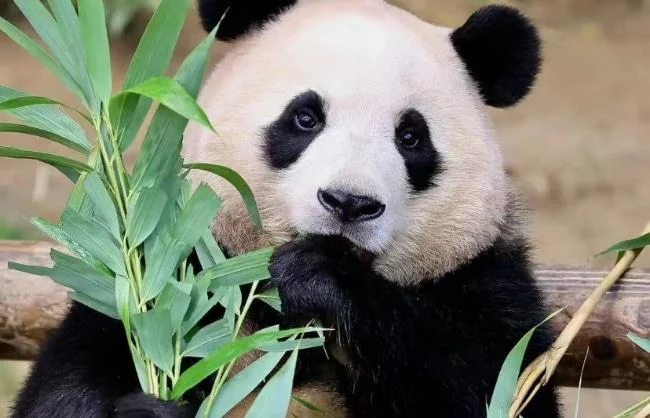







When it comes to giant panda, bamboo may firstly come into your mind. But, do you know why giant pandas eat bamboo? How much bamboo do they eat each day? What else do they eat? Do you think it is an herbivore? To sole solve these puzzles, just keep reading on and on.
Content Preview
- What Makes Giant Pandas’ Diet So Unique
- Bamboo
- What Else Do Giant Pandas Eat Besides Bamboo?
- What Do Baby Giant Pandas Eat?
- Where to See Pandas Eating in Real Life
- Conservation and Diet
What Makes Giant Pandas’ Diet So Unique
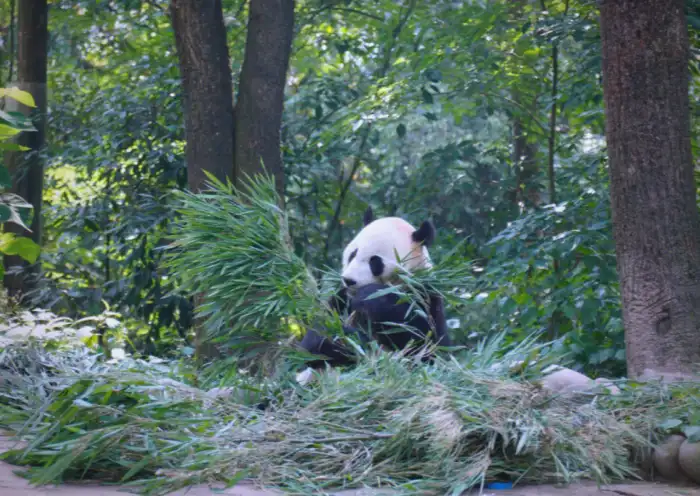
In the diet of giant pandas, bamboo has a big role to play. Their daily intake of bamboo is about 12-38 kilograms, including bamboo shoots, leaves and stems. And, they have a low digestibility because of 4-meter intestinal tracts, so they need to eat food about 12 hours per day.
Giant panda is carnivore because they have sharp canine teeth, short and straight intestinal tracts, and features of carnivorous animals. To seek for survival, they choose to eat bamboo. Thus, they not only get abundant energy but also avoid cut-throat competition with other carnivores.
As preys plunged in the ice age, giant pandas were forced to eat bamboos because of its easy accessibility. Besides, they have special intestinal flora to decompose bamboo fibres and obtain fewer nutrients. Eating bamboo enables giant pandas to have a lower metabolic rate, thus reducing energy consumption.

Bamboo
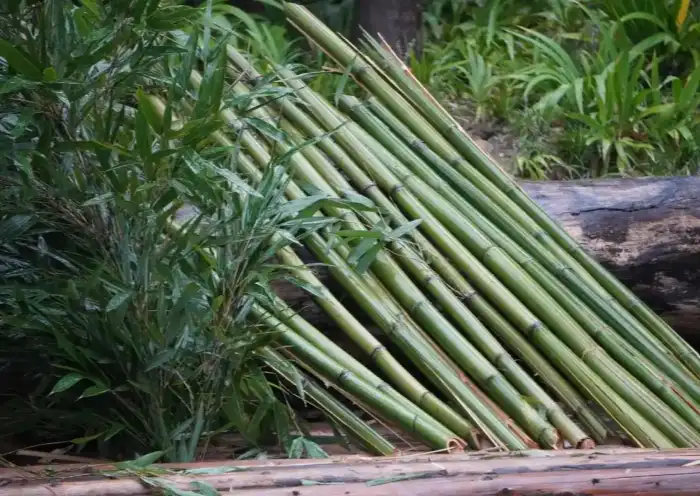
Bamboo is the main food source of giant pandas. It accounts for more than 99% of total consumption amount throughout the year.
In addition to that, bamboo embraces several species and giant pandas have their own preferences based on taste and seasons.
Why Do Pandas Rely on Bamboo?
The reason that pandas strongly rely on bamboo results from environmental pressure and physiological specialization.
The environmental degradation seriously slashes food source, but there is a large number of available bamboo. Besides, eating bamboo help pandas avoid the fight for preys with other fierce animals and obtain more life chances.
Giant pandas have special intestinal flora to decompose bamboo fibres and get nutrition. It enables them to follow a unique vegetarian recipe.
To compensate for the low nutrition of bamboo, adult pandas will spend 12 – 15 hours eating 12 – 38 kg bamboo every day. They will choose the most nutritious parts of bamboo, such as bamboo shoots and young bamboo leaves, and prefer specific bamboo species to maximize energy and nutrient intake. Their strong jaws and large molars can crush bamboo, and the unique wrist bone, known as the “pseudo-thumb”, can help them grip bamboo shoots.
The specific microorganisms in their intestines can break down cellulose and hemicellulose in bamboo. Besides, their basal metabolic rate is becoming lower, organs are significantly shrunk, and daily activities are reduced during the process of evolution.
Types of Bamboo Giant Pandas Prefer
The edible bamboo species of giant pandas can be mainly divided into seven types.
- Bashania fangiana is a primary species in Sichuan. It contains high water content, fewer fibers and good taste. The protein of bamboo leaves is 19.44%.
- Fargesia denudata is mainly distributed in southern Gansu and northern Sichuan. It has a strong adaptive ability and good taste.
- Fargesia robusta is commonly seen in natural habitats of Sichuan。Its shoots are warmly welcomed because of fresh and tender taste.
- Bashania fargesii contains rich nutrition, including 8.2% of fibre and 4.3% of sugar. It is the staple food of pandas in Sichuan and Shaanxi.
- Phyllostachys bissetii has a flavor of sweet and tender shoots.
- Chimonobambusa szechuanica is juicy and has soft fibers.
- Indocalamus tessellates has wide leaves and tender spears.
See the following table for more details.
Type |
Distribution |
Feature |
Bashania fangiana is a primary species in Sichuan. It contains high water content, fewer fibers and good taste. The protein of bamboo leaves is 19.44%. |
Sichuan |
It contains high water content, fewer fibers and good taste. The protein of bamboo leaves is 19.44%. |
Fargesia denudata |
Southern Gansu and northern Sichuan. |
It has a strong adaptive ability and good taste. |
Fargesia robusta |
Its shoots are warmly welcomed because of fresh and tender taste. |
|
Bashania fargesii |
Sichuan and Shaanxi |
It contains rich nutrition, including 8.2% of fibre and 4.3% of sugar. It is the staple food of pandas in |
Phyllostachys bissetii |
Sichuan and Hubei |
It has a flavor of sweet and tender shoots. |
Chimonobambusa szechuanica |
Sichuan |
It is juicy and has soft fibers. |
Indocalamus tessellates |
The southern region of the Yangtze River Basin |
It has wide leaves and tender spears. |
Influenced by season, nutritional value and taste, pandas have different preferences. In spring, they favor Bashania fangiana because of its water content, fewer crude fibers and abundant protein. In autumn, they like Bashania fargesii because its protein is up to 16.1%. In winter, they select Bashania fangiana. Its crude fat content is only 0.59%, but it is easy to gain.
How Much Bamboo Do They Eat Per Day?
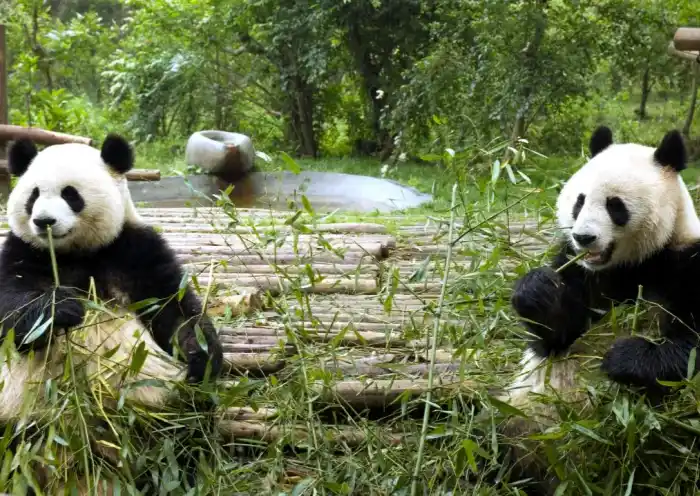
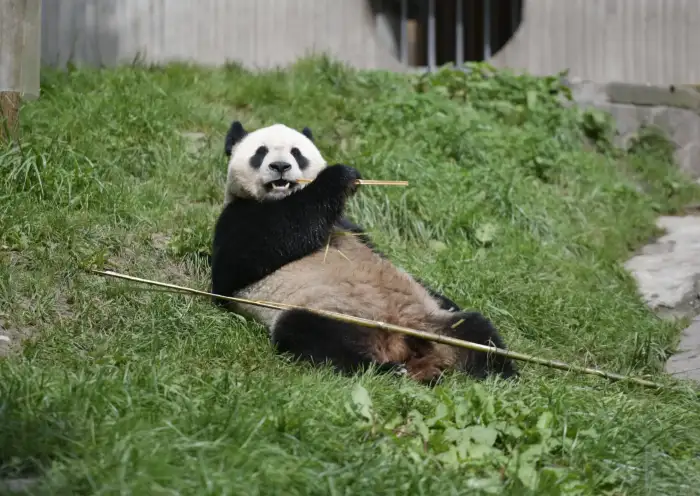
Wild giant pandas will need 20-40 kilograms of bamboo each day to get more nutrients. Pandas in captivity are fed on 20-30 kilograms of bamboos each day, but their actual intake is about 10-15 kilograms because they will dump bamboo stems.
Pandas are big eaters, but their digestibility is less than 20 %. The majority of nutrients are not fully absorbed before defecation. Besides, bamboo contains abundant moisture content, hard fibres and low energy density, so it cannot provide abundant nutrition. This is why pandas will be fed on bamboo five or six times each day.
Bamboo Nutrition and the Panda’s Digestive Challenge
Bamboo mainly consists of fibers and hemicelluloses, with lower protein and lipid content. It cannot provide key nutrients required by large mammals. And, bamboo stems are highly lignified and contain a large number of lignin that is difficult to decompose.
Bamboo primarily encompasses starch, hemicellulose and pectin. As main energy source of giant pandas, it is not easy to digest and cannot offer abundant nutrition. This is why they have to take food more than 10 hours each day to get enough energy.
The digestive tract of giant pandas is only four or five times as long as its body length. Food can be kept only for 5-13 hours in the stomach. The nutrient absorption efficiency is as low as 17%. Giant pandas have no caecum and the fermentation chamber of herbivores.
What Else Do Giant Pandas Eat Besides Bamboo?
Although bamboo accounts for 959% in the diet of pandas, they still take others foods for supplement, such as berries, croorps and herbs.
Occasional Foods in the Wild
Wild pandas are unable to regularly have abundant foods like those in captivity. In case of food shortage, they have no choice but to seek for other foods other than bamboo. In autumn, they often pick wild fruits like kiwifruits and loquat. They occasionally get corn stalks and awnless wheat. They even won’t say no to herbs in case of an acute bamboo shortage, like Chinese angelica. In winter, small animals like bamboo rats and birds will be their choice.
Giant Pandas in Captivity – a More Varied Menu
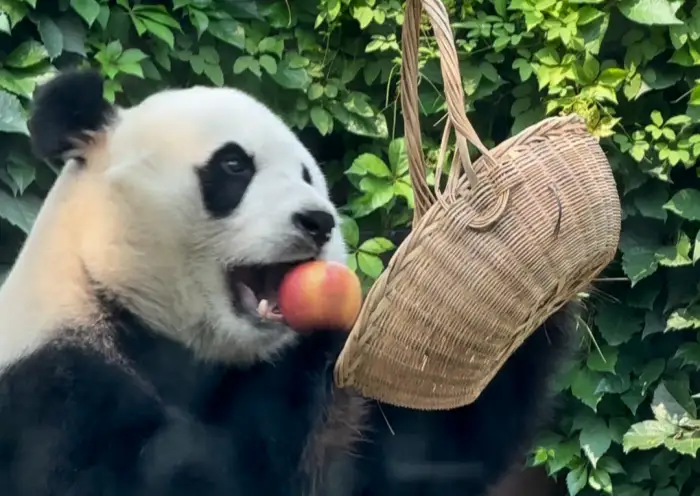
The diet of giant pandas in captivity centers on fresh bamboo. They will be provided with 20 or 30 kilograms of bamboos each day, which exceeds 60% of total food. This is to avoid dyspepsia. including Fargesia robusta, Yushania lineolata and Bashania fangiana. The bamboo species with high protein content will be better. To ensure comprehensive nutrition, In addition to that, they will be provided with concentrated feed, that is made of wheat, soybeans, corn, rice and wheat bran. High protein foods, fruits and vegetables will be also provided to supplement nutrition..
Whenever birthday or festivals arrive, pandas will get purpose-made foods, such as ice cake. To supplement nutrition, trace elements like bone meal, calcium carbonate and cod liver oil will be given. Animal keepers may give low-sugar cookies as positive motivation for the purpose of panda behavior training.
What Do Baby Giant Pandas Eat?
You have learned the diets of giant pandas, but you may not know some facts of baby giant panda.
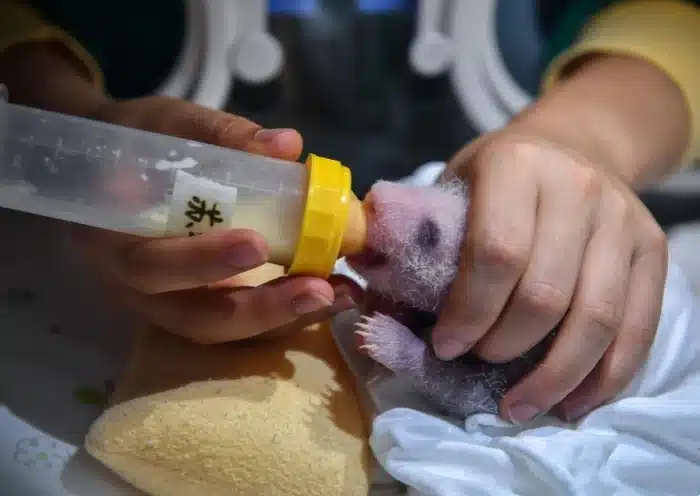
The newborn baby pandas totally rely on breast milk. Mothers will breast-feed their cubs for several months. If pandas are in captivity, they will be provided with artificial feeding in case of the mother’s milk shortage.
If baby pandas aged 6 months, such digestible plant foods as bamboo leaves and twigs will be introduced. But, they still need breast milk. Captive baby pandas will be provided with apples and carrots to supplement trace elements.
If baby pandas are above one year old, they will eat more bamboo, with breast milk as supplement.
they will completely follow the diets of adult giant pandas. Bamboo leaves and shoots are principal food, with complementary foods of watermelons and corns. If baby pandas are one and a half years old, they they will completely follow the diets of adult giant pandas. Bamboo leaves and shoots are principal food, with complementary foods of watermelons and corns.
Age |
Food |
newborn baby pandas |
breast milk |
baby pandas aged 6 months |
breast milk, bamboo leaves and twigs |
baby pandas are aged one year old |
bamboo leaves and shoots, breast milk |
baby pandas aged one and a half years old, |
Bamboo, watermelons and corns |
Where to See Pandas Eating in Real Life
To find out what pandas eat in real life, you are strongly recommended to visit Chengdu Research Base of Giant Panda Breeding i nin Sichuan province. This is the world’s largest breeding institution. You can see that pandas eat bamboo shoots and concentrated feeds. Near Chengdu, there are four other places to see pandas, including Dujiangyan Panda Base, Dujiangyan Panda Valley, Wolong Panda Base, and Bifengxia Panda Base.
Qinling Four Rare Animals Science Park in Shaanxi province is also a nice choice. It boasts the only one brown giant panda in captivity in the world.
Also, you can go to Baishuijiang national nature reserve in Gansu province. The infrared camera will present the picture that giant pandas enjoy bamboos and drink water in the wild.
Suggested China panda tours:
China Panda Volunteer Day Tour from Chengdu
Conservation and Diet
Threats to the bamboo supply
A stable supply of high-quality bamboo is of great importance for the survival of pandas. But there are several threats nowadays. The climate change may result in the shrinkage of bamboo-growing areas and cause bamboo to flower and die, so the supply is affected directly.
And human activities like over-exploitation result in the exhaustion of bamboo resources and isolation of their habitats, so pandas can not find different types of bamboo and can not exchange with other populations. Till now, more than 70% of pandas’ habitat has been lost. In addition, due to the cyclicity and regional restrictions of bamboo growth, the supply is unstable.
Captive breeding programs
Captive breeding is a very important strategy to save pandas in China, and remarkable achievements have been made. For example, in China Conservation and Research Center for the Giant Panda, the number of pandas has increased from 6 to over 350 in about 40 years. The center also develops a set of key techniques for wild training, release and monitoring. Till now, 11 pandas have been released into the wild with 9 survived.
With the aim of 100% natural mating, the center respects their natural mating behaviors, meanwhile helping them choose strong and healthy mates base on “competitive courtship”. Also, standardized DNA identification and paternity testing kits are used to make scientifically informed pairings and avoid inbreeding.

Start Your China Panda Tour with China Xian Tour
Cute pandas are famous animal stars all over the world. Tourists can not miss pandas during a China tour. And China Xian Tour can help you plan a panda tour. Just tell our travel consultant about your preferences, then she will customize a satisfying itinerary for you. We can also assign a knowledge guide, who can introduce the pandas in detail and answer your questions during the panda tour. So do not hesitate to contact us right now.