









Written by Veronica |
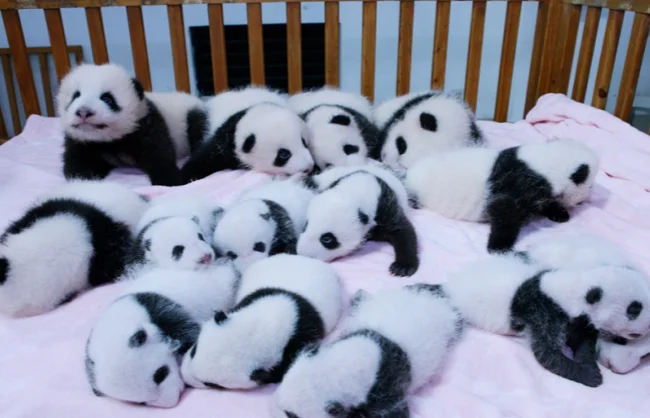
The giant panda is one of the most beloved and recognizable animals worldwide. With the distinctive black-and-white fur and gentle (or to say a bit “lazy”) demeanor, many of the giant panda have made people fall for them as China’s unique national treasure. But questions about this adorable creatures have always been raised: what exactly is the giant panda in a scientific context? And what makes it so unique?
From its biology and habitat to its fascinating behaviors and the sounds it makes, this article explores everything you may feel interested to know about the giant panda. No matter you’re now reading this as a wildlife enthusiast or someone who’s planning a China panda tour, understanding these gentle bears more comprehensively adds to the magic of seeing them in the wild or at breeding centers.
Content Preview
- What Is Giant Panda: Basic Scientific Facts
- Giant Panda Appearance & Anatomy
- Giant Panda Habitat & Population
- What Is the Behavior of a Giant Panda?
- China Panda Tour with Us
What Is Giant Panda: Basic Scientific Facts
What Is the Scientific Name for a Giant Panda?
The scientific name for a giant panda is Ailuropoda melanoleuca. This name originally derives from Greek, meaning “black and white cat-foot,” which refers to panda’s distinctive coloration and large paws. This species, indeed, belongs to the order Carnivora, but is unique in its diet and adaptations for eating bamboo.
What Family Is the Giant Panda In?
The giant panda is categorized in the bear family, Ursidae. Though its diet is almost entirely vegetarian. Some may falsely believe that giant pandas belong the same family as the smaller, tree-dwelling red panda (sometimes called “small panda” in Chinese), the panda shares common ancestors with other bears like the brown bear and polar bear. In case you get curious here, the red panda actually has its own family, Ailuridae. However, some debate exists about the evolutionary relationship between the two pandas.

What Is the Closest Relative to a Giant Panda?
For decades, scientists had debated whether the giant panda is more closely related to bears or raccoons, since it shares traits with both. Modern genetic research, however, later confirms that the giant panda is a true bear, belonging to the Ursidae family. It diverged from other bears around 19 million years ago, making it the most primitive living bear species. Its closest living relative is likely the spectacled bear of South America. Despite similar names and bamboo diets, the red panda is only distantly related and belongs to its own family.
If you want to know more about the giant panda research behind these findings or want to see these bears in person, consider joining a Chengdu panda tour, where you can visit world-famous panda research bases.
Recommended Chengdu panda tours:
- 3 Days Chengdu Panda Tour
- 4 Days Chengdu Panda Volunteer Experience
- 2 Days Chengdu Panda Tour
- Chengdu Panda Volunteer Tours
Giant Panda Appearance & Anatomy
What Color Is a Giant Panda?
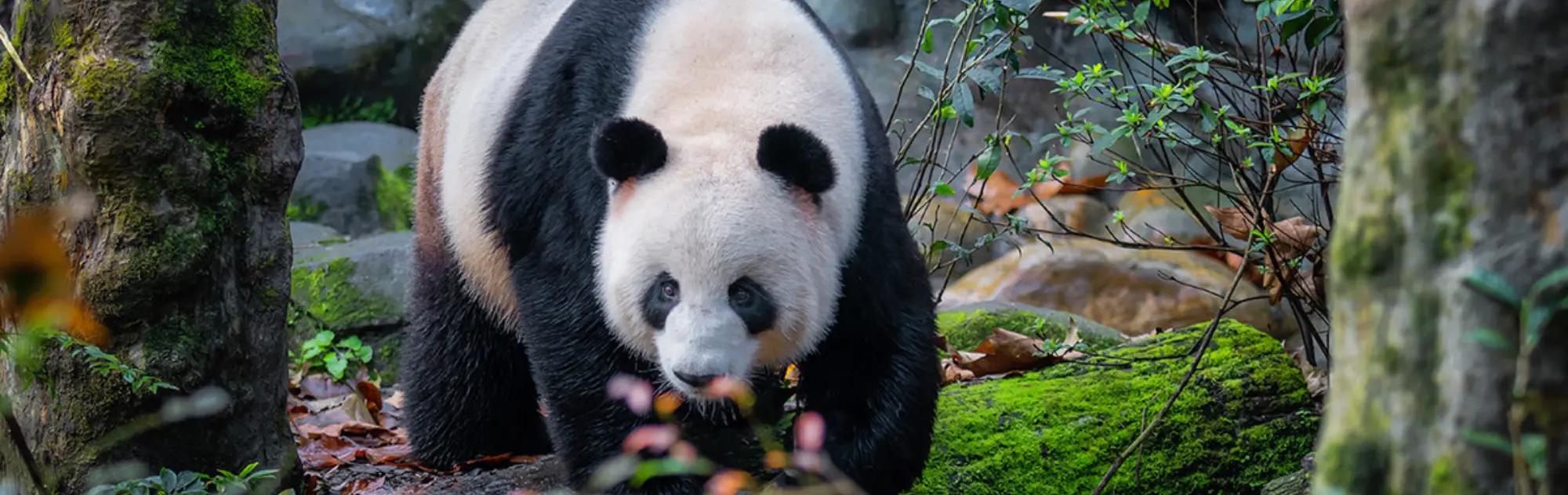
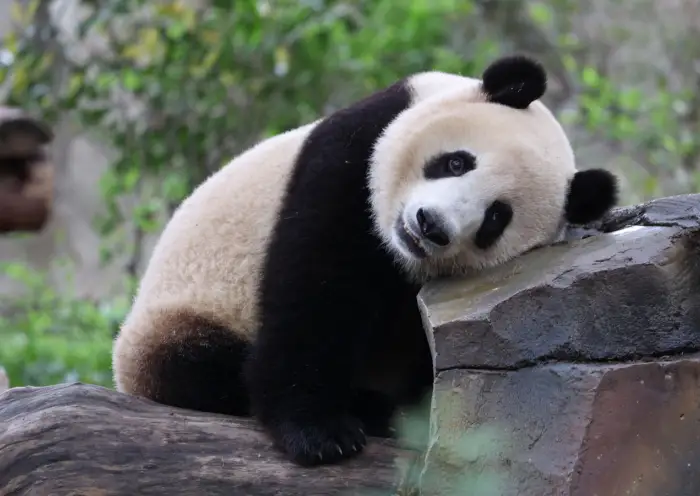
One of the most striking facts about the Pandas would be their unique black-and-white fur pattern. The white fur covers most of its body, while black patches distinctly appear around its eyes, ears, legs, and shoulders. Scientists believe this coloration are not just for a cute and special looking, they actually serves multiple practical purposes: camouflage in snowy and forested environments, communication among pandas, and temperature regulation. The black “panda eyes” make the bears instantly recognizable worldwide.
Panda Eyes: Meaning, Shape & Expression
The phrase “panda eyes” often refers to the dark patches around the panda’s eyes, giving it an endearing, expressive look. These blocks of color (usually color black) can help reduce glare and improve pandas’ vision in the dense bamboo forests. Interestingly, the term “panda eyes” in human interpretation sometimes describes dark circles that led by lack of rest or injury. Besides, these patches are not shaped exactly the same for all individuals, the sizes vary between different pandas, making each one of them unique and distinguishable.
Panda Paws and Their Thumb-like Bones
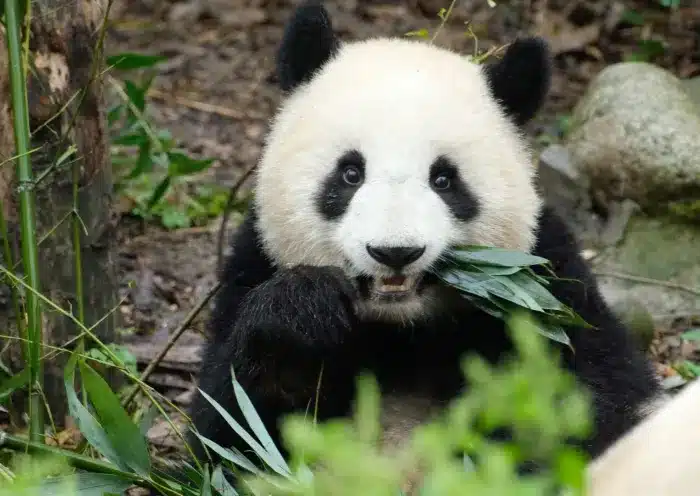
A giant panda’s paws are specially adapted for their bamboo diet, which significantly shows the greatness of nature. They have five fingers plus a pseudo-thumb, an extended wrist bone acting like a thumb (that human beings would have). This adaptation allows pandas to grasp bamboo stalks with precision. This is a crucial skill for pandas to have, since bamboo makes up over 99% of their diet. Their panda paws have thick fur and rough pads to help them walk on slippery forest floors.

Panda Head and Teeth
The giant panda’s head is large and round with strong jaw muscles and a broad skull (the latter two are not very easy to see directly). Their panda teeth are specialized for chewing tough bamboo stalks. Unlike carnivores, who have sharp teeth for tearing meat, pandas have grown large molars with flat surfaces for grinding plant material. Their powerful jaws and skull allow them to process bamboo efficiently also with the help of their special paws..
How Big Is a Giant Panda Bear?
Adult giant pandas typically weigh between 70 to 125 kilograms (154 to 276 pounds), with males generally grow larger than females. If they stand up, they’ll be about 60 to 90 cm (24 to 35 inches) tall at the shoulder and can reach up to 1.5 meters (5 feet) in length. These dimensions make them one of the larger bear species but still much smaller than brown or polar bears.
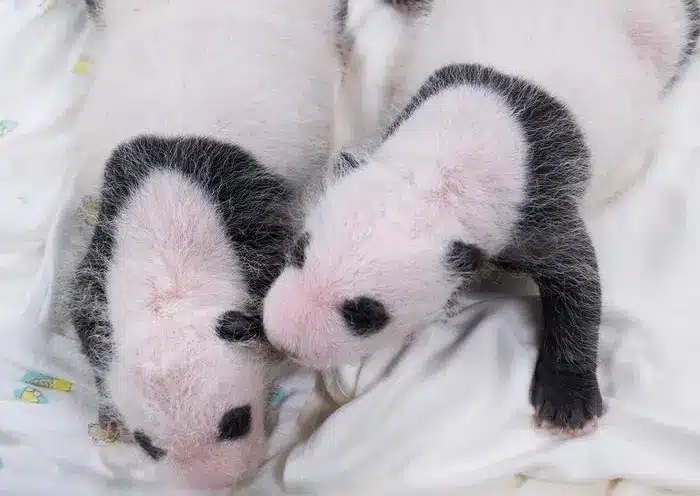
If you want to see these impressive creatures or even the baby pandas up close, many destinations in China offer visits to panda sanctuaries. Here, you can learn their size and playful behavior by real-life observation. If you’re really traveling to China for such an experience, don’t forget to meet the 16 most famous pandas and also the baby pandas.
Giant Panda Habitat & Population
Native Range: Sichuan, Shaanxi, Gansu Provinces
The mountainous regions in central China is the hometown of giant pandas. This large area spans from Sichuan province to Shaanxi and Gansu provinces. Panda’s habitats are located at elevations between 2,400–3,500 meters (8,500–11,500 ft), consisting of dense bamboo forests. These forests provide both fresh food and reliable shelter. Unfortunately, excessive human activities now result in serious habitat fragmentation, which has made pandas’ natural range smaller and more isolated.
Conservation Status and Population
The giant panda is currently classified as Vulnerable on the IUCN Red List. Thanks to extensive conservation efforts that done by a large lumber of experts, the wild population of panda is estimated at over 1,900 individuals in recent years, with hundreds in captivity worldwide. China has established several reserves and breeding centers like the renowned Chengdu Research Base of Giant Panda Breeding, which has played a crucial role in increasing panda numbers and genetic diversity
Global organizations like WWF and IFAW also play active roles in panda conservation. They have put a lot of effert in protecting habitats, anti-poaching measures, and scientific research. Captive breeding programs has also done a major help in panda population growth, though reintroduction of the captive pandas into the wild still remains challenging and needing more works.
Here are some of the most famous panda bases in Sichuan:
- Chengdu Research Base of Giant Panda Breeding (in Chengdu city center)
- Wolong National Nature Reserve (about 130-160 kilometers from Chengdu, 2-2.5 hours’ drive)
- Bifengxia Panda Base (about 150 kilometers from Chengdu, 2 hours’ drive)
- Dujiangyan Panda Base (about 1 hour’s drive from Chengdu city center)
What Is the Behavior of a Giant Panda?
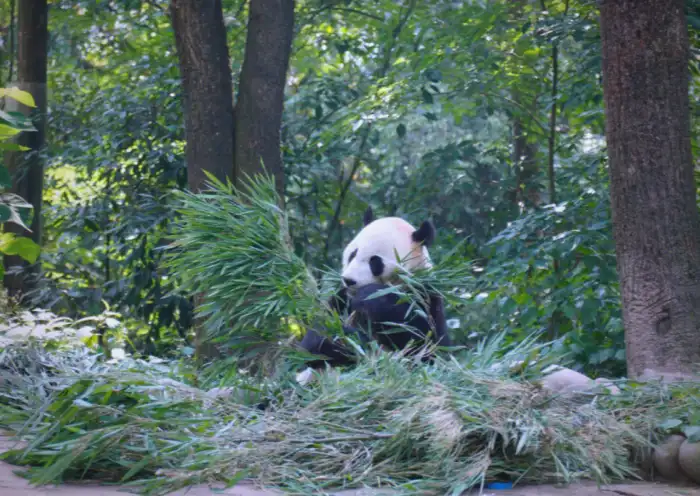
Giant pandas are generally solitary animals, they’ll live alone for most of the time in their life, except during mating season or when mothers starts to care for cubs. And when talking about their routine, pandas will devote most of the day to eating bamboo, as they need to consume about 38 kilograms (about 84 pounds) daily to get enough energy. Despite their calm appearance, pandas can also be really playful and curious, and that why you can often see pictures of them climbing trees or engaging in gentle wrestling with companions in captivity.
When it comes to what kind of sounds they can make, the giant panda will show you a variety of noises including bleats, honks, and growls to communicate. Cubs squeal to get attention, while adults may make honking sounds during mating season or to signal alarm. Unlike many bears, they do not roar but possesses a unique vocal range that suited to their environment. >> See more giant panda behaviors.
China Panda Tour with Us
If you want to meet these adorable creatures at a close range, then join one of our expertly guided China panda tours. Our packages offer unforgettable opportunities for you to see how how happy these pandas are in their natural or semi-natural habitats.
We also provide customized tours which combines panda encounters with other cultural experiences, including tasting local cuisine, visiting historical sites, and having other wildlife tours. Book your China panda tour today to experience the charm of this iconic animal firsthand!