










Written by Veronica |
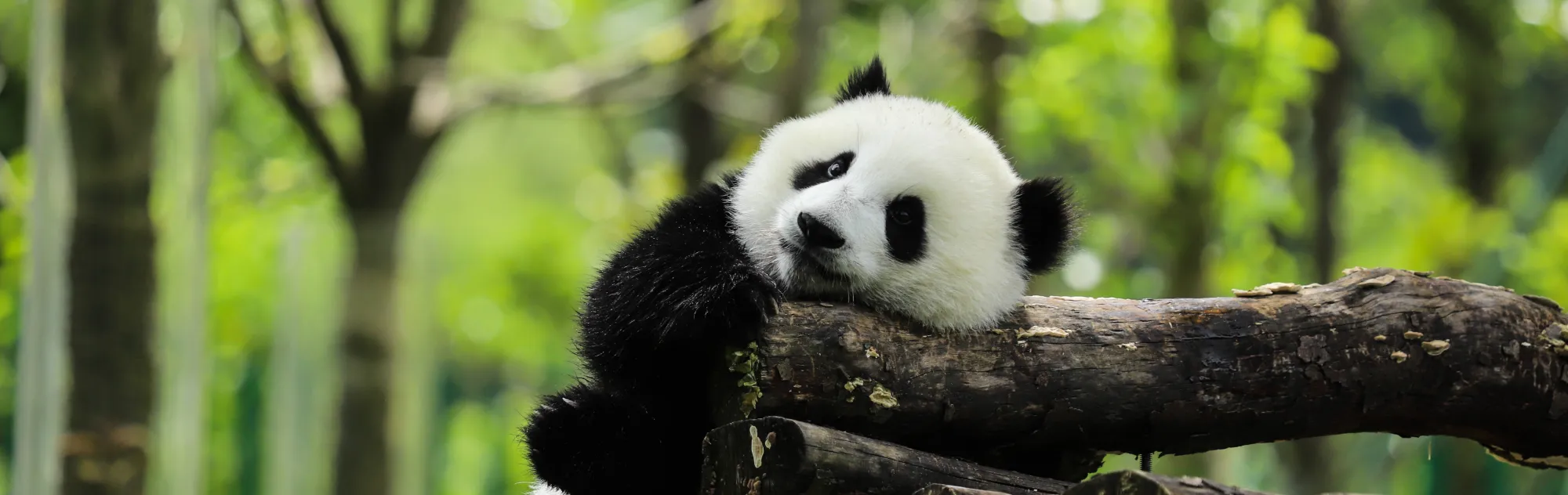
Giant pandas are one of the most beloved animals in the world. These gentle giants, which are native to China, have captured hearts and attention across the globe through their cute looking: an adorable face and fluffy black-and-white coats. Since some may say they want to know more than just the appearance of pandas, in this article, we’ll explore over 20 fun facts about giant pandas. You can discover things from their diet and habitat to their life span and behaviors. Whether you’re a curious animal lover or planning a China panda tour, this article has everything you need to know.
Content Preview
- What Is a Giant Panda? Are Pandas Bears?
- Where Do Giant Pandas Live? Native Habitat & Historic Range
- Giant Panda Diet & Eating Habits
- Pandas Can Poop 28 Kilos Per Day!
- Pandas Like Sleeping and Climbing Trees
- Pandas’ Black and White Coats Are Good Camouflage for Them
- Pandas Use Scent to Mark Their Territory
- Size, Weight & Sound of Giant Pandas
- Panda Cubs Are Very Small and Pink
- Life Cycle – Pandas Live 18-30 Years
- Are Giant Pandas Endangered?
- Giant Pandas Mate in Spring, Give Birth in Autumn
- Giant Panda Protection and Research
- Are Giant Pandas Dangerous or Friendly?
- What’s the Panda’s Closest Relative?
- Do Pandas Hibernate?
- Where to See Giant Pandas
- Giant Panda Keeper
- Giant Panda Cartoons
What Is a Giant Panda? Are Pandas Bears?
Scientifically named Ailuropoda melanoleuca (in Latin), the giant panda is known and protected as China’s iconic “national treasure.” And contrary to common myths, researches have shown that pandas belong to the Ursidae family—which means they’re true bears, not raccoon. However, its Chinese name, dà xióng māo (大熊猫), literally translates to “big bear cat,” mixing its robust bear-like build with a touch of feline character.
And what makes pandas so unique? Two of the most important traits would be their striking black-and-white fur and their 6 “fingers” which helps them to grip stalks of their featured food, bamboo. >> What is Giant Pandas?

Where Do Giant Pandas Live? Native Habitat & Historic Range
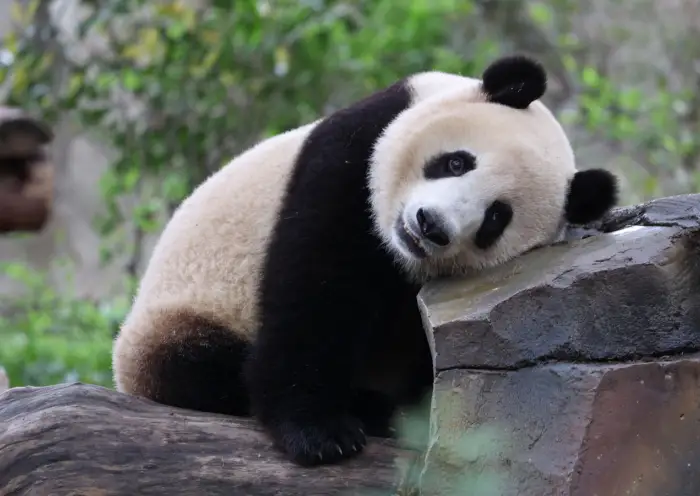
Giant pandas are born in China’s mountainous regions, specifically in Sichuan, Shaanxi, and Gansu provinces. After millions of years, today, panda’s wild habitat is found to be confined to only six mountain ranges in the areas mentioned. These giant creatures are now thriving in the misty and bamboo-rich environments at an altitude around 2,400–3,500 meters (8,500–11,500 ft).
Historically, pandas roamed across southern and eastern China, including Yunnan and Guizhou, but deforestation and human expansion fragmented their range over time. Nowadays, there are over 1,800 wild pandas live in these protected reserves, which also symbolizes the success of global conservation.
Giant Panda Diet & Eating Habits
What Do Giant Pandas Eat?
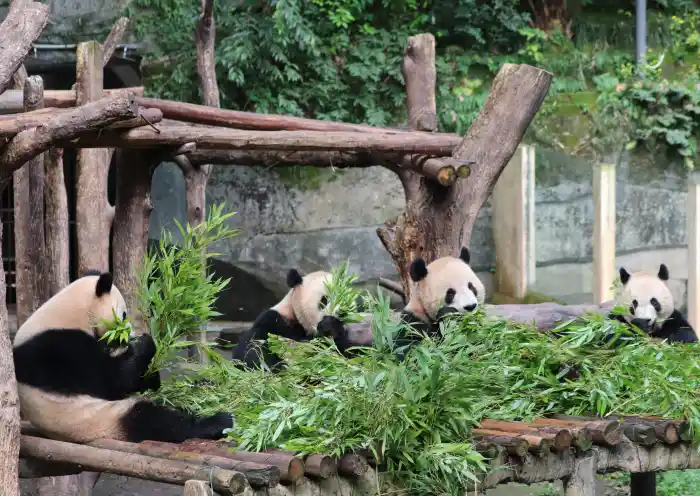
Bamboo is absolutely Giant Pandas’ lifeline. Over 95% of pandas’ diet consists of 12 bamboo genera (60+ species), including arrow bamboo, hooked bamboo, dragon bamboo and more. They naturally prefer tender shoots (new growth) for these kinds of shoots possess high nutritional value and are ease of digestion.
Pandas Used to Eat Meat
Despite their bamboo-heavy diet, giant pandas are actually evolved from carnivorous ancestors 2–3 million years ago. Fossil records show they had once hunted small mammals (like rodents) and birds for food. However, as bamboo forests expanded, they gradually adapted more and more to bamboo, a low-calorie food source. In fact, their digestive systems still retain traits from meat-eaters (e.g., short intestines), but they’ve evolved to thrive on bamboo.

How Much Do They Eat Daily?
To meet their energy needs, pandas eat 12–38 kg (26–84 lbs) of bamboo daily, spending 12–16 hours a day feeding.
Pandas Can Poop 28 Kilos Per Day!
Giant pandas’ high-fiber bamboo diet is tough to digest, and in fact, only 17% of how much they eat can be digested. The rest would pass through their system as waste, which explains why pandas poop up to 28 kg (62 lbs) daily. This constant eating and pooping cycle keeps them energized and helps their digestive systems stay active.
Pandas Like Sleeping and Climbing Trees
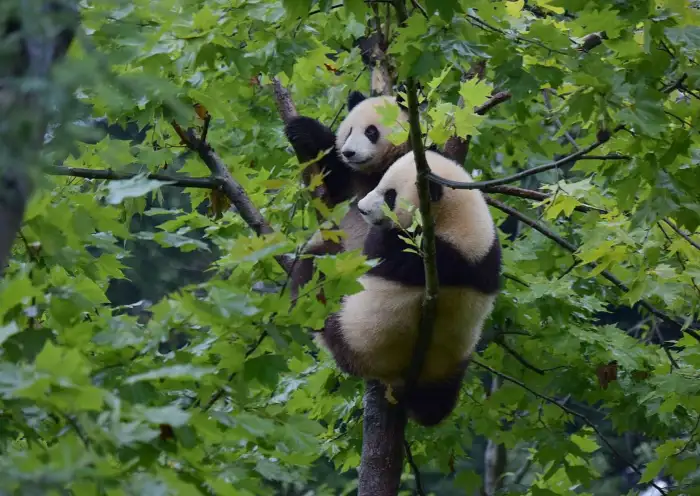
Pandas sleep 10–14 hours a day in order to reduce energy consumption and they would often curl up in tree hollows, sunny slopes, or cozy dens. When awake, they spend most of the time in munching bamboo and playing—especially cubs, who roll, climb, and tackle each other. Adult pandas also climb trees to escape threats, find mates, or nap in quiet spots.
Pandas’ Black and White Coats Are Good Camouflage for Them
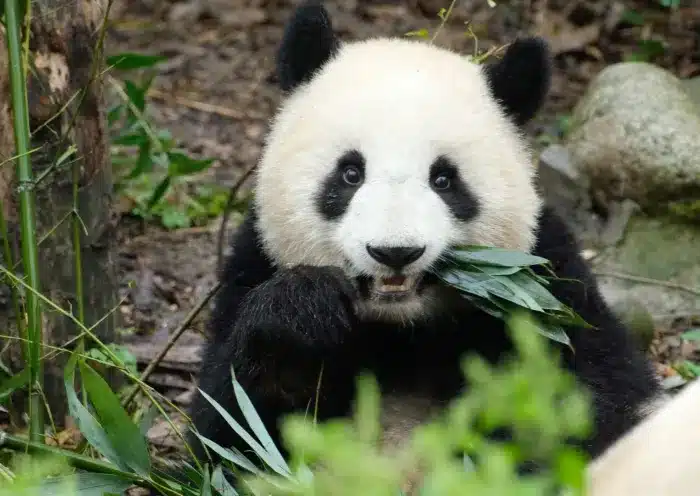
It is a misunderstanding that giant pandas iconic black-and-white fur would make them stand out in natural environment. In fact, their striking-colored fur isn’t just cute for looking—it’s functional as a perfect disguise. White patches would blend them into snowy slopes or bright rocks, while black limbs and ears hide them in shadowy forests. Even their “black eye rings” reduce glare, like built-in sunglasses, can help them better spot predators or prey.
Pandas Use Scent to Mark Their Territory
Pandas have scent glands mostly on their anus. They would often rub these on tree trunks, rocks, or grass to leave “messages” like “This area is mine!” or “I’m looking for a mate.” These scents can warn other pandas to stay away or invite them to interact during breeding season.
Size, Weight & Sound of Giant Pandas
How Big Are Giant Pandas?
Adult giant pandas stand 60–90 cm (2–3 ft) tall at the shoulder, with a robust, stocky build that makes them look both powerful and cuddly. Their total body length—including head and torso—spans 1.2–1.8 meters (4–6 ft), while their bushy tail adds another 10–12 cm (4–5 inches). Males are typically 10–20% heavier than females, average weighing 70–120 kg (154–265 lbs).
What Sound Does a Giant Panda Make?
Giant pandas produce a wide variety of sounds, mainly including:
- Cub sounds: Newly born giant panda cubs emit relatively monotonous sounds, primarily “吱吱” (zhī zhī, squeaks), “哇哇” (wā wā, wails), and “汪汪” (wāng wāng, barks), which could indicate hunger or discomfort.
- Adult sounds: Adult giant pandas have more complex calls, including roars, low roars, grunts, barks, loud barks, shouts, screams, and hisses, typically used to express emotions or convey information.
- Emotional expression: Different combinations of sounds can convey different emotions, such as fear, pleasure, or seeking mates.
Panda Cubs Are Very Small and Pink
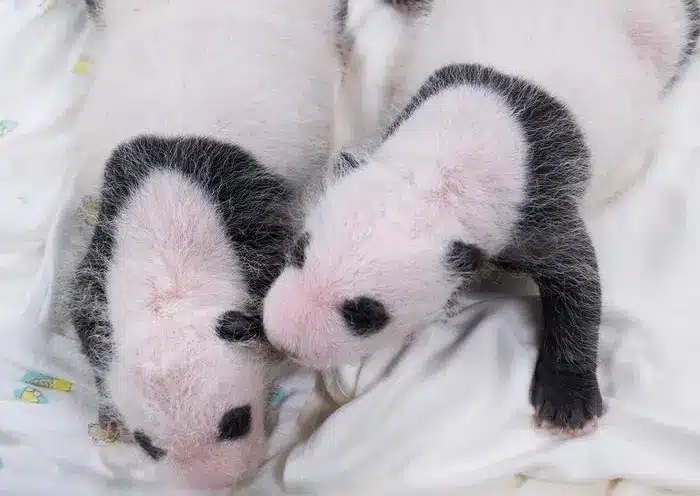
Newborn giant pandas are tiny, weigh only 85–140 grams (3–5 oz, about a pencil’s size!). They are pink, hairless, and fragile, looking more like small rodents than the iconic black-and-white bears they’ll grow into. Their eyes stay closed for 6–8 weeks, as a result, they will rely fully on their mother for warmth, milk, and protection.
By 3–4 months, their white fuzz emerges, also with black eye/ear/limb patches appearing. By 6–8 months, cubs will start to explore and nibble bamboo (nursing until 12–18 months). However, for those born in wild, they are really vulnerable to predators like eagles, pythons and more. The baby cubs are incredibly adorable, since most of them are born in August, it also makes this time period the most ideal for having a China tour including cub-spotting activity!
Life Cycle – Pandas Live 18-30 Years
Giant pandas’ life expectancy is about 18–30 years, while some could live 18–20 years in the wild (due to predation, habitat loss, etc.), most others can make it to 25–30 years in captivity (with better care). An interesting fact is that one panda year equals roughly 3 human years.
The world’s oldest recorded giant panda was Xinxing (“New Star”). He’s a male panda born in 1982 at Chongqing Zoo and he eventually lives 38 years and 4 months (until 2020), equivalent to 115 human years. Xinxing’s longevity can serves as a testament to the success of panda conservation, however, wild populations still need protection to thrive.
Are Giant Pandas Endangered?
To answer people’s concern about whether pandas are still endangered, we’re more than happy to say that giant pandas are now defined as “Vulnerable” (易危) on the IUCN Red List—upgraded from “Endangered” (濒危) in 2021. The status had been changed after over 1,800 wild pandas were found that year. The global population of giant panda now exceeds 2,600 (around 1900 wild, 757 captive), showing a recovery driven by habitat restoration and breeding programs.
Giant Pandas Mate in Spring, Give Birth in Autumn
Giant pandas breed seasonally, with females entering heat once yearly (March–May), which only lasts for 2–3 days. Males will then compete for mates, through marking territory and vocalizing; females respond with unique calls. After successfully mating, males leave, and females will raise cubs alone. Pregnancy normally lasts 83-200 days, with cubs normally born in August–October. Newborns weigh ~100g (3.5 oz), hairless, and pink, and these little babies will need to be nursed for 6–18 months.
Giant Panda Protection and Research
Efforts spent on protecting giant pandas mainly go to habitat preservation, captive breeding, and public education. China has designated pandas as “National Grade 1 Protected Animals,” while enforcing strict laws against poaching and habitat destruction. Large nature reserves (e.g., Wolong, Chengdu) restore bamboo forests and connect fragmented habitats.
Captive breeding programs, led by bases like the Chengdu Research Base of Giant Panda Breeding, use artificial insemination and cub-rearing techniques to help boost panda populations. Also, there are researchers study panda behavior, genetics, and health, they know how to track wild pandas via GPS collars, analyzing bamboo diet, and improving veterinary care. Panda bases also serve as education hubs, teaching visitors about conservation and fostering global support.

Are Giant Pandas Dangerous or Friendly?
Some may wonder that do giant pandas attack people? Well, generally speaking, giant pandas are not dangerous to humans. However, bare in mind that do not underestimate their strength and nature as wild animals. Wild pandas usually avoid people in their life, and they rarely attack unless being provoked (e.g., defending cubs or territory). Captive pandas, raised in human care, may appear docile for most of the time but still retain their natural instincts, as they’ll bite or swat if stressed.
Their “friendliness” is more like a human perception, in fact, they are never as social as dogs. While they tolerate interaction (e.g., zookeepers feeding), direct contact is limited to trained staff. In short, pandas are gentle giants but remain wildlife, so remember to observe with caution, not assumption.
What’s the Panda’s Closest Relative?
Giant pandas (Ursidae family) might share a name with bears, but their closest living relatives aren’t other bears—they’re red pandas (Ailurus fulgens), which is also called small pandas. Despite both loving bamboo, red pandas belong to another distinct family (Ailuridae), splitting from giant pandas’ lineage over 40 million years ago. Genetic studies confirm this distant but unique bond.
Do Pandas Hibernate?
No, giant pandas don’t hibernate. Their bamboo diet makes it impossible to store enough fat for winter sleep. Bamboo is low in calories, so they need to eat more year-round to stay energized. Besides, pandas are not afraid of cold, they even wander snowy bamboo groves at -4°C (25°F). When winter hits, they simply move downhill to warmer areas, munching bamboo as usual, staying active while most bears sleep.
Where to See Giant Pandas
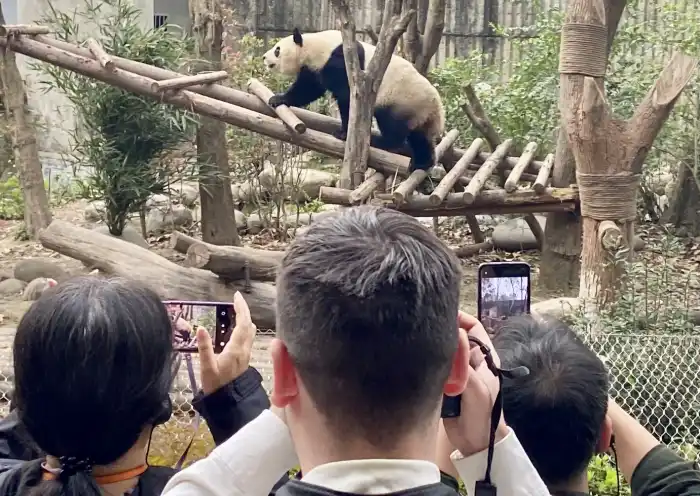
If you want to see giant pandas up close in a nature area, we highly recommend you to go to China’s top panda bases, which primarily stand in Chengdu, Sichuan.
- Chengdu Research Base of Giant Panda Breeding (成都大熊猫繁育研究基地): It is one of the most famous panda bases in China, with over 200 pandas living here. It allows you see the “top star in panda world”, Huahua, while many other visitors also come here for the cute cubs and breeding adults. Highlights include seeing the playful juveniles and the “Giant Panda Museum” for conservation insights.
- Dujiangyan Panda Valley (都江堰熊猫谷): A quieter base focusing on semi-wild panda rehabilitation, ideal for observing natural behaviors.
- The Sibao Science Park near Xian: It was established in 2021 (70km west of Xi’an), known as Shaanxi’s only provincial rare wildlife conservation base. Here, except for other rare species and some giant pandas, you can see “Qizai”—the world’s only captive brown giant panda. If you want to have a more immersive panda tour in Xi’an, please check Where to See Panda Nearby Xian.


Giant Panda Keeper
Join a hands-on panda keeper volunteer program at bases like Chengdu’s, where you’ll engage in daily panda care tasks:
- After changing into work clothes, clean the pandas’ rooms and activity sites and carry fresh bamboo under the guidance of the panda nursing staff.
- Visit the panda villa to learn about the habits of giant pandas.
- Have lunch at the panda base to enjoy the authentic local dishes.
- Watch a documentary to get further insight into pandas’ origin and tempers.
- Witness how the keepers take care of the pandas on a daily basis on the spot.
- Make steamed bread of corn for pandas.
- Get your Panda Volunteer Certificate.
Contact us to tailor authenticated experiences for you, for more information about private panda tour, please see Chengdu Panda Volunteer Tours.
Recommended China Panda Tour Packages:
- 2 Days Best Chengdu Tour with Luodai Town
- 2 Days Wolong Panda Base Volunteer Tour
- 6 Days Chengdu Leshan Mt. Emei Tour with Panda Volunteer
Giant Panda Cartoons
The most iconic panda cartoon is Kung Fu Panda—a global hit centered on Po, a chubby, endearing panda with a big heart. Blending martial arts, humor, and heartfelt moments, the Kung Fu Panda series celebrates the natural panda charm while also discovering themes of perseverance and self-discovery. Po’s journey—from a noodle-shop apprentice to a real hero—has made pandas (already beloved) even more recognizable worldwide, greatly boosting their cultural appeal and also inspiring people’s enthusiasm in meeting these adorable creatures.
Related reading: 16 Famous Giant Pandas in China


